

SSC CGL Geography – Interior of the Earth & Rocks – Level 2 · Exam Level · Tier I Sprint
SSC CGL Geography – Interior of the Earth & Rocks – Level 2 · Exam Level · Tier I Sprint – 15 questions, subject: Geography – India & World. Every question has the correct answer with a two-line explanation; tap "Show Answer". Free practice for TNPSC, UPSC, SSC, Bank and RRB exams – Shanmugam IAS Academy, Coimbatore.
Link to this page from your website / blog (HTML code)
I. The oceanic crust is thinner than the continental crust.
II. The oceanic crust is made mainly of SIAL.
Which is/are correct?
Correct Answer: B [Only I]
Explanation:
The oceanic crust averages about 5 km in thickness, while the continental crust averages about 30 km and is thicker under mountains, so statement I is correct. Statement II is wrong because the oceanic crust is made mainly of SIMA (silica and magnesium); SIAL forms the continents.
P. Basalt Q. Shale R. Slate S. Rock salt
1. metamorphic 2. chemically formed sedimentary 3. igneous 4. mechanically formed sedimentary
Correct Answer: A [P-3, Q-4, R-1, S-2]
Explanation:
Basalt is igneous (cooled lava), shale is mechanically formed sedimentary (compacted clay and silt), slate is metamorphic (formed from shale) and rock salt is chemically formed sedimentary (precipitated from evaporating water). This gives P-3, Q-4, R-1, S-2.
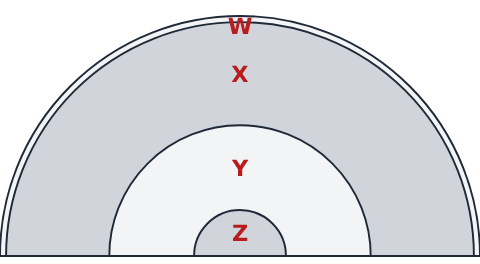
Correct Answer: C [Z]
Explanation:
The innermost layer Z is the inner core. Despite temperatures of several thousand degrees, the enormous pressure keeps it solid.
Correct Answer: D [Conrad, Moho, Gutenberg, Lehmann]
Explanation:
From the surface downwards the order is Conrad (between upper and lower crust), Moho (crust-mantle), Gutenberg (mantle-core, about 2,900 km) and Lehmann (outer-inner core, about 5,150 km). The Conrad discontinuity lies within the crust, which is why it comes before the Moho.
Correct Answer: B [Chalk]
Explanation:
Chalk is an organically formed sedimentary rock made of the calcium carbonate remains of tiny marine organisms. Pumice, basalt and granite are all igneous rocks formed from cooled magma or lava.
A: S-waves are not recorded at stations more than 105° away from the epicentre.
R: The outer core of the Earth is liquid.
Correct Answer: C [Both A and R are true and R explains A]
Explanation:
S-waves are transverse waves that cannot pass through liquids, so they are stopped by the liquid outer core and are not recorded beyond about 105 degrees from the epicentre. Thus both A and R are true and R correctly explains A; in fact this S-wave shadow is the main evidence that the outer core is liquid.
I. P-waves are the fastest earthquake waves.
II. Surface waves are the most destructive.
III. S-waves can travel through liquids.
IV. P-waves can pass through gases.
Correct Answer: A [3]
Explanation:
Statements I, II and IV are true: P-waves are the fastest, surface waves cause the most damage, and P-waves, being longitudinal, pass through solids, liquids and gases. Only III is false because transverse S-waves cannot travel through liquids, so three statements are true.
Correct Answer: D [Silicon]
Explanation:
By weight, the Earth's crust is about 46.6% oxygen and 27.7% silicon, followed by aluminium (8.1%) and iron (5.0%). So silicon is the second most abundant element, while aluminium is the most abundant metal.
Correct Answer: A [Topaz]
Explanation:
A mineral can scratch any mineral softer than itself, and topaz (hardness 8 on the Mohs scale) is harder than quartz (7). Orthoclase (6), apatite (5) and calcite (3) are softer than quartz, so they cannot scratch it.
Quantity I: Mohs hardness of orthoclase
Quantity II: Mohs hardness of apatite
Correct Answer: A [Quantity I > Quantity II]
Explanation:
On the Mohs scale orthoclase feldspar has hardness 6 and apatite has hardness 5, so Quantity I is greater. The scale runs from talc (1) to diamond (10).
Correct Answer: C [upper mantle]
Explanation:
The asthenosphere is the weak, partly molten layer of the upper mantle lying just below the lithosphere, roughly 100-400 km deep. Its plastic nature allows the lithospheric plates to move over it and it is a main source of magma.
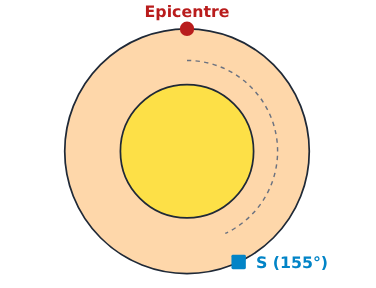
Correct Answer: D [Only P]
Explanation:
S waves cannot pass through the liquid outer core, so they are not recorded beyond about 105 degrees from the epicentre. P waves are refracted through the core and reappear beyond about 145 degrees, so a station at 155 degrees records only P waves.
Correct Answer: B [organically formed sedimentary rock]
Explanation:
Coal forms from plant remains buried in layers and compressed over millions of years, so it is an organically formed sedimentary rock. Other organically formed sedimentary rocks include chalk and some limestones, which come from shells and skeletons of marine organisms.
Correct Answer: D [Granite]
Explanation:
Coarse grains show slow cooling deep underground (intrusive), and a light colour with high silica marks an acidic rock; together they describe granite. Basalt is dark, basic and fine-grained, while marble is metamorphic and shale is sedimentary.
Correct Answer: C [Gneiss is formed from granite]
Explanation:
Granite → gneiss; limestone → marble.
➤ Full notes, shortcuts and every answer explained – SSC CGL 2026 Geography – India & World book (₹149): www.shanmugamiasacademy.in/study-materials/ssc-cgl-geography-india-world
நடப்பு நிகழ்வுகள் 25 நவம்பர் 2026 | Today Current Affairs in Tamil | TNPSC Group 4 வினா விடை
📚 SSC CGL 2026 Books
PDF நூல்கள் · ₹149 முதல் · ஒவ்வொன்றுக்கும் 50 பக்க இலவச மாதிரி · UPI-இல் பணம் செலுத்தியதும் உடனே பதிவிறக்கம்
 SSC CGL 2026 – Statistics (Tier II Paper II)
₹149
 SSC CGL 2026 – Full Mock Test Papers (Tier I + Tier II – 38 Full Mock Papers)
₹149
 SSC CGL 2026 – Quantitative Aptitude (Tier I + Tier II)
₹149
 SSC CGL 2026 – General Intelligence & Reasoning (Tier I + Tier II)
₹149
TNPSC குரூப் 1, 2/2A, 4 – நேரடி வகுப்புகள் · கோவை & மதுரை
2006 முதல் சண்முகம் IAS அகாடமி · Classroom & online coaching in Coimbatore and Madurai
