

SSC CGL Geography – Universe & the Solar System – Level 2 · Exam Level · Tier I Sprint
SSC CGL Geography – Universe & the Solar System – Level 2 · Exam Level · Tier I Sprint – 15 questions, subject: Geography – India & World. Every question has the correct answer with a two-line explanation; tap "Show Answer". Free practice for TNPSC, UPSC, SSC, Bank and RRB exams – Shanmugam IAS Academy, Coimbatore.
Link to this page from your website / blog (HTML code)
I. Sunspots look dark because they are cooler than the area around them.
II. The corona can be seen with the naked eye on any clear day.
Which is/are correct?
Correct Answer: C [Only I]
Explanation:
Sunspots look dark because they are about 1,500 degrees C cooler than the surrounding photosphere, so statement I is correct. Statement II is wrong because the faint corona is seen with the naked eye only during a total solar eclipse (or with a special instrument called a coronagraph).
Correct Answer: A [Saturn, Uranus, Earth, Mars]
Explanation:
By diameter, Saturn (about 1,20,500 km) is larger than Uranus (about 51,100 km), which is larger than the Earth (12,756 km), which is larger than Mars (about 6,790 km). So the decreasing order is Saturn, Uranus, Earth, Mars.
P. Mercury Q. Saturn R. Uranus S. Earth
1. densest planet 2. spins on its side 3. average density less than water 4. shortest year
Correct Answer: D [P-4, Q-3, R-2, S-1]
Explanation:
Mercury has the shortest year (88 days), Saturn's average density is less than that of water, Uranus spins on its side with an axial tilt of about 98 degrees, and the Earth is the densest planet (about 5.5 g/cm3). This gives P-4, Q-3, R-2, S-1.
Correct Answer: B [Neptune]
Explanation:
Mercury, Venus and Mars are rocky inner (terrestrial) planets, while Neptune is an outer ice giant made mostly of gases and ices. Neptune is also the farthest planet from the Sun.
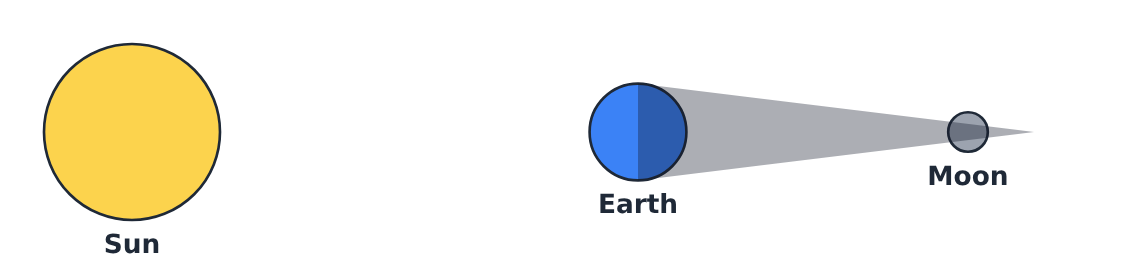
Correct Answer: C [Lunar eclipse]
Explanation:
The Moon lies in the Earth's shadow with the Earth between the Sun and the Moon. This alignment on a full-moon night causes a lunar eclipse.
A: There is no weather on the Moon.
R: The Moon has no atmosphere.
Correct Answer: B [Both A and R are true and R explains A]
Explanation:
Weather means changes in wind, clouds, rain and temperature in the air, so a body without an atmosphere cannot have weather. The Moon has practically no atmosphere, so both A and R are true and R explains A; this is also why its sky looks black even in daytime.
Correct Answer: D [8 min 20 s]
Explanation:
The average Earth-Sun distance (1 AU) is about 149.6 million km and light travels about 3,00,000 km per second, so sunlight takes about 499 seconds, i.e. roughly 8 min 20 s, to reach us. Light from the Moon takes only about 1.3 seconds.
Correct Answer: A [Titan]
Explanation:
Titan is not a dwarf planet but a moon, the largest satellite of Saturn. Ceres (in the asteroid belt), Eris and Makemake (in the outer Solar System) are recognised by the IAU as dwarf planets, along with Pluto and Haumea.
Correct Answer: B [away from the Sun]
Explanation:
A comet's tail always points away from the Sun because the solar wind and the pressure of sunlight push its gas and dust outward. So when the comet moves away from the Sun, its tail actually goes ahead of it.
I. Mercury has no natural moon.
II. Venus has one natural moon.
III. Mars has two natural moons.
IV. The Earth has one natural moon.
Correct Answer: D [3]
Explanation:
Mercury and Venus have no natural moon, the Earth has one and Mars has two (Phobos and Deimos), so statements I, III and IV are true. Statement II is false, so three statements are true.

Correct Answer: A [Saturn]
Explanation:
In order from the Sun the planets are Mercury, Venus, Earth, Mars, Jupiter, Saturn, Uranus and Neptune. The sixth place is therefore Saturn.
Correct Answer: C [a piece of rock from space that reaches the Earth's surface]
Explanation:
A meteorite is a piece of rock or metal from space that survives its passage through the atmosphere and lands on the Earth's surface. In space it is a meteoroid, and the streak of light it makes while burning in the sky is a meteor (shooting star).
Quantity I: time taken by light to travel from the Moon to the Earth
Quantity II: 1 second
Correct Answer: A [Quantity I > Quantity II]
Explanation:
The Moon is on average about 3,84,400 km away and light travels about 3,00,000 km per second, so moonlight takes about 3,84,400 / 3,00,000 = 1.28 seconds to reach the Earth. This is more than 1 second, so Quantity I is greater.
Correct Answer: D [Uranus]
Explanation:
Uranus was discovered by William Herschel in 1781 and was the first planet found with a telescope. Neptune was found later in 1846 through mathematical predictions, while Mars and Saturn have been known since ancient times.
Correct Answer: B [A light-year is a distance; the light takes about 4.2 years]
Explanation:
Light-year = distance light covers in a year; 4.2 ly away ⇒ light takes ≈ 4.2 years.
➤ Full notes, shortcuts and every answer explained – SSC CGL 2026 Geography – India & World book (₹149): www.shanmugamiasacademy.in/study-materials/ssc-cgl-geography-india-world
நடப்பு நிகழ்வுகள் 25 நவம்பர் 2026 | Today Current Affairs in Tamil | TNPSC Group 4 வினா விடை
📚 SSC CGL 2026 Books
PDF நூல்கள் · ₹149 முதல் · ஒவ்வொன்றுக்கும் 50 பக்க இலவச மாதிரி · UPI-இல் பணம் செலுத்தியதும் உடனே பதிவிறக்கம்
 SSC CGL 2026 – Statistics (Tier II Paper II)
₹149
 SSC CGL 2026 – Full Mock Test Papers (Tier I + Tier II – 38 Full Mock Papers)
₹149
 SSC CGL 2026 – Quantitative Aptitude (Tier I + Tier II)
₹149
 SSC CGL 2026 – General Intelligence & Reasoning (Tier I + Tier II)
₹149
TNPSC குரூப் 1, 2/2A, 4 – நேரடி வகுப்புகள் · கோவை & மதுரை
2006 முதல் சண்முகம் IAS அகாடமி · Classroom & online coaching in Coimbatore and Madurai
