

SSC CGL Geography – Weather & Climate – Clouds, Rainfall, Cyclones, Climate Types – Level 2 · Exam Level · Tier I Sprint
SSC CGL Geography – Weather & Climate – Clouds, Rainfall, Cyclones, Climate Types – Level 2 · Exam Level · Tier I Sprint – 13 questions, subject: Geography – India & World. Every question has the correct answer with a two-line explanation; tap "Show Answer". Free practice for TNPSC, UPSC, SSC, Bank and RRB exams – Shanmugam IAS Academy, Coimbatore.
Link to this page from your website / blog (HTML code)
I. Relative humidity rises when air is warmed without adding water.
II. Fog is a cloud at ground level.
Which is/are correct?
Correct Answer: C [Only II]
Explanation:
Only statement II is correct: fog is a cloud formed at or near ground level. Statement I is wrong because warming air without adding water raises its capacity to hold vapour, so its relative humidity falls.
P. Cirrus Q. Cumulonimbus R. Nimbostratus S. Cirrostratus
1. thunderstorms and hail 2. halo around the Sun 3. fair weather, feathery streaks 4. steady, continuous rain
Correct Answer: B [P-3, Q-1, R-4, S-2]
Explanation:
Cirrus gives fair-weather feathery streaks (P-3), cumulonimbus brings thunderstorms and hail (Q-1), nimbostratus gives steady continuous rain (R-4), and cirrostratus produces a halo around the Sun (S-2). Option (a) wrongly links cirrus with the halo, which is formed by the ice-crystal sheet of cirrostratus.
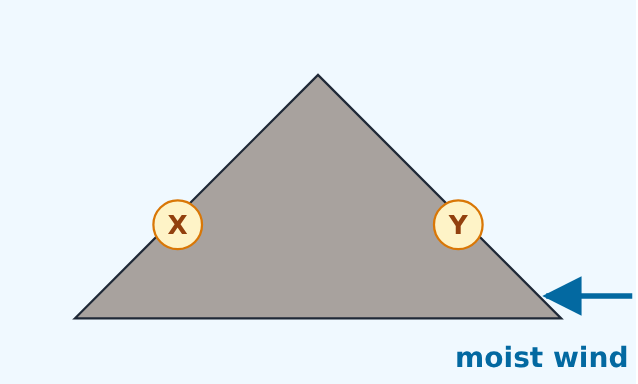
Correct Answer: A [X]
Explanation:
The moist wind strikes slope Y first, so Y is the windward slope that gets heavy rain. Slope X lies on the leeward side and receives dry descending air, so X is in the rain-shadow.
Quantity I: relative humidity of air holding 7 g of vapour when it can hold 10 g
Quantity II: relative humidity of air holding 12 g when it can hold 16 g
Correct Answer: B [Quantity I < Quantity II]
Explanation:
Quantity I = 7/10 = 70% and Quantity II = 12/16 = 75%, so Quantity I is smaller. Relative humidity compares the vapour present with the maximum the air can hold.
Correct Answer: D [Cirrus, Altostratus, Stratus]
Explanation:
Cirrus are high clouds (above about 6 km), altostratus are middle-level clouds (about 2–6 km) and stratus are low clouds near the ground, so the order from highest to lowest is cirrus, altostratus, stratus. The prefixes 'cirro-' and 'alto-' mark high and middle clouds respectively.
Correct Answer: D [Tornado]
Explanation:
A tornado is a small, short-lived but violent whirlwind over land, while the hurricane, typhoon and willy-willy are regional names for the same large tropical cyclone. Hurricanes occur in the Atlantic, typhoons in the western Pacific and willy-willies near north-west Australia.
A: A tropical cyclone weakens and dies out after it crosses the coast.
R: Over land it loses its supply of moisture from the warm sea.
Correct Answer: B [Both A and R are true and R explains A]
Explanation:
A tropical cyclone weakens after landfall because over land it loses its supply of warm, moist air from the sea, the source of the latent heat that powers it, so R explains A. Greater friction over land also slows its winds.
I. Cyclones in the Northern Hemisphere rotate anticlockwise.
II. Anticyclones usually bring calm, clear weather.
III. Temperate cyclones move from east to west.
IV. The eye of a tropical cyclone has the lowest pressure.
Correct Answer: A [3]
Explanation:
Statements I, II and IV are true, so three are correct: Northern Hemisphere cyclones turn anticlockwise, anticyclones bring calm clear weather, and the eye has the lowest pressure. Statement III is false because temperate cyclones move from west to east with the westerlies.
Correct Answer: C [Willy-willy – Western Australia]
Explanation:
Tropical cyclones near north-western Australia are called willy-willies. Hurricanes form in the Atlantic and Caribbean, typhoons in the western Pacific, and western disturbances come to north-west India from the Mediterranean region.

Correct Answer: D [Southern Hemisphere]
Explanation:
The winds spiral inwards towards the low-pressure centre in a clockwise direction. Clockwise inflow around a low is found in the Southern Hemisphere; in the Northern Hemisphere it is anticlockwise.
Correct Answer: C [10 g]
Explanation:
Vapour held = 40% of 25 g = 0.4 × 25 = 10 g. Relative humidity is the ratio of the vapour actually present to the maximum the air can hold at that temperature.
Correct Answer: A [Highland climates]
Explanation:
In Köppen's classification, as presented in the NCERT scheme, the letter H stands for highland climates, whose conditions change with altitude. The main groups are A (tropical humid), B (dry), C (warm temperate), D (cold snow forest) and E (polar).
Correct Answer: D [offshore trade winds and cold ocean currents]
Explanation:
Dry offshore winds; cold currents stop air rising.
➤ Full notes, shortcuts and every answer explained – SSC CGL 2026 Geography – India & World book (₹149): www.shanmugamiasacademy.in/study-materials/ssc-cgl-geography-india-world
நடப்பு நிகழ்வுகள் 25 நவம்பர் 2026 | Today Current Affairs in Tamil | TNPSC Group 4 வினா விடை
📚 SSC CGL 2026 Books
PDF நூல்கள் · ₹149 முதல் · ஒவ்வொன்றுக்கும் 50 பக்க இலவச மாதிரி · UPI-இல் பணம் செலுத்தியதும் உடனே பதிவிறக்கம்
 SSC CGL 2026 – Statistics (Tier II Paper II)
₹149
 SSC CGL 2026 – Full Mock Test Papers (Tier I + Tier II – 38 Full Mock Papers)
₹149
 SSC CGL 2026 – Quantitative Aptitude (Tier I + Tier II)
₹149
 SSC CGL 2026 – General Intelligence & Reasoning (Tier I + Tier II)
₹149
TNPSC குரூப் 1, 2/2A, 4 – நேரடி வகுப்புகள் · கோவை & மதுரை
2006 முதல் சண்முகம் IAS அகாடமி · Classroom & online coaching in Coimbatore and Madurai
