

SSC CGL History – Revolt of 1857 – Level 3 · Challenge
SSC CGL History – Revolt of 1857 – Level 3 · Challenge – 7 questions, subject: History & Culture of India. Every question has the correct answer with a two-line explanation; tap "Show Answer". Free practice for TNPSC, UPSC, SSC, Bank and RRB exams – Shanmugam IAS Academy, Coimbatore.
Link to this page from your website / blog (HTML code)
Reason (R): Many sepoys of the Bengal Army came from Awadh, whose annexation in 1856 hurt their families.
Correct Answer: A [Both A and R are true and R is the correct explanation of A]
Explanation:
Both statements are true and R explains A: many sepoys of the Bengal Army came from Awadh, and its annexation in 1856 under Dalhousie hurt their families. Begum Hazrat Mahal led the revolt at Lucknow in Awadh.
Correct Answer: C [Kanpur]
Explanation:
Lucknow was finally relieved by Sir Colin Campbell, who also fought at Kanpur, where he defeated Tantia Tope's forces in December 1857. Delhi was recaptured under Archdale Wilson and John Nicholson, and Jhansi by Hugh Rose.
I. The Government of India Act, 1858 ended the rule of the East India Company.
II. The Queen's Proclamation promised that the British would not annex more Indian states.
Which of the statements given above is/are correct?
Correct Answer: B [Both I and II]
Explanation:
Both statements are correct: the Government of India Act of 2 August 1858 ended the rule of the East India Company and transferred power to the Crown. The Queen's Proclamation of 1 November 1858 promised that no more Indian states would be annexed.
Correct Answer: A [Replace 1857 with 1806 and 'after' with 'long before']
Explanation:
The Vellore mutiny took place in July 1806, half a century before the Meerut rising of 1857, so 1857 must be replaced with 1806 and 'after' with 'long before'. It was provoked by new dress rules that banned caste marks and introduced a new turban.
Writer / group: P. V. D. Savarkar Q. R. C. Majumdar R. British officials of the time S. Many modern historians
View of 1857: 1. neither first, nor national, nor a war of independence 2. First War of Indian Independence 3. popular revolt with sepoys at its core 4. Sepoy Mutiny
Correct Answer: A [P-2, Q-1, R-4, S-3]
Explanation:
V. D. Savarkar called 1857 the First War of Indian Independence, R. C. Majumdar said it was neither first, nor national, nor a war of independence, British officials called it a Sepoy Mutiny, and many modern historians see it as a popular revolt with sepoys at its core, giving P-2, Q-1, R-4, S-3. Savarkar's book was published in 1909.
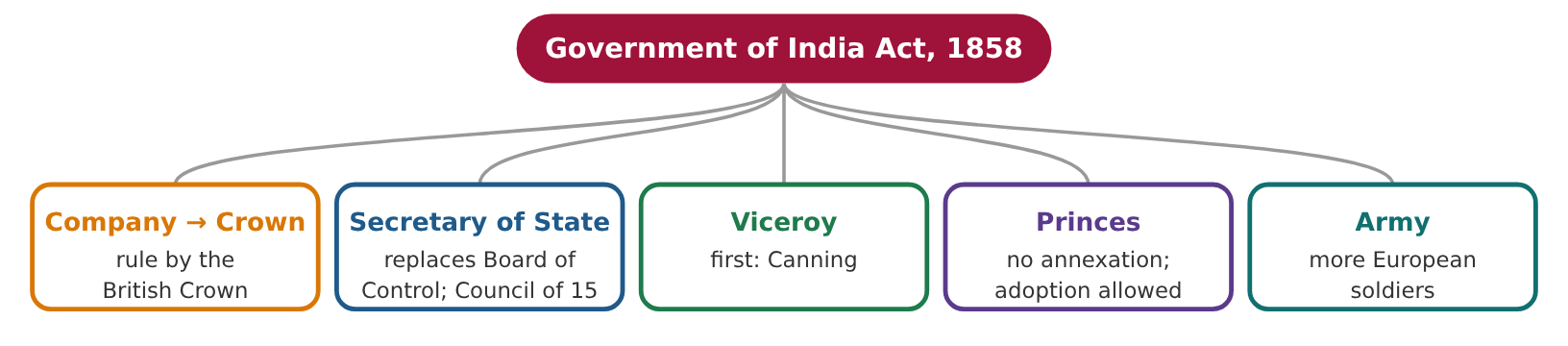
Correct Answer: C [Viceroy]
Explanation:
Under the Government of India Act, 1858, rule passed from the Company to the Crown and the Governor-General also became the Crown's representative with the title Viceroy. Lord Canning was the first Viceroy.
Correct Answer: D [The rebels had the support of all Indian princes]
Explanation:
Many princes stayed loyal to the British – so 'support of all princes' is false and not a reason.
➤ Full notes, shortcuts and every answer explained – SSC CGL 2026 History & Culture of India book (₹149): www.shanmugamiasacademy.in/study-materials/ssc-cgl-history-culture-of-india
நடப்பு நிகழ்வுகள் 25 நவம்பர் 2026 | Today Current Affairs in Tamil | TNPSC Group 4 வினா விடை
📚 SSC CGL 2026 Books
PDF நூல்கள் · ₹149 முதல் · ஒவ்வொன்றுக்கும் 50 பக்க இலவச மாதிரி · UPI-இல் பணம் செலுத்தியதும் உடனே பதிவிறக்கம்
 SSC CGL 2026 – Statistics (Tier II Paper II)
₹149
 SSC CGL 2026 – Full Mock Test Papers (Tier I + Tier II – 38 Full Mock Papers)
₹149
 SSC CGL 2026 – Quantitative Aptitude (Tier I + Tier II)
₹149
 SSC CGL 2026 – General Intelligence & Reasoning (Tier I + Tier II)
₹149
TNPSC குரூப் 1, 2/2A, 4 – நேரடி வகுப்புகள் · கோவை & மதுரை
2006 முதல் சண்முகம் IAS அகாடமி · Classroom & online coaching in Coimbatore and Madurai
