

SSC CGL History – Socio-Religious Reform Movements – Level 3 · Challenge
SSC CGL History – Socio-Religious Reform Movements – Level 3 · Challenge – 6 questions, subject: History & Culture of India. Every question has the correct answer with a two-line explanation; tap "Show Answer". Free practice for TNPSC, UPSC, SSC, Bank and RRB exams – Shanmugam IAS Academy, Coimbatore.
Link to this page from your website / blog (HTML code)
Reason (R): The Deoband school promoted English education among Muslims.
Correct Answer: A [A is true but R is false]
Explanation:
A is true: the Deoband school, founded in 1866, was opposed to British rule and welcomed the Indian National Congress. R is false because Deoband stood for traditional Islamic learning; English education among Muslims was promoted by Sir Syed Ahmad Khan's Aligarh movement.
Correct Answer: D [Parsi]
Explanation:
The Age of Consent Act (1891) followed the campaign of Behramji Malabari, a Parsi journalist and social reformer from Bombay. The Act raised the age of consent for girls from 10 to 12 years.
I. Annie Besant founded the Central Hindu College at Benares.
II. The Central Hindu College was the forerunner of Aligarh Muslim University.
Which of the statements given above is/are correct?
Correct Answer: A [Only I]
Explanation:
Statement I is correct: Annie Besant founded the Central Hindu College at Benares in 1898. Statement II is wrong because the Central Hindu College became the nucleus of Banaras Hindu University (1916), not Aligarh Muslim University.
Correct Answer: C [Replace Dublin with London]
Explanation:
Annie Besant was born in London in 1847 to a family of Irish descent, so Dublin must be replaced with London. She did join the Theosophical Society in 1889 and later became its president in 1907.
Correct Answer: D [100]
Explanation:
The first law (Sati ban) was in 1829 and the last (Sarda Act) in 1929, so 1929 − 1829 = 100 years. The Sati ban came under Lord William Bentinck with the support of Raja Ram Mohan Roy.
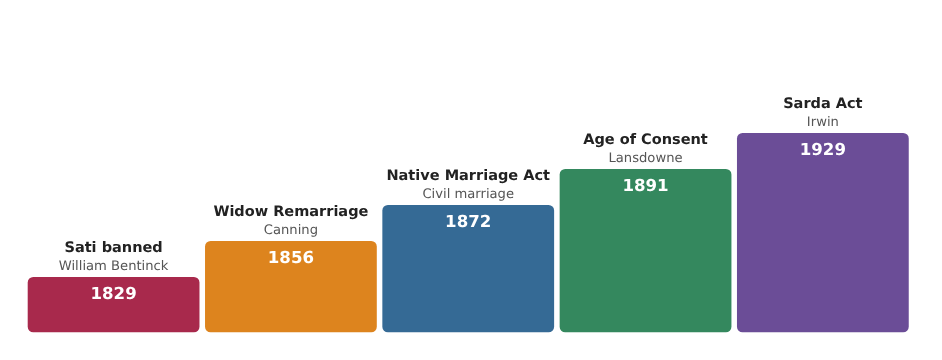
Correct Answer: B [Widow Remarriage]
Explanation:
1856 – Hindu Widows' Remarriage Act (Canning).
➤ Full notes, shortcuts and every answer explained – SSC CGL 2026 History & Culture of India book (₹149): www.shanmugamiasacademy.in/study-materials/ssc-cgl-history-culture-of-india
நடப்பு நிகழ்வுகள் 25 நவம்பர் 2026 | Today Current Affairs in Tamil | TNPSC Group 4 வினா விடை
📚 SSC CGL 2026 Books
PDF நூல்கள் · ₹149 முதல் · ஒவ்வொன்றுக்கும் 50 பக்க இலவச மாதிரி · UPI-இல் பணம் செலுத்தியதும் உடனே பதிவிறக்கம்
 SSC CGL 2026 – Statistics (Tier II Paper II)
₹149
 SSC CGL 2026 – Full Mock Test Papers (Tier I + Tier II – 38 Full Mock Papers)
₹149
 SSC CGL 2026 – Quantitative Aptitude (Tier I + Tier II)
₹149
 SSC CGL 2026 – General Intelligence & Reasoning (Tier I + Tier II)
₹149
TNPSC குரூப் 1, 2/2A, 4 – நேரடி வகுப்புகள் · கோவை & மதுரை
2006 முதல் சண்முகம் IAS அகாடமி · Classroom & online coaching in Coimbatore and Madurai
