

SSC CGL Quant – Graphs of Linear Equations & Coordinate Basics – Level 2 · Exam Level · Tier I Sprint
SSC CGL Quant – Graphs of Linear Equations & Coordinate Basics – Level 2 · Exam Level · Tier I Sprint – 14 questions, subject: Quantitative Aptitude. Every question has the correct answer with a two-line explanation; tap "Show Answer". Free practice for TNPSC, UPSC, SSC, Bank and RRB exams – Shanmugam IAS Academy, Coimbatore.
Link to this page from your website / blog (HTML code)
Correct Answer: D [30 sq units]
Explanation:
5x + 3y = 30 cuts the x-axis at 6 and the y-axis at 10, so the triangle's area = 1/2 × 6 × 10 = 30 sq units. In general, ax + by = c encloses c²/(2ab) = 900/30 = 30 with the axes.
Correct Answer: A [(4, 3)]
Explanation:
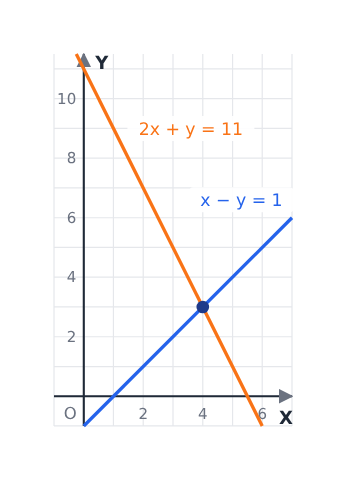
Adding 2x + y = 11 and × − y = 1 gives 3x = 12, so × = 4 and y = × − 1 = 3; the lines meet at (4, 3). Check: 2 × 4 + 3 = 11 and 4 − 3 = 1.
Correct Answer: C [−2]
Explanation:
For infinitely many solutions a1/a2 = b1/b2 = c1/c2, so 3/6 = −1/k = 5/10 = 1/2, giving k = −2. If the coefficient ratios matched but not the constants, the lines would be parallel with no solution.
Correct Answer: B [1]
Explanation:
No solution needs a1/a2 = b1/b2 not equal to c1/c2: k/3 = 2/6 gives k = 1. Then c1/c2 = 3/10, which is not 1/3, so the lines are parallel and distinct.
Correct Answer: D [3 sq units]
Explanation:
Solving 2x + y = 8 and × − y = 1 gives (3, 2), and the lines cut the x-axis at (4, 0) and (1, 0), a base of 3. Area = 1/2 × 3 × 2 = 3 sq units.
Correct Answer: B [10]
Explanation:
Distance = √[(5 − (−3))² + (−2 − 4)²] = √(64 + 36) = √100 = 10. The sides 8 and 6 form a 6-8-10 right triangle, a common shortcut.
Correct Answer: C [−3/2]
Explanation:
For perpendicular lines the product of slopes is −1, so the required slope is −1 ÷ (2/3) = −3/2. The slope −2/3 only changes the sign and does not give a product of −1.
Correct Answer: A [2x − y + 6 = 0]
Explanation:
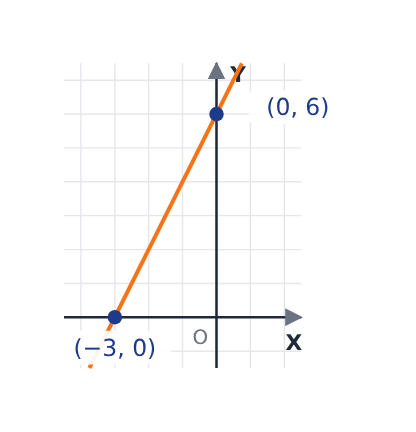
The line passes through (-3, 0) and (0, 6), so its slope is 2 and y-intercept 6: y = 2x + 6. This is 2x - y + 6 = 0.
Quantity I: Area enclosed by 3x + 4y = 24 and the axes
Quantity II: Area enclosed by 2x + y = 10 and the axes
Correct Answer: B [Quantity I < Quantity II]
Explanation:
Quantity I: 3x + 4y = 24 has intercepts 8 and 6, area = 1/2 × 8 × 6 = 24; Quantity II: 2x + y = 10 has intercepts 5 and 10, area = 1/2 × 5 × 10 = 25. Hence Quantity I < Quantity II.
Correct Answer: A [−4]
Explanation:
Putting y = 0 in 3x − 4y = -12 gives 3x = -12, so × = -4, and the x-intercept is -4. The mistake was dropping the minus sign of the constant term.
Correct Answer: C [(5, 2)]
Explanation:
Reflection in the y-axis keeps the y-coordinate and changes the sign of x, so (-5, 2) becomes (5, 2). Reflection in the x-axis would instead give (-5, -2).
Correct Answer: D [(3, −4)]
Explanation:
The fourth quadrant needs × > 0 and y < 0, and (3, -4) satisfies × − y = 3 + 4 = 7. Points (5, 2) and (10, 3) lie in the first quadrant, and (-4, 3) in the second.
Correct Answer: B [3]
Explanation:
Slope = (y2 − y1)/(x2 − x1) = (11 − 2)/(4 − 1) = 9/3 = 3. Taking 9 alone ignores the change in x.
Correct Answer: D [2]
Explanation:
x-intercept = 12/a = 6 → a = 2.
➤ Full notes, shortcuts and every answer explained – SSC CGL 2026 Quantitative Aptitude book (₹149): www.shanmugamiasacademy.in/study-materials/ssc-cgl-quantitative-aptitude
நடப்பு நிகழ்வுகள் 25 நவம்பர் 2026 | Today Current Affairs in Tamil | TNPSC Group 4 வினா விடை
📚 SSC CGL 2026 Books
PDF நூல்கள் · ₹149 முதல் · ஒவ்வொன்றுக்கும் 50 பக்க இலவச மாதிரி · UPI-இல் பணம் செலுத்தியதும் உடனே பதிவிறக்கம்
 SSC CGL 2026 – Statistics (Tier II Paper II)
₹149
 SSC CGL 2026 – Full Mock Test Papers (Tier I + Tier II – 38 Full Mock Papers)
₹149
 SSC CGL 2026 – Quantitative Aptitude (Tier I + Tier II)
₹149
 SSC CGL 2026 – General Intelligence & Reasoning (Tier I + Tier II)
₹149
TNPSC குரூப் 1, 2/2A, 4 – நேரடி வகுப்புகள் · கோவை & மதுரை
2006 முதல் சண்முகம் IAS அகாடமி · Classroom & online coaching in Coimbatore and Madurai
