

SSC CGL Quant – Ratio, Proportion, Partnership, Averages & Ages – Level 2 · Exam Level · Tier I Sprint
SSC CGL Quant – Ratio, Proportion, Partnership, Averages & Ages – Level 2 · Exam Level · Tier I Sprint – 14 questions, subject: Quantitative Aptitude. Every question has the correct answer with a two-line explanation; tap "Show Answer". Free practice for TNPSC, UPSC, SSC, Bank and RRB exams – Shanmugam IAS Academy, Coimbatore.
Link to this page from your website / blog (HTML code)
Correct Answer: A [12]
Explanation:
Let the numbers be 4x and 7x; then 3(4x + 6) = 2(7x + 6), so 12x + 18 = 14x + 12 and x = 3. The numbers are 12 and 21, and the smaller is 12.
Correct Answer: B [₹ 4,200]
Explanation:
If C = 6 parts, then B = C/3 = 2 parts and A = B/2 = 1 part, so A : B : C = 1 : 2 : 6. One part is 6,300/9 = ₹ 700, so C gets 6 × 700 = ₹ 4,200.
Correct Answer: C [₹ 13,500]
Explanation:
Profit shares follow capital × months: A = 24,000 × 12 and B = 36,000 × 9, that is 288 : 324 = 8 : 9. B's share is 9/17 × 25,500 = ₹ 13,500.
Correct Answer: D [45 years]
Explanation:
Total age of 30 students = 30 × 14 = 420, and total with the teacher = 31 × 15 = 465, so the teacher is 465 − 420 = 45 years. Using 30 × 15 instead of 31 × 15 is the usual mistake.
Correct Answer: A [45]
Explanation:
A fall of 3 in the average of 10 numbers means the total fell by 10 × 3 = 30. So the new number is 75 − 30 = 45.
Correct Answer: D [25 years]
Explanation:
Let the ages be 4x and 5x; then (4x − 5)/(5x − 5) = 3/4, so 16x − 20 = 15x − 15 and x = 5. The sisters are 20 and 25, so the elder sister is 25 years old.
Quantity I: the fourth proportional to 3, 5 and 12
Quantity II: the mean proportional between 16 and 25
Correct Answer: C [Quantity I = Quantity II]
Explanation:
The fourth proportional x to 3, 5 and 12 satisfies 3 : 5 = 12 : x, so x = 5 × 12/3 = 20. The mean proportional between 16 and 25 is √(16 × 25) = √400 = 20, so Quantity I = Quantity II.
P. duplicate ratio of 2 : 3 Q. sub-duplicate ratio of 49 : 64 R. triplicate ratio of 1 : 2
1. 7 : 8 2. 1 : 8 3. 4 : 9
Correct Answer: B [P-3, Q-1, R-2]
Explanation:
The duplicate ratio of 2 : 3 is 2² : 3² = 4 : 9, the sub-duplicate ratio of 49 : 64 is √49 : √64 = 7 : 8, and the triplicate ratio of 1 : 2 is 1³ : 2³ = 1 : 8. So P-3, Q-1, R-2 is correct.
Correct Answer: D [56]
Explanation:
The two groups are of unequal size, so a weighted average is needed: (20 × 50 + 30 × 60)/50 = (1,000 + 1,800)/50 = 56. The simple average 55 is wrong because the larger group of 30 pulls the result towards 60.
Correct Answer: C [80]
Explanation:
One set of 1 + 2 + 3 coins is worth ₹ 1 + 2 × ₹ 0.50 + 3 × ₹ 0.25 = ₹ 2.75, so ₹ 110 holds 110/2.75 = 40 sets. There are 2 × 40 = 80 coins of 50 paise.
Correct Answer: B [37]
Explanation:
In an odd count of consecutive odd numbers the average is the middle (4th) number, 31. The numbers are 25, 27, 29, 31, 33, 35, 37, so the largest is 31 + 3 × 2 = 37.
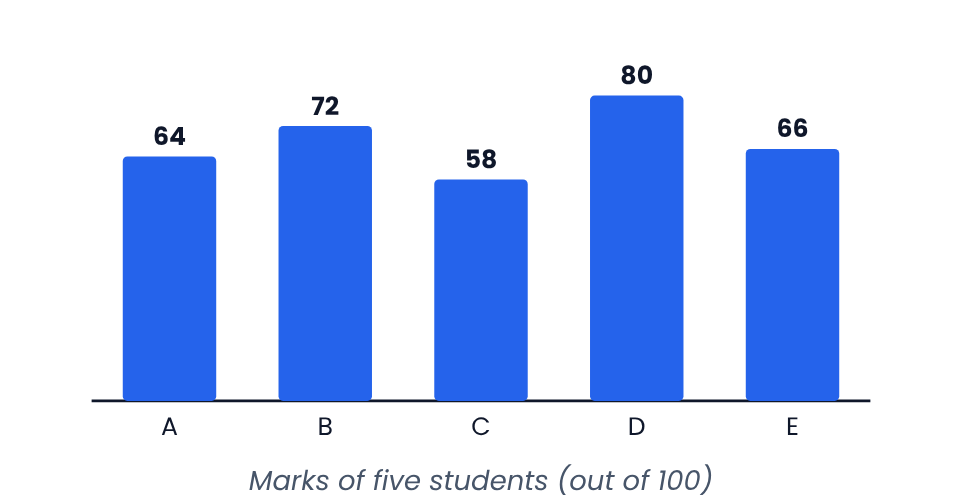
Correct Answer: A [68]
Explanation:
The marks are 64, 72, 58, 80 and 66, which add up to 340. Average = 340 / 5 = 68.
A: If every value in a list is increased by 5, the average increases by 5.
R: The average is the sum divided by the number of values, and the sum increases by 5n.
Correct Answer: B [Both A and R are true and R explains A]
Explanation:
Adding 5 to each of n values raises the sum S by 5n, so the new average is (S + 5n)/n = S/n + 5. Both statements are true and R, which uses the definition of the average, correctly explains A.
Correct Answer: A [6 : 8]
Explanation:
6 : 8 = 3 : 4; all the others equal 2 : 3.
➤ Full notes, shortcuts and every answer explained – SSC CGL 2026 Quantitative Aptitude book (₹149): www.shanmugamiasacademy.in/study-materials/ssc-cgl-quantitative-aptitude
நடப்பு நிகழ்வுகள் 25 நவம்பர் 2026 | Today Current Affairs in Tamil | TNPSC Group 4 வினா விடை
📚 SSC CGL 2026 Books
PDF நூல்கள் · ₹149 முதல் · ஒவ்வொன்றுக்கும் 50 பக்க இலவச மாதிரி · UPI-இல் பணம் செலுத்தியதும் உடனே பதிவிறக்கம்
 SSC CGL 2026 – Statistics (Tier II Paper II)
₹149
 SSC CGL 2026 – Full Mock Test Papers (Tier I + Tier II – 38 Full Mock Papers)
₹149
 SSC CGL 2026 – Quantitative Aptitude (Tier I + Tier II)
₹149
 SSC CGL 2026 – General Intelligence & Reasoning (Tier I + Tier II)
₹149
TNPSC குரூப் 1, 2/2A, 4 – நேரடி வகுப்புகள் · கோவை & மதுரை
2006 முதல் சண்முகம் IAS அகாடமி · Classroom & online coaching in Coimbatore and Madurai
