

SSC CGL Quant – Simple & Compound Interest – Level 2 · Exam Level · Tier I Sprint
SSC CGL Quant – Simple & Compound Interest – Level 2 · Exam Level · Tier I Sprint – 13 questions, subject: Quantitative Aptitude. Every question has the correct answer with a two-line explanation; tap "Show Answer". Free practice for TNPSC, UPSC, SSC, Bank and RRB exams – Shanmugam IAS Academy, Coimbatore.
Link to this page from your website / blog (HTML code)
Correct Answer: B [₹ 2,580]
Explanation:
For 2 years at 15%, the effective CI rate is 2 × 15 + 15²/100 = 32.25%. So CI = 32.25% of 8,000 = ₹2,580.
Correct Answer: A [₹ 15,000]
Explanation:
For 2 years, CI − SI = P(R/100)², so P × (8/100)² = P × 0.0064 = 96. Hence P = 96 ÷ 0.0064 = ₹15,000.
Correct Answer: C [₹ 3,264]
Explanation:
Half-yearly compounding at 8% a year means 4% for each of 2 half-years, an effective rate of 4 + 4 + 16/100 = 8.16%. So CI = 8.16% of 40,000 = ₹3,264.
Correct Answer: D [₹ 10,000]
Explanation:
At 20% the yearly factor is 6/5, so the 3-year factor is (6/5)³ = 216/125. The sum is 17,280 × 125 ÷ 216 = 80 × 125 = ₹10,000.
Quantity I: SI on ₹ 10,000 at 10% per annum for 3 years
Quantity II: CI on ₹ 10,000 at 9% per annum for 3 years (yearly)
Correct Answer: A [Quantity I > Quantity II]
Explanation:
Quantity I = 10,000 × 10 × 3 ÷ 100 = ₹3,000. Quantity II = 10,000 × (1.09³ − 1) = 10,000 × 0.295029 ≈ ₹2,950.29, so Quantity I is greater.
Correct Answer: D [18 years]
Explanation:
At compound interest the amount doubles every 6 years, and 8 times = 2 × 2 × 2, so it takes 3 × 6 = 18 years. The answer 42 years wrongly treats the growth as simple interest.
Correct Answer: C [20 years]
Explanation:
Doubling in 10 years means the simple interest equals P every 10 years, i.e. 10% a year. To become 3 times the interest must be 2P, which takes 20 years.
Directions (Q 20–21): The line graph shows the amount of a deposit kept at compound interest (compounded yearly).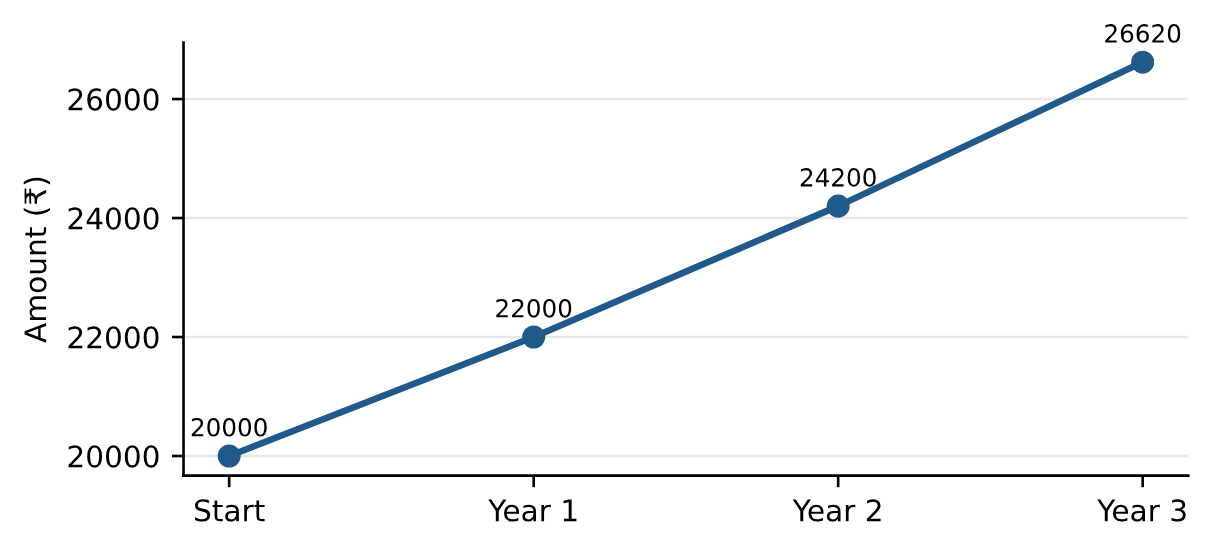
Correct Answer: B [10%]
Explanation:
The amount grows from 20,000 to 22,000 in the first year, then 24,200 and 26,620. Each year it rises by 10%, so the rate is 10% per annum.
Correct Answer: B [₹ 1,935]
Explanation:
For 2 years at 15%, the effective CI rate is 15 + 15 + (15 × 15)/100 = 32.25%, so CI = 32.25% of 6,000 = ₹1,935. The mistake was using simple interest (30%), which ignores the interest on the first year's interest.
Correct Answer: D [₹ 6,000]
Explanation:
If x is lent at 6%, then 0.06x + 0.08(12,000 − x) = 840, i.e. 960 − 0.02x = 840. So x = ₹6,000 (check: 360 + 480 = 840).
Correct Answer: C [₹ 612]
Explanation:
For 2 years at 4%, the effective CI rate is 4 + 4 + (4 × 4)/100 = 8.16%. So CI = 8.16% of 7,500 = ₹612.
A: At 10% per annum, CI for 3 years exceeds SI for 3 years by 3.1% of the principal.
R: CI − SI for 3 years = P(R/100)²(3 + R/100).
Correct Answer: C [Both A and R are true and R explains A]
Explanation:
By the formula in R, CI − SI for 3 years at 10% = P × (0.1)² × (3 + 0.1) = 0.031P, i.e. 3.1% of P, so A is true. R is a correct formula and directly gives A, so R explains A.
Correct Answer: B [₹ 8,000]
Explanation:
Rate = 968/9,680 = 10%; P = 9,680 ÷ 1.21 = 8,000.
➤ Full notes, shortcuts and every answer explained – SSC CGL 2026 Quantitative Aptitude book (₹149): www.shanmugamiasacademy.in/study-materials/ssc-cgl-quantitative-aptitude
நடப்பு நிகழ்வுகள் 25 நவம்பர் 2026 | Today Current Affairs in Tamil | TNPSC Group 4 வினா விடை
📚 SSC CGL 2026 Books
PDF நூல்கள் · ₹149 முதல் · ஒவ்வொன்றுக்கும் 50 பக்க இலவச மாதிரி · UPI-இல் பணம் செலுத்தியதும் உடனே பதிவிறக்கம்
 SSC CGL 2026 – Statistics (Tier II Paper II)
₹149
 SSC CGL 2026 – Full Mock Test Papers (Tier I + Tier II – 38 Full Mock Papers)
₹149
 SSC CGL 2026 – Quantitative Aptitude (Tier I + Tier II)
₹149
 SSC CGL 2026 – General Intelligence & Reasoning (Tier I + Tier II)
₹149
TNPSC குரூப் 1, 2/2A, 4 – நேரடி வகுப்புகள் · கோவை & மதுரை
2006 முதல் சண்முகம் IAS அகாடமி · Classroom & online coaching in Coimbatore and Madurai
