

SSC CGL Quant – Time, Speed & Distance – Level 2 · Exam Level · Tier I Sprint
SSC CGL Quant – Time, Speed & Distance – Level 2 · Exam Level · Tier I Sprint – 13 questions, subject: Quantitative Aptitude. Every question has the correct answer with a two-line explanation; tap "Show Answer". Free practice for TNPSC, UPSC, SSC, Bank and RRB exams – Shanmugam IAS Academy, Coimbatore.
Link to this page from your website / blog (HTML code)
Correct Answer: C [54 km/h]
Explanation:
To cross the bridge the train covers 360 + 240 = 600 m in 40 s, a speed of 15 m/s. Converting, 15 × 18/5 = 54 km/h.
Correct Answer: B [3 km]
Explanation:
The two times differ by 8 + 7 = 15 minutes = 1/4 h, so D/3 − D/4 = 1/4, i.e. D/12 = 1/4. Hence D = 3 km (1 h at 3 km/h and 45 min at 4 km/h, which differ by 15 min).
Correct Answer: D [11 s]
Explanation:
In opposite directions the relative speed is 54 + 90 = 144 km/h = 144 × 5/18 = 40 m/s. They must cover the sum of their lengths, 240 + 200 = 440 m, so the time is 440 ÷ 40 = 11 s.
Correct Answer: A [2.5 km/h]
Explanation:
Downstream speed is 30 ÷ 2 = 15 km/h and upstream speed is 30 ÷ 3 = 10 km/h. Stream speed = (15 − 10) ÷ 2 = 2.5 km/h (and boat speed in still water = 12.5 km/h).
Directions (Q 17–18): The distance–time graph shows two motorists R and S on the same road from the same starting point.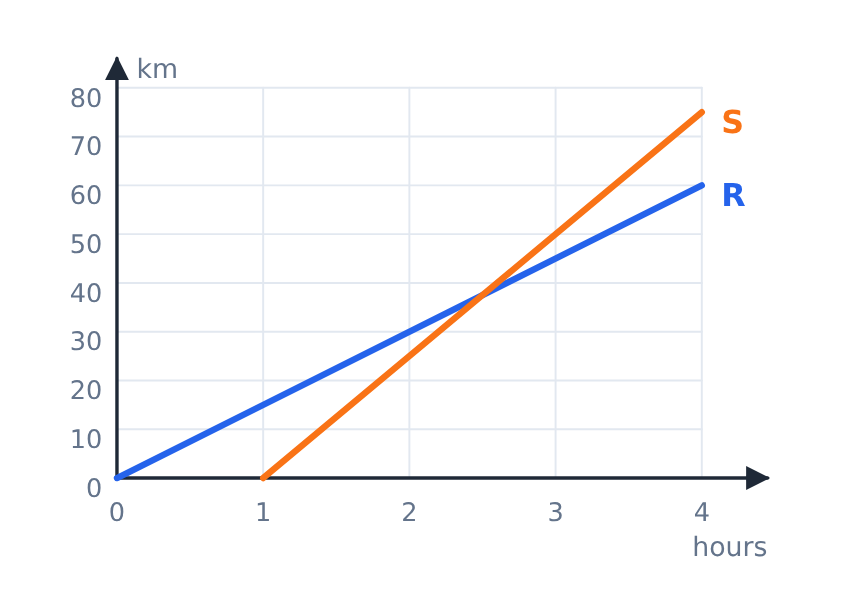
Correct Answer: D [2.5 h]
Explanation:
R travels at 15 km/h from time 0; S starts 1 hour later at 25 km/h. 15t = 25(t - 1) gives t = 2.5 hours.
Quantity I: average speed going at 20 km/h and returning the same way at 30 km/h
Quantity II: average speed driving 1 hour at 20 km/h and then 1 hour at 28 km/h
Correct Answer: C [Quantity I = Quantity II]
Explanation:
For equal distances the average speed is 2 × 20 × 30 ÷ (20 + 30) = 24 km/h, so Quantity I = 24. For equal times it is the simple mean (20 + 28) ÷ 2 = 24 km/h, so the two quantities are equal.
Correct Answer: B [30 s]
Explanation:
To cross a platform the train must cover its own length plus the platform, 150 + 300 = 450 m, and 54 km/h = 15 m/s. So the time is 450 ÷ 15 = 30 s; the mistake was leaving out the train's own 150 m.
Correct Answer: B [1 hour]
Explanation:
In the 20 minutes the thief gets a lead of 30 × 1/3 = 10 km. The policeman gains 40 − 30 = 10 km/h, so he catches the thief 10 ÷ 10 = 1 hour after starting.
Correct Answer: C [90 s]
Explanation:
A beats B by 50 m or 10 s, so B runs 50 m in 10 s, a speed of 5 m/s, and B needs 500 ÷ 5 = 100 s for the race. A finishes 10 s earlier, in 90 s.
A: A man sitting in a train at 60 km/h sees a 120 m train coming the other way at 48 km/h pass him in 4 seconds.
R: For a man in a train, only the length of the other train has to be crossed, at the relative speed.
Correct Answer: D [Both A and R are true and R explains A]
Explanation:
The relative speed of trains moving in opposite directions is 60 + 48 = 108 km/h = 30 m/s, so the 120 m train passes the man in 120 ÷ 30 = 4 s and A is true. R is the correct principle used, because a man's own length is negligible, so R explains A.
Correct Answer: A [250 m]
Explanation:
75 km/h = 75 × 5/18 m/s, and in 24 s the train covers 75 × 5/18 × 24 = 500 m. This distance is train length plus platform, so the train is 500 − 250 = 250 m long.
Correct Answer: A [60 min]
Explanation:
At 4/5 of the usual speed the time becomes 5/4 of the usual time, so the extra time is 1/4 of the usual time. Since this extra is 15 minutes, the usual time is 4 × 15 = 60 minutes.
Correct Answer: D [15 km/h]
Explanation:
Take each distance as 30 km: times 3 + 2 + 1 = 6 h for 90 km → 15 km/h (not the simple average 18⅓).
➤ Full notes, shortcuts and every answer explained – SSC CGL 2026 Quantitative Aptitude book (₹149): www.shanmugamiasacademy.in/study-materials/ssc-cgl-quantitative-aptitude
நடப்பு நிகழ்வுகள் 25 நவம்பர் 2026 | Today Current Affairs in Tamil | TNPSC Group 4 வினா விடை
📚 SSC CGL 2026 Books
PDF நூல்கள் · ₹149 முதல் · ஒவ்வொன்றுக்கும் 50 பக்க இலவச மாதிரி · UPI-இல் பணம் செலுத்தியதும் உடனே பதிவிறக்கம்
 SSC CGL 2026 – Statistics (Tier II Paper II)
₹149
 SSC CGL 2026 – Full Mock Test Papers (Tier I + Tier II – 38 Full Mock Papers)
₹149
 SSC CGL 2026 – Quantitative Aptitude (Tier I + Tier II)
₹149
 SSC CGL 2026 – General Intelligence & Reasoning (Tier I + Tier II)
₹149
TNPSC குரூப் 1, 2/2A, 4 – நேரடி வகுப்புகள் · கோவை & மதுரை
2006 முதல் சண்முகம் IAS அகாடமி · Classroom & online coaching in Coimbatore and Madurai
