UPSC CSAT Comprehension – Chapter 1: CSAT Paper II – Pattern Qualifying Standard and Strategy (26 MCQs) – 24 questions, subject: CSAT Comprehension. Every question has the correct answer with a two-line explanation; tap "Show Answer". Free practice for TNPSC, UPSC, SSC, Bank and RRB exams – Shanmugam IAS Academy, Coimbatore.
Link to this page from your website / blog (HTML code)
1.
The minimum qualifying marks in Paper II of the Civil Services (Preliminary) Examination are:
Correct Answer:
A [33 per cent]
Explanation:
Under the UPSC Civil Services Examination rules, Paper II (CSAT) of the Preliminary Examination is qualifying with a minimum of 33 per cent marks. Only the marks of Paper I (General Studies) decide the merit for qualifying to Mains.
2.
How many questions are there in Paper II?
Correct Answer:
B [80]
Explanation:
CSAT Paper II has 80 questions of 2.5 marks each, making a total of 200 marks. It is a two-hour paper with a qualifying mark of 33 per cent.
3.
What is the qualifying mark of Paper II in absolute terms?
Correct Answer:
C [66 marks]
Explanation:
Paper II (CSAT) carries 200 marks and the qualifying standard is 33 per cent, so 33% of 200 = 66 marks. Paper II is only qualifying, and its marks are not counted for the Prelims merit list.
4.
A wrong answer in Paper II costs about:
Correct Answer:
C [0.83 marks]
Explanation:
A wrong answer in Paper II attracts a penalty of one-third of the marks for that question, that is 2.5 ÷ 3 = about 0.83 mark. An unanswered question carries no penalty, so blind guessing should be avoided.
5.
Passage: "A candidate who treats Paper II as an afterthought often learns too late that a qualifying paper can still end the year's attempt. Because its marks are not added to the merit list, many give all their hours to Paper I; yet one bad morning in Paper II makes every mark earned in Paper I irrelevant. A few weeks of steady practice usually removes this risk."
Which one of the following is the most logical inference from the passage?
Correct Answer:
A [Neglecting a qualifying paper can make strong preparation for the scored paper useless.]
Explanation:
The passage says one bad morning in Paper II makes every mark earned in Paper I irrelevant, because failing the qualifying paper ends that year's attempt. So neglecting a qualifying paper can make strong preparation for the scored paper useless; the passage does not say most candidates fail in Paper II.
6.
With no wrong answer, the least number of correct answers that clears 66 marks is:
Correct Answer:
B [27]
Explanation:
Each correct answer in Paper II carries 2.5 marks, so 27 correct answers give 27 × 2.5 = 67.5 marks, crossing the 66-mark qualifying line. With 26 correct answers the score would be only 65 marks, which fails.
7.
The merit list for admission to the Main Examination is based on:
Correct Answer:
C [Paper I only, among those who qualify in Paper II]
Explanation:
Paper II of the Preliminary Examination is only qualifying, with a minimum of 33 per cent. Among those who qualify in it, the merit list for admission to the Main Examination is based on Paper I (General Studies) marks alone.
8.
Every three wrong answers in Paper II cancel the marks of:
Correct Answer:
C [one correct answer]
Explanation:
Each wrong answer in Paper II carries a penalty of one-third of 2.5, about 0.83 mark, so three wrong answers cost 3 × 0.83 = 2.5 marks. That equals the marks of exactly one correct answer, which is worth 2.5 marks.
9.
The standing direction for comprehension items says that answers should be based on:
Correct Answer:
A [the passages only]
Explanation:
The standing direction for comprehension items says 'Your answers to these items should be based on the passages only'. So general knowledge, personal opinion or news reports must not be used to choose an answer.
10.
Consider the following statements about Paper II:
1. It is a qualifying paper.
2. Its questions are of multiple choice, objective type.
3. A candidate who does not appear in it can still be evaluated on Paper I.
Which of the statements given above is/are correct?
Correct Answer:
B [1 and 2 only]
Explanation:
CSAT Paper II is a qualifying paper (1) with objective, multiple-choice questions (2), so 1 and 2 are correct. Statement 3 is wrong because a candidate must appear in both Paper I and Paper II to be evaluated; absence in either disqualifies.
11.
Assertion (A): A blind guess among four options gives no advantage on average in Paper II.
Reason (R): The gain from a one-in-four chance of a correct answer equals the expected loss from the three-in-four chance of a wrong one.
Correct Answer:
A [Both A and R are true, and R is the correct explanation of A]
Explanation:
A blind guess among four options gives a 1/4 chance of +2.5 (0.625) and a 3/4 chance of losing 0.83 (about 0.625). The expected gain equals the expected loss, so a blind guess gives no advantage on average, and R explains A.
12.
The average time available for each question in Paper II is about:
Correct Answer:
C [90 seconds]
Explanation:
Paper II has 80 questions in 120 minutes, so 120 ÷ 80 = 1.5 minutes, or about 90 seconds per question. Passage-based questions usually need more time than this average, so quick questions must be finished faster.
13.
Of the four areas listed below, which one usually has the most questions in Paper II?
Correct Answer:
D [Comprehension]
Explanation:
Comprehension is the largest area of CSAT Paper II, usually making up about a third of its 80 questions. Decision making and interpersonal skills, though listed in the syllabus, have had very few or no questions in recent papers.
14.
Passage: "Some candidates leave every doubtful question blank for fear of losing marks; others mark every question in the hope that luck will carry them. Both habits ignore the same fact: a guess is worth taking only when one can first strike out at least one option for a clear reason. Without such a reason, the expected gain from a guess is close to nothing."
Which one of the following best reflects the crux of the passage?
Correct Answer:
D [Whether to guess should be decided by sound elimination, not by fear or hope.]
Explanation:
The author says both leaving every doubtful question blank (fear) and marking every question (hope) ignore one fact: a guess is worth taking only after striking out at least one option for a clear reason. So whether to guess should be decided by sound elimination, not by fear or hope.
15.
Under the penalty rule of Paper II, a question that the candidate leaves blank:
Correct Answer:
A [costs no marks]
Explanation:
In CSAT Paper II only wrong answers carry the penalty of one-third of the marks, about 0.83 for a 2.5-mark question. A question left blank carries no penalty and costs no marks.
16.
Marking two options for one question in Paper II is treated as:
Correct Answer:
D [a wrong answer]
Explanation:
Under the UPSC rule, marking more than one answer for a question is treated as a wrong answer, even if one of the marked answers is correct. So the same penalty of one-third of the question's marks applies.
17.
Passage: "When an examination tests a skill that some candidates could practise at home and others could not, it measures opportunity as much as ability. A test that hopes to choose the most capable must therefore keep asking whether its questions reward what was learnt or merely where one was born."
Which one of the following is the most logical assumption underlying the passage?
Correct Answer:
C [The purpose of a selection test is to find ability rather than advantage of background.]
Explanation:
The author wants test questions to reward what was learnt rather than where one was born, which makes sense only if a selection test exists to find ability rather than advantage of background. The passage does not say poor candidates are less capable or that all examinations are unfair.
18.
With 10 wrong answers, how many correct answers are needed to reach 66 marks?
Correct Answer:
D [30]
Explanation:
Ten wrong answers cost 10 × 0.83 = 8.33 marks, so 30 correct answers give 75 − 8.33 = 66.67 marks, which clears the 66-mark cut-off. With 29 correct answers the score is only 72.5 − 8.33 = 64.17, which falls short.
19.
If one option is surely eliminated, the expected gain from guessing among the remaining three is about:
Correct Answer:
B [+0.28 marks]
Explanation:
Each CSAT question carries 2.5 marks and a wrong answer costs one-third, about 0.83 marks. Guessing among three options gives (1/3 x 2.5) - (2/3 x 0.83) = 0.83 - 0.56, about +0.28 marks per question.
20.
UPSC Prelims (CSAT) 2024
Passage: Only with long experience and opening of his wares on many a beach where his language is not spoken, will the merchant come to know the worth of what he carries, and what is parochial and what is universal in his choice. Such delicate goods as justice, love and honour, courtesy, and indeed all the things we care for, are valid everywhere but they are variously moulded and often differently handled, and sometimes nearly unrecognizable if you meet them in a foreign land, and the art of learning fundamental common values is perhaps the greatest gain of travel to those who wish to live at ease among their fellows.
When we meet other people while we travel, we learn to differentiate between
Correct Answer:
C [local values and universal values]
Explanation:
The merchant learns 'what is parochial and what is universal', and values such as justice and courtesy are valid everywhere but 'variously moulded' in each land. So travel teaches us to tell local values from universal values; friends and foes or communities and nationalities are not the contrast drawn.
21.
UPSC Prelims (CSAT) 2024
Passage: By the time children reach class 8, the bulk of them tend to be in the age range of 13 years to 15 years. But in our country, about a quarter of all children in class 8 struggle with reading simple texts and more than half are still unable to do basic arithmetic operations like division. Every year about 25 million young boys and girls from elementary school move into the life that lies for them beyond compulsory schooling. They cannot enter the workforce at least in the organized sector till they are 18. For many families, these children are the first from their families ever to get this far in school. Parents and children expect that such 'graduates' from school will go on to high school and college. Hardly anyone wants to go back to agriculture. On the other hand, abilities in terms of academic competencies are far lower than they should be even based on curricular expectations of class 8.
Which one of the following statements best reflects the central idea conveyed by the passage?
Correct Answer:
C [Public policy should ensure that competencies and achievements of young people are aligned with their expectations.]
Explanation:
The passage sets the high expectations of school 'graduates' and their families, who hope for high school and college, against academic competencies far below class 8 levels. So public policy should align young people's competencies with their expectations; poverty eradication, cash incentives or a return to agriculture are not discussed as solutions.
22.
UPSC Prelims (CSAT) 2024
Passage: As inflation rises, even governments previously committed to budget discipline are spending freely to help households. Higher interest rates announced by central banks are supposed to help produce modest fiscal austerity, because to maintain stable debts while paying more to borrow, governments must cut spending or raise taxes. Without the fiscal backup, monetary policy eventually loses traction. Higher interest rates become inflationary, not disinflationary, because they simply lead governments to borrow more to pay rising debt service costs. The risk of monetary unmooring is greater when public debt rises, because interest rates become more important to budget deficits.
Which of the following statements best reflects/reflect the most logical and rational inference/inferences that can be made from the passage?
1. Central banks cannot bring down inflation without budgetary backing.
2. The effects of monetary policy depend on the fiscal policies pursued by the government.
Select the correct answer using the code given below.
Correct Answer:
C [Both 1 and 2]
Explanation:
'Without the fiscal backup, monetary policy eventually loses traction' supports statement 1, that central banks cannot bring down inflation without budgetary backing. The passage also shows higher interest rates can even become inflationary when governments borrow more, so the effect of monetary policy depends on fiscal policy (2); both are valid.
23.
UPSC Prelims (CSAT) 2024
Passage: In a robust democracy, reality, howsoever inconvenient it may be, finds its expression both in the speech of political leaders and the other social forms of assertion. The existence of the real has to be transparent, both through its circulation in and by the media as well as its argumentative articulation in deliberative democracy. A normatively responsible media through its communication effect has the responsibility to circulate the content of reality without distortion.
Which one of the following statements best reflects the crux of the above passage?
Correct Answer:
A [Responsible media should not distort the real in an ideal democracy.]
Explanation:
The last sentence says a normatively responsible media must circulate the content of reality without distortion, which states the crux almost directly. The passage does not say fake news is inherent, call for no restrictions at all, or say irresponsible media cannot be controlled.
24.
UPSC Prelims (CSAT) 2024
Passage: Now-a-days there is a growing trend to use interconnected home devices. As consumers increasingly network their homes, the connected home device manufacturers and service providers will seek to overcome "thin profit margins by gathering more of our personal data-with or without our agreement- turning the home into a corporate storefront". Corporate marketers will have powerful incentives to observe consumer behaviour to understand the buying needs and preferences of the device owners.
Which one of the following statements best reflects the most logical, rational and practical message implied by the passage?
Correct Answer:
D [Interconnected devices can be at security risk and home users may have privacy risk.]
Explanation:
data gathered "with or without our agreement" points to a privacy risk.
➤ Full notes, maps, tables, a reason for every option and Mains PYQs – U23 · CSAT Comprehension (UPSC book, ₹249): www.shanmugamiasacademy.in/study-materials/upsc-csat-comprehension
📘 U23 · CSAT – Comprehension and Interpersonal Skills – UPSC Civil Services (Prelims Paper II – CSAT)
Here you get the answer with a one-line explanation. 16 chapters · 463 questions incl. UPSC CSAT comprehension PYQs with a reason for every option · method for every question type · revision cards


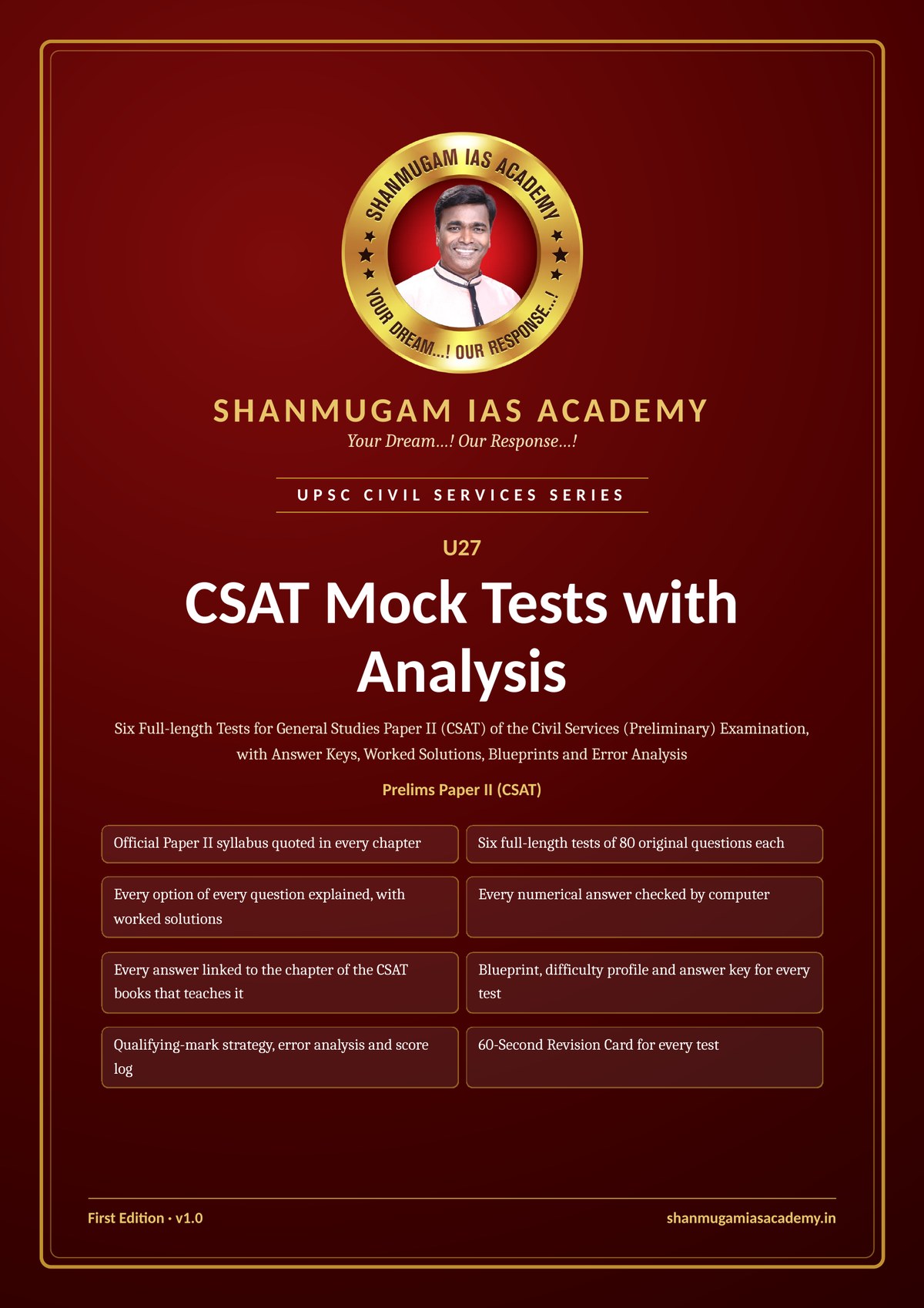 U27 · CSAT Mock Tests with Analysis – UPSC Civil Services (Prelims Paper II – CSAT)
₹249
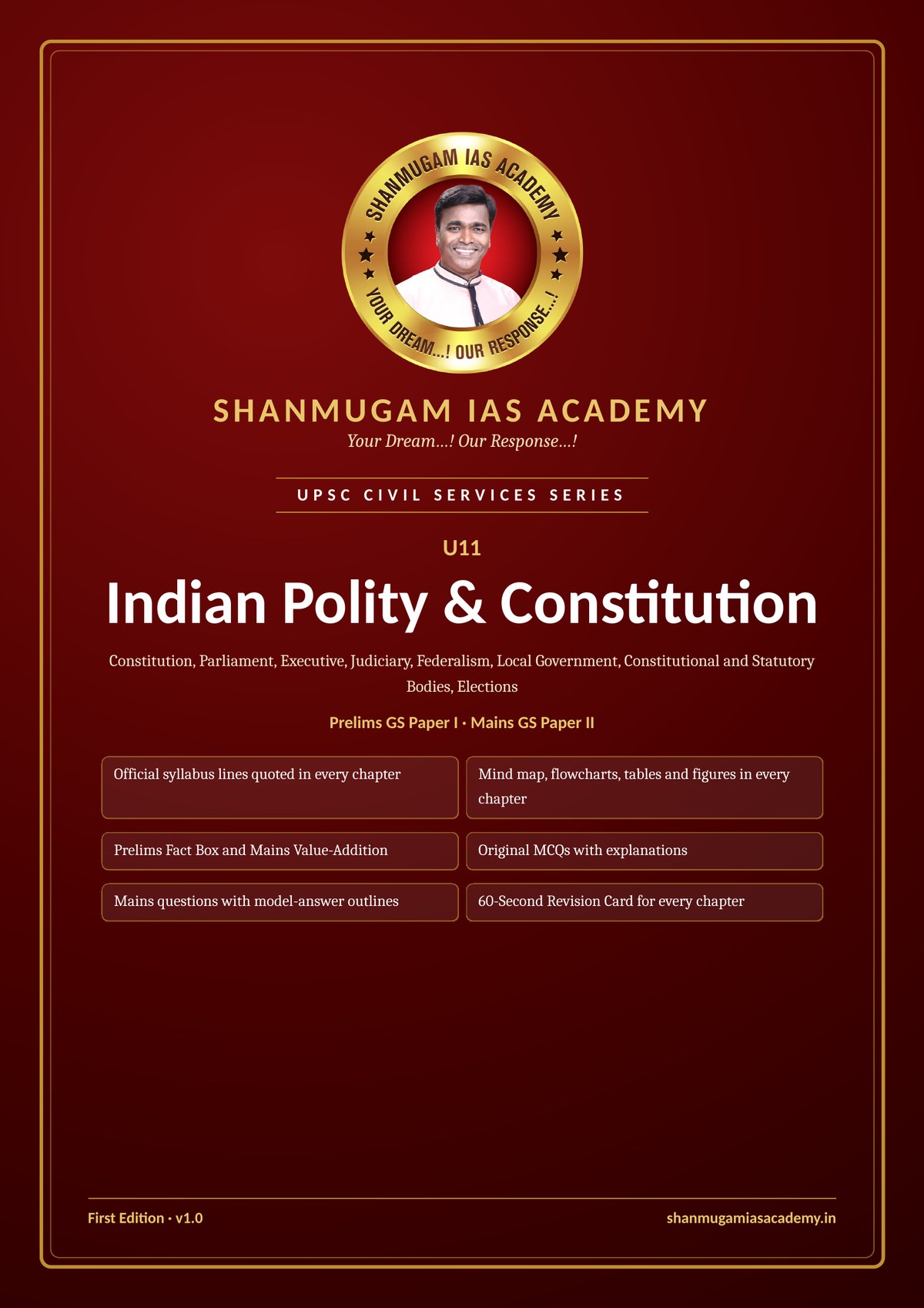 U11 · Indian Polity & Constitution – UPSC Civil Services (Prelims & Mains)
₹249
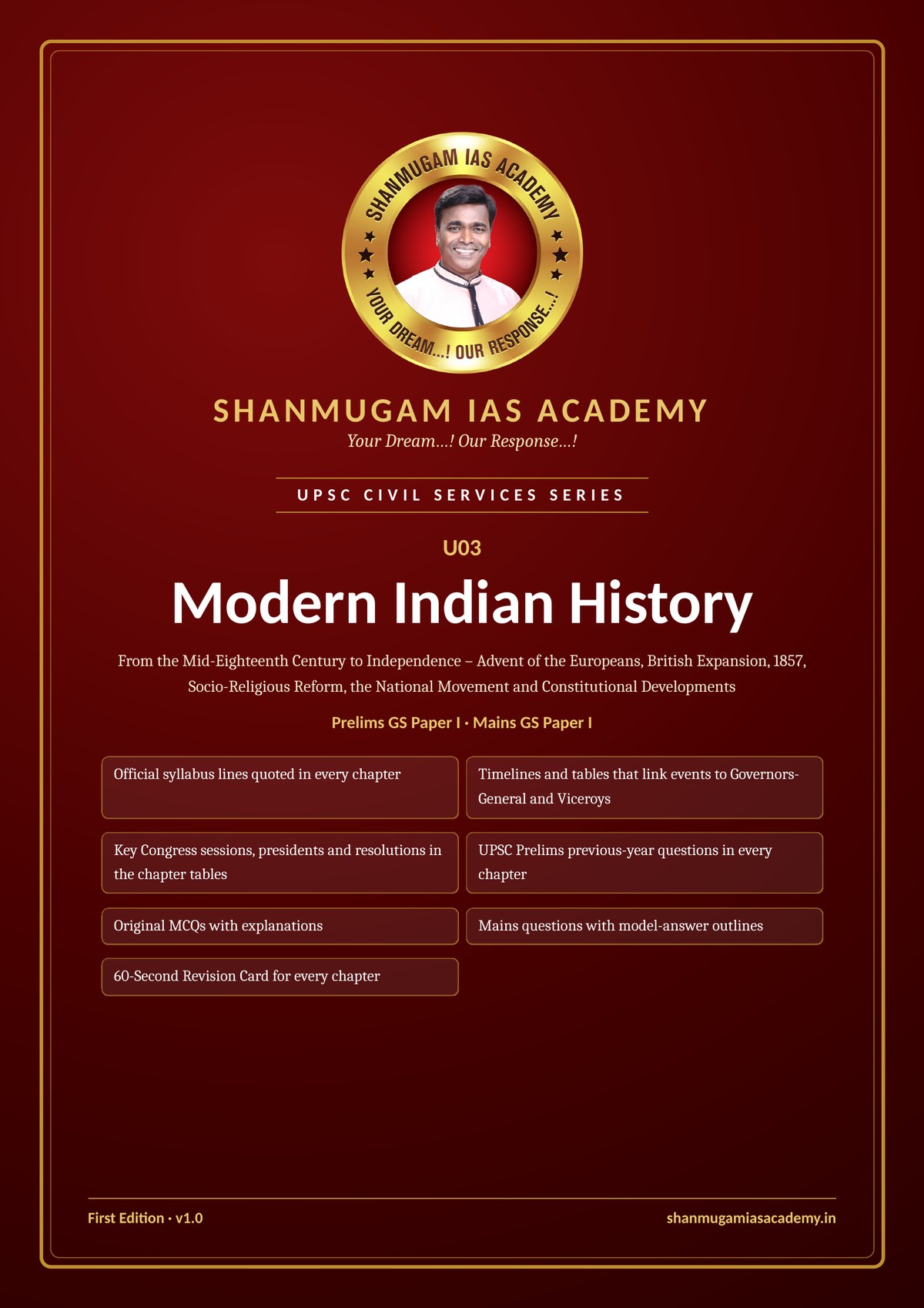 U03 · Modern Indian History – UPSC Civil Services (Prelims & Mains)
₹249
 U15 · Indian Economy – UPSC Civil Services (Prelims & Mains)
₹249
