

UPSC CSAT Numeracy – Chapter 1: Numeracy in CSAT – Pattern Syllabus and Approach (25 MCQs)
UPSC CSAT Numeracy – Chapter 1: Numeracy in CSAT – Pattern Syllabus and Approach (25 MCQs) – 25 questions, subject: CSAT Numeracy. Every question has the correct answer with a two-line explanation; tap "Show Answer". Free practice for TNPSC, UPSC, SSC, Bank and RRB exams – Shanmugam IAS Academy, Coimbatore.
Link to this page from your website / blog (HTML code)
Correct Answer: D [9,996]
Explanation:
102 × 98 = (100 + 2)(100 − 2) = 100² − 2² = 10,000 − 4 = 9,996. This uses the identity (a + b)(a − b) = a² − b².
Correct Answer: C [998,001]
Explanation:
999 × 999 = (1,000 − 1)² = 1,000,000 − 2,000 + 1 = 998,001. The square of a number just below a power of 10 follows this pattern, e.g. 99² = 9,801.
Correct Answer: C [12.5%]
Explanation:
1 ÷ 8 = 0.125, which is exactly 12.5%. Multiples follow easily: 3/8 = 37.5% and 5/8 = 62.5%.
Correct Answer: D [16.67%]
Explanation:
1 ÷ 6 = 0.1666…, which is about 16.67%. It is half of 1/3 ≈ 33.33%, a useful fraction-percentage link.
Correct Answer: A [1,000]
Explanation:
19.9 × 50.2 ≈ 20 × 50 = 1,000, since 19.9 is slightly below 20 and 50.2 is slightly above 50. The exact value is 998.98, which is closest to 1,000.
Correct Answer: B [1,200]
Explanation:
7/8 × 2,400 = 7 × 300 = 2,100 and 3/5 × 1,500 = 3 × 300 = 900. The difference is 2,100 − 900 = 1,200.
Correct Answer: C [1]
Explanation:
10 = 9 × 1 + 1, so 10 and every power of 10 leave remainder 1 on division by 9. Hence a number such as 100a + 10b + c leaves the same remainder as a + b + c, which is why the digit-sum check works.
Correct Answer: D [two digits swapped]
Explanation:
Swapping two digits does not change the digit sum, so the digit-sum (casting out nines) check cannot detect it; for example, 28,164 and 28,614 both leave remainder 3 on division by 9. A wrong single digit usually changes the digit sum and is caught.
Correct Answer: A [0 per cent]
Explanation:
49 × 102 = 4,998 and 50 × 100 = 5,000, so the error is only 2 in about 5,000, i.e. about 0.04%, which is practically 0%. This happens because rounding 49 up (about +2%) and 102 down (about −2%) nearly cancel each other.
Correct Answer: B [1 and 3 only]
Explanation:
Statement 1 is true (2 × 3 = 6 with two decimal places gives 0.06), and Statement 3 is true because both 25% of 48 and 48% of 25 equal 12. Statement 2 is false: 1/3 + 1/4 = 4/12 + 3/12 = 7/12, not 2/7.
Correct Answer: A [Both A and R are true, and R is the correct explanation of A]
Explanation:
On division by 9, 2,347 leaves 7 and 12 leaves 3, so their product must leave the same remainder as 7 × 3 = 21, i.e. 3, but 28,154 leaves 2. This mismatch proves the product is wrong (the true product is 28,164), so both are true and R explains A.
Correct Answer: A [3/7]
Explanation:
As decimals, 3/7 ≈ 0.429, 5/12 ≈ 0.417, 2/5 = 0.4 and 4/11 ≈ 0.364, so 3/7 is the largest. Cross-multiplying also shows 3/7 > 5/12, since 3 × 12 = 36 > 5 × 7 = 35.
Correct Answer: D [240]
Explanation:
37.5% = 3/8, so 37.5% of 640 = 3/8 × 640 = 3 × 80 = 240. Similar useful equivalents are 12.5% = 1/8 and 62.5% = 5/8.
Correct Answer: D [12.5%]
Explanation:
The rise is 720 − 640 = 80, and 80 ÷ 640 = 1/8 = 12.5%. The 11.1% option wrongly divides the rise by the new value 720 instead of the original 640.
Correct Answer: B [43]
Explanation:
43² = 1,849, which is just 1 below 1,850, so the square root of 1,850 is very close to 43. By comparison, 42² = 1,764 and 44² = 1,936 are much farther away.
Correct Answer: B [2-3-1-4]
Explanation:
Converting to percentages: 0.6 = 60%, 65%, 2/3 ≈ 66.7% and 7/10 = 70%. In increasing order this is 2-3-1-4.
Correct Answer: D [60]
Explanation:
20% of 50 is 10, and 20% more than 50 means 50 + 10 = 60. The option 10 is only the increase, not the new value.
Correct Answer: A [28.57%]
Explanation:
2/7 = 0.285714…, which is about 28.57%. A useful fact: 1/7 ≈ 14.29%, so 2/7 is double that.
Correct Answer: B [11]
Explanation:
The number n satisfies n + n² = 132, that is n(n + 1) = 132 = 11 × 12. So the positive number is 11, since 11 + 121 = 132.
Correct Answer: A [30]
Explanation:
30 per cent of 500 is 150, and 20 per cent of 150 is 30. Equivalently, 0.2 × 0.3 × 500 = 0.06 × 500 = 30.
Correct Answer: A [9]
Explanation:
If w answers are wrong, 90 − w are correct, so 5(90 − w) − 2w = 387. This gives 450 − 7w = 387, so 7w = 63 and the student has 9 incorrect responses.
Correct Answer: B [10]
Explanation:
8 questions at 50% marks each are worth 4 full questions, and this equals 40% of the total. So the number of questions is 4 × 100 ÷ 40 = 10.
Correct Answer: C [150]
Explanation:
The pass mark is 30 + 30 = 60 marks, and this equals 40% of the maximum, so maximum marks = 60 × 100 ÷ 40 = 150. Check: 40% of 150 = 60, and 60 − 30 = 30 marks short.
Correct Answer: B [12]
Explanation:
Girls are twice the boys in 60 students, so there are 20 boys and 40 girls; Kamal ranks 17th, so 16 students are ahead, of whom 9 are girls and 7 are boys. Boys after Kamal = 20 − 7 − 1 = 12.
Correct Answer: D [the value of money only would be halved.]
Explanation:
relative values stay the same; only money buys half as much.
➤ Class X level methods, shortcuts with proof, worked solutions to UPSC CSAT numeracy PYQs and a reason for every option – U25 · CSAT Numeracy (UPSC book, ₹249): www.shanmugamiasacademy.in/study-materials/upsc-csat-numeracy
Today Current Affairs in Tamil | 23 நவம்பர் 2026 | TNPSC Group 4 முக்கிய வினாக்கள்
📚 UPSC Civil Services Books (Prelims & Mains)
PDF நூல்கள் · ₹149 முதல் · ஒவ்வொன்றுக்கும் 50 பக்க இலவச மாதிரி · UPI-இல் பணம் செலுத்தியதும் உடனே பதிவிறக்கம்
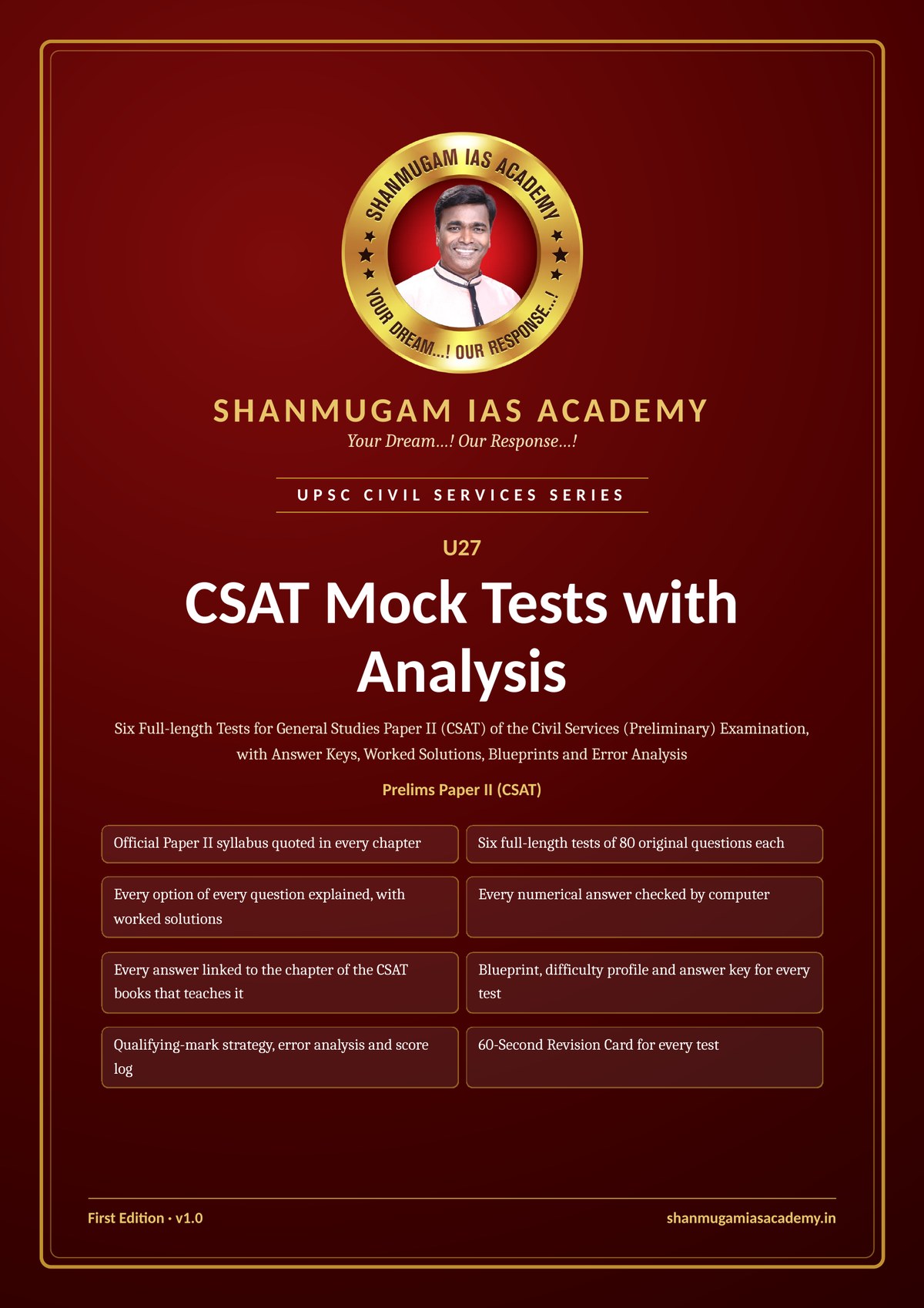 U27 · CSAT Mock Tests with Analysis – UPSC Civil Services (Prelims Paper II – CSAT)
₹249
 U11 · Indian Polity & Constitution – UPSC Civil Services (Prelims & Mains)
₹249
 U03 · Modern Indian History – UPSC Civil Services (Prelims & Mains)
₹249
 U15 · Indian Economy – UPSC Civil Services (Prelims & Mains)
₹249
TNPSC குரூப் 1, 2/2A, 4 – நேரடி வகுப்புகள் · கோவை & மதுரை
2006 முதல் சண்முகம் IAS அகாடமி · Classroom & online coaching in Coimbatore and Madurai
