

UPSC CSAT Numeracy – Chapter 10: Averages (39 MCQs)
UPSC CSAT Numeracy – Chapter 10: Averages (39 MCQs) – 39 questions, subject: CSAT Numeracy. Every question has the correct answer with a two-line explanation; tap "Show Answer". Free practice for TNPSC, UPSC, SSC, Bank and RRB exams – Shanmugam IAS Academy, Coimbatore.
Link to this page from your website / blog (HTML code)
Correct Answer: C [sum of values ÷ number of values]
Explanation:
The arithmetic mean is the sum of all the values divided by the number of values. The middle value is the median and the most frequent value is the mode, which are different measures.
Correct Answer: B [100]
Explanation:
Sum = average × number of values = 20 × 5 = 100. The option 4 comes from wrongly dividing 20 by 5.
Correct Answer: B [(n + 1)/2]
Explanation:
The first n natural numbers form an arithmetic progression, so their mean is (first + last) ÷ 2 = (1 + n) ÷ 2. Check: their sum is n(n + 1)/2, and dividing by n gives (n + 1)/2.
Correct Answer: A [40 years]
Explanation:
The new total for 25 people is 25 × 16 = 400, and the 24 students total 24 × 15 = 360, so the teacher is 400 − 360 = 40 years old. Shortcut: teacher = new average + 24 × 1 = 16 + 24 = 40.
Correct Answer: A [m + (x − m)/(n + 1)]
Explanation:
The new total is nm + x, which can be written as (n + 1)m + (x − m); dividing by n + 1 gives the new mean m + (x − m)/(n + 1). So the mean moves towards x by its excess (x − m) shared among n + 1 values, not n.
Correct Answer: B [Median]
Explanation:
The median depends only on the middle position after the values are arranged, so a few extreme values hardly change it. The arithmetic mean uses every value, so one very large or very small value pulls it strongly.
Correct Answer: C [3 median − 2 mean]
Explanation:
Karl Pearson's empirical relation for a moderately skewed distribution is mode ≈ 3 median − 2 mean. It is often written as mean − mode ≈ 3(mean − median).
Correct Answer: C [mean = median = mode]
Explanation:
A symmetric distribution balances equally on both sides of its centre, so the mean, median and mode all fall at the same point. In a positively skewed distribution, by contrast, the mean is pulled above the median.
Correct Answer: B [51]
Explanation:
The even numbers from 2 to 100 form an arithmetic progression, so their mean is (first + last) ÷ 2 = (2 + 100) ÷ 2 = 51. Check: there are 50 such numbers with sum 2,550, and 2,550 ÷ 50 = 51.
Correct Answer: B [1 and 3 only]
Explanation:
Statement 1 is correct because a weighted mean always lies between the smallest and largest group means, and statement 3 is correct because sum = mean × number of values. Statement 2 is wrong: adding a value equal to the mean leaves the mean unchanged.
Correct Answer: A [Both A and R are true, and R is the correct explanation of A]
Explanation:
Adding 5 to each of n values raises the sum by 5n while the count stays n, so the mean rises by exactly 5n ÷ n = 5. Thus both A and R are true, and R is exactly the reason for A.
Correct Answer: C [41.8]
Explanation:
Copying 64 as 46 made the total 64 − 46 = 18 too low, so the mean rises by 18 ÷ 10 = 1.8 when corrected. The correct mean is 40 + 1.8 = 41.8.
Correct Answer: D [61.1]
Explanation:
Entering 84 instead of 48 made the total 36 too high, so the mean was too high by 36 ÷ 40 = 0.9. The correct mean is 62 − 0.9 = 61.1.
Correct Answer: D [30]
Explanation:
If the second number is x, the numbers are 2x, x and 3x, and 6x = 3 × 20 = 60 gives x = 10. The largest is 3x = 30 (the numbers are 20, 10 and 30).
Correct Answer: C [59]
Explanation:
A + B + C = 180 and A + B + C + D = 4 × 58 = 232, so D = 52 and E = 55. B + C + D + E = 4 × 57 = 228 gives B + C = 228 − 107 = 121, so A = 180 − 121 = 59 kg.
Correct Answer: D [2-3-4-1]
Explanation:
The values are: mean of 2, 4, 6, 8, 30 = 50 ÷ 5 = 10; their median = 6; mean of 5, 7, 9 = 7; median of 1, 9, 10, 20 = (9 + 10) ÷ 2 = 9.5. In increasing order this is 6, 7, 9.5, 10, that is 2-3-4-1.
Correct Answer: B [61]
Explanation:
The combined mean is weighted by class size: (40 × 55 + 60 × 65) ÷ 100 = (2,200 + 3,900) ÷ 100 = 61. The simple average of 55 and 65 (60) is wrong because Section B has more students.
Correct Answer: A [34]
Explanation:
The first four and the last four together count the fourth number twice: 4 × 28 + 4 × 33 = 112 + 132 = 244. Subtracting the total of all seven, 7 × 30 = 210, gives the fourth number 244 − 210 = 34.
Correct Answer: C [6]
Explanation:
Arranged in order the values are 3, 4, 5, 7, 9 and 12; with six values the median is the average of the two middle ones, (5 + 7) ÷ 2 = 6. The option 6.67 is the mean (40 ÷ 6), not the median.
Correct Answer: A [34]
Explanation:
Multiplying every value by 3 multiplies the mean by 3, and adding 4 to every value adds 4 to the mean: 3 × 10 + 4 = 34. The option 42 comes from wrongly adding first, (10 + 4) × 3.
Correct Answer: B [39.7]
Explanation:
The misreading added 83 − 53 = 30 extra marks to the total of 100 × 40 = 4,000. The correct total is 3,970, so the corrected mean is 3,970 ÷ 100 = 39.7.
Correct Answer: A [Rs. 12,000]
Explanation:
A rise of ₹1,20,000 a year is ₹10,000 a month, so the family's monthly income rises from 5 × 10,000 = ₹50,000 to ₹60,000. The new average is 60,000 ÷ 5 = ₹12,000.
Correct Answer: D [N + 5]
Explanation:
The first three tests total 3N and the fourth test score is N + 20, so the four tests total 4N + 20. The new average is (4N + 20) ÷ 4 = N + 5, as the extra 20 points are shared over 4 tests.
Correct Answer: C [62]
Explanation:
Runs after 50 innings = 50 × 46.4 = 2,320 and after 60 innings = 60 × (46.4 + 2.6) = 60 × 49 = 2,940. The last ten innings gave 620 runs, an average of 62.
Correct Answer: C [35 years]
Explanation:
If each student is x years old, the teacher is x + 20, and 3x + x + 20 = 4 × 20 = 80 gives x = 15. So the teacher is 15 + 20 = 35 years old.
Correct Answer: D [54 kg]
Explanation:
Children + father = 3 × 52 = 156, so the children weigh 156 − 60 = 96 kg. Children + mother = 3 × 50 = 150, so the mother weighs 150 − 96 = 54 kg.
Correct Answer: C [50 kg]
Explanation:
The first five total 5 × 45 = 225 kg and the last five total 5 × 55 = 275 kg, and the 5th person is counted in both groups. So the 5th person weighs 225 + 275 − (9 × 50 = 450) = 50 kg.
Correct Answer: C [41 kg]
Explanation:
A + B + C = 3 × 40 = 120, and since F = B, D + E + F = D + E + B = 3 × 42 = 126. So the six weights total 246 kg and their average is 246 ÷ 6 = 41 kg, even though B itself is unknown.
Correct Answer: C [0.80 inch]
Explanation:
Six-day total = 6 × 0.50 = 3.0 inches and the first four days total 4 × 0.40 = 1.6 inches, so the last two days had 1.4 inches. Split in the ratio 4 : 3, the fifth day had 1.4 × 4/7 = 0.8 inch.
Correct Answer: A [47]
Explanation:
Five consecutive odd numbers with mean 39 are 35, 37, 39, 41 and 43, so the thirteen numbers run from 35 to 59. The mean of an evenly spaced list is the average of its ends: (35 + 59) ÷ 2 = 47.
Correct Answer: D [30 units]
Explanation:
The single-digit odd primes are 3, 5 and 7, so the first piece is their average, 5 units; if the third piece is T, the second is 5 + T/3 and T = 5 + 5 + T/3, giving T = 15. The pieces are 5, 10 and 15, so the sheet was 30 units long.
Correct Answer: B [3]
Explanation:
Take maximum marks as 100 per paper: the marks 5k to 10k total 45k = 60 per cent of 600 = 360, so k = 8 and the marks are 40, 48, 56, 64, 72 and 80. Three papers (40, 48 and 56) are below 60 per cent.
Correct Answer: A [7.8]
Explanation:
For English, 9g + 8b = 8.8(g + b) gives 0.2g = 0.8b, so girls : boys = 4 : 1. The Hindi average is then (4 × 8 + 1 × 7) ÷ 5 = 39 ÷ 5 = 7.8.
Correct Answer: B [80%]
Explanation:
By alligation, males and females are in the ratio (5000 − 4200) : (5200 − 5000) = 800 : 200 = 4 : 1. So males form 4/5 = 80% of the employees.
Correct Answer: A [1 only]
Explanation:
Every Class-A student scores at most 21, below Class-B's lowest of 22, so adding any four of them must lower Class-B's average and statement 1 is correct. Class-A's average rises only if the movers are below its average, which is not given, so statement 2 is not definite.
Correct Answer: D [skewed to the left]
Explanation:
When Mean < Median < Mode, a long tail of small values pulls the mean to the left, so the distribution is negatively skewed (skewed to the left). In a right-skewed distribution the order is reversed: Mode < Median < Mean.
Correct Answer: D [Cannot be determined]
Explanation:
Team Y took 18 overs (10 per cent fewer than 20), so its run rate was N/18. A rate 50 per cent higher is 1.5 × N/18 = N/12, and N runs at N/12 an over take exactly 12 overs – for every value of N. The last condition adds no information, so N cannot be determined.
Correct Answer: C [Value-I = Value-II]
Explanation:
Value-I: the average of 11 consecutive integers is the middle one; the lowest set allowed is −5, −4, …, 5, with middle (and average) 0. Value-II: the set 0, 1, …, 10 contains 0, so the product is 0, and no such product is negative. Both values are 0.
Correct Answer: A [k]
Explanation:
Write p = k + d and q = k − d. Then p + q = 2k, and since p + q + r = 3k, r = k.
➤ Class X level methods, shortcuts with proof, worked solutions to UPSC CSAT numeracy PYQs and a reason for every option – U25 · CSAT Numeracy (UPSC book, ₹249): www.shanmugamiasacademy.in/study-materials/upsc-csat-numeracy
Today Current Affairs in Tamil | 23 நவம்பர் 2026 | TNPSC Group 4 முக்கிய வினாக்கள்
📚 UPSC Civil Services Books (Prelims & Mains)
PDF நூல்கள் · ₹149 முதல் · ஒவ்வொன்றுக்கும் 50 பக்க இலவச மாதிரி · UPI-இல் பணம் செலுத்தியதும் உடனே பதிவிறக்கம்
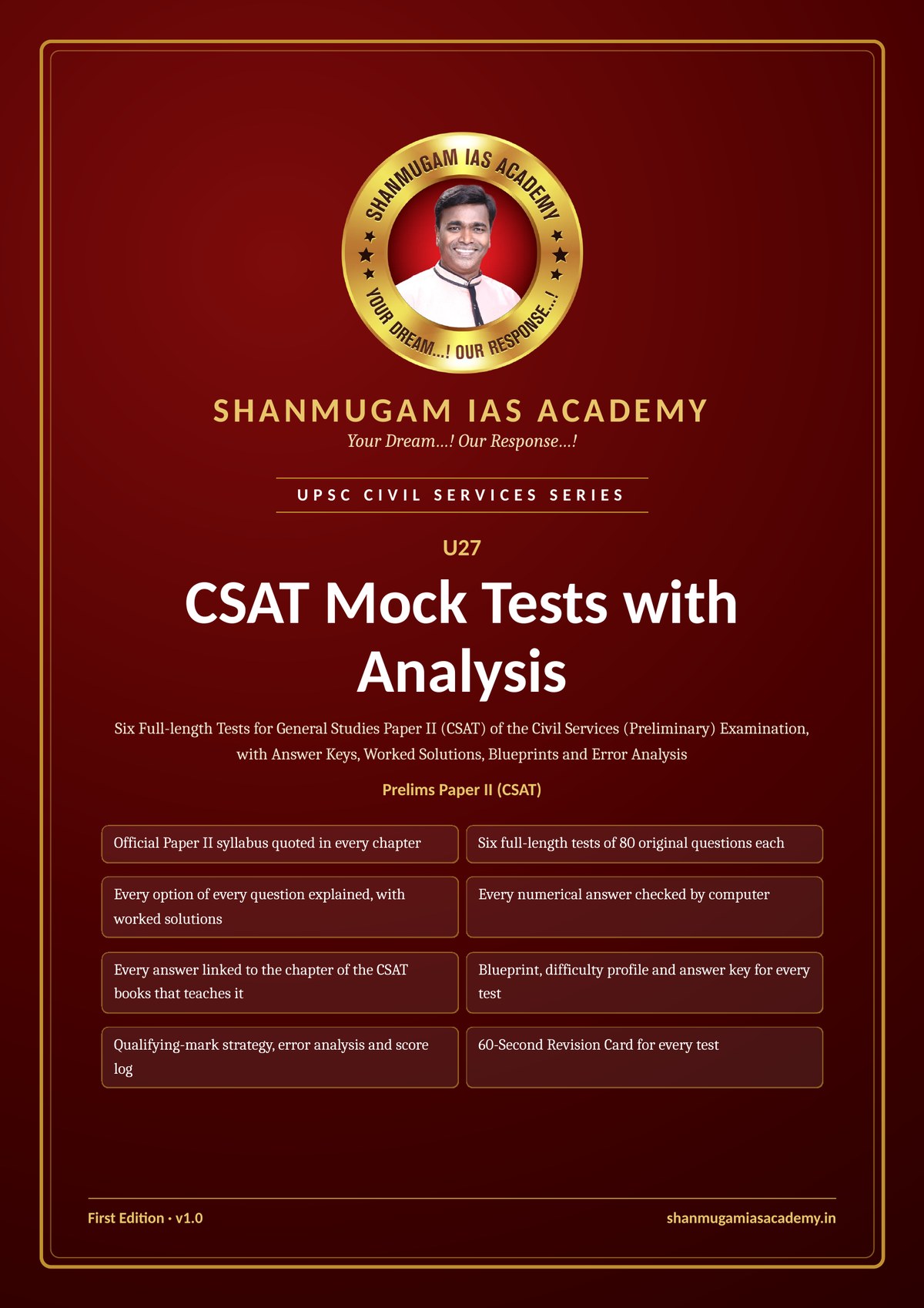 U27 · CSAT Mock Tests with Analysis – UPSC Civil Services (Prelims Paper II – CSAT)
₹249
 U11 · Indian Polity & Constitution – UPSC Civil Services (Prelims & Mains)
₹249
 U03 · Modern Indian History – UPSC Civil Services (Prelims & Mains)
₹249
 U15 · Indian Economy – UPSC Civil Services (Prelims & Mains)
₹249
TNPSC குரூப் 1, 2/2A, 4 – நேரடி வகுப்புகள் · கோவை & மதுரை
2006 முதல் சண்முகம் IAS அகாடமி · Classroom & online coaching in Coimbatore and Madurai
