

UPSC CSAT Numeracy – Chapter 5: Digit Puzzles and Cryptarithms (42 MCQs)
UPSC CSAT Numeracy – Chapter 5: Digit Puzzles and Cryptarithms (42 MCQs) – 42 questions, subject: CSAT Numeracy. Every question has the correct answer with a two-line explanation; tap "Show Answer". Free practice for TNPSC, UPSC, SSC, Bank and RRB exams – Shanmugam IAS Academy, Coimbatore.
Link to this page from your website / blog (HTML code)
Correct Answer: A [9]
Explanation:
(10a + b) − (10b + a) = 9a − 9b = 9(a − b), so the difference is always a multiple of 9. For example, 82 − 28 = 54 = 9 × 6; the sum, not the difference, is the multiple of 11.
Correct Answer: B [11]
Explanation:
(10a + b) + (10b + a) = 11a + 11b = 11(a + b), so the sum is always a multiple of 11. For example, 47 + 74 = 121 = 11 × 11, while it need not be a multiple of 9 or 10.
Correct Answer: C [99(a − c)]
Explanation:
(100a + 10b + c) − (100c + 10b + a) = 99a − 99c = 99(a − c), because the middle digit cancels out. For example, 742 − 247 = 495 = 99 × 5.
Correct Answer: D [1]
Explanation:
When two numbers are added, a column total is at most 9 + 9 + 1 = 19, so the carry passed to the next column is never more than 1. A larger carry such as 2 is possible only when three or more numbers are added.
Correct Answer: A [198]
Explanation:
The largest two-digit number is 99, so the largest sum of two two-digit numbers is 99 + 99 = 198. A three-digit sum like 200 is impossible because each number is at most 99.
Correct Answer: B [6]
Explanation:
For a two-digit number 10a + b, the difference from its reverse is (10a + b) − (10b + a) = 9(a − b). So 9(a − b) = 54 gives a − b = 6.
Correct Answer: C [equal or as close as possible]
Explanation:
For x + y = S, the product xy = (S/2)² − ((x − y)/2)², so it is greatest when the difference x − y is zero or as small as possible. For example, with S = 10, 5 × 5 = 25 beats 4 × 6 = 24 and 1 × 9 = 9.
Correct Answer: B [2]
Explanation:
AB + BA = 11(A + B), and with A + B at most 17 the only three-digit multiple of 11 of the form CDC is 121, so C = 1 and D = 2. Pairs such as 38 + 83 or 47 + 74 = 121 confirm that D is fixed, so it is not 'cannot be determined'.
Correct Answer: D [6]
Explanation:
3 × AB = 100C + AB gives 2 × AB = 100C, so AB = 50 and C = 1 (check: 50 + 50 + 50 = 150). Hence A + B + C = 5 + 0 + 1 = 6; only B may be zero here, which the question allows.
Correct Answer: B [1 and 3 only]
Explanation:
Statement 1 is true because ab − ba = 9(a − b), and Statement 3 is the basic rule of cryptarithms that different letters mean different digits. Statement 2 is false: adding three or more numbers can give a carry of 2 or more (e.g. 9 + 9 + 9 = 27).
Correct Answer: A [Both A and R are true, and R is the correct explanation of A]
Explanation:
In the tens column A + C + carry must give C with a carry of 1 into the hundreds, so A + carry = 10; since a carry is only 0 or 1, A = 9 with carry 1. Thus both statements are true and R directly explains A.
Correct Answer: C [74]
Explanation:
Let the number be 10a + b; adding its reverse gives 11(a + b) = 121, so a + b = 11, and with a − b = 3 we get a = 7, b = 4, i.e. 74. Check: 74 + 47 = 121 and 7 − 4 = 3, while 47 fails because its units digit is the larger one.
Correct Answer: C [369]
Explanation:
The digits k, 2k and 3k add to 6k, which must be a multiple of 9, and with 3k at most 9, k can only be 3. The number is 369 (3 + 6 + 9 = 18, divisible by 9).
Correct Answer: D [389]
Explanation:
A first digit of 2 would need the other two to add to 18 (9 + 9), which repeats a digit, so the first digit must be 3 with 8 and 9. The smallest arrangement is 389 (3 + 8 + 9 = 20).
Correct Answer: C [156]
Explanation:
For a fixed sum, the product is greatest when the two numbers are as close as possible. With an odd total of 25, the nearest whole numbers are 12 and 13, giving 12 × 13 = 156 (169 would need 12.5 × 12.5).
Correct Answer: D [1-3-2-4]
Explanation:
The values are: largest two-digit number with digit sum 10 = 91; smallest three-digit number with all digits different = 102; largest two-digit prime = 97; smallest three-digit number with digit sum 5 = 104. In increasing order 91, 97, 102, 104 is 1-3-2-4.
Correct Answer: B [2]
Explanation:
A number minus its reverse is 9(a − b) = 63, so a − b = 7. With b at least 1, the numbers are 81 and 92, so there are 2 such numbers.
Correct Answer: A [70 + 24P]
Explanation:
By place value, 3P = 30 + P, 4P = 40 + P and each PP = 10P + P = 11P. Adding them gives 30 + 40 + P + P + 11P + 11P = 70 + 24P.
Correct Answer: B [423]
Explanation:
The largest number is 730 and the smallest is 307, because 0 cannot be the first digit. The difference is 730 − 307 = 423.
Correct Answer: A [63]
Explanation:
A number minus its reverse is 9 × (difference of digits) = 27, so the digits differ by 3, and they add up to 9, so they are 6 and 3. The number is 63, since 63 − 36 = 27.
Correct Answer: D [8]
Explanation:
X + Y = 11(a + b), and the greatest two-digit number is 99, so a + b = 9. Since Y must also be a two-digit number, neither digit can be 0, giving 18, 27, 36, 45, 54, 63, 72 and 81, that is 8 values.
Correct Answer: A [9]
Explanation:
Two two-digit numbers add up to less than 200, so the hundreds digit is 1, and in the tens column A + C + carry must give C with a carry of 1 to the hundreds. So A + carry = 10, and since the carry from the units can only be 0 or 1, A = 9.
Correct Answer: A [18]
Explanation:
ABC × D must equal 3,7DD; trying D = 1 to 9, only D = 4 works with distinct non-zero digits, since 3,744 ÷ 4 = 936. So A + B + C = 9 + 3 + 6 = 18.
Correct Answer: D [9]
Explanation:
If p = 10a + b, the reversed number is q = 10b + a, and 2,430 = 45 × 54 fits this pattern. So the difference is 54 − 45 = 9, which matches 9 × (a − b) with digits differing by 1.
Correct Answer: B [3]
Explanation:
Writing ⊗ as x: x + (10 + x) + (50 + x) + 11x + (10x + 1) = 100 + 11x, so 24x + 61 = 100 + 11x and 13x = 39, giving x = 3. Check: 3 + 13 + 53 + 33 + 31 = 133.
Correct Answer: C [3]
Explanation:
Units: C + F = 12 (carry 1); tens: B + 2 + 1 = 10, so B = 7 (carry 1), which leaves C and F as 4 and 8; hundreds: 3 + E + 1 = 9, so E = 5. Thousands: A + D = 15 from the remaining digits 6 and 9, so the difference between A and D is 3.
Correct Answer: B [4]
Explanation:
7(10a + b) = 4(10b + a) gives 66a = 33b, so b = 2a. The numbers are 12, 24, 36 and 48 (each with its reverse), so there are 4 such pairs.
Correct Answer: D [None of the above]
Explanation:
A two-digit number minus its reverse is 9 × (difference of digits), so the digits must differ by 3. This gives 14, 25, 36, 47, 58, 69 and their reverses 41, 52, 63, 74, 85, 96, that is twelve numbers, so none of the options 3, 4 or 5 is right.
Correct Answer: C [D = 1, E = 0]
Explanation:
ABCABC = ABC × 1,000 + ABC = ABC × 1,001, so DEED = 1001. Hence D = 1 and E = 0.
Correct Answer: C [Both 1 and 2]
Explanation:
pp + qq + rr = 11(p + q + r), and a number of the form tt0 needs p + q + r = 10 (110) or 20 (220). The triples are 127, 136, 145, 235, 389, 479, 569 and 578, so p takes 5 values (1 to 5) and q takes 6 values (2, 3, 4, 6, 7, 8), and both statements are correct.
Correct Answer: C [2]
Explanation:
With the second row twice and the third row thrice the first, using all digits 1 to 9 once, the possible first rows are 192, 219, 273 and 327. Only 273 (546, 819) and 327 (654, 981) use three of the digits 2, 3, 7 and 9, so there are 2 arrangements.
Correct Answer: C [202]
Explanation:
The sum is (30 + P) + (40 + P) + 11P + 11P = 70 + 24P, which ends in 2 only for P = 3 (sum 142) and P = 8 (sum 262), both with different digits P, Q, R. The mean of the possible sums is (142 + 262) ÷ 2 = 202.
Correct Answer: B [2]
Explanation:
Q × 3 must end in Q, so Q is 0 or 5; Q = 0 gives no solution, and Q = 5 gives 85 × 3 = 255, so P = 8, Q = 5 and R = 2. Then (P + R) ÷ Q = (8 + 2) ÷ 5 = 2.
Correct Answer: B [2]
Explanation:
The number is a0c with a + c = 4, and c0a − a0c = 99(c − a) = 198, so c − a = 2. So a = 1 and c = 3, the number is 103, and its reverse 301 is 198 more.
Correct Answer: D [45]
Explanation:
The remainder must be less than the smaller number, and 94 ÷ 49 gives quotient 1 and remainder 94 − 49 = 45. When the quotient is 1 the remainder is 9 × (difference of digits), which is largest for digits 9 and 4 among cases where the larger is still less than twice the smaller.
Correct Answer: D [0]
Explanation:
Using − twice, + once and × once, 5 − 4 − 3 + 2 × 1 = 5 − 4 − 3 + 2 = 0 (multiplication is done first). A negative value is not allowed, so 0 is the smallest possible non-negative value.
Correct Answer: A [11880]
Explanation:
Each word is coded as the product of its letters' alphabet positions: ABCD = 1 × 2 × 3 × 4 = 24 and EFGH = 5 × 6 × 7 × 8 = 1,680. So IJKL = 9 × 10 × 11 × 12 = 11,880.
Correct Answer: B [2]
Explanation:
Q = 3S allows (S, Q) = (4, 12) or (5, 15). With S = 4, T = R + 7 needs R = 5, T = 12, but 12 is already Q – impossible. So S = 5, Q = 15; T = R + 8 gives R = 4, T = 12, P = 10: 10 + 4 − 12 = 2.
Correct Answer: B [225]
Explanation:
The four largest distinct digits 9, 8, 7, 6 give a total of 30, and a product of two parts with a fixed sum is largest when the parts are equal. So (9 + 6)(8 + 7) = 15 × 15 = 225 is the greatest value, more than 221 from (9 + 8)(7 + 6).
Correct Answer: D [6]
Explanation:
P = 4 and the difference between P and T is 5, so T = 9 (since −1 is not allowed). The difference between N and T is 3, so N = 6 (12 is not allowed).
Correct Answer: B [3]
Explanation:
In place values, (100P + 30 + R) − (10P + S) = 110P + T, so 30 + R − S − T = 20P. Only P = 1 is possible, giving S + T = R + 10. T can be 2, 4 or 5 (distinct from P = 1 and Q = 3): T = 2 needs R = 1, already used; T = 4 gives (2, 8); T = 5 gives (2, 7) and (4, 9). Three pairs: 132 − 18 = 114, 132 − 17 = 115, 134 − 19 = 115.
Correct Answer: B [4]
Explanation:
P = 3T with T ≠ 0 gives (P, T) = (3, 1), (6, 2) or (9, 3). S = Q + 4 = R + 7 gives (R, Q, S) = (0, 3, 7), (1, 4, 8) or (2, 5, 9). Of the nine pairings, five repeat a digit; the four with all digits distinct are 35291, 63072, 64182 and 94183.
➤ Class X level methods, shortcuts with proof, worked solutions to UPSC CSAT numeracy PYQs and a reason for every option – U25 · CSAT Numeracy (UPSC book, ₹249): www.shanmugamiasacademy.in/study-materials/upsc-csat-numeracy
Today Current Affairs in Tamil | 23 நவம்பர் 2026 | TNPSC Group 4 முக்கிய வினாக்கள்
📚 UPSC Civil Services Books (Prelims & Mains)
PDF நூல்கள் · ₹149 முதல் · ஒவ்வொன்றுக்கும் 50 பக்க இலவச மாதிரி · UPI-இல் பணம் செலுத்தியதும் உடனே பதிவிறக்கம்
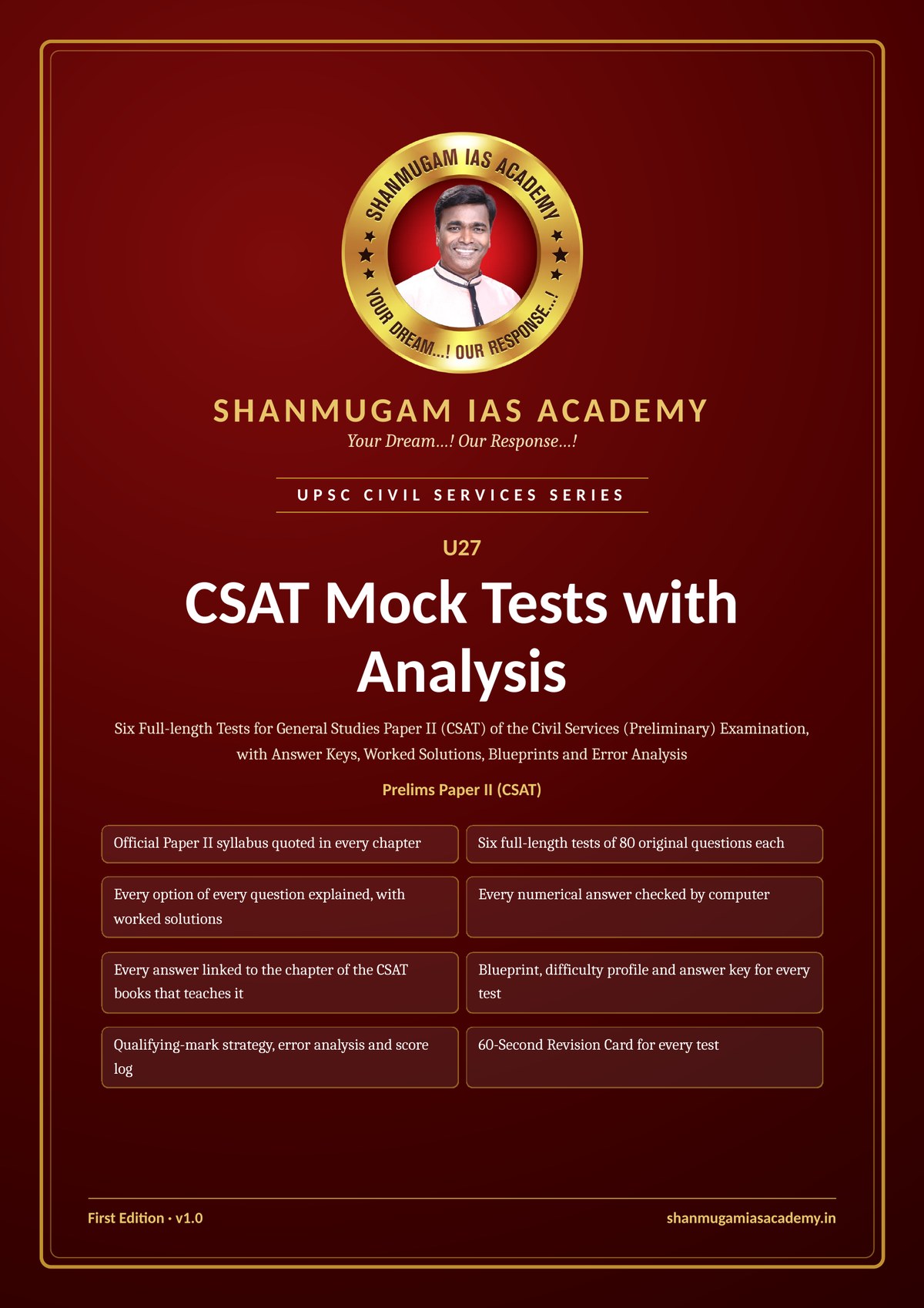 U27 · CSAT Mock Tests with Analysis – UPSC Civil Services (Prelims Paper II – CSAT)
₹249
 U11 · Indian Polity & Constitution – UPSC Civil Services (Prelims & Mains)
₹249
 U03 · Modern Indian History – UPSC Civil Services (Prelims & Mains)
₹249
 U15 · Indian Economy – UPSC Civil Services (Prelims & Mains)
₹249
TNPSC குரூப் 1, 2/2A, 4 – நேரடி வகுப்புகள் · கோவை & மதுரை
2006 முதல் சண்முகம் IAS அகாடமி · Classroom & online coaching in Coimbatore and Madurai
