

UPSC CSAT Numeracy – Chapter 6: Fractions, Powers and Orders of Magnitude (32 MCQs)
UPSC CSAT Numeracy – Chapter 6: Fractions, Powers and Orders of Magnitude (32 MCQs) – 32 questions, subject: CSAT Numeracy. Every question has the correct answer with a two-line explanation; tap "Show Answer". Free practice for TNPSC, UPSC, SSC, Bank and RRB exams – Shanmugam IAS Academy, Coimbatore.
Link to this page from your website / blog (HTML code)
Correct Answer: A [5/11]
Explanation:
A two-digit repeating block "ab" equals ab/99, so 0.4545... = 45/99. This simplifies to 5/11, while 45/100 = 0.45 is a terminating decimal.
Correct Answer: B [81]
Explanation:
A negative exponent inverts the base: (1/3)⁻⁴ = 3⁴ = 81. The option 1/81 is (1/3)⁴, which ignores the minus sign.
Correct Answer: C [10 million]
Explanation:
1 crore = 10⁷ = 10 × 10⁶, and 1 million = 10⁶. So 1 crore = 10 million (and 100 crore = 1 billion).
Correct Answer: D [10⁶ mm³]
Explanation:
1 litre = 1,000 cm³ and 1 cm³ = 10 × 10 × 10 = 1,000 mm³. So 1 litre = 1,000 × 1,000 = 10⁶ mm³.
Correct Answer: C [9/7]
Explanation:
Adding the same positive number to both terms moves a fraction towards 1, so a proper fraction rises and an improper one falls. 9/7 is improper and becomes 12/10 = 1.2, less than 9/7 ≈ 1.286, while 2/5, 7/9 and 1/3 all increase.
Correct Answer: B [8 times]
Explanation:
Volume is the cube of the side, so doubling the side multiplies the volume by 2³ = 8. The area of each face, by contrast, becomes 2² = 4 times.
Correct Answer: C [2³⁶]
Explanation:
4¹⁸ = (2²)¹⁸, and a power of a power multiplies the exponents: 2 × 18 = 36. So 4¹⁸ = 2³⁶.
Correct Answer: D [5 × 3 and 7 × 2]
Explanation:
To compare a/b and c/d quickly, cross-multiply and compare a × d with b × c; here 5 × 3 = 15 and 7 × 2 = 14. Since 15 > 14, 5/7 is greater than 2/3.
Correct Answer: A [1/6]
Explanation:
Let x = 0.1666...; then 100x − 10x = 16.666... − 1.666... = 15, so x = 15/90 = 1/6. Check: 1 ÷ 6 = 0.1666...
Correct Answer: B [1 and 3 only]
Explanation:
Statement 1 is correct because 1 km = 1,000 m, so 10⁻³ km = 1 m, and statement 3 is correct because 0.0045 = 4.5 × 10⁻³. Statement 2 is wrong: a power of a power multiplies the exponents, so (2³)² = 2⁶, not 2⁹.
Correct Answer: A [Both A and R are true, and R is the correct explanation of A]
Explanation:
Adding k to both terms changes a/b by k(b − a)/[b(b + k)], and with b − a = 1 this is k/[b(b + k)], which falls as b rises. So 5/6, with the largest denominator, changes the least, and R correctly explains A.
Correct Answer: C [7³⁰]
Explanation:
Writing each as a tenth power: 2⁶⁰ = 64¹⁰, 3⁴⁰ = 81¹⁰, 7³⁰ = 343¹⁰ and 5²⁰ = 25¹⁰. With the same exponent, the largest base wins, so 7³⁰ is the largest.
Correct Answer: D [360 km]
Explanation:
3.6 crore centimetres = 3.6 × 10⁷ cm, and 1 km = 1,000 m = 10⁵ cm. So the distance is 3.6 × 10⁷ ÷ 10⁵ = 360 km.
Correct Answer: C [0.3]
Explanation:
(0.3)³ = 0.027 and 0.09 = (0.3)², so the value is 0.3³ ÷ 0.3² = 0.3. Check: 0.027 ÷ 0.09 = 27/90 = 0.3.
Correct Answer: B [4096³]
Explanation:
By the rule (aᵐ)ⁿ = aᵐⁿ, 2³⁶ = (2¹²)³ and 2¹² = 4,096, so 2³⁶ = 4,096³. The other options do not match: 1,024³ = 2³⁰ and 256⁴ = 2³².
Correct Answer: D [4-3-2-1]
Explanation:
The values are 5⁴ = 625, 3⁶ = 729, 10³ = 1,000 and 2¹⁰ = 1,024. In increasing order this is 4-3-2-1.
Correct Answer: C [2]
Explanation:
2⁻³ = 1/8, 4² = 16 and 8⁰ = 1 (any non-zero number to the power 0 is 1). So the value is (1/8) × 16 ÷ 1 = 2.
Correct Answer: A [10¹² rupees]
Explanation:
One lakh is 10⁵ and one crore is 10⁷, so one lakh crore = 10⁵ × 10⁷ = 10¹² rupees. In the international system this is one trillion rupees.
Correct Answer: B [10 hectares]
Explanation:
Area = 250 × 400 = 1,00,000 m², and 1 hectare = 10,000 m². So the plot is 1,00,000 ÷ 10,000 = 10 hectares.
Correct Answer: A [10 lakh]
Explanation:
One million is 10⁶ = 10,00,000, which in the Indian system is 10 lakh. One crore is 10⁷, that is 10 million.
Correct Answer: C [(1/3)⁻⁴]
Explanation:
A negative power flips the fraction: (1/2)⁻⁶ = 2⁶ = 64, (1/4)⁻³ = 4³ = 64, (1/3)⁻⁴ = 3⁴ = 81 and (1/6)⁻² = 6² = 36. So (1/3)⁻⁴ = 81 is the largest.
Correct Answer: B [14/11]
Explanation:
1.272727... = 1 + 27/99 = 1 + 3/11 = 14/11. Check: 14 ÷ 11 = 1.2727..., while 127/99 = 1.2828... is a different number.
Correct Answer: B [3²¹]
Explanation:
Writing in powers of 2: 4¹⁸ = 2³⁶ and 8¹² = 2³⁶, both smaller than 2⁴⁰. Since 3² = 9 is close to 2³ = 8, 3²¹ is about 2³³·³, which is the smallest of all.
Correct Answer: D [5/6]
Explanation:
Adding 5 to both parts changes n/d by 5(d − n)/[d(d + 5)]; here d − n = 1 for every fraction, so the change is smallest when d is largest. Hence 5/6 (becoming 10/11) changes the least, while 2/3 (becoming 7/8) changes the most.
Correct Answer: B [Always greater than the original fraction]
Explanation:
For a proper fraction a/b (a < b), adding the same positive k gives (a + k)/(b + k), and (a + k)/(b + k) − a/b = k(b − a)/[b(b + k)], which is positive. So the new fraction is always greater; for example 1/2 becomes 2/3 when 1 is added.
Correct Answer: C [100]
Explanation:
1 litre (1 kg = 1,000 g) of water occupies 1,000 cm³ = 10⁶ mm³, so 1 g occupies 1,000 mm³. Hence 0.1 g of water occupies 100 mm³.
Correct Answer: A [u = 4v]
Explanation:
Doubling each side makes the volume 2³ = 8 times, so y = 8x, while n = 2m. Then v = n/y = 2m/8x = u/4, so u = 4v.
Correct Answer: A [10 kg]
Explanation:
The difference between full and one-third full is two-thirds of the water, which weighs 40 − 20 = 20 kg. So all the water weighs 30 kg and the empty vessel weighs 40 − 30 = 10 kg.
Correct Answer: A [XY]
Explanation:
Since X is at least 2 and Y > X, XY is at least 2Y, which is more than Y and so more than Y/X. X/Y and (X + Y)/XY are both less than 1 (for example X = 2, Y = 3 gives 6, 0.67, 1.5 and 0.83), so XY is the largest.
Correct Answer: C [Three]
Explanation:
Take p ≤ q ≤ r. Then 1/p is the largest of the three, so 1/p ≥ 1/3 and p is 2 or 3 (p = 1 leaves nothing for the other two). p = 3 forces q = r = 3. p = 2 needs 1/q + 1/r = 1/2, giving (3, 6) or (4, 4). The solutions (3, 3, 3), (2, 4, 4) and (2, 3, 6) give sums 9, 10 and 11 – three values.
Correct Answer: B [9]
Explanation:
N² has 17 digits, so 10¹⁶ ≤ N² < 10¹⁷ and 10⁸ ≤ N < 10⁸·⁵ (about 3.2 × 10⁸): N has 9 digits. In fact N = 111111111.
Correct Answer: A [I only]
Explanation:
For 0 < x < 1, multiplying by x makes a positive number smaller: x³ = x² × x < x², so I holds. For the same reason x = √x × √x < √x, so II is false (x = 0.25: √x = 0.5).
➤ Class X level methods, shortcuts with proof, worked solutions to UPSC CSAT numeracy PYQs and a reason for every option – U25 · CSAT Numeracy (UPSC book, ₹249): www.shanmugamiasacademy.in/study-materials/upsc-csat-numeracy
Today Current Affairs in Tamil | 23 நவம்பர் 2026 | TNPSC Group 4 முக்கிய வினாக்கள்
📚 UPSC Civil Services Books (Prelims & Mains)
PDF நூல்கள் · ₹149 முதல் · ஒவ்வொன்றுக்கும் 50 பக்க இலவச மாதிரி · UPI-இல் பணம் செலுத்தியதும் உடனே பதிவிறக்கம்
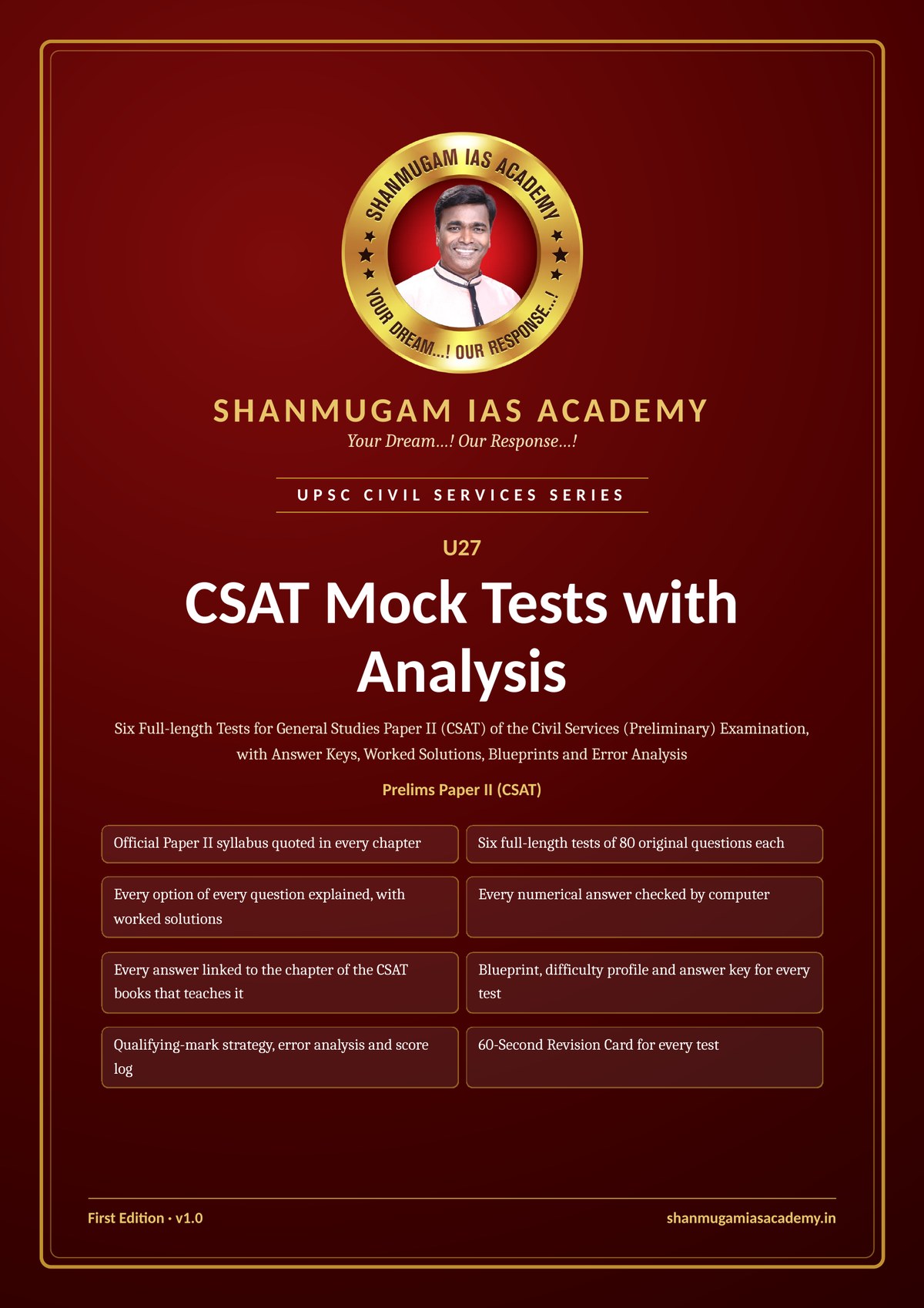 U27 · CSAT Mock Tests with Analysis – UPSC Civil Services (Prelims Paper II – CSAT)
₹249
 U11 · Indian Polity & Constitution – UPSC Civil Services (Prelims & Mains)
₹249
 U03 · Modern Indian History – UPSC Civil Services (Prelims & Mains)
₹249
 U15 · Indian Economy – UPSC Civil Services (Prelims & Mains)
₹249
TNPSC குரூப் 1, 2/2A, 4 – நேரடி வகுப்புகள் · கோவை & மதுரை
2006 முதல் சண்முகம் IAS அகாடமி · Classroom & online coaching in Coimbatore and Madurai
