

UPSC CSAT Numeracy – Chapter 7: Percentages (45 MCQs)
UPSC CSAT Numeracy – Chapter 7: Percentages (45 MCQs) – 45 questions, subject: CSAT Numeracy. Every question has the correct answer with a two-line explanation; tap "Show Answer". Free practice for TNPSC, UPSC, SSC, Bank and RRB exams – Shanmugam IAS Academy, Coimbatore.
Link to this page from your website / blog (HTML code)
Correct Answer: A [21 per cent]
Explanation:
The net multiplier is 1.10 × 1.10 = 1.21, which is a 21% increase. The extra 1% comes from 10% of the first 10% increase, so it is not simply 20%.
Correct Answer: B [20 per cent]
Explanation:
With B = 100, A = 125, and the gap of 25 measured on A gives 25/125 = 20 per cent. The gap is the same, but the base changes from B to A, so it is not 25 per cent.
Correct Answer: A [a 4 per cent loss]
Explanation:
The net multiplier is 1.20 × 0.80 = 0.96, so the final value is 4% less than the original. Equal percentage rise and fall always give a net loss of x²/100 %, here 20² ÷ 100 = 4%.
Correct Answer: D [original value]
Explanation:
Percentage change = (new value − original value) ÷ original value × 100, so the original value is always the base. This is why a rise from 80 to 100 is 25 per cent but a fall from 100 to 80 is only 20 per cent.
Correct Answer: A [57]
Explanation:
Candidates failing at least one subject = 30 + 25 − 12 = 43 per cent (those failing both are counted once). So 100 − 43 = 57 per cent passed both subjects.
Correct Answer: B [50]
Explanation:
The overlap is least when the two groups together cover everyone, so the minimum passing both = 80 + 70 − 100. That gives 50 per cent.
Correct Answer: D [y per cent of x]
Explanation:
x per cent of y = xy/100 and y per cent of x = yx/100, which are equal. For example, 8 per cent of 50 = 4 and 50 per cent of 8 = 4.
Correct Answer: B [12 per cent]
Explanation:
Spending = price × quantity, so the new quantity must be 1.10 ÷ 1.25 = 0.88 of the old one. That is a cut of 12 per cent, not the 15 per cent got by simply subtracting 10 from 25.
Correct Answer: A [₹20]
Explanation:
The 20 per cent fall saves 20 per cent of ₹400 = ₹80, and this saving buys the extra 4 kg. So the reduced price is 80 ÷ 4 = ₹20 a kg (the original price was ₹25).
Correct Answer: B [1 and 3 only]
Explanation:
Statement 1 is correct (29.17 − 11.28 = 17.89 percentage points) and statement 3 is correct, since two groups of a and b per cent must overlap by at least a + b − 100 per cent. Statement 2 is wrong: +a per cent then −a per cent leaves a net loss of a²/100 per cent (for example, +10 then −10 gives 99).
Correct Answer: A [Both A and R are true, and R is the correct explanation of A]
Explanation:
P = 0.8Q and Q = 0.8R, so P = 0.64R and R/P = 1 ÷ 0.64 = 1.5625, meaning R is 56.25 per cent more than P. R states exactly the step that gives this result, so both are true and R explains A.
Correct Answer: C [150]
Explanation:
The correct result is 1.2 times the number and the wrong one 0.8 times, a gap of 0.4 times the number. So 0.4 × number = 60 and the number is 150 (correct 180, wrong 120).
Correct Answer: D [42 per cent]
Explanation:
Employed women are 35 per cent of the 60 per cent employed, that is 21 per cent of all adults. Women are 50 per cent of adults, so 21 ÷ 50 = 42 per cent of adult women are employed.
Correct Answer: D [10 kg]
Explanation:
The alloy has 20 per cent of 30 = 6 kg copper; adding x kg gives 6 + x = 0.4(30 + x), so 0.6x = 6 and x = 10 kg. Check: 16 kg copper in 40 kg is 40 per cent.
Correct Answer: C [5 percentage points, or 25 per cent of the earlier share]
Explanation:
The share rose by 25 − 20 = 5 percentage points. Measured on the earlier share, 5 ÷ 20 = 25 per cent, so both descriptions in option (c) are correct.
Correct Answer: C [24,000]
Explanation:
The winner's margin is 60 − 40 = 20 per cent of votes cast = 3,600, so 18,000 votes were cast. With a 75 per cent turnout, the list has 18,000 ÷ 0.75 = 24,000 voters.
Correct Answer: B [3-2-1-4]
Explanation:
The percentage rises are 40 to 50 = 25 per cent, 60 to 72 = 20 per cent, 80 to 92 = 15 per cent and 90 to 117 = 30 per cent. In increasing order this is 3-2-1-4.
Correct Answer: C [100]
Explanation:
The number is multiplied by 1.2 and then by 0.75, a net factor of 0.9, so the original number is 90 ÷ 0.9 = 100. Check: 100 → 120 → 90; a rise of 20 per cent and a fall of 25 per cent do not cancel.
Correct Answer: A [150]
Explanation:
The pass mark is 30 + 30 = 60 marks, and this equals 40% of the maximum. Maximum marks = 60 ÷ 0.4 = 150.
Correct Answer: B [25 per cent]
Explanation:
The rate rose by 10 − 8 = 2 percentage points, which on the original base of 8 is 2/8 = 25 per cent. The option '2 per cent' confuses percentage points with per cent.
Correct Answer: B [10%]
Explanation:
The overall multiplier is 1.25 × 0.80 × 1.10 = 1.10. So the price ends 10% higher than at the start.
Correct Answer: A [0%]
Explanation:
Net effect = 0.80 × 1.25 = 1.00, so the price returns to its original value. A 20% decrease is exactly cancelled by a 25% increase, because 25% of 80 is 20.
Correct Answer: B [56.25%]
Explanation:
If R = 100, then Q = 80 and P = 64. R is more than P by 36, and 36 ÷ 64 × 100 = 56.25%.
Correct Answer: D [93.75%]
Explanation:
The correct result is 4x but the wrong result is x/4, so the change is (x/4 − 4x) ÷ 4x = −15/16. That is a fall of 93.75 per cent, since the wrong result is only 1/16 of the correct one.
Correct Answer: B [20%]
Explanation:
20 per cent failed in English and 30 per cent failed in Hindi, with 15 per cent failing both. Those failing only one subject are (20 − 15) + (30 − 15) = 5 + 15 = 20 per cent.
Correct Answer: D [None of the above can be concluded with certainty.]
Explanation:
P − Q = (0.4A + 0.65B) − (0.5A + 0.5B) = 0.15B − 0.1A, whose sign depends on the actual values. For A = 10, B = 9 it is positive, but for A = 10, B = 1 it is negative, so nothing can be concluded with certainty.
Correct Answer: C [More men cleared the examination than women.]
Explanation:
Men who succeed are 60 × 0.7 × 0.8 = 33.6 per cent of all candidates and women 40 × 0.75 × 0.7 = 21 per cent, so more men cleared the examination. The men's success rate (56 per cent) is also higher than the women's (52.5 per cent) and the overall rate is 54.6 per cent, so (a) and (b) are wrong.
Correct Answer: D [2/3]
Explanation:
Out of 100 persons, 70 are male and 2/7 of them (20) are married, so the other 30 − 20 = 10 married persons are female. Of the 30 females, 20 are single, which is 20/30 = 2/3.
Correct Answer: D [20%]
Explanation:
Out of 100 students, 60 are Indian, of whom 30 per cent (18) are girls, so the other 50 − 18 = 32 girls are foreign. There are 40 foreign students, so foreign boys are 40 − 32 = 8, which is 8/40 = 20 per cent of foreign students.
Correct Answer: C [34 2/7%]
Explanation:
Each married man has exactly one wife, so 0.4M = 0.3W and W = 4M/3. Married adults = 0.4M + 0.3W = 0.8M out of M + 4M/3 = 7M/3, that is 2.4/7 = 34 2/7 per cent.
Correct Answer: B [Rs. 40]
Explanation:
A 25% hike means Rs. 1,200 now buys 1/1.25 = 80% of the earlier quantity, so the 6 kg lost is 20% of the original quantity, which was 30 kg. Original price = 1,200 ÷ 30 = Rs. 40 per kg.
Correct Answer: A [15000]
Explanation:
X got 56 per cent and Y 44 per cent of the votes cast, so the winning margin is 12 per cent of votes cast = 1,440, giving 12,000 votes cast. Since only 80 per cent voted, the voters list has 12,000 ÷ 0.8 = 15,000 names.
Correct Answer: A [z < x < y]
Explanation:
0.7x + y = 1.65y gives 0.7x = 0.65y, so y = 14x/13, and 0.6x + z = 1.65z gives z = 12x/13. So z is below x and y is above x, that is z < x < y.
Correct Answer: A [360]
Explanation:
Q scored 10 per cent less than P, so the 40-mark gap is 10 per cent of P's marks and P = 40 × 100/10 = 400. Q scored 400 − 40 = 360.
Correct Answer: B [380]
Explanation:
B scored 5 per cent less than A, so the 20-mark gap is 5 per cent of A's marks and A = 20 × 100/5 = 400. B scored 400 − 20 = 380.
Correct Answer: D [30 or more]
Explanation:
There are 120 − 80 = 40 foreigners, so at most 40 of the 70 English speakers can be foreigners. At least 70 − 40 = 30 English speakers must be Indians, so the number is 30 or more.
Correct Answer: B [240]
Explanation:
Households earning ₹30,000 to ₹1,00,000 are 100 − 12 − 22 = 66 per cent, and 66 per cent = 990, so there are 1,500 households. Those earning ₹1,00,000 to ₹2,00,000 are 22 − 6 = 16 per cent of 1,500 = 240.
Correct Answer: B [20]
Explanation:
Students playing at least one game = 60 + 30 − 10 = 80 (both-game players are counted only once). So 100 − 80 = 20 students play neither game.
Correct Answer: D [12 : 11]
Explanation:
Equal total pay gives 1.65 × B₁ = 1.80 × B₂, so B₁ : B₂ = 1.80 : 1.65 = 180 : 165 = 12 : 11. The person with the smaller allowance share must have the larger basic pay.
Correct Answer: B [Some villagers under 25 years of age are literate.]
Explanation:
Four-fifths are under 25 and one-third are literate, and 4/5 + 1/3 = 17/15 is more than the whole, so at least 2/15 of the villagers must be both under 25 and literate. The other statements may or may not be true, so only (b) is certain.
Correct Answer: B [44]
Explanation:
5% of 120 = 6 musicians play all three, 30 play exactly two and 40 play guitar alone. Since every member plays at least one instrument, those playing violin alone or flute alone = 120 − 6 − 30 − 40 = 44.
Correct Answer: C [3 to 7]
Explanation:
The least number of male licence-holders is 70 + 80 − 120 = 30 (when the overlap is forced), and the most is 70 (when every male has a licence). So the ratio of minimum to maximum is 30 : 70 = 3 : 7.
Correct Answer: C [6]
Explanation:
Every boy wears a shirt or pants or both, so by the union rule 19 = 11 + 14 − (both). Hence the boys wearing both, that is the full uniform, number 25 − 19 = 6.
Correct Answer: A [p(10⁴ − k²)² = q × 10⁸]
Explanation:
A rise of k% followed by a fall of k% multiplies the price by (1 + k/100)(1 − k/100) = (10⁴ − k²)/10⁴. The change happens twice, so q = p(10⁴ − k²)²/10⁸, that is p(10⁴ − k²)² = q × 10⁸.
Correct Answer: B [200 km]
Explanation:
Old spend: 2,200 ÷ 16 = 137.5 litres × ₹90 = ₹12,375. New price ₹99, so ₹12,375 buys 125 litres = 2,000 km. He must cut 2,200 − 2,000 = 200 km. (Quicker: a 10 per cent rise in price cuts the distance by 1/11; 2,200 ÷ 11 = 200.)
➤ Class X level methods, shortcuts with proof, worked solutions to UPSC CSAT numeracy PYQs and a reason for every option – U25 · CSAT Numeracy (UPSC book, ₹249): www.shanmugamiasacademy.in/study-materials/upsc-csat-numeracy
Today Current Affairs in Tamil | 23 நவம்பர் 2026 | TNPSC Group 4 முக்கிய வினாக்கள்
📚 UPSC Civil Services Books (Prelims & Mains)
PDF நூல்கள் · ₹149 முதல் · ஒவ்வொன்றுக்கும் 50 பக்க இலவச மாதிரி · UPI-இல் பணம் செலுத்தியதும் உடனே பதிவிறக்கம்
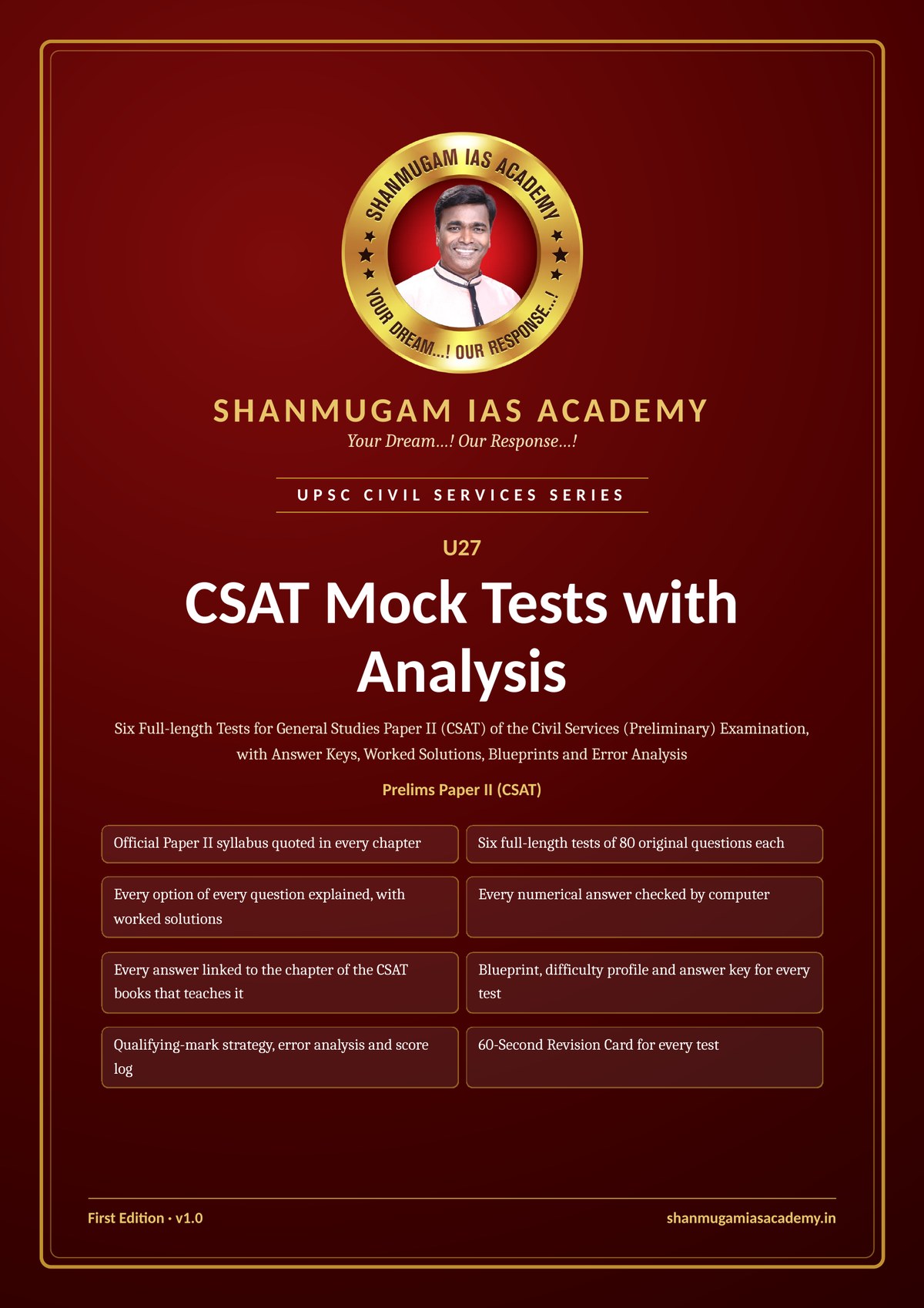 U27 · CSAT Mock Tests with Analysis – UPSC Civil Services (Prelims Paper II – CSAT)
₹249
 U11 · Indian Polity & Constitution – UPSC Civil Services (Prelims & Mains)
₹249
 U03 · Modern Indian History – UPSC Civil Services (Prelims & Mains)
₹249
 U15 · Indian Economy – UPSC Civil Services (Prelims & Mains)
₹249
TNPSC குரூப் 1, 2/2A, 4 – நேரடி வகுப்புகள் · கோவை & மதுரை
2006 முதல் சண்முகம் IAS அகாடமி · Classroom & online coaching in Coimbatore and Madurai
