

UPSC Geography Optional Paper II – Chapter 9: Energy Resources and the Energy Crisis (18 MCQs)
UPSC Geography Optional Paper II – Chapter 9: Energy Resources and the Energy Crisis (18 MCQs) – 18 questions, subject: Geography Optional Paper II. Every question has the correct answer with a two-line explanation; tap "Show Answer". Free practice for TNPSC, UPSC, SSC, Bank and RRB exams – Shanmugam IAS Academy, Coimbatore.
Link to this page from your website / blog (HTML code)
Correct Answer: A [Tertiary coal, low in ash but high in sulphur]
Explanation:
The Makum coalfield near Margherita in Assam has young Tertiary coal that is low in ash but high in sulphur. This makes it unlike the older Gondwana coal of peninsular India, which is high in ash.
Correct Answer: C [Odisha]
Explanation:
According to the Geological Survey of India's inventory, Odisha has the largest coal resources of any State, ahead of Jharkhand and Chhattisgarh. Most of Odisha's coal lies in the Talcher and Ib valley coalfields.
Correct Answer: A [pithead thermal power generation]
Explanation:
The lignite of Neyveli in Tamil Nadu is mainly burnt in pithead thermal power stations at the mine. Lignite has low heat value and high moisture, so it is not worth transporting over long distances.
Correct Answer: B [Rajasthan]
Explanation:
Rohil is a uranium deposit in Sikar district of Rajasthan. India's main producing uranium mines, by contrast, are at Jaduguda in Jharkhand and Tummalapalle in Andhra Pradesh.
Correct Answer: C [Mathura]
Explanation:
Mathura is a market-based inland refinery, sited near its market in north India and receiving crude by pipeline from the coast. Digboi is based on local crude, while Jamnagar and Visakhapatnam are coastal refineries.
Correct Answer: D [Visakhapatnam, Mangaluru and Padur]
Explanation:
India's strategic petroleum reserves are stored in underground rock caverns at Visakhapatnam, Mangaluru and Padur. They are managed by Indian Strategic Petroleum Reserves Limited to guard against supply disruptions.
Correct Answer: D [cut freight by supplying each plant from a nearer mine]
Explanation:
Rationalisation of coal linkages swaps the coal sources of thermal power plants so that each plant draws coal from a nearer mine. This cuts rail freight costs and lowers the cost of power.
Correct Answer: A [Gujarat]
Explanation:
The LNG import terminals at Dahej and Hazira are located on the Gujarat coast and feed imported gas into the national gas grid. Gujarat has more LNG terminals than any other State.
Correct Answer: C [Krishna–Godavari basin]
Explanation:
India's offshore gas hydrates have been found mainly in the Krishna-Godavari basin by deep-water drilling under the National Gas Hydrate Programme. Gas hydrates are ice-like solids of methane and water that could become a future energy source.
Correct Answer: D [Himachal Pradesh]
Explanation:
Manikaran, with its hot springs in the Parvati valley of Kullu district, is in Himachal Pradesh. The Puga valley of Ladakh is another important geothermal site of India.
Correct Answer: D [Lakshadweep and the Andaman and Nicobar Islands]
Explanation:
Ocean thermal energy conversion needs a large difference between warm surface water and cold deep water. This condition is best met around Lakshadweep and the Andaman and Nicobar Islands, where deep water lies close to the coast.
Correct Answer: A [40 per cent]
Explanation:
India's first NDC of 2015 aimed at about 40 per cent of installed electricity capacity from non-fossil sources by 2030, a target reached in 2021. The updated NDC of 2022 raised this goal to 50 per cent by 2030.
Correct Answer: B [25 MW]
Explanation:
In India, hydroelectric plants of up to 25 MW capacity are classed as small hydro and are handled by the Ministry of New and Renewable Energy. Larger hydro projects come under the Ministry of Power.
Correct Answer: B [100 million tonnes of coal by 2030]
Explanation:
Under the National Coal Gasification Mission, the Ministry of Coal aims to gasify 100 million tonnes of coal by 2030. Gasification turns coal into syngas for making fertilisers, chemicals and fuels with lower imports.
Correct Answer: A [Vindhyachal (Singrauli)]
Explanation:
Vindhyachal is a pithead thermal power station built on the Singrauli coalfield, and it is one of the largest in India. Mundra and Thoothukudi are coastal plants, and Dadri is a load-centre plant near Delhi.
Correct Answer: D [1774]
Explanation:
Commercial coal mining in India began at Raniganj in West Bengal in 1774, started by servants of the East India Company. Raniganj lies in the Damodar valley Gondwana coalfields.
Correct Answer: B [Australia]
Explanation:
India's steel industry imports coking coal chiefly from Australia for use in blast furnaces. Indian coking coal is limited and high in ash, so imports are needed for quality steel making.
Correct Answer: B [1 only]
Explanation:
India imports most of its crude but exports more refined products than it imports.
➤ India maps, regional data, diagrams, PYQs and Mains answer-writing practice for Geography Optional Paper II – U33 · Geography Optional Paper II (UPSC book, ₹349): www.shanmugamiasacademy.in/study-materials/upsc-geography-optional-paper-2
Today Current Affairs in Tamil | 23 நவம்பர் 2026 | TNPSC Group 4 முக்கிய வினாக்கள்
📚 UPSC Civil Services Books (Prelims & Mains)
PDF நூல்கள் · ₹149 முதல் · ஒவ்வொன்றுக்கும் 50 பக்க இலவச மாதிரி · UPI-இல் பணம் செலுத்தியதும் உடனே பதிவிறக்கம்
 U27 · CSAT Mock Tests with Analysis – UPSC Civil Services (Prelims Paper II – CSAT)
₹249
 U11 · Indian Polity & Constitution – UPSC Civil Services (Prelims & Mains)
₹249
 U03 · Modern Indian History – UPSC Civil Services (Prelims & Mains)
₹249
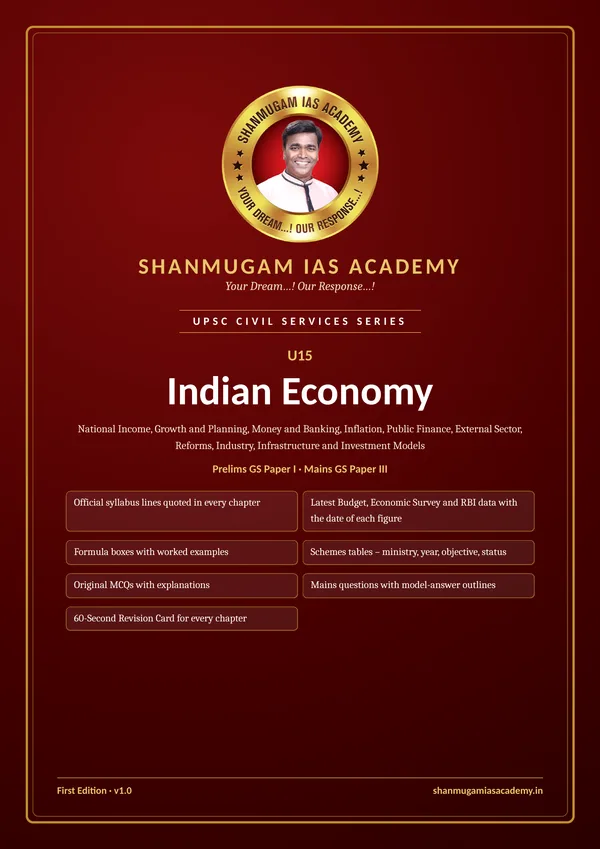 U15 · Indian Economy – UPSC Civil Services (Prelims & Mains)
₹249
TNPSC குரூப் 1, 2/2A, 4 – நேரடி வகுப்புகள் · கோவை & மதுரை
2006 முதல் சண்முகம் IAS அகாடமி · Classroom & online coaching in Coimbatore and Madurai
