

UPSC CSAT Reasoning – Chapter 13: Clocks and Calendars (38 MCQs)
UPSC CSAT Reasoning – Chapter 13: Clocks and Calendars (38 MCQs) – 38 questions, subject: CSAT Reasoning. Every question has the correct answer with a two-line explanation; tap "Show Answer". Free practice for TNPSC, UPSC, SSC, Bank and RRB exams – Shanmugam IAS Academy, Coimbatore.
Link to this page from your website / blog (HTML code)
Correct Answer: A [5.5° per minute]
Explanation:
The minute hand moves 6° a minute (360° in 60 minutes) and the hour hand 0.5° a minute (30° in 60 minutes). So the minute hand gains 6 − 0.5 = 5.5° every minute.
Correct Answer: B [100°]
Explanation:
Angle = |30H − 5.5M| = |30 × 7 − 5.5 × 20| = |210 − 110| = 100°. The other angle, 260°, is the reflex angle, so the smaller angle is 100°.
Correct Answer: C [11 times]
Explanation:
The minute hand gains 360° on the hour hand every 720/11 minutes (about 65 5/11 minutes), so in 720 minutes the hands meet 720 ÷ (720/11) = 11 times. They do not meet between 11 and 1 except at 12 itself, which is why it is not 12 times.
Correct Answer: D [1 odd day]
Explanation:
365 days = 52 weeks + 1 day, so an ordinary year leaves exactly 1 odd day. A leap year (366 days) leaves 2 odd days.
Correct Answer: A [2000]
Explanation:
2000 is a leap year because a century year must be divisible by 400. 1900 and 2100 are divisible by 4 and 100 but not by 400, and 2023 is not divisible by 4.
Correct Answer: B [2037]
Explanation:
Odd days from 2026 to 2036 add to 1 + 1 + 2 + 1 + 1 + 1 + 2 + 1 + 1 + 1 + 2 = 14, a multiple of 7, so 2037 starts on the same day as 2026. Both are ordinary years, so 2037 has the same calendar; 2032 and 2036 are leap years and cannot match.
Correct Answer: A [8:00 a.m.]
Explanation:
The clock shows 72 hours 45 minutes = 4,365 minutes passed, but it runs 1,455 minutes for every 1,440 real minutes. Real time = 4,365 × 1,440 ÷ 1,455 = 4,320 minutes = 72 hours, so the correct time is 8:00 a.m. on Thursday.
Correct Answer: D [0]
Explanation:
400 years contain 97 leap years and 303 ordinary years, giving 303 × 1 + 97 × 2 = 497 odd days. 497 = 71 × 7, so 400 years have 0 odd days (that is why the calendar repeats every 400 years).
Correct Answer: B [2:10 10/11]
Explanation:
At 2:00 the minute hand is 60° behind the hour hand and gains 5.5° a minute, so it catches up after 60 ÷ 5.5 = 10 10/11 minutes. The hands coincide at 2:10 10/11, slightly after 2:10.
Correct Answer: B [1 and 3 only]
Explanation:
A 31-day month is 4 weeks + 3 days, so it has 3 odd days, and within the same century a leap year's calendar repeats after 28 years, so statements 1 and 3 are correct. Statement 2 is wrong: the hour hand moves only 0.5° a minute (30° an hour); 6° a minute is the minute hand's speed.
Correct Answer: A [Both A and R are true, and R is the correct explanation of A]
Explanation:
One watch gains 3 minutes and the other loses 3, so the gap grows by 6 minutes a day, and a 12-hour dial repeats after 720 minutes. They show the same time again after 720 ÷ 6 = 120 days, so both A and R are true and R explains A.
Correct Answer: C [4:54 6/11]
Explanation:
At 4:00 the minute hand is 120° behind the hour hand, and it gains 5.5° a minute, so for the hands to be opposite 5.5M − 120 = 180, giving M = 300 ÷ 5.5 = 54 6/11. They point in opposite directions at 4:54 6/11.
Correct Answer: D [Tuesday]
Explanation:
March, April and May have 31 + 30 + 31 = 92 days = 13 weeks + 1 odd day. So 1 June falls one day after Monday, on a Tuesday.
Correct Answer: B [Monday]
Explanation:
2025, 2026 and 2027 give 1 odd day each and the leap year 2028 gives 2, so the total is 5 odd days. Wednesday + 5 = Monday.
Correct Answer: B [3:40]
Explanation:
The actual time and its mirror image always add up to 11:60 (12:00), so the actual time is 12:00 − 8:20 = 3:40. Times from 11:00 to 1:00 use 23:60 instead, but 8:20 is not in that range.
Correct Answer: C [Sunday]
Explanation:
From 15 August 2026 to 15 August 2027 there are 365 days with no 29 February in between, so there is 1 odd day. Saturday + 1 = Sunday; a gap containing 29 February 2028 would give 2 odd days.
Correct Answer: D [2 odd days]
Explanation:
30 days = 4 weeks (28 days) + 2 days, so a 30-day month has 2 odd days. A 31-day month has 3 odd days and a 28-day February has none.
Correct Answer: A [Friday]
Explanation:
They meet again after LCM(4, 6, 10) = 60 days, and 60 days = 8 weeks + 4 odd days. Monday + 4 = Friday.
Correct Answer: B [44]
Explanation:
In 12 hours the minute hand gains 360° on the hour hand 11 times, and each such lap brings the hands to a right angle twice, giving 22 right angles. In 24 hours this happens 2 × 22 = 44 times.
Correct Answer: A [75°]
Explanation:
Angle = |30H − 5.5M| = |30 × 3 − 5.5 × 30| = |90 − 165| = 75°. The hour hand has moved 15° past 3, so it is not a simple 90°.
Correct Answer: C [17.5°]
Explanation:
Angle = |30H − 5.5M| = |30 × 4 − 5.5 × 25| = |120 − 137.5| = 17.5°. At 4:25 the minute hand is at 150° and the hour hand at 120 + 12.5 = 132.5°.
Correct Answer: D [Between 7:05 hours and 7:10 hours]
Explanation:
At 7:00 the angle is 210°, and it reduces by 5.5° a minute, so 210 − 5.5M = 180 gives M = 30 ÷ 5.5 = 5 5/11 minutes. The hands are opposite at about 7:05:27, i.e. between 7:05 and 7:10.
Correct Answer: C [6:36 PM]
Explanation:
'Ahead by 3 minutes' means 3 minute-spaces = 18°, so 5.5M − 30 × 6 = 18 gives 5.5M = 198 and M = 36. At 6:36 the minute hand is at 216° and the hour hand at 198°.
Correct Answer: C [65]
Explanation:
The hands coincide every 720 / 11 = 65.45 minutes, which is 65 minutes to the nearest integer. This is because the minute hand gains 330 degrees on the hour hand in 60 minutes.
Correct Answer: A [3 times]
Explanation:
The hands coincide every 12/11 hours (65 5/11 minutes): in this interval at about 10:54:33, 12:00 and 1:05:27. The next coincidence is at about 2:10:55, after 2:00 p.m., so it happens 3 times.
Correct Answer: C [Both 1 and 2]
Explanation:
The hands coincide at 3:16 4/11 (about 3:16:22), since 5.5M = 90 gives M = 16 4/11, so statement 1 is correct. Near 4:58 the minute hand sits just short of the 59-minute mark, and the second hand reaches it at about 4:58:59, so statement 2 is also correct.
Correct Answer: A [5:36 p.m.]
Explanation:
The clock gains 10 minutes in 24 hours, so it runs 1450 minutes for every 1440 real minutes; from Monday 8 a.m. to Wednesday 6 p.m. it shows 58 hours = 3480 minutes. Real time = 3480 x 1440 / 1450 = 3456 minutes = 57 h 36 min, so the correct time is 5:36 p.m.
Correct Answer: D [None of the above statements are correct.]
Explanation:
The gap between the watches grows by 2 + 2 = 4 minutes a day, and on a 24-hour clock they show the same time again only when the gap reaches 24 × 60 = 1,440 minutes. That takes 1,440 ÷ 4 = 360 days, so none of 30, 90 or 120 days is correct.
Correct Answer: C [Wednesday]
Explanation:
If the 3rd is a Monday, the 21st is 18 days later, i.e. 4 odd days, so it is a Friday. The fifth day from the 21st is the 26th, which is a Wednesday.
Correct Answer: D [Friday]
Explanation:
Music (Monday), Sports (Tuesday), Mathematics (Wednesday) and History (Thursday, the day after Mathematics) fill Monday to Thursday. Literature is not on Friday, so it must be on Saturday, leaving Friday free besides Sunday.
Correct Answer: B [22]
Explanation:
The fewest working days come in a 28-day February, which has exactly 4 Sundays and 4 Saturdays, of which the 2nd and 4th are holidays. 28 − 4 − 2 = 22 working days.
Correct Answer: C [12th July is Sunday if the year is a leap year.]
Explanation:
From 12 January to 12 July in a leap year there are 19 + 29 + 31 + 30 + 31 + 30 + 12 = 182 days, exactly 26 weeks. So 12 July falls on the same day as 12 January, a Sunday; in an ordinary year it would be 181 days and fall on a Saturday.
Correct Answer: B [Thursday]
Explanation:
April (30 days) has five Mondays only if 1 April is a Monday or Sunday, and November has five Thursdays only if 1 November is a Thursday or Wednesday; since 1 November falls 214 days (4 odd days) after 1 April, only 1 April Sunday and 1 November Thursday fit. 20 December is 49 days (exactly 7 weeks) after 1 November, so it is a Thursday.
Correct Answer: A [Sunday]
Explanation:
Counting odd days from a known date shows that 10 October 2027 falls on a Sunday. For example, 10 October 2026 is a Saturday and 2027 is not a leap year, so the day moves forward by one.
Correct Answer: D [7]
Explanation:
1 June 2099 falls on a Monday, so the first Sunday of June 2099 is the 7th. The other Sundays that month are the 14th, 21st and 28th.
Correct Answer: C [2031]
Explanation:
2025 is a non-leap year beginning on Wednesday; the start day shifts by 1, 1, 1, 2 (2028 is leap), 1 and 1 days, totalling 7 days by 2031. So 2031 also begins on Wednesday and is non-leap, giving the same calendar.
Correct Answer: D [2015]
Explanation:
A year repeats the calendar of 2009 (an ordinary year) when the odd days add to a multiple of 7: 2009 to 2014 give 1 + 1 + 1 + 2 + 1 + 1 = 7 odd days (2012 is a leap year). So 2015 starts on the same day as 2009 and, being ordinary too, has the same calendar.
Correct Answer: B [Wednesday]
Explanation:
LCM 360 days; 360 = 51 weeks + 3 days; Sunday + 3 = Wednesday.
➤ Full notes, maps, tables, a reason for every option and Mains PYQs – U24 · CSAT Reasoning (UPSC book, ₹249): www.shanmugamiasacademy.in/study-materials/upsc-csat-reasoning
Today Current Affairs in Tamil | 23 நவம்பர் 2026 | TNPSC Group 4 முக்கிய வினாக்கள்
📚 TNPSC குரூப் 4 / 2 / 2A – பொதுத்தமிழ், பொது அறிவு நூல்கள்
PDF நூல்கள் · ₹149 முதல் · ஒவ்வொன்றுக்கும் 50 பக்க இலவச மாதிரி · UPI-இல் பணம் செலுத்தியதும் உடனே பதிவிறக்கம்
 பொதுத் தமிழ் — முழுமையான கையேடு (TNPSC குரூப் 2 · 2A · 4)
₹199
 TNPSC முழுமையான பாடநூல்கள் – முழுத் தொகுப்பு (9 நூல்கள்)
₹1599
 பொதுத் தமிழ் — முந்தைய ஆண்டு வினா – விடை – விளக்கம் (புதிய பாடத்திட்டம்)
₹199
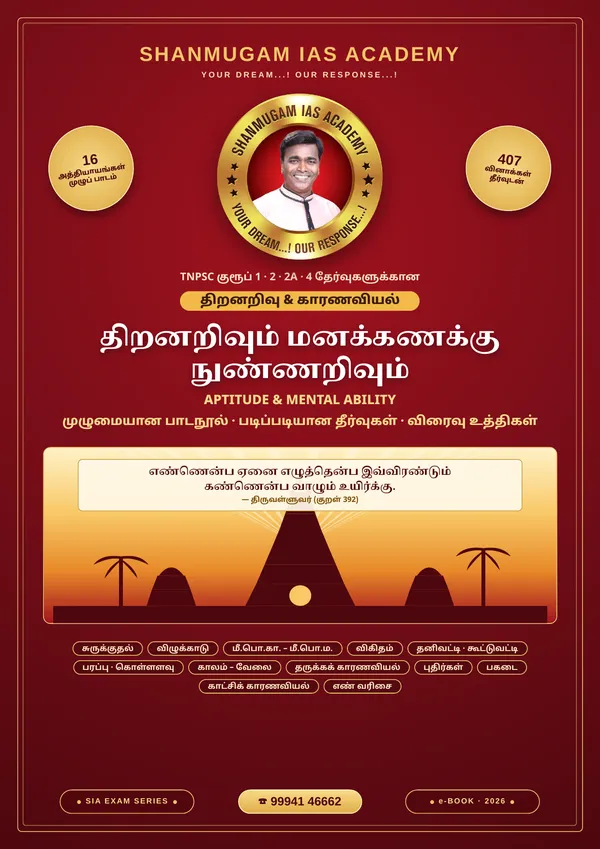 TNPSC திறனறிவும் மனக்கணக்கு நுண்ணறிவும் (Aptitude & Mental Ability) – முழுமையான பாடநூல்
₹199
TNPSC குரூப் 1, 2/2A, 4 – நேரடி வகுப்புகள் · கோவை & மதுரை
2006 முதல் சண்முகம் IAS அகாடமி · Classroom & online coaching in Coimbatore and Madurai
