

UPSC Interview – Chapter 12: Clear and Logical Exposition – Communication Skills (20 MCQs)
UPSC Interview – Chapter 12: Clear and Logical Exposition – Communication Skills (20 MCQs) – 18 questions, subject: Interview (Personality Test). Every question has the correct answer with a two-line explanation; tap "Show Answer". Free practice for TNPSC, UPSC, SSC, Bank and RRB exams – Shanmugam IAS Academy, Coimbatore.
Link to this page from your website / blog (HTML code)
Correct Answer: D [policy and district questions]
Explanation:
The Problem-Cause-Solution structure suits policy and district questions, as it states the issue, explains why it arises and ends with practical steps. Stories from work and life are better told through a situation-action-result frame.
Correct Answer: B [first]
Explanation:
In a conversation the most important point should come first, because the listener may interrupt or move on at any time. Holding the main point back to the end risks never reaching it.
Correct Answer: D [change or reform]
Explanation:
The Past-Present-Future frame suits questions on change or reform, since it shows where things stood, where they stand now and where they should go. Simple facts or hobbies do not need such a time frame.
Correct Answer: D [10–20 seconds]
Explanation:
A simple factual answer needs only about 10 to 20 seconds, giving the fact and perhaps one line of context. Stretching it to a minute or more adds padding the Board did not ask for.
Correct Answer: D [English, Hindi or any one of the Indian languages]
Explanation:
UPSC's Annual Report 2021-22 states that for CSE 2020 candidates could take the Personality Test in English, Hindi or any one of the Indian languages. So a candidate is not forced to speak in English and can choose the language in which he or she is most comfortable.
Correct Answer: B [a club for practising public speaking and leadership, founded in California]
Explanation:
Toastmasters, founded by Ralph C. Smedley in 1924 at Santa Ana, California, is a club for practising public speaking and leadership. Members give prepared and impromptu speeches and receive structured feedback.
Correct Answer: C ["Inflation means that the same money buys less than before."]
Explanation:
The best spoken opening is a plain one such as 'Inflation means that the same money buys less than before', which answers the question at once in simple words. Technical details like CPI and WPI can follow if the Board wants more.
Correct Answer: B [1 and 3 only]
Explanation:
Statements 1 and 3 are correct: a short pause before answering looks thoughtful, and one good example is usually enough to support a point. Statement 2 is wrong because repeating 'Respected sir, with due respect' before every answer wastes time and sounds artificial.
Correct Answer: A [Both A and R are true, and R is the correct explanation of A]
Explanation:
Both statements are true and R explains A: the last words of a question often carry its real request, such as 'in one sentence' or 'from the farmer's point of view'. Starting to answer before the question ends risks missing that request.
Correct Answer: C [you should finish your answer]
Explanation:
A Board member looking at the clock usually signals that the candidate should bring the current answer to a close. A quick one-line wrap-up is the right response, not starting again or speaking louder.
Correct Answer: A [loud enough for the farthest member, with a varied tone]
Explanation:
A candidate's voice should be loud enough for the farthest member to hear, with a varied tone so that the answer does not sound like a recitation. A soft voice forces members to strain, while speaking fast to cover more points loses clarity.
Correct Answer: B [Repeating the question before answering]
Explanation:
Repeating the question before answering is a weak habit, because it wastes time and sounds like stalling. Starting with the answer, using simple words and pausing instead of using fillers are all good habits.
Correct Answer: A [Source, Message, Channel, Receiver]
Explanation:
David Berlo's 1960 SMCR model described communication as Source, Message, Channel and Receiver. Point, Reason, Example, Point (PREP) and STAR (Situation, Task, Action, Result) are answer frameworks, not communication models.
Correct Answer: A [Oxford]
Explanation:
S. Radhakrishnan held the Spalding Professorship of Eastern Religions and Ethics at Oxford from 1936 to 1952. He later became India's first Vice-President (1952) and second President (1962), and his birthday, 5 September, is celebrated as Teachers' Day.
Correct Answer: C [1-4-2-3]
Explanation:
Toastmasters began in 1924, Berlo's SMCR (Source-Message-Channel-Receiver) model came in 1960, the first TED conference was held in 1984 and the PechaKucha format started in 2003, giving 1-4-2-3. PechaKucha uses 20 slides shown for 20 seconds each.
Correct Answer: C [Technology, Entertainment, Design]
Explanation:
TED takes its name from Technology, Entertainment and Design, the three fields covered when the conference was first held in 1984. It is now known for short talks, usually under 18 minutes, on ideas from many fields.
Correct Answer: B [90–120 seconds]
Explanation:
About 90 to 120 seconds suits an answer to 'Tell us about yourself', enough to cover background, education, work and interests. Ten to twenty seconds is too thin, while five minutes or more tests the Board's patience.
Correct Answer: C [twenty slides shown for twenty seconds each]
Explanation:
Twenty slides of twenty seconds each – a discipline of brevity.
➤ DAF analysis, question banks, current affairs, communication and mock-interview practice – U30 · Interview Guide (UPSC book, ₹249): www.shanmugamiasacademy.in/study-materials/upsc-interview-personality-test
Today Current Affairs in Tamil | 23 நவம்பர் 2026 | TNPSC Group 4 முக்கிய வினாக்கள்
📚 TNPSC குரூப் 4 / 2 / 2A – பொதுத்தமிழ், பொது அறிவு நூல்கள்
PDF நூல்கள் · ₹149 முதல் · ஒவ்வொன்றுக்கும் 50 பக்க இலவச மாதிரி · UPI-இல் பணம் செலுத்தியதும் உடனே பதிவிறக்கம்
 பொதுத் தமிழ் — முழுமையான கையேடு (TNPSC குரூப் 2 · 2A · 4)
₹199
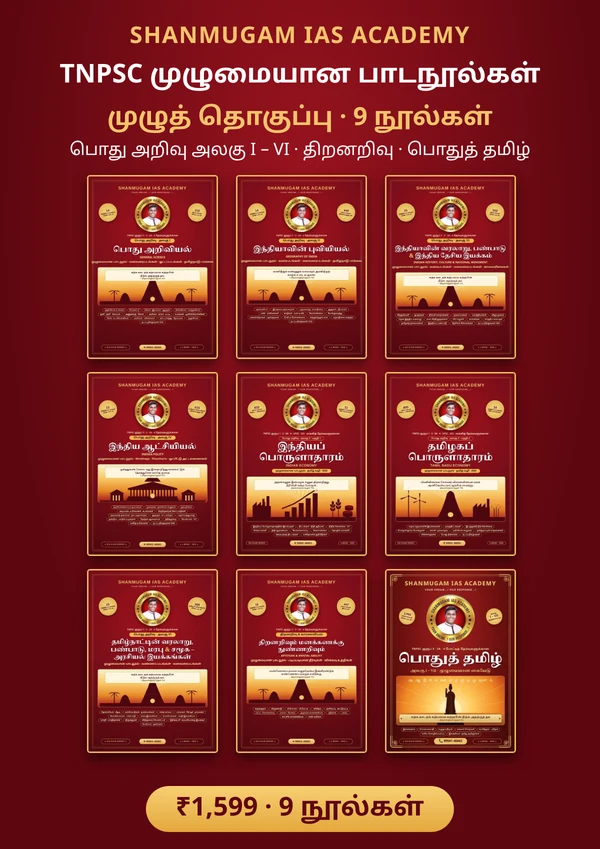 TNPSC முழுமையான பாடநூல்கள் – முழுத் தொகுப்பு (9 நூல்கள்)
₹1599
 பொதுத் தமிழ் — முந்தைய ஆண்டு வினா – விடை – விளக்கம் (புதிய பாடத்திட்டம்)
₹199
 TNPSC திறனறிவும் மனக்கணக்கு நுண்ணறிவும் (Aptitude & Mental Ability) – முழுமையான பாடநூல்
₹199
TNPSC குரூப் 1, 2/2A, 4 – நேரடி வகுப்புகள் · கோவை & மதுரை
2006 முதல் சண்முகம் IAS அகாடமி · Classroom & online coaching in Coimbatore and Madurai
