

National Education Day, 11 November: Maulana Azad's birth anniversary
10 November 2026 · English Important Days
⬇ Download this article as free PDF
Topics: Important Days · UPSC Prelims · TNPSC · SSC · Current Affairs
Current affairs of 10 November 2026 (Shanmugam IAS Academy) – explained for UPSC, TNPSC and other competitive exams
News
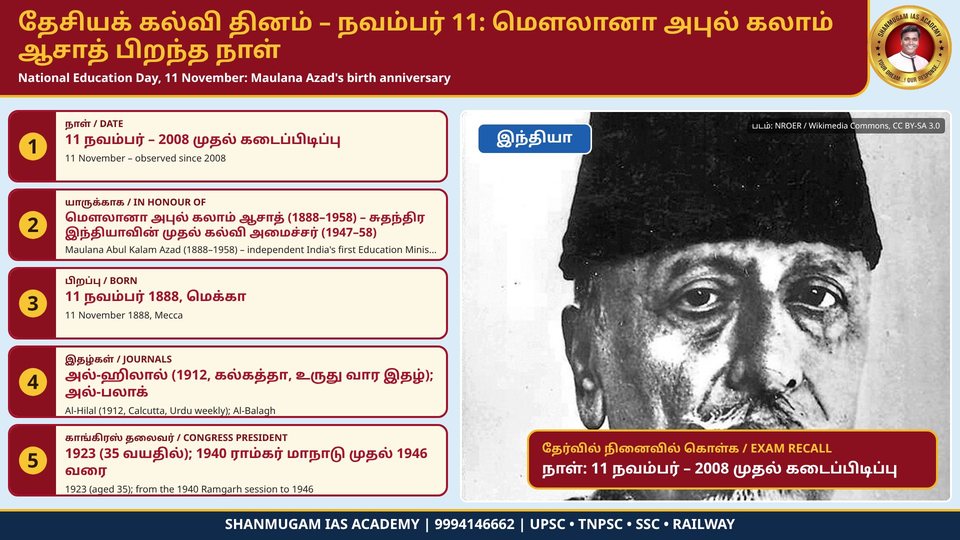
11 November, the birth anniversary of Maulana Abul Kalam Azad, independent India's first Education Minister, is observed every year as 'National Education Day'. In 2026 it marks his 138th birth anniversary. The day has been observed since 2008, as announced by the then Ministry of Human Resource Development (now the Ministry of Education). Azad was born in Mecca on 11 November 1888 and served as Education Minister in Nehru's cabinet from 1947 until his death in 1958. His tenure saw the creation of the University Grants Commission (UGC) and IIT Kharagpur (1951), and the University Education Commission (1948) and Secondary Education Commission (1952). The Indian Council for Cultural Relations (ICCR) was founded in 1950 through his efforts. Schools and colleges mark the day with seminars and essay and speech competitions.
Key facts for the exam
| Point | Details |
|---|---|
| Date | 11 November – observed since 2008 |
| In honour of | Maulana Abul Kalam Azad (1888–1958) – independent India's first Education Minister (1947–58) |
| Born | 11 November 1888, Mecca |
| Journals | Al-Hilal (1912, Calcutta, Urdu weekly); Al-Balagh |
| Congress President | 1923 (aged 35); from the 1940 Ramgarh session to 1946 |
| Bodies of his era | UGC, IIT Kharagpur, Sangeet Natak Akademi, ICCR (1950) |
| Book | 'India Wins Freedom' (published 1959) |
| Award | Bharat Ratna – 1992 (posthumous) |
Background
- History: Azad's Urdu weekly 'Al-Hilal', started in Calcutta in 1912, spread nationalist ideas and was banned in 1914; he then started 'Al-Balagh'. He became Congress President in 1923 at 35. Elected again at the 1940 Ramgarh session, he continued until 1946 because leaders were jailed during the Quit India movement; he led the Congress at the 1945 Simla Conference and in the 1946 Cabinet Mission talks. A firm champion of Hindu–Muslim unity, he opposed Partition.
- Education: Azad stressed free and compulsory education for all up to 14, adult education, women's education and scientific and technical education. The University Education Commission under Dr S. Radhakrishnan (1948–49) and the Secondary Education Commission under A. Lakshmanaswami Mudaliar (1952–53) belong to his tenure. The UGC began in 1953 and became statutory under the 1956 Act; the Sangeet Natak Akademi (1953), Sahitya Akademi and Lalit Kala Akademi (1954) were also founded then.
- Constitution: The 86th Amendment (2002) inserted Article 21A, making free and compulsory education for children aged 6–14 a fundamental right, implemented through the Right to Education Act, 2009. The 42nd Amendment (1976) moved education from the State List to the Concurrent List. The current National Education Policy was released in 2020.
What is this news about?
11 November, the birth anniversary of Maulana Abul Kalam Azad, independent India's first Education Minister, is observed every year as 'National Education Day'. In 2026 it marks his 138th birth anniversary.
What are the key facts to remember for the exam?
Date: 11 November – observed since 2008; In honour of: Maulana Abul Kalam Azad (1888–1958) – independent India's first Education Minister (1947–58); Born: 11 November 1888, Mecca; Journals: Al-Hilal (1912, Calcutta, Urdu weekly); Al-Balagh.
What is the background to this news?
History: Azad's Urdu weekly 'Al-Hilal', started in Calcutta in 1912, spread nationalist ideas and was banned in 1914; he then started 'Al-Balagh'.
Practise more: Weekly current affairs · Daily subject quiz · Knowledge nugget
Sources: Ministry of Education (PIB release); ICCR; Britannica; INC; The Sentinel; India Code. Compiled by Shanmugam IAS Academy.
Prepared by the Shanmugam IAS Academy faculty team, Coimbatore (since 2006) · independently checked against primary sources · Our editorial policy
Add us as a preferred source on Google
Link to this page from your website / blog (HTML code)
BANK Achievers
-

SARANYA
BANKING BANKING
Today Current Affairs in Tamil | 23 நவம்பர் 2026 | TNPSC Group 4 முக்கிய வினாக்கள்
📚 TNPSC குரூப் 4 / 2 / 2A – பொதுத்தமிழ், பொது அறிவு நூல்கள்
PDF நூல்கள் · ₹149 முதல் · ஒவ்வொன்றுக்கும் 50 பக்க இலவச மாதிரி · UPI-இல் பணம் செலுத்தியதும் உடனே பதிவிறக்கம்
 பொதுத் தமிழ் — முழுமையான கையேடு (TNPSC குரூப் 2 · 2A · 4)
₹199
 TNPSC முழுமையான பாடநூல்கள் – முழுத் தொகுப்பு (9 நூல்கள்)
₹1599
 பொதுத் தமிழ் — முந்தைய ஆண்டு வினா – விடை – விளக்கம் (புதிய பாடத்திட்டம்)
₹199
 TNPSC திறனறிவும் மனக்கணக்கு நுண்ணறிவும் (Aptitude & Mental Ability) – முழுமையான பாடநூல்
₹199
TNPSC குரூப் 1, 2/2A, 4 – நேரடி வகுப்புகள் · கோவை & மதுரை
2006 முதல் சண்முகம் IAS அகாடமி · Classroom & online coaching in Coimbatore and Madurai
