

World Science Day for Peace and Development – 10 November 2026
10 November 2026 · English Important Days
⬇ Download this article as free PDF
Topics: Important Days · UPSC Prelims · TNPSC · SSC · Current Affairs
Current affairs of 10 November 2026 (Shanmugam IAS Academy) – explained for UPSC, TNPSC and other competitive exams
News
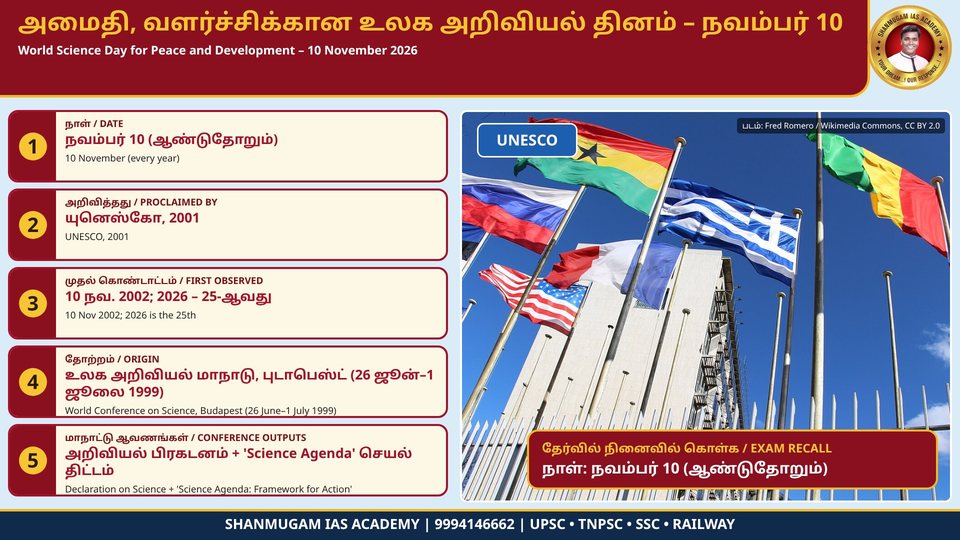
World Science Day for Peace and Development is observed every year on 10 November. UNESCO proclaimed the day in 2001, and it was first celebrated on 10 November 2002 – so 2026 is its 25th observance. It highlights the role of science in society and seeks to involve the public in debates on emerging scientific issues. It grew out of the 1999 World Conference on Science held in Budapest, Hungary, by UNESCO and the International Council for Science (ICSU). The UN General Assembly has declared 2024–2033 the International Decade of Sciences for Sustainable Development (A/RES/77/326).
Key facts for the exam
| Point | Details |
|---|---|
| Date | 10 November (every year) |
| Proclaimed by | UNESCO, 2001 |
| First observed | 10 Nov 2002; 2026 is the 25th |
| Origin | World Conference on Science, Budapest (26 June–1 July 1999) |
| Conference outputs | Declaration on Science + 'Science Agenda: Framework for Action' |
| UN Decade | 2024–2033: Sciences for Sustainable Development |
| UNESCO science prize | Kalinga Prize (1951; Biju Patnaik's grant) |
Background
- UNESCO: the UN Educational, Scientific and Cultural Organization, founded in 1945, is headquartered in Paris. Its Constitution's preamble says that 'since wars begin in the minds of men, it is in the minds of men that the defences of peace must be constructed'. The day rests on the idea that scientific cooperation is a tool for peace.
- Budapest 1999: the World Conference on Science (26 June–1 July 1999), co-sponsored by UNESCO and ICSU, adopted two non-binding texts – the 'Declaration on Science and the Use of Scientific Knowledge' and the 'Science Agenda: Framework for Action' – calling for a 'new social contract' between science and society.
- Kalinga Prize: UNESCO's Kalinga Prize for the Popularization of Science was instituted in 1951 with a grant from Biju Patnaik of Odisha, founder of the Kalinga Foundation Trust; the first award went in 1952 to French physicist Louis de Broglie. It is funded by the Kalinga Foundation Trust, the Odisha Government and the Government of India.
- Constitution: Article 51A(h) makes 'developing the scientific temper, humanism and the spirit of inquiry and reform' a fundamental duty of every citizen (42nd Amendment, 1976). India's National Science Day is 28 February (Raman Effect, 1928).
What is this news about?
World Science Day for Peace and Development is observed every year on 10 November. UNESCO proclaimed the day in 2001, and it was first celebrated on 10 November 2002 – so 2026 is its 25th observance.
What are the key facts to remember for the exam?
Date: 10 November (every year); Proclaimed by: UNESCO, 2001; First observed: 10 Nov 2002; 2026 is the 25th; Origin: World Conference on Science, Budapest (26 June–1 July 1999).
What is the background to this news?
UNESCO: the UN Educational, Scientific and Cultural Organization, founded in 1945, is headquartered in Paris. Its Constitution's preamble says that 'since wars begin in the minds of men, it is in the minds of men that the defences of peace must be constructed'.
Practise more: Weekly current affairs · Daily subject quiz · Knowledge nugget
Sources: UN observances; US Congressional Research Service RS20291 (World Conference on Science, 1999); Odisha Review (Govt of Odisha), Jan 2012; IMSc. Compiled by Shanmugam IAS Academy.
Prepared by the Shanmugam IAS Academy faculty team, Coimbatore (since 2006) · independently checked against primary sources · Our editorial policy
Add us as a preferred source on Google
Link to this page from your website / blog (HTML code)
UPSC Achievers
-

SIVARANJANI
UPSC UPSC
Today Current Affairs in Tamil | 23 நவம்பர் 2026 | TNPSC Group 4 முக்கிய வினாக்கள்
📚 TNPSC குரூப் 4 / 2 / 2A – பொதுத்தமிழ், பொது அறிவு நூல்கள்
PDF நூல்கள் · ₹149 முதல் · ஒவ்வொன்றுக்கும் 50 பக்க இலவச மாதிரி · UPI-இல் பணம் செலுத்தியதும் உடனே பதிவிறக்கம்
 பொதுத் தமிழ் — முழுமையான கையேடு (TNPSC குரூப் 2 · 2A · 4)
₹199
 TNPSC முழுமையான பாடநூல்கள் – முழுத் தொகுப்பு (9 நூல்கள்)
₹1599
 பொதுத் தமிழ் — முந்தைய ஆண்டு வினா – விடை – விளக்கம் (புதிய பாடத்திட்டம்)
₹199
 TNPSC திறனறிவும் மனக்கணக்கு நுண்ணறிவும் (Aptitude & Mental Ability) – முழுமையான பாடநூல்
₹199
TNPSC குரூப் 1, 2/2A, 4 – நேரடி வகுப்புகள் · கோவை & மதுரை
2006 முதல் சண்முகம் IAS அகாடமி · Classroom & online coaching in Coimbatore and Madurai
