

Ancient dairy, plant-food traces in Keeladi, Gottiprolu pottery
13 November 2026 · English History, Art & Culture
⬇ Download this article as free PDF
Topics: History & Archaeology · UPSC Prelims · TNPSC · SSC · Current Affairs
Current affairs of 13 November 2026 (Shanmugam IAS Academy) – explained for UPSC, TNPSC and other competitive exams
News
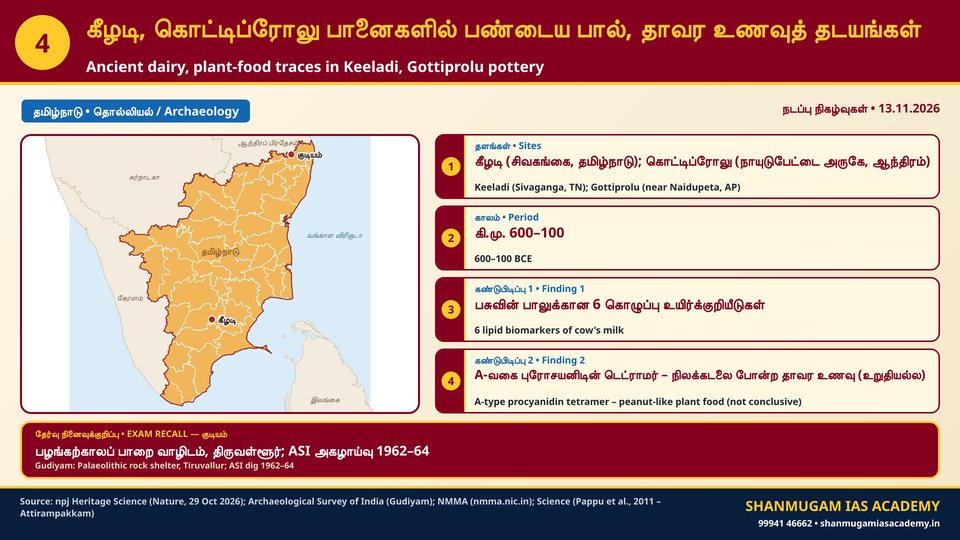
A paper analysing food residues absorbed into pottery from the archaeological sites of Keeladi in Tamil Nadu and Gottiprolu in Andhra Pradesh was published in 'npj Heritage Science' (Nature group) on 29 October 2026. Researchers from the Vellore Institute of Technology (VIT), the Archaeological Survey of India (ASI), PSGR Krishnammal College for Women and the Tamil Nadu Department of Archaeology took part. Four unglazed potsherds of 600–100 BCE (two from each site) were examined with UPLC-Q-ToF-MS/MS (liquid chromatography–mass spectrometry) and X-ray micro-CT scanning. Six lipid biomarkers consistent with cow's milk were found, taken as evidence of dairy processing. A plant molecule never before recovered from an archaeological context (an A-type procyanidin tetramer) was also found, which the researchers think points to peanuts or similar plant foods. They themselves note that with so few samples this is not conclusive. Tamil Nadu's other key windows into deep prehistory are the Palaeolithic sites of Gudiyam and Attirampakkam in Tiruvallur district.
Key facts for the exam
| Point | Details |
|---|---|
| Journal, date | npj Heritage Science, 29 Oct 2026 |
| Sites | Keeladi (Sivaganga, TN); Gottiprolu (near Naidupeta, AP) |
| Period | 600–100 BCE |
| Samples | 4 unglazed potsherds |
| Methods | UPLC-Q-ToF-MS/MS; X-ray micro-CT |
| Finding 1 | 6 lipid biomarkers of cow's milk |
| Finding 2 | A-type procyanidin tetramer – peanut-like plant food (not conclusive) |
| Team | VIT, ASI, PSGR Krishnammal College, TN Archaeology Dept |
| Gudiyam | Palaeolithic rock shelter, Tiruvallur; ASI dig 1962–64 |
Background
- Scientific method: fats (lipids) from cooked food survive for thousands of years in the pores of unglazed pottery. Extracting and identifying them by chromatography–mass spectrometry reveals ancient diets. The age of once-living remains is found by carbon-14 (radiocarbon) dating, useful only up to about 50,000 years (Willard Libby, 1949).
- Agricultural history: the groundnut (peanut) is native to South America and is usually held to have reached India through the Portuguese in the 16th century. This study's suggestion that it may have been present earlier is debatable. Bones of humped Indian cattle (Bos indicus) found at both Keeladi and Gottiprolu fit the milk finding. The Mullai tinai of Sangam literature depicts herders' life of milk, curd and ghee.
- Prehistory – Gudiyam: the Gudiyam cave in the Allikuli hills of Tiruvallur district is one of South India's large natural rock shelters. K.D. Banerjee of the Archaeological Survey of India excavated it in 1962–63 and 1963–64 and found continuous layers of stone-tool cultures from the Palaeolithic onwards. It is listed by the National Mission on Monuments and Antiquities (NMMA).
- Attirampakkam: at this site in the Kortallaiyar (Kosasthalaiyar) valley, research by the Sharma Centre for Heritage Education (Chennai) dated Acheulian hand-axes to about 1.5 million years ago ('Science', 2011). Middle Palaeolithic tools about 385,000 years old were reported in 'Nature' in 2018. Gudiyam, Attirampakkam and Poondi lie in the same area west of Chennai.
What is this news about?
A paper analysing food residues absorbed into pottery from the archaeological sites of Keeladi in Tamil Nadu and Gottiprolu in Andhra Pradesh was published in 'npj Heritage Science' (Nature group) on 29 October 2026.
What are the key facts to remember for the exam?
Journal, date: npj Heritage Science, 29 Oct 2026; Sites: Keeladi (Sivaganga, TN); Gottiprolu (near Naidupeta, AP); Period: 600–100 BCE; Samples: 4 unglazed potsherds.
What is the background to this news?
Scientific method: fats (lipids) from cooked food survive for thousands of years in the pores of unglazed pottery. Extracting and identifying them by chromatography–mass spectrometry reveals ancient diets.
Practise more: Weekly current affairs · Daily subject quiz · Knowledge nugget
Sources: npj Heritage Science (Nature, 29 Oct 2026); Archaeological Survey of India (Gudiyam); NMMA (nmma.nic.in); Science (Pappu et al., 2011 – Attirampakkam); Nature (2018 – Middle Palaeolithic); Govt of Tamil Nadu 'Trek Tamil Nadu' (Gudiyam trail). Compiled by Shanmugam IAS Academy.
Prepared by the Shanmugam IAS Academy faculty team, Coimbatore (since 2006) · independently checked against primary sources · Our editorial policy
Add us as a preferred source on Google
Link to this page from your website / blog (HTML code)
TNPSC Achievers
-

LAKSHMINARAYANAN
TNPSC TNPSC
நடப்பு நிகழ்வுகள் 24 நவம்பர் 2026 | Today Current Affairs in Tamil | TNPSC Group 4 வினா விடை
📚 TNPSC குரூப் 4 / 2 / 2A – பொதுத்தமிழ், பொது அறிவு நூல்கள்
PDF நூல்கள் · ₹149 முதல் · ஒவ்வொன்றுக்கும் 50 பக்க இலவச மாதிரி · UPI-இல் பணம் செலுத்தியதும் உடனே பதிவிறக்கம்
 பொதுத் தமிழ் — முழுமையான கையேடு (TNPSC குரூப் 2 · 2A · 4)
₹199
 TNPSC முழுமையான பாடநூல்கள் – முழுத் தொகுப்பு (9 நூல்கள்)
₹1599
 TNPSC குரூப் 4 பொதுத் தமிழ் – முழுமையான தேர்வுக் களஞ்சியம் 2026
₹249
 பொதுத் தமிழ் — முந்தைய ஆண்டு வினா – விடை – விளக்கம் (புதிய பாடத்திட்டம்)
₹199
TNPSC குரூப் 1, 2/2A, 4 – நேரடி வகுப்புகள் · கோவை & மதுரை
2006 முதல் சண்முகம் IAS அகாடமி · Classroom & online coaching in Coimbatore and Madurai
