

Chandrayaan-3 ChaSTE: three layers in the top 10 cm of lunar soil
20 November 2026 · English
⬇ Download this article as free PDF
Topics: Space Science · UPSC Prelims · TNPSC · SSC · Current Affairs
Current affairs of 20 November 2026 (Shanmugam IAS Academy) – explained for UPSC, TNPSC and other competitive exams
News
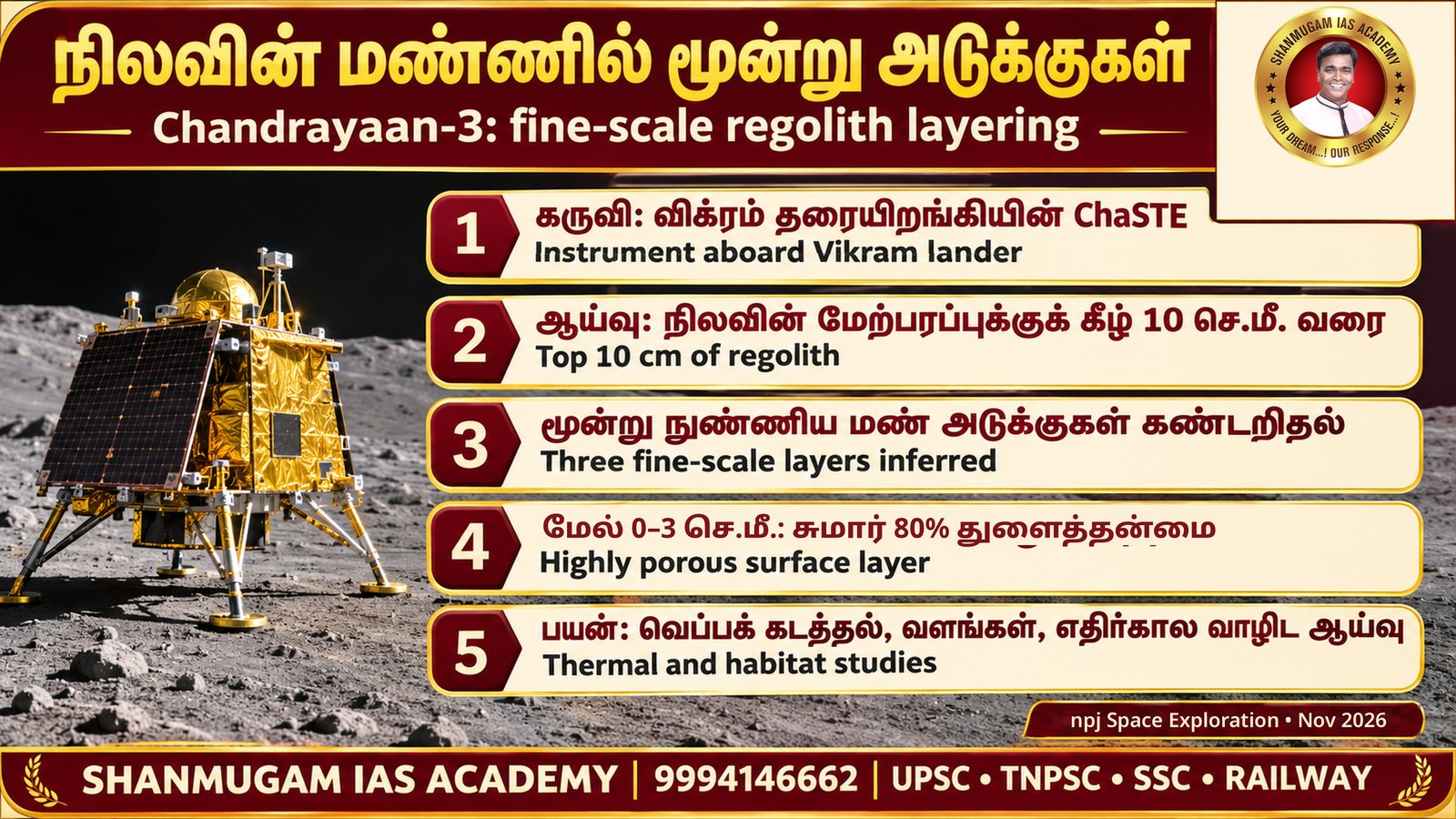
A study published in November 2026 in 'npj Space Exploration', a Nature Portfolio journal, reports that data from 'ChaSTE' (Chandra's Surface Thermophysical Experiment) on the Chandrayaan-3 Vikram lander show three distinct layers with different thermal properties within the top 10 cm of lunar soil (regolith) at the 'Shiv Shakti' landing site (69.37° S). The team is from the Physical Research Laboratory (PRL), Ahmedabad, with K. Durga Prasad as lead author and Anil Bhardwaj as corresponding author. The top 0–3 cm layer is highly porous (about 80%) with very low thermal conductivity; the middle 3–6 cm layer conducts heat best; the bottom 6–10 cm layer is intermediate. The authors link the layering to material thrown out (ejecta) from several nearby impact craters at different times, and say it may vary from place to place, so more in-situ measurements are needed. Earlier, a study by the same group released by ISRO in May 2026 described how, at the spot where Vikram 'hopped' about 50 cm, engine exhaust stripped away the top ~3 cm of loose dust, exposing a compact, 'cake-like' two-layer structure beneath. ChaSTE, built by the Space Physics Laboratory (SPL) of VSSC, Thiruvananthapuram, with PRL, is a rod-shaped probe with 10 temperature sensors that measured temperatures down to about 10 cm. Such data will help future landings and the search for water ice in the Moon's south polar region.
Key facts for the exam
| Point | Details |
|---|---|
| Instrument | ChaSTE – Chandra's Surface Thermophysical Experiment |
| Built by | SPL (VSSC, Thiruvananthapuram) + PRL (Ahmedabad) |
| Sensors | 10 temperature sensors; top ~10 cm measured |
| Site | Shiv Shakti Point, about 69°S (south polar region) |
| New study | Three layers (0–3, 3–6, 6–10 cm) – npj Space Exploration, 16 Nov 2026; PRL team |
| Earlier study | Hop site: two layers – ISRO, May 2026 |
| Landing | 23 Aug 2023 – 'National Space Day' |
| Project Director | P. Veeramuthuvel (Villupuram) |
Background
- Science: the layer of loose dust and broken rock covering the Moon's bedrock is called 'regolith'; with no atmosphere, meteorites and micrometeorites strike the surface directly and create it. The lack of an atmosphere also causes huge day–night temperature swings. The soil's density, porosity and thermal conductivity matter for designing future landers and human bases.
- History: Chandrayaan-3 was launched on an LVM3 rocket from Sriharikota on 14 July 2023 and landed in the Moon's south polar region on 23 August 2023. The site was named 'Shiv Shakti Point' and 23 August was declared 'National Space Day'. Before ChaSTE, ISRO says, temperatures inside lunar soil had been measured directly only by Apollo 15 and 17, near the equator.
- South pole significance: the south polar region matters because 'permanently shadowed craters', never reached by sunlight, may hold water ice – a future source of water, oxygen and rocket fuel. A 2025 study based on ChaSTE data suggested that ice could collect a few tens of centimetres deep on pole-facing slopes (ISRO).
What is this news about?
A study published in November 2026 in 'npj Space Exploration', a Nature Portfolio journal, reports that data from 'ChaSTE' (Chandra's Surface Thermophysical Experiment) on the Chandrayaan-3 Vikram lander show three distinct layers with different thermal properties within the top 10 cm of lunar soil (regolith) at the 'Shiv Shakti' landing site (69.37° S). The team is from the Physical Research Laboratory (PRL), Ahmedabad, with K. Durga Prasad as lead author and Anil Bhardwaj as corresponding author.
What are the key facts to remember for the exam?
Instrument: ChaSTE – Chandra's Surface Thermophysical Experiment; Built by: SPL (VSSC, Thiruvananthapuram) + PRL (Ahmedabad); Sensors: 10 temperature sensors; top ~10 cm measured; Site: Shiv Shakti Point, about 69°S (south polar region).
What is the background to this news?
Science: the layer of loose dust and broken rock covering the Moon's bedrock is called 'regolith'; with no atmosphere, meteorites and micrometeorites strike the surface directly and create it. The lack of an atmosphere also causes huge day–night temperature swings.
Practise more: Weekly current affairs · Daily subject quiz · Knowledge nugget
Sources: npj Space Exploration (Nature Portfolio), 16 Nov 2026; ISRO; SPL–VSSC; News On AIR; DT Next. Compiled by Shanmugam IAS Academy.
Prepared by the Shanmugam IAS Academy faculty team, Coimbatore (since 2006) · independently checked against primary sources · Our editorial policy
Add us as a preferred source on Google
Link to this page from your website / blog (HTML code)
BANK Achievers
-

THIYAGU
BANKING BANKING
நடப்பு நிகழ்வுகள் 24 நவம்பர் 2026 | Today Current Affairs in Tamil | TNPSC Group 4 வினா விடை
📚 TNPSC குரூப் 4 / 2 / 2A – பொதுத்தமிழ், பொது அறிவு நூல்கள்
PDF நூல்கள் · ₹149 முதல் · ஒவ்வொன்றுக்கும் 50 பக்க இலவச மாதிரி · UPI-இல் பணம் செலுத்தியதும் உடனே பதிவிறக்கம்
 பொதுத் தமிழ் — முழுமையான கையேடு (TNPSC குரூப் 2 · 2A · 4)
₹199
 TNPSC முழுமையான பாடநூல்கள் – முழுத் தொகுப்பு (9 நூல்கள்)
₹1599
 TNPSC குரூப் 4 பொதுத் தமிழ் – முழுமையான தேர்வுக் களஞ்சியம் 2026
₹249
 பொதுத் தமிழ் — முந்தைய ஆண்டு வினா – விடை – விளக்கம் (புதிய பாடத்திட்டம்)
₹199
TNPSC குரூப் 1, 2/2A, 4 – நேரடி வகுப்புகள் · கோவை & மதுரை
2006 முதல் சண்முகம் IAS அகாடமி · Classroom & online coaching in Coimbatore and Madurai
