

Draft rules: antimicrobials to need a central nod as 'new drugs'
20 November 2026 · English Health
⬇ Download this article as free PDF
Topics: Health · UPSC Prelims · TNPSC · SSC · Current Affairs
Current affairs of 20 November 2026 (Shanmugam IAS Academy) – explained for UPSC, TNPSC and other competitive exams
News
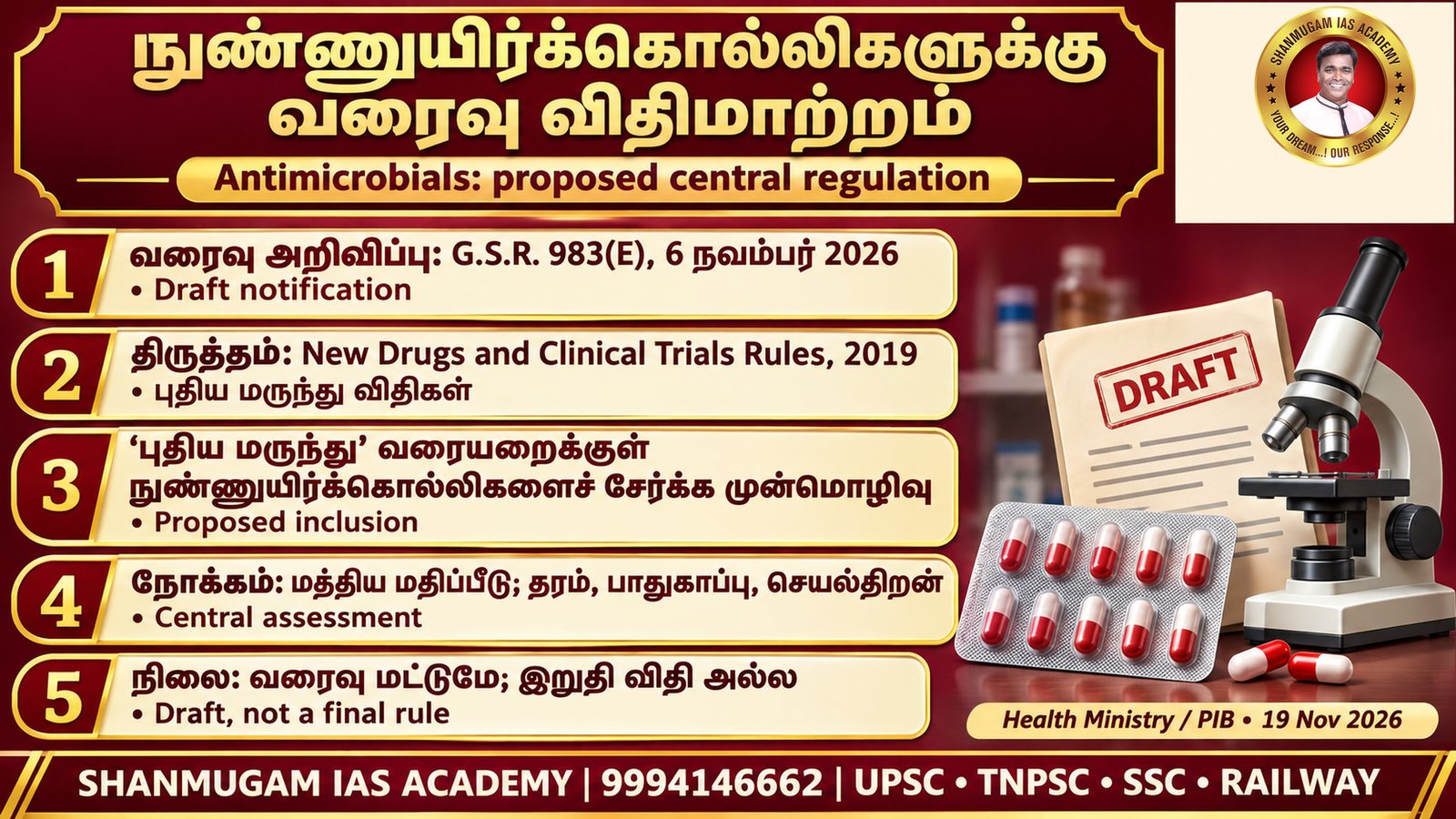
The Union Ministry of Health and Family Welfare announced on 19 November 2026 a draft notification amending the New Drugs and Clinical Trials (NDCT) Rules, 2019. 'Antimicrobials' will be added to the definition of 'new drug' in Rule 2(1)(w)(v). If finalised, a firm wishing to make these medicines must first get permission from the Central Licensing Authority (CLA) and only then seek a manufacturing licence from the State Licensing Authority (SLA). The Ministry flagged concern that manufacturing licences were being granted without adequate regulatory scrutiny such as bioavailability/bioequivalence (BA/BE) and stability studies, and said substandard or ineffective antimicrobials help antimicrobial resistance (AMR) spread. The draft, G.S.R. 983(E), is dated 6 November; objections and suggestions may be sent within 30 days of its Gazette publication, it was reported. The Ministry also cited the G20 New Delhi Leaders' Declaration, which stressed a One Health approach.
Key facts for the exam
| Point | Details |
|---|---|
| Ministry | Union Ministry of Health & Family Welfare |
| Draft | G.S.R. 983(E) dated 6 Nov 2026 (reported); announced 19 Nov |
| Rules amended | NDCT Rules, 2019 – Rule 2(1)(w)(v) |
| Change | Antimicrobials treated as 'new drugs' |
| Licensing order | Central Licensing Authority nod first → then State licence |
| Reason | Licences without BA/BE & stability studies; poor drugs fuel AMR |
| Comments | 30 days from Gazette publication |
| AMR toll | 4.71 million deaths associated, 1.14 million attributable in 2021 (Lancet) |
Background
- Constitution: 'Drugs and poisons' are in the Concurrent List (Entry 19) of the Seventh Schedule, so both the Union and the States can legislate. Under the central Drugs and Cosmetics Act, 1940, new-drug approval, imports and clinical trials are handled by the Drugs Controller General of India (DCGI), who heads the Central Drugs Standard Control Organisation (CDSCO), while State drug-control departments grant manufacturing and sale licences for most drugs. The draft seeks to strengthen central oversight within this dual system.
- NDCT Rules, 2019: these rules govern new drugs, clinical trials, bioavailability/bioequivalence studies and ethics committees. If a drug is a 'new drug', marketing or manufacturing it needs the Central Licensing Authority's permission. A BA/BE study checks whether a generic delivers the same amount of active ingredient into the blood at the same rate as the reference medicine; a stability study confirms that quality lasts until expiry.
- Science: 'antimicrobials' is the umbrella term for medicines against bacteria (antibiotics), viruses, fungi and parasites. Wrong doses, needless use and substandard drugs help microbes resist medicines (AMR). In 2017 WHO grouped antibiotics into three 'AWaRe' categories – Access, Watch and Reserve; 'Reserve' drugs are to be used only when others fail.
- History and economy: Hindustan Antibiotics Ltd, the first public sector undertaking in India's drugs sector, was set up on 10 March 1954 at Pimpri near Pune, marking the country's early step into antibiotic production such as penicillin. Today India is one of the world's big generic-medicine producers, so quality control of antibiotics matters for public health at home and for export credibility. While CDSCO watches drug quality, prices are regulated under the Drugs (Prices Control) Order by the National Pharmaceutical Pricing Authority (NPPA), set up on 29 August 1997.
What is this news about?
The Union Ministry of Health and Family Welfare announced on 19 November 2026 a draft notification amending the New Drugs and Clinical Trials (NDCT) Rules, 2019. 'Antimicrobials' will be added to the definition of 'new drug' in Rule 2(1)(w)(v).
What are the key facts to remember for the exam?
Ministry: Union Ministry of Health & Family Welfare; Draft: G.S.R. 983(E) dated 6 Nov 2026 (reported); announced 19 Nov; Rules amended: NDCT Rules, 2019 – Rule 2(1)(w)(v); Change: Antimicrobials treated as 'new drugs'.
What is the background to this news?
Constitution: 'Drugs and poisons' are in the Concurrent List (Entry 19) of the Seventh Schedule, so both the Union and the States can legislate.
Practise more: Weekly current affairs · Daily subject quiz · Knowledge nugget
Sources: ThePrint; The Hans India (IANS); The News Mill; WHO; Department of Pharmaceuticals; Department of Pharmaceuticals (NPPA); DGHS (CDSCO); TNMSC. Compiled by Shanmugam IAS Academy.
Prepared by the Shanmugam IAS Academy faculty team, Coimbatore (since 2006) · independently checked against primary sources · Our editorial policy
Add us as a preferred source on Google
Link to this page from your website / blog (HTML code)
TNPSC Achievers
-

M. AJIMUNISHA
TNPSC TNPSC
நடப்பு நிகழ்வுகள் 24 நவம்பர் 2026 | Today Current Affairs in Tamil | TNPSC Group 4 வினா விடை
📚 TNPSC குரூப் 4 / 2 / 2A – பொதுத்தமிழ், பொது அறிவு நூல்கள்
PDF நூல்கள் · ₹149 முதல் · ஒவ்வொன்றுக்கும் 50 பக்க இலவச மாதிரி · UPI-இல் பணம் செலுத்தியதும் உடனே பதிவிறக்கம்
 பொதுத் தமிழ் — முழுமையான கையேடு (TNPSC குரூப் 2 · 2A · 4)
₹199
 TNPSC முழுமையான பாடநூல்கள் – முழுத் தொகுப்பு (9 நூல்கள்)
₹1599
 TNPSC குரூப் 4 பொதுத் தமிழ் – முழுமையான தேர்வுக் களஞ்சியம் 2026
₹249
 பொதுத் தமிழ் — முந்தைய ஆண்டு வினா – விடை – விளக்கம் (புதிய பாடத்திட்டம்)
₹199
TNPSC குரூப் 1, 2/2A, 4 – நேரடி வகுப்புகள் · கோவை & மதுரை
2006 முதல் சண்முகம் IAS அகாடமி · Classroom & online coaching in Coimbatore and Madurai
