

Mains Analysis: Kashmir attacks and why J&K Statehood matters
22 November 2026 · English Polity & Governance
⬇ Download this analysis as free PDF
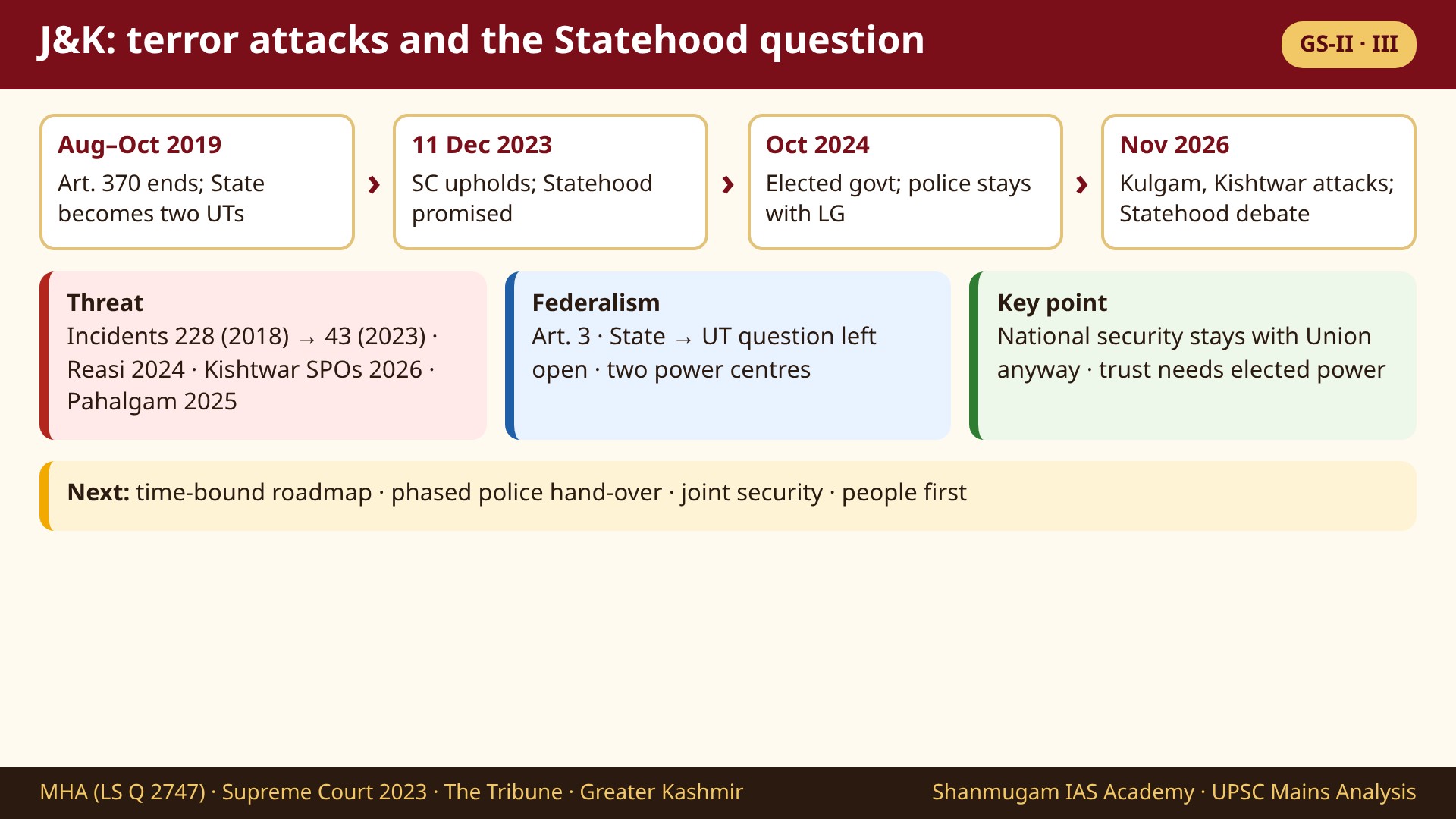
Topics: Polity – Federalism, Article 3, J&K Reorganisation Act 2019 · GS-II · Internal Security (GS-III) · UPSC Mains Analysis
Key takeaways
- November 2026 attacks – a CRPF post in Kulgam (11 Nov, three injured) and two SPOs found shot dead in Kishtwar (12 Nov) – have revived the debate on restoring Statehood to J&K, a Union Territory since 31 October 2019.
- On 11 December 2023 the Supreme Court upheld the abrogation of Article 370 and, relying on the Centre's assurance of Statehood, did not rule on the downgrade to a UT; the Centre now cites security. Violence has fallen (228 incidents in 2018 → 43 in 2023) but attacks in the Jammu region persist (Reasi, June 2024; Kishtwar, November 2026 – suspected militant killing of two SPOs).
- Statehood needs only a law under Articles 3 and 4. National security stays with the Union anyway; a time-bound, phased roadmap with joint security can serve both peace and federalism. PYQ: Prelims 2001 (new State → First Schedule).

Why in news
A run of violence in November 2026 has revived the debate on when Jammu and Kashmir gets back its Statehood:
- 11 November: two armed men on a motorcycle fired at a CRPF post in Kulgam (south Kashmir), injuring three jawans; security agencies suspected a local Lashkar-e-Taiba (LeT) commander (The Week, 11 November 2026).
- 12 November: the bullet-riddled bodies of two Special Police Officers who had gone missing on their way to an Army post were found in a forest in Kishtwar (Jammu division); their rifles were taken. The FIR invokes the BNS, the Arms Act and the UAPA (The Tribune, 21 November 2026).
- 16 and 18 November: two local militants were killed in Kulgam; the J&K DGP called the second the "last remaining active local terrorist" and said local recruitment had fallen to "nearly zero" in two years (Greater Kashmir, 19 November 2026).
At the same time, the elected government of Chief Minister Omar Abdullah keeps pressing for Statehood – the J&K Assembly passed a (non-binding) resolution for its "immediate" restoration on 28 September 2026, with BJP members walking out – while the Centre says Statehood will come at an "appropriate time", citing security.
Background: from State to Union Territory
| Date | Event |
|---|---|
| 5–6 Aug 2019 | Presidential Orders end the special status under Article 370; Parliament passes the J&K Reorganisation Act, 2019 (the State was under President's Rule, so Parliament acted in place of the State legislature) |
| 31 Oct 2019 | J&K becomes a Union Territory with a legislature; Ladakh a UT without one |
| 11 Dec 2023 | Supreme Court (In Re: Article 370, five judges) upholds the abrogation and the Ladakh UT; records the Solicitor General's assurance that Statehood will be restored; leaves open whether a State can be turned into a UT; orders Assembly elections by 30 Sept 2024 |
| Sept–Oct 2024 | First Assembly elections since 2014; Omar Abdullah sworn in as Chief Minister on 16 Oct 2024 |
| 22 Apr 2025 | Pahalgam attack – 26 people, mostly tourists, killed; Operation Sindoor follows on 7 May 2025 |
| 14 Aug 2025 | Hearing Statehood petitions, the Supreme Court says "you cannot ignore what happened in Pahalgam" and that the decision lies with Parliament and the Executive |
| 10 Oct 2025 | Centre tells the Court that "wider concerns" must be addressed before Statehood |
| 28 Sept 2026 | J&K Assembly resolution for immediate restoration of Statehood |
What the data say
| Indicator | 2018 | 2023 (to 30 Nov) |
|---|---|---|
| Terrorist-initiated incidents | 228 | 43 |
| Encounters | 189 | 48 |
| Civilians killed | 55 | 13 |
| Security personnel killed | 91 | 25 |
Source: Ministry of Home Affairs reply, Lok Sabha Unstarred Question 2747, 19 December 2023 (data from CID, J&K). Violence has fallen sharply, and the DGP's figures (UAPA arrests: 240 in 2025, 210 so far in 2026) show sustained pressure on networks. But the pattern has changed: fewer local recruits, more trained infiltrators using the forests of the Jammu region (Reasi bus attack, June 2024), killings such as Kishtwar, November 2026 – suspected militant killing of two SPOs – and occasional mass-casualty strikes such as Pahalgam.
Analysis: is Statehood a security risk or a security asset?
| The Centre's caution | The case for Statehood now |
|---|---|
| Pakistan-backed terror continues; an attack like Pahalgam shows the threat is real | Terror is a national-security matter in any case – border, Army, CAPFs, NIA and intelligence stay with the Union even in a State (Article 355 duty to protect States) |
| Unified control of police and intelligence helps counter-terror operations | Two power centres (elected government vs LG) blur accountability; people cannot hold anyone answerable for local policing |
| "Wider concerns" and ground situation must be assessed | The Supreme Court left the State-to-UT question undecided because Statehood was promised; delay erodes trust in that promise |
| Gains since 2019 – tourism, investment, falling violence – should not be risked | Militancy feeds on alienation; giving elected leaders real power is the best answer to separatist propaganda |
The core point: security and Statehood are not opposites. Terrorism in J&K is driven from across the border; it will not end because Delhi controls the local police, nor will it grow because an elected government does. What a long UT status does damage is democratic ownership – and ownership is what isolates the gun.
The federalism question
- Article 3 lets Parliament form new States, alter boundaries and names; the State legislature's views are only recommendatory. Turning a full State into a UT was unprecedented – the Supreme Court did not decide its validity because Statehood was promised.
- If any State can be downgraded during President's Rule, the "indestructible Union of destructible States" leans further to the Centre. That makes the restoration a test of cooperative federalism for every State, not only J&K.
- Under the 2019 Act, police and public order lie outside the Assembly (section 32), and the Business Rules were amended in July 2024 to require the LG's approval on police, All-India Services and anti-corruption matters.
- Restoring Statehood needs only an ordinary law of Parliament amending the 2019 Act (Articles 3 and 4) – not an Article 368 amendment.
Static syllabus link
- GS-II: federal structure; Articles 1–4; Union Territories (Articles 239–241); Article 356 and President's Rule; separation of powers; role of the judiciary (S.R. Bommai, 1994 – federalism is a basic feature).
- GS-III: internal security – role of external state and non-state actors; cross-border terrorism; security forces and their mandate; linkages of organised crime with terrorism.
- Essay: "Peace is not the absence of violence but the presence of trust."
Tamil Nadu angle
- Tamil Nadu has long argued for stronger States: the Rajamannar Committee (appointed by the Tamil Nadu government in 1969) recommended more autonomy for States. The J&K case – a State converted into a UT – is watched closely by States that value this principle.
- The question the Supreme Court left open (can Parliament turn a State into a UT?) matters to every State, including Tamil Nadu, because Article 3 does not need the State's consent.
Faculty view
Avoid a one-sided answer. Start with the data (2018 vs 2023), then the 2026 pattern (local recruitment near zero, but infiltrator attacks such as Reasi, June 2024, and Kishtwar, November 2026 – suspected militant killing of two SPOs). Next, show that Statehood is a constitutional and federal promise – the 2023 judgment and Article 3. Then separate the two issues: national security tools stay with the Union in any case; local policing and accountability belong to an elected government. End with a time-bound, phased roadmap. Examiners reward balance and exact dates.
Way forward
- Time-bound roadmap: announce a schedule for Statehood, as the Supreme Court's judgment expected, with a phased hand-over of police and public order.
- Security that stays national: keep a joint Centre–State security mechanism (unified headquarters) for counter-terror operations, border and intelligence.
- Fix the Jammu forest gap: better local intelligence, Village Defence Guards with training and oversight, and safe movement protocols for SPOs and patrols.
- Win the people: jobs, tourism safety, return of displaced Kashmiri Pandits, and outreach that cuts the space for radicalisation.
- Diplomacy and law: keep pressure on cross-border terror at FATF and the UN; speedy NIA trials for deterrence.
Glossary – Union Territory with legislature
A Union Territory that has an elected Assembly and a Council of Ministers, but where the Union keeps the final say through a Lieutenant Governor (LG). Delhi (Article 239AA), Puducherry (Article 239A) and, since 31 October 2019, Jammu and Kashmir (J&K Reorganisation Act, 2019) are examples. In J&K the Assembly can make laws on State List subjects except "public order" and "police" (section 32 of the Act), and the LG has the final word on many service and security matters. The arrangement creates two centres of authority: the elected government answers to voters, but key levers – police, senior officers, anti-corruption – lie with the LG. Restoring Statehood would end this split; it needs only a law of Parliament under Articles 3 and 4, not a constitutional amendment under Article 368.
Asked before in UPSC
1. "If a new state of the Indian Union is to be created, which one of the following schedules of the Constitution must be amended? (a) First (b) Second (c) Third (d) Fifth" – Prelims 2001 (answer: First Schedule). Statehood for J&K would again change the First Schedule through a law under Articles 3 and 4.
2. Mains GS-III regularly asks about cross-border terrorism and the role of external state and non-state actors in internal security; GS-II asks about federalism and Centre–State relations. This topic joins both.
Mains practice question
"Restoring Statehood to Jammu and Kashmir is a constitutional promise, not a security concession." Critically examine in the light of recent terror attacks and the Supreme Court's 2023 judgment on Article 370. (15 marks, 250 words)
FAQ
Is Jammu and Kashmir a State or a Union Territory now?
A Union Territory with a legislature, since 31 October 2019 under the J&K Reorganisation Act, 2019. It has an elected Assembly and Chief Minister, but the Lieutenant Governor controls police and public order.
What did the Supreme Court say about Statehood in 2023?
In In Re: Article 370 (11 December 2023) it upheld the abrogation, recorded the Centre's assurance that Statehood would be restored, did not decide whether turning a State into a UT is valid, and ordered elections by 30 September 2024.
How can Statehood be restored?
By an ordinary law of Parliament amending the 2019 Act under Articles 3 and 4. A constitutional amendment under Article 368 is not needed.
What happened in Kashmir in November 2026?
A CRPF post in Kulgam was attacked on 11 November (three jawans injured), two Special Police Officers were found shot dead in Kishtwar on 12 November, and two local militants were killed in Kulgam on 16 and 18 November.
Has terror violence fallen in J&K?
Yes. Government data show terrorist-initiated incidents fell from 228 in 2018 to 43 in 2023 (up to 30 November), but serious attacks such as Pahalgam (2025) show the threat remains.
Sources: The Week, 11 November 2026; The Tribune, 21 November 2026; Greater Kashmir, 19 November 2026 (statements of the J&K DGP); Ministry of Home Affairs, Lok Sabha Unstarred Question 2747 (19 December 2023); Supreme Court of India, In Re: Article 370 of the Constitution (11 December 2023); Supreme Court hearings of 14 August 2025 and 10 October 2025 (The Tribune, ThePrint); AFP report on the J&K Assembly resolution (28 September 2026); Jammu and Kashmir Reorganisation Act, 2019; Constitution of India. Analysis is our own.
Related on our site: UPSC Mains Analysis – all articles · UPSC glossary · UPSC Mains answer-writing practice · Free PDF downloads
Add us as a preferred source on Google
Link to this page from your website / blog (HTML code)
TNPSC Achievers
-

D. MATHAN
TNPSC TNPSC
Today Current Affairs in Tamil | 23 நவம்பர் 2026 | TNPSC Group 4 முக்கிய வினாக்கள்
📚 TNPSC குரூப் 4 / 2 / 2A – பொதுத்தமிழ், பொது அறிவு நூல்கள்
PDF நூல்கள் · ₹149 முதல் · ஒவ்வொன்றுக்கும் 50 பக்க இலவச மாதிரி · UPI-இல் பணம் செலுத்தியதும் உடனே பதிவிறக்கம்
 பொதுத் தமிழ் — முழுமையான கையேடு (TNPSC குரூப் 2 · 2A · 4)
₹199
 TNPSC முழுமையான பாடநூல்கள் – முழுத் தொகுப்பு (9 நூல்கள்)
₹1599
 பொதுத் தமிழ் — முந்தைய ஆண்டு வினா – விடை – விளக்கம் (புதிய பாடத்திட்டம்)
₹199
 TNPSC திறனறிவும் மனக்கணக்கு நுண்ணறிவும் (Aptitude & Mental Ability) – முழுமையான பாடநூல்
₹199
TNPSC குரூப் 1, 2/2A, 4 – நேரடி வகுப்புகள் · கோவை & மதுரை
2006 முதல் சண்முகம் IAS அகாடமி · Classroom & online coaching in Coimbatore and Madurai
