

Mains Analysis: COP31 ends without a deal – finance and fairness
24 November 2026 · English Environment & Ecology
⬇ Download this analysis as free PDF
Topics: Environment – Climate Change, International Negotiations, Climate Finance · GS-III · UPSC Mains Analysis

Faculty view: U. Shunmugam – Founder, Shanmugam IAS Academy (since 2006); faced the UPSC Civil Services (IAS) Interview
Key takeaways
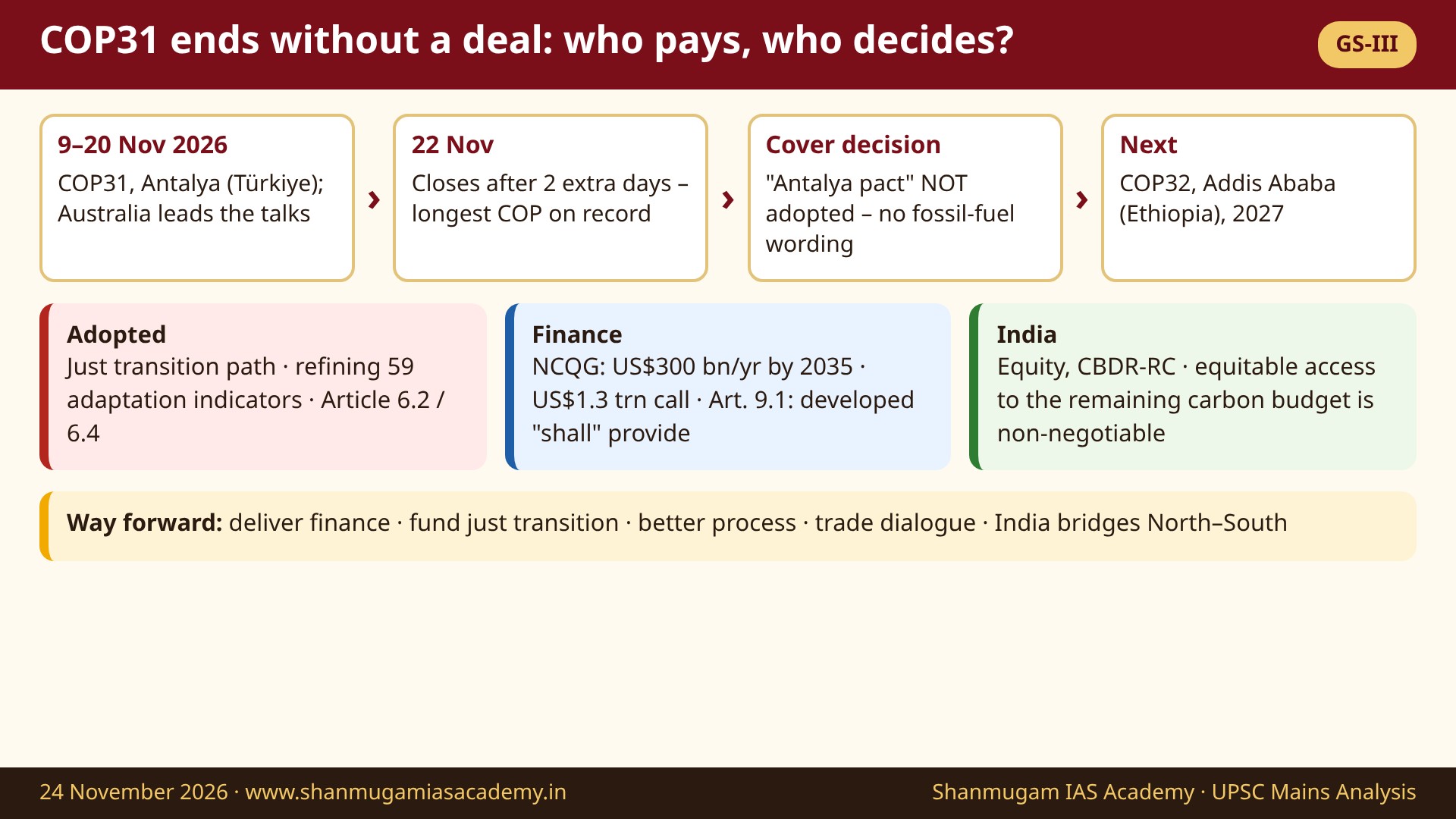
- COP31 (Antalya, Türkiye) was scheduled for 9–20 November 2026 but closed on 22 November after two extra days – the longest UN climate conference on record – without adopting its cover decision, the "Antalya pact". The EU objected that the text did not mention fossil fuels.
- Separate decisions were adopted on a step-by-step path to a just transition mechanism, on refining adaptation indicators and on carbon markets (Article 6). No figure for tripling adaptation finance made it into the final texts. COP32 will be held at Addis Ababa, Ethiopia, in 2027.
- The deadlock is about finance and fairness: Article 9.1 says developed countries "shall" provide finance; the COP29 goal is US$300 billion a year by 2035 (with a US$1.3 trillion call). India stressed equity and CBDR-RC and said equitable access to the carbon budget is non-negotiable. PYQ: GS-III 2022.

Why in news
The 31st UN climate conference (COP31) at Antalya, Türkiye, was scheduled for 9–20 November 2026. It closed only on Sunday, 22 November, after two extra days of talks – the longest UN climate conference on record – and without adopting its main political text (the "cover decision", which had been called the "Antalya pact"). COP President Murat Kurum told the closing plenary that there was no agreement on the text and that the decisions had therefore not been adopted. The European Union objected that the text did not mention fossil fuels at all; Panama and the Marshall Islands also withheld support.
UN Secretary-General António Guterres called the result deeply disappointing and said: "There may be no consensus in the negotiating room. There is no ambiguity in the science." The next conference, COP32, will be held at Addis Ababa, Ethiopia, in 2027.
What Antalya decided – and what it did not
| Area | Outcome at COP31 |
|---|---|
| Cover decision ("Antalya pact") | Not adopted. The final draft did not mention fossil fuels at all, which the EU and others could not accept |
| Just transition | A decision on the just transition work programme sets out a step-by-step path towards a just transition mechanism; what the mechanism will do and how it will work is to be worked out in 2027, with a decision aimed at COP32 – no money is attached yet |
| Climate finance | Developing countries pressed for the Climate Finance Work Programme to be taken up as an agenda item; its outcome was largely procedural and the work continues. No figure for tripling adaptation finance appeared in the final texts |
| Adaptation | Work continues on refining the 59 Belém Adaptation Indicators agreed at COP30 under the Global Goal on Adaptation |
| Carbon markets (Article 6) | Decisions on cooperative approaches (Article 6.2) and the Paris Agreement crediting mechanism (Article 6.4) were adopted; no new fee was set |
| What still stands | The COP28 (Dubai, 2023) call for "transitioning away from fossil fuels in energy systems" remains; a failed cover decision does not cancel earlier decisions |
Background: the climate-finance promises
| Milestone | What it says |
|---|---|
| UNFCCC, 1992 | Article 3.1: Parties act on the basis of equity and "common but differentiated responsibilities and respective capabilities" (CBDR-RC); developed countries should take the lead. Article 4.7: how far developing countries implement depends on developed countries' finance and technology |
| US$100 billion goal (2009–10) | Developed countries promised to mobilise US$100 billion a year by 2020 for developing countries. By the OECD's count it was first met only in 2022 (about US$115.9 billion) – two years late |
| Paris Agreement, 2015 – Article 9.1 | "Developed country Parties shall provide financial resources to assist developing country Parties with respect to both mitigation and adaptation" – a binding "shall" |
| New Collective Quantified Goal (COP29, Baku, 2024) | Developed countries to "take the lead" in mobilising at least US$300 billion a year by 2035; all actors called on to scale up finance to US$1.3 trillion a year by 2035. India objected at the closing plenary, calling the goal too low and the adoption unfair |
| COP30, Belém, 2025 | Call for efforts to at least triple adaptation finance by 2035; 59 adaptation indicators; a two-year work programme on climate finance |
| ICJ advisory opinion, 23 July 2025 | The International Court of Justice unanimously advised that States have legal obligations under the climate treaties and customary international law to protect the climate system from greenhouse gas emissions |
Analysis: why consensus broke down
| Fault line | What it shows |
|---|---|
| Fossil-fuel language | The EU, small island States and Latin American countries wanted a clear signal on moving away from fossil fuels; major producers resisted any such wording. The final text satisfied neither side |
| Finance trust deficit | Developing countries see the US$300 billion goal as inadequate and the old US$100 billion as delivered late. Without credible public finance, they resist new mitigation demands |
| Who pays? | Developed countries want the donor base widened to large emerging economies; developing countries insist on Article 9.1 – the obligation lies with developed countries |
| Trade and climate | Developing countries object to unilateral trade measures such as the EU's Carbon Border Adjustment Mechanism (CBAM); the issue found no place in the final outcome |
| The consensus rule | With no agreed voting rule, nearly 200 countries must all accept a text – a few objections are enough to block it |
| Geopolitics | The United States' withdrawal from the Paris Agreement took effect in January 2026, weakening the finance side and the push for ambition |
Climate justice is the heart of the deadlock. The carbon space left for 1.5 °C is small and was mostly used by countries that industrialised early. When the finance promised to developing countries arrives late and in small amounts, demands that they cut faster look unfair – and texts that ask more of them without money on the table do not win consensus. Equally, developing countries also suffer most when ambition stalls: heatwaves, cyclones and sea-level rise do not wait for negotiations.
India's position
- At COP31 on 18 November 2026, Union Environment Minister Bhupender Yadav called for action based on equity, climate justice and CBDR-RC, placed historical responsibility on countries whose industrialisation drove emissions for two centuries, and said that equitable access to the remaining carbon budget is non-negotiable.
- India spoke for the Like-Minded Developing Countries (LMDC) group on some agenda items and argued that the cover decision should not divert attention from mandated negotiating items.
- India's own record strengthens its voice: it reached 50% non-fossil installed power capacity in 2025, five years ahead of its 2030 target, and its NDC for 2031–35 commits to a 47% cut in emissions intensity of GDP from the 2005 level and 60% non-fossil power capacity by 2035.
Static syllabus link
- GS-III: climate change – UNFCCC (1992), Kyoto Protocol (1997), Paris Agreement (2015: Articles 2, 4, 6, 9, 13, 14), NDCs, adaptation and mitigation, carbon markets (India's Carbon Credit Trading Scheme, 2023, under the Energy Conservation Act, 2001 as amended in 2022).
- GS-II: important international institutions and fora; effect of developed countries' policies (such as CBAM) on India's interests; India in multilateral diplomacy (BASIC, LMDC, G77/China).
- GS-IV / Essay: intergenerational and international justice – "The polluter pays, but who pays the polluted?"
Tamil Nadu angle
- Tamil Nadu has a coastline of about 1,076 km and faces cyclones, storm surges and sea erosion during the northeast monsoon. Adaptation finance is a practical need, not an abstract demand.
- The State runs its climate work through the Tamil Nadu Green Climate Company, a not-for-profit special purpose vehicle that manages the Green Tamil Nadu Mission, the Tamil Nadu Wetlands Mission, the Tamil Nadu Climate Change Mission and the coastal restoration mission.
- The ₹1,675 crore TN-SHORE project with the World Bank (coastal resilience and the blue economy) shows how international finance can reach States – the kind of flow that a weak global finance outcome makes harder to scale.
Faculty view
A COP that ends without a cover decision is not the end of the Paris Agreement – write this clearly. Build the answer in three steps: (1) the facts – what Antalya adopted (just transition path, adaptation indicators, Article 6) and what failed (the cover decision, fossil-fuel language, an adaptation-finance figure); (2) the reasons – finance trust deficit, Article 9.1 versus a wider donor base, trade measures, and the consensus rule; (3) India's stand – equity, CBDR-RC and the carbon budget, backed by its 50% non-fossil capacity record. End with reforms that are realistic, not slogans. Examiners reward balance: criticise developed-country finance, but also show why delay hurts developing countries the most.
Way forward
- Deliver before asking: a clear, year-by-year pathway to the US$300 billion goal, with a larger share of grants and adaptation finance for the most vulnerable.
- Make the just transition mechanism real: agree its functions in 2027 and attach money and technology support, so that coal- and oil-dependent regions and workers are not left behind.
- Reform the process, not the principle: keep consensus for treaty matters but improve how texts are prepared – earlier drafts, smaller packages, transparent presidency consultations.
- Address trade concerns: dialogue on CBAM-type measures inside the UNFCCC and the WTO so that climate policy does not become disguised protection.
- India's role: lead coalitions of developing countries on adaptation finance and fair carbon budgets, and act as a bridge between developed and developing countries in the run-up to the second global stocktake (2028).
Glossary – Cover decision
The overarching political decision of a UN climate conference (COP, or CMA for the Paris Agreement) that sums up its main messages – the level of ambition, finance and the direction of travel. It sits above the many technical decisions taken on separate agenda items. Recent examples are the Glasgow Climate Pact (COP26, 2021) and the Sharm el-Sheikh Implementation Plan (COP27, 2022). Because the UNFCCC has never adopted a voting rule, every decision needs consensus – a formal objection by even a few countries can stop it. At COP31 (Antalya, 2026) the proposed cover decision, called the "Antalya pact", was not adopted; the technical decisions adopted separately still stand. A cover decision is political, not a treaty, but it shapes the agenda and expectations for the following years.
Asked before in UPSC
1. "Discuss global warming and mention its effects on the global climate. Explain the control measures to bring down the level of greenhouse gases which cause global warming, in the light of the Kyoto Protocol, 1997." – GS-III, 2022 (15 marks, 250 words)
2. UPSC has also asked directly about the outcomes of a COP and India's commitments there (GS-III, 2021, on COP26). A question on why climate talks stall – finance, equity and consensus – fits this pattern; keep the Article 9.1 text and the US$300 billion / US$1.3 trillion figures ready.
Mains practice question
"The failure of COP31 to adopt a cover decision exposes the limits of consensus-based climate diplomacy." Examine this statement with reference to climate finance and the principle of common but differentiated responsibilities. (15 marks, 250 words)
FAQ
What happened at COP31 in Antalya?
COP31 was scheduled for 9–20 November 2026 but closed on 22 November after two extra days, without adopting its main political text (the cover decision or "Antalya pact"). Separate decisions on the just transition work programme, adaptation indicators and carbon markets were adopted. COP32 will be held at Addis Ababa, Ethiopia, in 2027.
Why did the cover decision fail?
The final draft did not mention fossil fuels, which the European Union and others refused to accept, while major oil producers opposed any fossil-fuel wording. Deep distrust over climate finance and the consensus rule made a compromise impossible.
What is the new climate finance goal?
Agreed at COP29 in Baku (2024), the New Collective Quantified Goal asks developed countries to take the lead in mobilising at least US$300 billion a year by 2035, and calls on all actors to scale up finance to US$1.3 trillion a year by 2035. India called the goal inadequate.
What does Article 9.1 of the Paris Agreement say?
Developed country Parties shall provide financial resources to assist developing country Parties with respect to both mitigation and adaptation, in continuation of their existing obligations under the Convention.
What was India's stand at COP31?
India called for equity, climate justice and common but differentiated responsibilities and respective capabilities; Environment Minister Bhupender Yadav said equitable access to the remaining carbon budget is non-negotiable.
Related on our site: UPSC Mains Analysis – all articles · UPSC glossary · UPSC Mains answer-writing practice · Free PDF downloads
Add us as a preferred source on Google
Link to this page from your website / blog (HTML code)
BANK Achievers
-

CHANDRA
BANK BANK
நடப்பு நிகழ்வுகள் 24 நவம்பர் 2026 | Today Current Affairs in Tamil | TNPSC Group 4 வினா விடை
📚 TNPSC குரூப் 4 / 2 / 2A – பொதுத்தமிழ், பொது அறிவு நூல்கள்
PDF நூல்கள் · ₹149 முதல் · ஒவ்வொன்றுக்கும் 50 பக்க இலவச மாதிரி · UPI-இல் பணம் செலுத்தியதும் உடனே பதிவிறக்கம்
 பொதுத் தமிழ் — முழுமையான கையேடு (TNPSC குரூப் 2 · 2A · 4)
₹199
 TNPSC முழுமையான பாடநூல்கள் – முழுத் தொகுப்பு (9 நூல்கள்)
₹1599
 TNPSC குரூப் 4 பொதுத் தமிழ் – முழுமையான தேர்வுக் களஞ்சியம் 2026
₹249
 பொதுத் தமிழ் — முந்தைய ஆண்டு வினா – விடை – விளக்கம் (புதிய பாடத்திட்டம்)
₹199
TNPSC குரூப் 1, 2/2A, 4 – நேரடி வகுப்புகள் · கோவை & மதுரை
2006 முதல் சண்முகம் IAS அகாடமி · Classroom & online coaching in Coimbatore and Madurai
