

Mains Analysis: Anthropic IPO and the AI race – where India stands
24 November 2026 · English Science & Technology
⬇ Download this analysis as free PDF
Topics: Science and Technology – Artificial Intelligence, Technology Policy and Governance · GS-III · UPSC Mains Analysis

Faculty view: U. Shunmugam – Founder, Shanmugam IAS Academy (since 2006); faced the UPSC Civil Services (IAS) Interview
Key takeaways
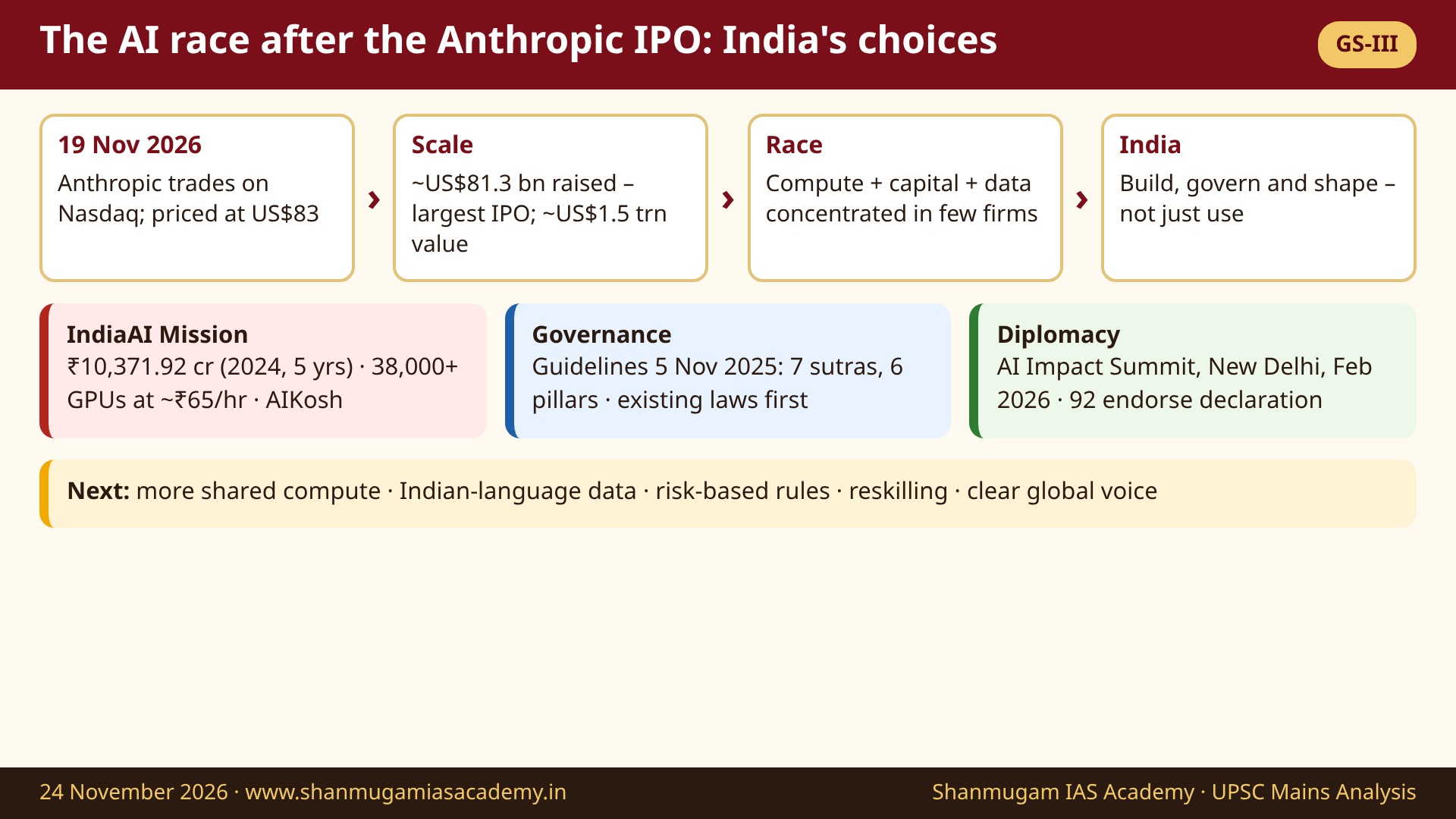
- Anthropic priced its IPO at US$83 a share, raising about US$81.3 billion – the largest IPO on record – at a fully diluted valuation of about US$1.5 trillion; trading began on the Nasdaq on 19 November 2026.
- The listing shows that frontier AI is a race of capital and compute concentrated in a few firms. India's response: the IndiaAI Mission (₹10,371.92 crore, approved March 2024; 38,000+ GPUs at about ₹65 per GPU-hour by February 2026), the India AI Governance Guidelines (5 November 2025) and the AI Impact Summit in New Delhi (February 2026).
- India must build enough capacity to have real choices – shared compute, Indian-language data, risk-based sector rules, reskilling – and take clear positions in global AI rule-making. TN: Safe and Ethical AI Policy (2020). PYQ: Essay 2019.

Why in news
US artificial-intelligence company Anthropic listed its shares on the Nasdaq stock exchange, with trading beginning on 19 November 2026. The shares were priced at US$83 each, above the initial range of US$70–78, raising about US$81.3 billion – the largest initial public offering (IPO) on record – at a fully diluted valuation of about US$1.5 trillion.
The listing is more than a market event. It shows that frontier AI has become a race of capital and computing power in which a few firms, mostly in the United States and China, spend sums larger than the GDP of many countries. For India, the question is simple: will it only use and regulate AI made elsewhere, or will it also build, shape and govern it?
Background: how the AI race works
| Driver | What it means |
|---|---|
| Compute | Training and running large models need tens of thousands of advanced chips (GPUs) and huge data centres. Chip design and supply are concentrated in a few countries and firms |
| Capital | Frontier labs raise money in the tens of billions; public listings like this one bring in even more, so the gap between leaders and the rest widens |
| Data and talent | Models are trained mostly on English-language internet data; researchers cluster where compute and funding are |
| Energy and water | The International Energy Agency's 2025 Energy and AI report projected data-centre electricity use to roughly double from about 415 TWh in 2024 to around 945 TWh by 2030; cooling also needs water |
| Rules | Countries are moving at different speeds – binding laws in some places, voluntary commitments in others; a UN Independent International Scientific Panel on AI and a Global Dialogue on AI Governance were set up in 2025 |
India's response so far
| Step | Details |
|---|---|
| IndiaAI Mission (Cabinet approval, March 2024) | Outlay of ₹10,371.92 crore over five years; seven pillars – compute capacity, innovation centre (foundation models), datasets platform (AIKosh), application development, FutureSkills, start-up financing, and safe and trusted AI |
| Shared compute | More than 38,000 GPUs made available through the IndiaAI compute portal by February 2026, at a subsidised rate of about ₹65 per GPU-hour |
| India AI Governance Guidelines (5 November 2025) | Released under the IndiaAI Mission: seven guiding principles ("sutras") and six pillars; the approach is to use existing laws (IT Act, 2000; Digital Personal Data Protection Act, 2023) wherever possible rather than a separate AI law for now |
| AI Impact Summit (New Delhi, February 2026) | Held at Bharat Mandapam – the first in the global AI summit series hosted in the Global South; its declaration was endorsed by 92 countries and international organisations, and 13 leading model providers signed the New Delhi Frontier AI Impact Commitments |
| Summit diplomacy | India signed the Bletchley Declaration (UK, 2023) and co-chaired the AI Action Summit in Paris (February 2025) before hosting the 2026 summit |
Analysis: why India cannot stay a bystander
| Concern | Why it matters for India |
|---|---|
| Dependence | If key public services, finance and defence run on foreign models and foreign cloud, India's choices can be shaped by others' export rules, prices and outages |
| Concentration | A few firms controlling frontier models, chips and cloud can set terms for everyone else – a competition and fairness issue, not just a technology one |
| Jobs and the IT model | AI tools automate routine coding, testing and back-office work – the base of India's IT-services exports and of millions of white-collar jobs |
| Scale gap | IndiaAI's five-year outlay is small next to what single global firms raise and spend in a year; India must spend smartly – shared compute, open models, Indian-language data |
| Energy and water | Data-centre growth adds to power demand and water stress; it must be planned with renewable power and water-efficient cooling |
| Voice in rule-making | Global norms on frontier-AI safety, compute access and liability are being written now; a country that does not take clear positions will have to accept rules made by others |
The core point: India's advantage is not money but scale of use – a large digital public infrastructure (Aadhaar, UPI), many languages, a big talent pool and a huge market. The aim should be to turn that into bargaining power: build enough capacity at home to have real choices, and speak clearly in global forums on safety, fairness and access.
Static syllabus link
- GS-III: awareness in the fields of IT, computers and robotics; indigenisation of technology; intellectual property rights; infrastructure (energy for data centres); effects of liberalisation and technology on jobs.
- GS-II: government policies and interventions (IndiaAI Mission); IT Act, 2000 and Digital Personal Data Protection Act, 2023; India's role in global forums (AI summits, G20, UN).
- GS-IV: ethics of AI – accountability, bias, transparency; corporate responsibility in a profit-driven race.
- Essay: "Whoever controls computing power controls the future" – examine.
Tamil Nadu angle
- Tamil Nadu released the Tamil Nadu Safe and Ethical Artificial Intelligence Policy in 2020 – among the first State AI policies in India – with a focus on transparency, accountability, fairness and safety in using AI in governance.
- Chennai's submarine-cable landing stations and power network make the State attractive for data centres; the 2019 Chennai water crisis is a reminder that data-centre cooling must be planned with water-efficient technology and renewable power.
- Tamil-language AI needs good Tamil datasets – government records, literature, classroom material and speech data in Tamil can feed national platforms like AIKosh, so that AI serves people who do not use English.
- With a large engineering and IT-services workforce in Chennai and Coimbatore, reskilling for AI-era jobs is a priority for the State.
Faculty view
Do not write this as a stock-market story. Use the IPO only as the hook, then move to the policy question: concentration of compute and capital, and what it means for India. A strong answer has three parts: (1) the facts – the scale of the listing and the race; (2) India's response – IndiaAI Mission numbers, governance guidelines, the New Delhi summit; (3) the gaps and a balanced way forward – neither "ban and fear" nor "anything goes". Mention jobs, energy and Indian languages; examiners like answers that connect technology to people.
Way forward
- Scale shared compute: expand the GPU pool steadily and give priority access to universities, public-interest projects and Indian-language models.
- Data as a public good: open, consent-based Indian-language datasets through AIKosh, with privacy protected under the DPDP Act.
- Smart regulation: sector regulators (RBI, SEBI, health and telecom authorities) to issue risk-based rules; incident reporting and testing for high-risk uses.
- Competition safeguards: watch for lock-in by a few cloud and model providers; promote interoperability and open models.
- People first: large-scale reskilling with industry, and social-security support for workers displaced by automation.
- Clear global positions: build on the New Delhi summit to push for fair access to compute, safety testing of frontier models and a voice for the Global South.
Glossary – Sovereign AI
A country's capacity to build, run and govern artificial intelligence with its own computing power, data, models and talent, under its own laws – so that critical services do not depend wholly on foreign companies or foreign decisions. It does not mean cutting off global technology; it means having enough capacity at home to choose. Its building blocks are compute (chips and data centres), data (including datasets in Indian languages), models (foundation models trained for local needs), talent and rules. India's IndiaAI Mission follows this logic: a shared GPU pool for researchers and start-ups, the AIKosh dataset platform and support for Indian foundation models.
Asked before in UPSC
1. "Rise of Artificial Intelligence: the threat of jobless future or better job opportunities through reskilling and upskilling" – Essay, 2019 (125 marks)
2. GS-III (2023) also asked how AI helps clinical diagnosis and whether it threatens privacy. UPSC has so far asked about uses and risks of AI; a question on concentration of AI power and India's strategy is a natural next step – keep the IndiaAI Mission numbers and the 2025 governance guidelines ready.
Mains practice question
"The concentration of capital and computing power in a few frontier AI firms poses strategic, economic and governance challenges for India." Discuss, and suggest the steps India should take. (15 marks, 250 words)
FAQ
Why is the Anthropic IPO in the news?
Anthropic priced its shares at US$83, raising about US$81.3 billion – the largest IPO on record – at a fully diluted valuation of about US$1.5 trillion; trading began on the Nasdaq on 19 November 2026. It shows how much capital the frontier-AI race now draws.
What is the IndiaAI Mission?
A national programme approved by the Union Cabinet in March 2024 with an outlay of ₹10,371.92 crore over five years. It has seven pillars, including shared compute, datasets (AIKosh), Indian foundation models, skills, start-up finance and safe and trusted AI. More than 38,000 GPUs were available on its compute portal by February 2026.
Does India have a separate law on AI?
No. The India AI Governance Guidelines released on 5 November 2025 set out seven principles and six pillars, and prefer using existing laws such as the IT Act, 2000 and the Digital Personal Data Protection Act, 2023 wherever possible.
What was the AI Impact Summit 2026?
A global summit held at Bharat Mandapam, New Delhi, in February 2026 – the first of the AI summit series in the Global South. Its declaration was endorsed by 92 countries and international organisations.
What is sovereign AI?
A country's capacity to build, run and govern AI with its own compute, data, models, talent and laws, so that it is not wholly dependent on foreign providers. It does not mean cutting off global technology.
Related on our site: UPSC Mains Analysis – all articles · UPSC glossary · UPSC Mains answer-writing practice · Free PDF downloads
Add us as a preferred source on Google
Link to this page from your website / blog (HTML code)
SI/POLICE Achievers
-

MURUGAN
SI / POLICE SI / POLICE
நடப்பு நிகழ்வுகள் 24 நவம்பர் 2026 | Today Current Affairs in Tamil | TNPSC Group 4 வினா விடை
📚 TNPSC குரூப் 4 / 2 / 2A – பொதுத்தமிழ், பொது அறிவு நூல்கள்
PDF நூல்கள் · ₹149 முதல் · ஒவ்வொன்றுக்கும் 50 பக்க இலவச மாதிரி · UPI-இல் பணம் செலுத்தியதும் உடனே பதிவிறக்கம்
 பொதுத் தமிழ் — முழுமையான கையேடு (TNPSC குரூப் 2 · 2A · 4)
₹199
 TNPSC முழுமையான பாடநூல்கள் – முழுத் தொகுப்பு (9 நூல்கள்)
₹1599
 TNPSC குரூப் 4 பொதுத் தமிழ் – முழுமையான தேர்வுக் களஞ்சியம் 2026
₹249
 பொதுத் தமிழ் — முந்தைய ஆண்டு வினா – விடை – விளக்கம் (புதிய பாடத்திட்டம்)
₹199
TNPSC குரூப் 1, 2/2A, 4 – நேரடி வகுப்புகள் · கோவை & மதுரை
2006 முதல் சண்முகம் IAS அகாடமி · Classroom & online coaching in Coimbatore and Madurai
