

Mains Analysis: India–Nepal ties – aid is not enough, listen too
25 November 2026 · English International
⬇ Download this analysis as free PDF
Topics: International Relations – India and its Neighbourhood, Bilateral Relations · GS-II · UPSC Mains Analysis

Faculty view: U. Shunmugam – Founder, Shanmugam IAS Academy (since 2006); faced the UPSC Civil Services (IAS) Interview
Key takeaways
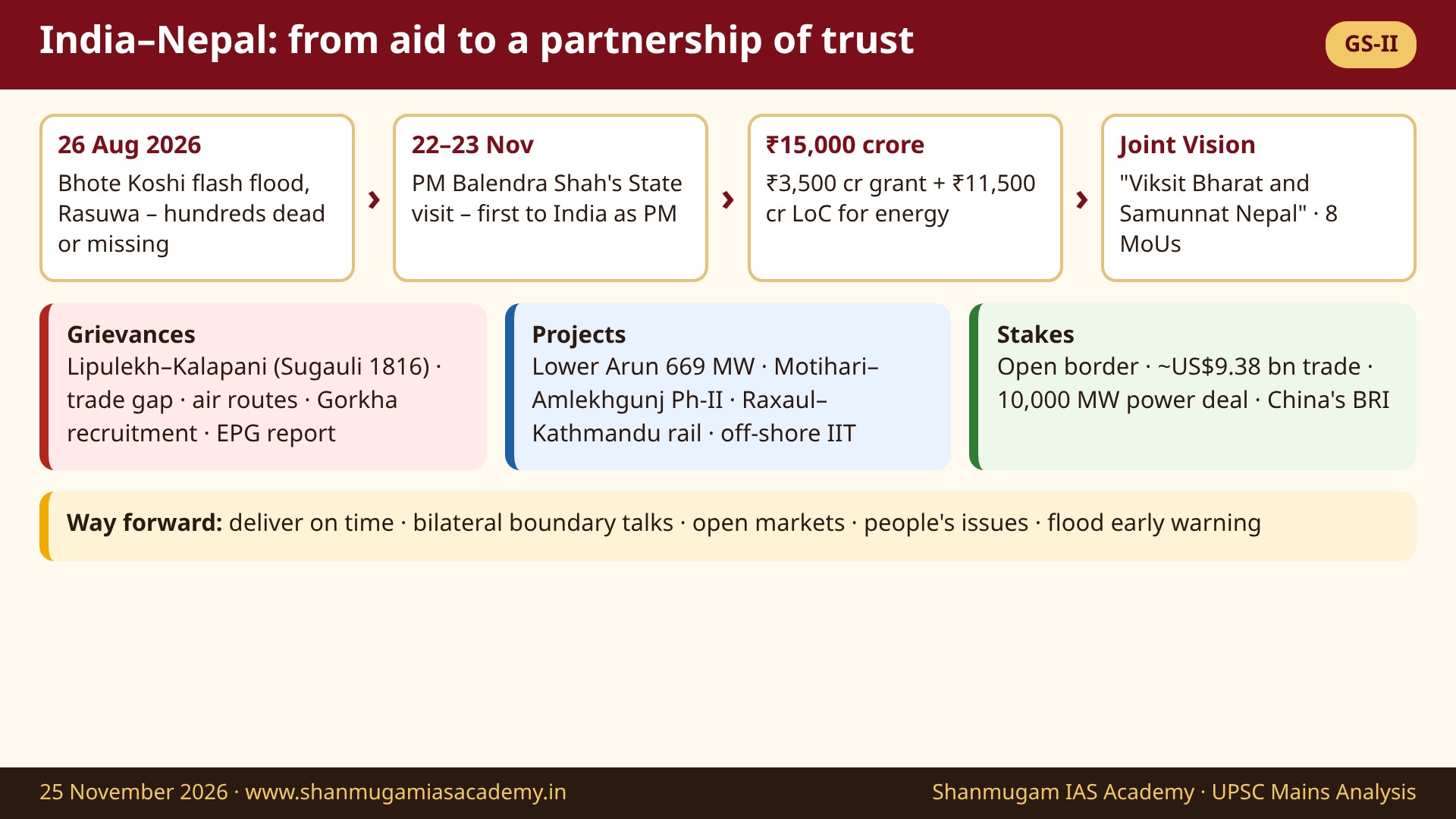
- Nepal PM Balendra (Balen) Shah made a State visit to India on 22–23 November 2026, his first as PM. India announced ₹15,000 crore – a ₹3,500 crore grant for reconstruction and infrastructure and an ₹11,500 crore Line of Credit for energy.
- Projects: 669 MW Lower Arun (foundation stone), Motihari–Amlekhgunj pipeline Phase II, Raxaul–Kathmandu rail survey finalised, Banbasa ICP, Dharchula–Darchula bridge, an off-shore IIT; Joint Vision "Viksit Bharat and Samunnat Nepal" and 8 MoUs.
- Trust needs more than aid: Nepal's grievances – Lipulekh–Kalapani (Sugauli 1816; 2020 map), the trade gap, air routes, Gorkha recruitment under Agnipath and the 2018 EPG report – need dialogue through bilateral mechanisms and on-time delivery. PYQ: GS-II 2022.

Why in news
Nepal's Prime Minister Balendra (Balen) Shah paid a State visit to India on 22–23 November 2026 – his first visit to India since taking office. He held talks with Prime Minister Narendra Modi and called on President Droupadi Murmu. India announced a package of ₹15,000 crore: a grant of ₹3,500 crore for post-disaster reconstruction and new infrastructure, and a rupee-denominated Line of Credit of ₹11,500 crore for energy projects. The leaders adopted a Joint Vision, "Viksit Bharat and Samunnat Nepal", and exchanged eight MoUs.
The visit came three months after the 26 August 2026 Bhote Koshi flash flood in Rasuwa district, which killed or left missing hundreds of people. It also came after a tense spring over Lipulekh. The lesson for India is clear: generous help builds goodwill, but lasting trust also needs India to hear and address Nepal's grievances.
What the visit delivered
| Area | Outcome (22–23 November 2026) |
|---|---|
| Money | ₹15,000 crore: ₹3,500 crore grant (reconstruction, new infrastructure) + ₹11,500 crore LoC (energy). Projects to be finalised by mutual consultation |
| Energy | Foundation stone (virtual) for the 669 MW Lower Arun hydro project; progress on forming joint ventures for two cross-border transmission lines – Inaruwa–New Purnea and Dododhara–Bareilly |
| Petroleum | Phase II of the Motihari–Amlekhgunj pipeline dedicated; foundation stone for a petroleum terminal at Jhapa; early start sought on the Siliguri–Jhapa pipeline |
| Rail and roads | Field Location Survey of the Raxaul–Kathmandu electrified broad-gauge line finalised; Sarayu–Kamala Express (Ayodhya–Janakpur) flagged off; Dharchula–Darchula motorable bridge inaugurated; foundation stone for a new Integrated Check Post at Banbasa |
| Air and ports | Air route B345 (Kathmandu–Bhairahawa–Lucknow) to become two-way; transit via Deendayal Port (Kandla), and via Paradip once ready |
| Water | Pancheshwar Multipurpose Project Detailed Project Report (DPR) to be finalised and implementation begun; DPR work on the Sapta Koshi and Sun Koshi multipurpose projects to speed up |
| People and skills | An off-shore IIT campus in Nepal; easier banking and telecom access for each other's citizens; eight MoUs (police training, civil-service capacity, traditional medicine, health, urban development, livestock and fisheries, South Asia Satellite SATCOM) |
| Boundary | Leaders welcomed progress in joint field work on maintenance and repair of boundary pillars and directed the Foreign Secretaries to work on the outstanding boundary issues |
Background: why Nepal matters to India
- Open border and shared people: the 1950 Treaty of Peace and Friendship gives citizens of each country national treatment in the other. The open border runs along five Indian States – Sikkim, West Bengal, Bihar, Uttar Pradesh and Uttarakhand. Nepali Gorkha soldiers have long served in the Indian Army, and over one lakh Indian Army ex-servicemen live in Nepal.
- Economy: India–Nepal goods trade was about US$9.38 billion in FY 2025-26 – over 60% of Nepal's external goods trade; India took more than 80% of Nepal's goods exports. India is the largest source of foreign investment in Nepal (almost one-third of total FDI).
- Energy: under a long-term agreement signed in January 2024, India plans to import 10,000 MW from Nepal within ten years. Nepal already exports over 1,000 MW of hydropower to India.
- Strategic location: Nepal lies between India and China. It signed a Belt and Road Initiative (BRI) cooperation framework with China in December 2024, so India's performance on projects is closely compared.
Analysis: the grievances India must hear
| Grievance | What it is about |
|---|---|
| Lipulekh–Kalapani–Limpiyadhura | Nepal claims these areas under the 1816 Treaty of Sugauli and put them in its map by a constitutional amendment in 2020. On 3 May 2026 it protested to India and China over the 2026 Kailash Mansarovar Yatra through Lipulekh. India called the claim "neither justified nor based on historical facts and evidence" but stayed open to dialogue |
| Third-party talk | On 31 May 2026 PM Shah referred in Nepal's parliament to the United Kingdom's link with the dispute through the 1816 Sugauli Treaty, and said both sides had encroached on each other's land. India's MEA replied that there is "no role for any third parties" in a bilateral matter |
| Trade imbalance | Nepal imports far more from India than it sells. In September 2026 the two sides agreed to set up a technical committee to review the bilateral Trade Treaty; Nepal wants the treaty updated – including protection for its farmers from cheaper imports and simpler rules of origin for its processed goods |
| Air routes | Nepal has long sought more entry routes into its new airports at Bhairahawa and Pokhara. Making route B345 two-way is a first step |
| Gorkha recruitment | Recruitment of Nepali Gorkhas into the Indian Army has been on hold since the Agnipath scheme (2022), as Nepal has not accepted its four-year terms |
| EPG report | The India–Nepal Eminent Persons Group (set up 2016) to review bilateral ties, including the 1950 Treaty, finished its report in 2018; it has still not been formally received |
| Delivery record | Past delays in joint and India-funded projects (for example Pancheshwar, under the 1996 Mahakali Treaty, still at the DPR stage) feed the view that promises outrun delivery |
Why aid alone is not enough Aid shows India's goodwill, but in Nepal, India is also seen as a big neighbour that decides alone – on routes, roads and recruitment. A relationship built only on packages can look like dependence; one built on listening looks like partnership. Nepal's voters, who gave the Rastriya Swatantra Party a majority in March 2026, will judge India on fairness and on delivery.
Static syllabus link
- GS-II: India and its neighbourhood – relations; bilateral agreements involving India; effect of policies of other countries (China's BRI) on India's interests; Neighbourhood First policy; BBIN and BIMSTEC.
- GS-III: security challenges in border areas – open border, Sashastra Seema Bal (SSB) as the border-guarding force; disaster management – cross-border early warning for glacial and landslide floods; energy – hydropower and the regional power market.
- GS-I: Himalayan rivers – the Kosi (the "sorrow of Bihar"), Gandak and Mahakali (Sharda) – and floods in the Indo-Gangetic plain.
Tamil Nadu angle
- The off-shore IIT campus has a Tamil Nadu precedent: IIT Madras opened India's first overseas IIT campus at Zanzibar (Tanzania) in 2023. That model shows how education can become a tool of partnership, not just aid.
- Tamil Nadu's own experience of floods and cyclones gives it lessons in early warning and disaster response that are useful for Himalayan neighbours too – cross-border data sharing is the gap the Bhote Koshi flood exposed.
Faculty view
Do not write this answer as a list of projects. Use a simple frame: (1) Assistance – the ₹15,000 crore package, energy, pipelines, rail; (2) Grievances – boundary (Sugauli, 2020 map, Lipulekh), trade, air routes, Gorkha recruitment, EPG; (3) Balance – India's interests (open-border security, China factor, energy). Quote one fact from each part. Examiners reward answers that show both sides: India's assistance is real, and so are Nepal's concerns. End with a practical way forward – dialogue through existing mechanisms, time-bound delivery and people-centred projects.
Way forward
- Deliver on time: finalise the projects under the ₹15,000 crore package quickly and publish progress – delivery is the best answer to the BRI comparison.
- Talk on the boundary: use the existing bilateral mechanisms, at Foreign Secretary level, regularly and calmly; avoid public statements that harden positions on either side.
- Open markets: complete the Trade Treaty review, ease non-tariff barriers and help Nepal sell more – a smaller trade gap means less resentment.
- Address people's issues: air routes, a workable solution on Gorkha recruitment, and a decision on how to take up the EPG report.
- Disaster partnership: joint flood forecasting on the Kosi, Gandak and Mahakali basins and real-time data sharing for glacial and landslide floods.
Glossary – Line of Credit (LoC)
A Line of Credit is a soft loan that India extends to a partner government, mostly through the Export-Import Bank of India under the Indian Development and Economic Assistance Scheme (IDEAS). The borrowing country uses it for agreed projects and repays it over a long period at a concessional rate. It differs from a grant, which is not repaid. Many LoCs carry a condition that a large share of goods and services be sourced from India, which supports Indian exports but can slow projects. In November 2026 India announced for Nepal a rupee-denominated LoC of ₹11,500 crore for energy projects, alongside a ₹3,500 crore grant – a total of ₹15,000 crore. The test of any LoC is not the amount announced but how fast projects are finalised and completed.
Asked before in UPSC
1. "'India is an age-old friend of Sri Lanka.' Discuss India's role in the recent crisis in Sri Lanka in the light of the preceding statement." – GS-II, 2022
2. The same pattern applies to Nepal: a neighbour in distress, India's assistance, and the question of trust. Keep the ₹15,000 crore package, the Sugauli–Lipulekh issue and the trade figures ready for a direct question on India–Nepal relations.
Mains practice question
"India's assistance to Nepal must be matched by sensitivity to Nepal's concerns." Discuss with reference to recent developments in India–Nepal relations. (15 marks, 250 words)
FAQ
Who visited India from Nepal in November 2026?
Nepal's Prime Minister Balendra (Balen) Shah paid a State visit to India on 22–23 November 2026, his first since taking office in March 2026. He held talks with PM Narendra Modi and called on President Droupadi Murmu.
What package did India announce for Nepal?
A total of ₹15,000 crore: a grant of ₹3,500 crore for post-disaster reconstruction and new infrastructure, and a rupee-denominated Line of Credit of ₹11,500 crore for energy projects.
What is the Lipulekh–Kalapani dispute?
Nepal claims Lipulekh, Kalapani and Limpiyadhura under the 1816 Treaty of Sugauli and added them to its map by a constitutional amendment in 2020. India rejects the claim. In May 2026 Nepal protested over the Kailash Mansarovar Yatra through Lipulekh; India rejected the claim, and when PM Shah later referred to Britain's role, India said there is no role for third parties.
What is the 1950 India–Nepal Treaty?
The Treaty of Peace and Friendship, 1950, is the base of India–Nepal relations. It allows citizens of each country national treatment in the other and supports the open border. Nepal has sought its review; the Eminent Persons Group report of 2018 was prepared for this purpose.
Which projects were launched during the visit?
Foundation stones for the 669 MW Lower Arun hydro project, a petroleum terminal at Jhapa and an Integrated Check Post at Banbasa; Phase II of the Motihari–Amlekhgunj pipeline was dedicated; the Dharchula–Darchula bridge was opened; and the Raxaul–Kathmandu railway survey was finalised.
One-page summary of this article – save it or share it with friends
Related on our site: UPSC Mains Analysis – all articles · UPSC glossary · UPSC Mains answer-writing practice · Free PDF downloads
Add us as a preferred source on Google
Link to this page from your website / blog (HTML code)
TET Achievers
-

RAJARAJESHWARI
TNTET TNTET
நடப்பு நிகழ்வுகள் 25 நவம்பர் 2026 | Today Current Affairs in Tamil | TNPSC Group 4 வினா விடை
📚 TNPSC குரூப் 4 / 2 / 2A – பொதுத்தமிழ், பொது அறிவு நூல்கள்
PDF நூல்கள் · ₹149 முதல் · ஒவ்வொன்றுக்கும் 50 பக்க இலவச மாதிரி · UPI-இல் பணம் செலுத்தியதும் உடனே பதிவிறக்கம்
 பொதுத் தமிழ் — முழுமையான கையேடு (TNPSC குரூப் 2 · 2A · 4)
₹199
 TNPSC முழுமையான பாடநூல்கள் – முழுத் தொகுப்பு (9 நூல்கள்)
₹1599
 TNPSC குரூப் 4 பொதுத் தமிழ் – முழுமையான தேர்வுக் களஞ்சியம் 2026
₹249
 பொதுத் தமிழ் — முந்தைய ஆண்டு வினா – விடை – விளக்கம் (புதிய பாடத்திட்டம்)
₹199
TNPSC குரூப் 1, 2/2A, 4 – நேரடி வகுப்புகள் · கோவை & மதுரை
2006 முதல் சண்முகம் IAS அகாடமி · Classroom & online coaching in Coimbatore and Madurai
