

Mains Analysis: Bike taxi verdict and the urban mobility policy gap
25 November 2026 · English Infrastructure & Energy
⬇ Download this analysis as free PDF
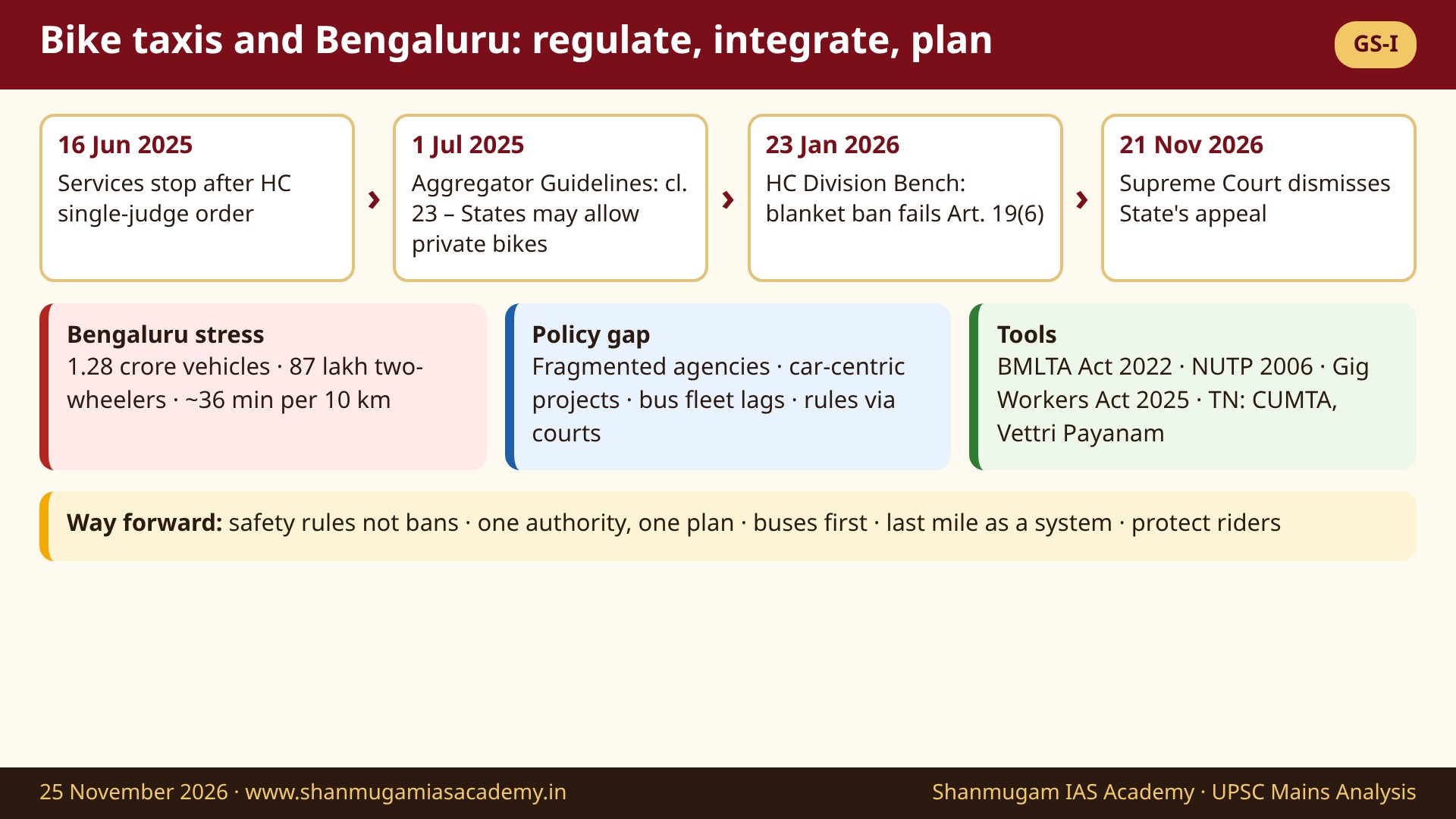
Topics: Indian Society – Urbanisation, Urban Transport, Regulation of the Gig Economy · GS-I · UPSC Mains Analysis

Faculty view: U. Shunmugam – Founder, Shanmugam IAS Academy (since 2006); faced the UPSC Civil Services (IAS) Interview
Key takeaways
- On 21 November 2026 the Supreme Court dismissed Karnataka's appeal against the High Court ruling of 23 January 2026, which held that a blanket ban on bike taxis is not a reasonable restriction under Article 19(6) and that motorcycles can run as contract carriages.
- The Motor Vehicle Aggregator Guidelines, 2025 (clause 23) let States allow private motorcycles for passenger rides. Karnataka is now drafting rules on rider verification, GPS and insurance. Bengaluru has about 1.28 crore vehicles and is the world's second most congested city on the TomTom index.
- The real gap is policy: one metropolitan transport authority (BMLTA Act, 2022), buses first, last-mile planning and rider welfare (Gig Workers Act, 2025). TN: CUMTA, Vettri Payanam, Chennai Metro Phase II. PYQ: GS-I 2017.

Why in news
On 21 November 2026 the Supreme Court (Justices Satish Chandra Sharma and N. Kotiswar Singh) dismissed the Karnataka government's appeal against a High Court judgment that allows bike taxis to operate in the State. On 23 January 2026, a Division Bench of the Karnataka High Court (then Chief Justice Vibhu Bakhru and Justice C.M. Joshi) had held that a blanket ban on bike taxis was not a reasonable restriction, and that motorcycles can be registered as transport vehicles and run as contract carriages, subject to conditions set by the State.
The State has said it will now frame rules – rider verification, GPS and insurance – with passenger safety, especially for women, as the priority. The case shows a larger problem: Karnataka, and Bengaluru in particular, has decided mobility issues one at a time – often through courts – instead of through one clear urban mobility policy.
How the case unfolded
| When | What happened |
|---|---|
| April 2025 | A single judge of the Karnataka High Court said aggregators could not run bike taxis until the State notified a framework; services stopped from 16 June 2025 |
| 1 July 2025 | The Union Road Transport Ministry issued the Motor Vehicle Aggregator Guidelines, 2025. Clause 23: the State government may allow aggregation of non-transport motorcycles for journeys by passengers – a choice left to States |
| 23 January 2026 | High Court Division Bench: a total prohibition is disproportionate and not a reasonable restriction under Article 19(6) on the right to carry on trade or business (Article 19(1)(g)); motorcycles may be registered as transport (yellow-board) vehicles and given contract carriage permits, with conditions under Section 74(2) |
| 21 November 2026 | Supreme Court dismissed the State's appeal. Operators still need transport registration and permits; the State is drafting rules on verification, GPS and insurance |
Background: Bengaluru's mobility stress
- Vehicle load: by mid-2026 Bengaluru had about 1.28 crore registered vehicles, including about 87 lakh two-wheelers and over 25 lakh private cars (30 June 2026).
- Congestion: the TomTom Traffic Index 2025 ranks Bengaluru the world's second most congested city, with about 36 minutes to travel 10 km.
- Public transport: the Shakti scheme (free bus travel for women in Karnataka, from 11 June 2023) raised bus demand, but fleet growth has lagged; metro expansion has been slow and fares were raised steeply in February 2025.
- Constitution: "Mechanically propelled vehicles" is Entry 35 of the Concurrent List. The Centre makes the Motor Vehicles Act; States register vehicles, issue permits and license aggregators (Section 93 of the Act).
Analysis: why a coherent policy is needed
| Issue | What the bike-taxi case reveals |
|---|---|
| Ban vs regulate | A ban stopped a cheap last-mile option and the livelihood of many riders, without solving safety. Courts have now said: regulate, do not prohibit |
| Safety and insurance | Real concerns – rider verification, helmets for passengers, insurance cover, women's safety – need clear rules, not a vacuum |
| Competing interests | Auto and taxi drivers fear loss of income; commuters want affordable choice; the State wants revenue and order. Only a policy can balance them |
| Fragmented bodies | Buses, metro, suburban rail, roads, parking and permits sit with different agencies. The Bengaluru Metropolitan Land Transport Authority Act, 2022 created a single authority; making it work in practice is the test |
| Gig workers | Riders are platform workers. Karnataka's Platform-based Gig Workers (Social Security and Welfare) Act, 2025 charges aggregators a welfare fee of 1–5% of each payout made to a worker, credited to a State welfare fund – mobility and labour rules must fit together |
| Car-centric projects | Large road projects attract more cars. The National Urban Transport Policy, 2006 says plan for moving people, not vehicles – public transport, walking and cycling first |
The core point: bike taxis are neither the problem nor the solution. They are one link in a chain – walk, ride to the metro or bus, travel, walk again. When that chain is planned as a whole, each mode has a place and clear rules. When it is not, every new mode becomes a court case.
Static syllabus link
- GS-I: urbanisation – its problems and remedies.
- GS-II: government policies and interventions; Article 19(1)(g) and reasonable restrictions under Article 19(6); Concurrent List (Entry 35); the 74th Amendment and the 12th Schedule (urban planning, roads).
- GS-III: infrastructure – roads, urban transport, metro rail; inclusive growth and the gig economy (Code on Social Security, 2020 – platform workers).
Tamil Nadu angle
- Chennai has a statutory Chennai Unified Metropolitan Transport Authority (CUMTA) under a 2010 State Act – the kind of single body that urban transport experts recommend for every large city.
- Tamil Nadu's free bus travel for women, renamed "Vettri Payanam" from 2 October 2026, and Chennai Metro Phase II (118.9 km) show the public-transport-first approach. The lesson from Bengaluru: new modes such as bike taxis should be fitted into that plan through clear rules, before disputes reach the courts.
Faculty view
A question on bike taxis is really a question on urban governance. Structure: (1) the legal position – Article 19(1)(g), reasonable restrictions, the 2025 Aggregator Guidelines, the High Court and Supreme Court rulings; (2) the policy gap – fragmented agencies, car-centric planning, weak buses; (3) the solution – one metropolitan transport authority, integrated planning and clear safety rules. Use Bengaluru data (1.28 crore vehicles; 36 minutes per 10 km) and one Tamil Nadu example. Avoid taking sides between auto drivers and platforms – show how a policy can protect commuters, workers and safety together.
Way forward
- Regulate, do not ban: notify bike-taxi rules quickly – police verification, GPS tracking, an SOS button, passenger helmets, insurance and fare transparency.
- One authority, one plan: make the metropolitan transport authority the single planner for bus, metro, suburban rail, parking and permits, with a Comprehensive Mobility Plan.
- Buses first: expand the bus fleet and bus priority lanes; integrate tickets and timetables across bus and metro.
- Last mile as a system: plan feeder buses, bike taxis, autos, cycling and footpaths around metro and bus stations.
- Protect workers: link aggregator licences with the gig-workers welfare law so that riders get social security and safe working conditions.
Glossary – Contract carriage
Under the Motor Vehicles Act, 1988, a contract carriage is a motor vehicle that carries passengers for hire or reward under a contract for the whole vehicle – the hirer engages it as a unit, from one point to another, without stopping to pick up or set down passengers not included in the contract. Taxis and app-based cabs work as contract carriages. It differs from a stage carriage (such as a bus), which charges separate fares for separate passengers along a route. A contract carriage needs a permit, and the Regional Transport Authority may attach conditions to it. In January 2026 the Karnataka High Court held that a motorcycle carrying a pillion passenger for hire can be registered as a transport vehicle and run as a contract carriage; on 21 November 2026 the Supreme Court dismissed the State's appeal against that ruling.
Asked before in UPSC
1. "The growth of cities as I.T. hubs has opened up new avenues of employment, but has also created new problems. Substantiate this statement with examples." – GS-I, 2017
2. "Smart cities in India cannot sustain without smart villages. Discuss this statement in the backdrop of rural urban integration." – GS-I, 2015
Bengaluru is the textbook example for the 2017 question: jobs and growth, but also congestion and stressed public transport.
Mains practice question
"The legal battle over bike taxis reflects the absence of an integrated urban mobility policy in Indian cities." Discuss with reference to Bengaluru. (15 marks, 250 words)
FAQ
What did the Supreme Court decide on bike taxis in Karnataka?
On 21 November 2026 the Supreme Court dismissed the Karnataka government's appeal against the High Court judgment of 23 January 2026. As a result, bike taxis can operate once they get transport registration and contract carriage permits, under conditions the State may set. The State has said it will decide on allowing services after framing rules.
What did the Karnataka High Court hold?
A Division Bench held that a blanket ban on bike taxis is not a reasonable restriction under Article 19(6) on the right to carry on trade or business, and that motorcycles can be registered as transport vehicles and operated as contract carriages.
What do the Motor Vehicle Aggregator Guidelines, 2025 say about bike taxis?
Issued by the Union Road Transport Ministry on 1 July 2025, clause 23 says the State government may allow aggregation of non-transport (private) motorcycles for passenger journeys. The decision is left to each State.
Is transport a Union or State subject?
Mechanically propelled vehicles are in Entry 35 of the Concurrent List. Parliament made the Motor Vehicles Act, 1988, while States register vehicles, grant permits and license aggregators.
What is a unified metropolitan transport authority?
A single statutory body that plans and coordinates all transport modes in a city region – bus, metro, suburban rail, roads and parking. Karnataka created one for Bengaluru by the BMLTA Act, 2022; Chennai has CUMTA.
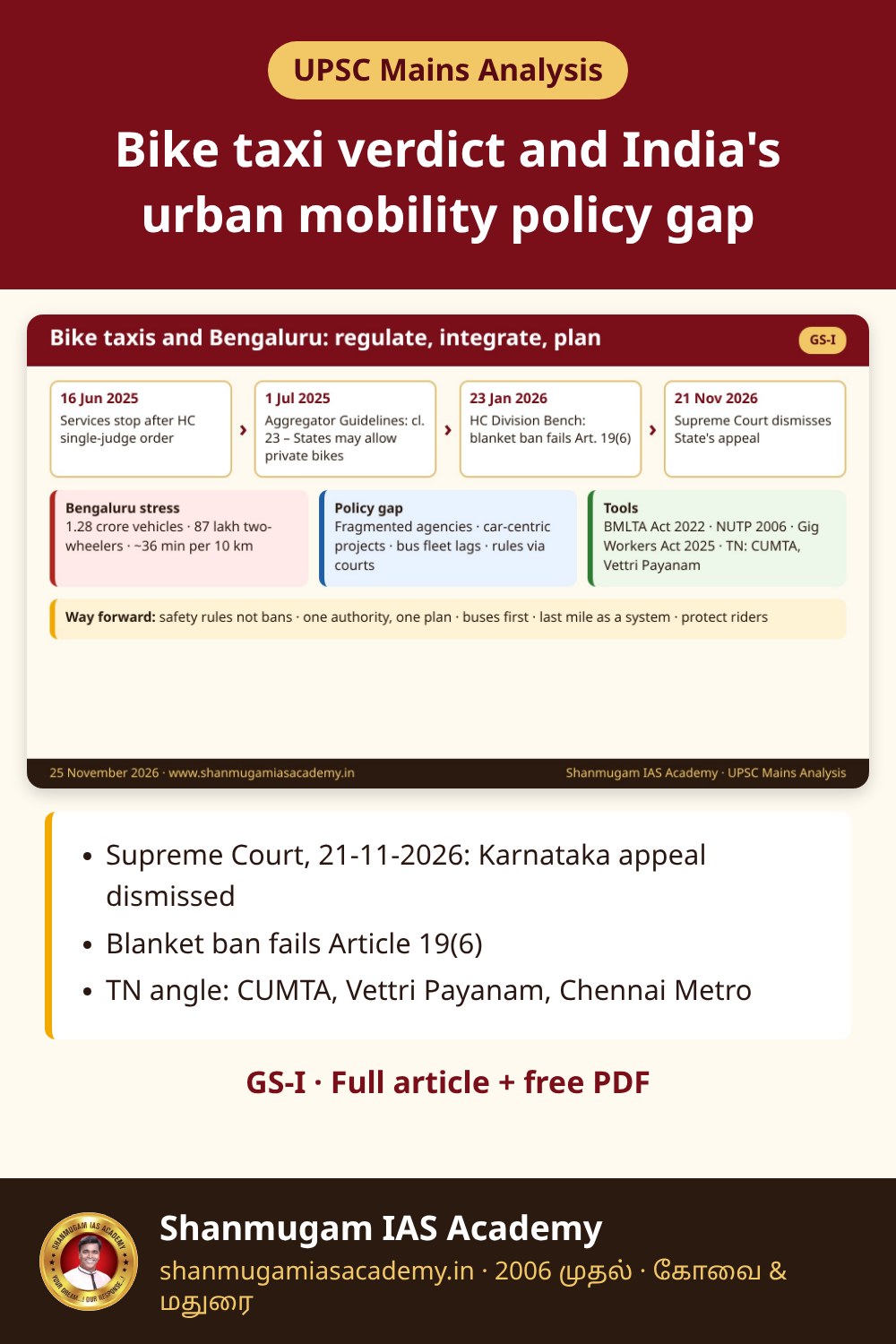
One-page summary of this article – save it or share it with friends
Related on our site: UPSC Mains Analysis – all articles · UPSC glossary · UPSC Mains answer-writing practice · Free PDF downloads
Add us as a preferred source on Google
Link to this page from your website / blog (HTML code)
BANK Achievers
-

PRAVEEN
BANK BANK
நடப்பு நிகழ்வுகள் 25 நவம்பர் 2026 | Today Current Affairs in Tamil | TNPSC Group 4 வினா விடை
📚 TNPSC குரூப் 4 / 2 / 2A – பொதுத்தமிழ், பொது அறிவு நூல்கள்
PDF நூல்கள் · ₹149 முதல் · ஒவ்வொன்றுக்கும் 50 பக்க இலவச மாதிரி · UPI-இல் பணம் செலுத்தியதும் உடனே பதிவிறக்கம்
 பொதுத் தமிழ் — முழுமையான கையேடு (TNPSC குரூப் 2 · 2A · 4)
₹199
 TNPSC முழுமையான பாடநூல்கள் – முழுத் தொகுப்பு (9 நூல்கள்)
₹1599
 TNPSC குரூப் 4 பொதுத் தமிழ் – முழுமையான தேர்வுக் களஞ்சியம் 2026
₹249
 பொதுத் தமிழ் — முந்தைய ஆண்டு வினா – விடை – விளக்கம் (புதிய பாடத்திட்டம்)
₹199
TNPSC குரூப் 1, 2/2A, 4 – நேரடி வகுப்புகள் · கோவை & மதுரை
2006 முதல் சண்முகம் IAS அகாடமி · Classroom & online coaching in Coimbatore and Madurai
