

Mains Analysis: India's anaemia – a problem beyond iron
26 November 2026 · English Health
⬇ Download this analysis as free PDF
Topics: Social Justice – Health, Nutrition, Vulnerable Sections · GS-II · UPSC Mains Analysis

Faculty view: U. Shunmugam – Founder, Shanmugam IAS Academy (since 2006); faced the UPSC Civil Services (IAS) Interview
Key takeaways
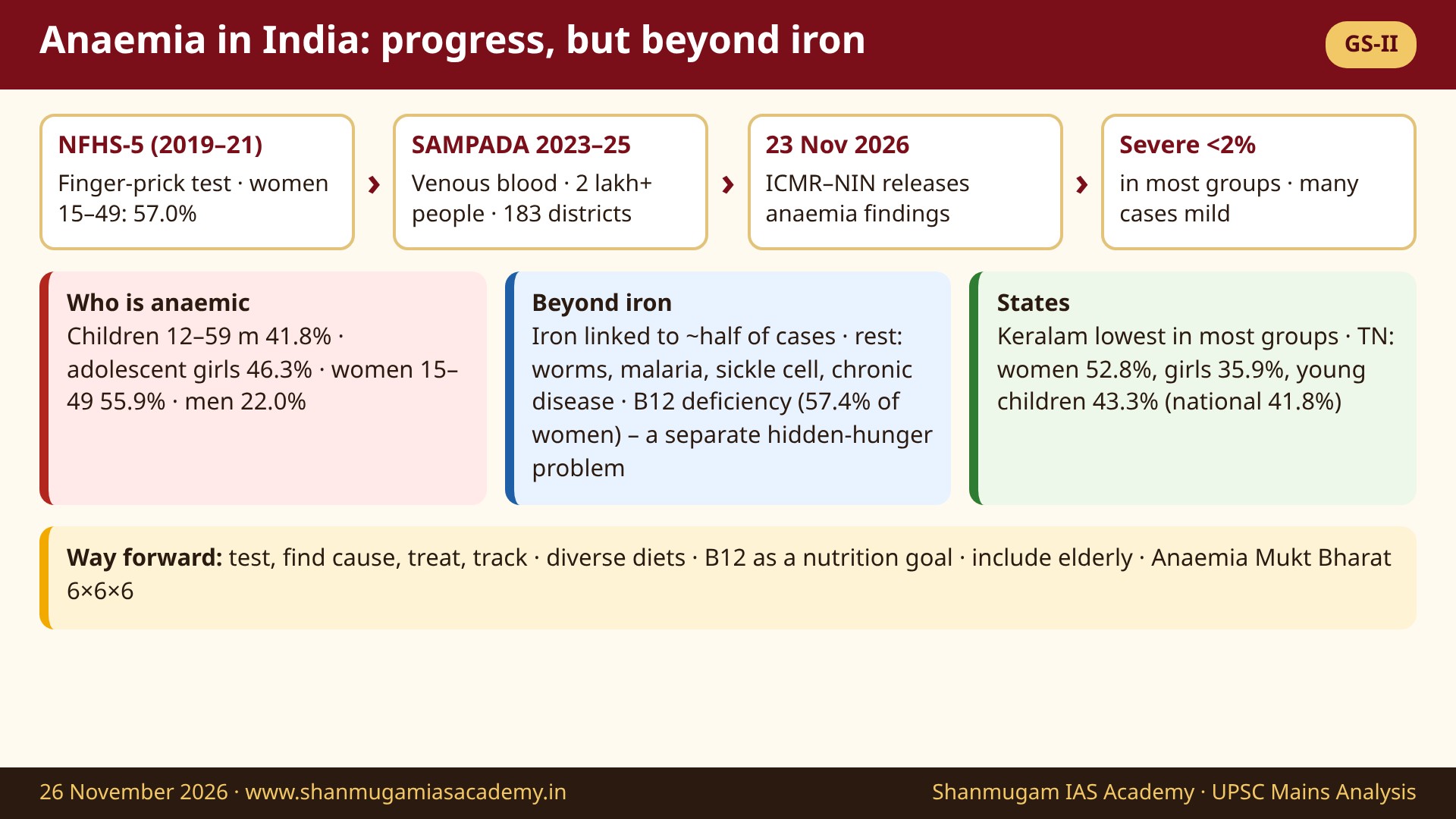
- ICMR–NIN released the anaemia findings of SAMPADA 2023–25 on 23 November 2026 – over 2 lakh people, 183 districts, 35 States/UTs, venous blood. Anaemia: children 12–59 months 41.8%, adolescent girls 46.3%, women 15–49 55.9%, men 20–59 22.0%; severe anaemia below 2% in most groups.
- Figures are lower than NFHS-5 (women 57.0%, children 67.1%), partly because SAMPADA used the more accurate venous method and WHO 2024 cut-offs, and the groups are not identical. Iron deficiency is linked to only about half of the anaemia among women, adolescent girls and children. Vitamin B12 deficiency is very high (57.4% of women 15–49) but is a separate hidden-hunger problem, not a main cause of anaemia.
- Response must move from "iron for all" to "test, find the cause, treat and track": diverse diets, deworming, B12 as a separate nutrition goal, include the elderly. Keralam lowest in most groups; Tamil Nadu girls 35.9% but young children 43.3%. Anaemia Mukt Bharat (6×6×6). PYQ: Prelims 2023, GS-II 2018.

Why in news
On 23 November 2026 the ICMR–National Institute of Nutrition (NIN), Hyderabad released the anaemia findings of SAMPADA 2023–25 (Survey for Assessment of Markers of Population Health, Activity, Diet and Anthropometry). It tested blood drawn from a vein (venous blood) – over 2 lakh people in more than 81,000 households, 183 districts and 35 States and UTs, with over 1.7 lakh blood samples analysed.
The good news: anaemia is lower than earlier national surveys showed, and severe anaemia is below 2% in most age groups. The hard news: more than half of India's women are still anaemic, and iron deficiency is linked to only about half of the cases among women, adolescent girls and children – the rest need other explanations.
What the survey found
| Group | Anaemia (SAMPADA 2023–25) | Iron deficiency | Vitamin B12 deficiency |
|---|---|---|---|
| Children 12–59 months | 41.8% | 23.0% | 37.3% |
| Children 5–9 years | 31.3% | 17.6% | 46.5% |
| Adolescent girls 10–19 | 46.3% | 36.3% | 65.4% |
| Adolescent boys 10–19 | 22.8% | 10.0% | 66.1% |
| Women 15–49 (not pregnant or lactating) | 55.9% | 34.1% | 57.4% |
| Pregnant women | 43.6% | 29.6% | 63.1% |
| Lactating women | 58.1% | 26.6% | 51.8% |
| Men 20–59 | 22.0% | 3.4% | 60.4% |
States and UTs: Keralam has the lowest anaemia among children, adolescent girls, women and men aged 20–59 (for example 14.5% among young children and 28.0% among women aged 20–59). The highest are Andhra Pradesh for young children (57.5%), Ladakh for adolescent girls (70.6%), Andaman and Nicobar Islands for women aged 20–59 (80.0%) and Assam for adult men (46.8%).
Background: why the numbers fell – and why caution is needed
- Earlier picture (NFHS-5, 2019–21): anaemia was 67.1% among children aged 6–59 months, 57.0% among women aged 15–49, 59.1% among girls aged 15–19 and 25.0% among men aged 15–49.
- Better method: NFHS used a finger-prick (capillary) blood drop on a point-of-care device. SAMPADA used venous blood tested on automated analysers within 4–6 hours – the "gold standard". It also used the WHO 2024 haemoglobin cut-offs. So part of the fall comes from better measurement, not only from real improvement. Comparisons must be made carefully: the women's figure is almost unchanged (57.0% → 55.9%), and the child figures cover different age bands (6–59 months in NFHS-5, 12–59 months in SAMPADA).
- Many cases are mild: about half the cases among children, adolescent girls and women are mild; among men and adolescent boys about three-quarters are mild. Mild anaemia is easier and cheaper to correct early.
- What anaemia is: too little haemoglobin – the iron-containing protein in red blood cells that carries oxygen. It causes tiredness, poor concentration, lower work capacity, and risks in pregnancy such as low birth weight and maternal death.
Analysis: a problem beyond iron
| Issue | What SAMPADA shows | Why it matters |
|---|---|---|
| Iron is only part | Anaemia with iron deficiency is about 27% among adolescent girls and women 15–49, against total anaemia of 46% and 56% | So iron is linked to only about half of the cases; iron tablets alone cannot end anaemia – causes must be found person by person |
| Hidden hunger | Vitamin B12 deficiency is very high in all groups (57.4% of women 15–49, 60.4% of men); its rate is similar in anaemic and non-anaemic people | B12 deficiency is not a main driver of anaemia across the population, but it is a separate, widespread nutrition problem (it harms nerves and growth) – linked to diets low in milk, eggs and other animal foods |
| Diet quality | The burden is spread across rich and poor States, men and women | The gap is dietary diversity, not only food quantity – cereals fill the plate, pulses, vegetables, fruit and milk do not |
| Other causes | Many cases are not explained by iron, B12 or folate | Worm infections, malaria, inherited blood disorders (such as sickle cell disease and thalassaemia) and chronic disease also cause anaemia |
| New group: the elderly | 55.7% of women and 44.7% of men aged 60+ are anaemic | Programmes have focused on mothers and children; ageing India needs screening of older people too |
| Women carry the load | Women 20–59: 54.8%; men 20–59: 22.0% | Menstruation, pregnancy, eating last and least at home, and low awareness |
What the government is doing
- Anaemia Mukt Bharat (2018) under POSHAN Abhiyaan – a 6×6×6 strategy: 6 beneficiary groups, 6 interventions, 6 institutional mechanisms. Interventions include iron and folic acid supplements, twice-yearly deworming (National Deworming Day), Test, Treat and Talk (T3) camps, delayed cord clamping at birth, food fortification and attention to non-nutritional causes (malaria, haemoglobinopathies, fluorosis).
- Rice fortification: fortified rice (with iron, folic acid and vitamin B12) is supplied through the Public Distribution System, PM POSHAN and ICDS; in October 2024 the Union Cabinet extended universal supply up to December 2028.
- National Sickle Cell Anaemia Elimination Mission (2023) – screening and care in tribal areas, with the goal of eliminating sickle cell disease as a public health problem by 2047.
Static syllabus link
- GS-II: issues relating to health and nutrition; welfare schemes for vulnerable sections – women, children, adolescents; role of data in policy (NFHS, SAMPADA).
- GS-I: role of women; social issues – gender gap in nutrition within the household.
- GS-III: food security and the public distribution system; food processing and fortification.
Tamil Nadu angle
- Tamil Nadu figures (SAMPADA): women 15–49 – 52.8%; adolescent girls – 35.9% (well below the national 46.3%); men 20–59 – 17.3%. But among young children (12–59 months) the State is at 43.3% – slightly above the national 41.8%. Even a well-performing State cannot be complacent.
- The State's strengths can be used better: the Perunthalaivar Kamarajar Breakfast Scheme in schools, maternity benefit support with nutrition kits for pregnant women and door-step health services can add regular haemoglobin testing and diet counselling.
Faculty view
Do not write "anaemia is falling, so the problem is solved", and do not write "nothing has improved" either. Write both: (1) Progress – lower prevalence, severe anaemia below 2% in most groups; (2) Caution – a part of the fall is due to the better venous method; (3) The real lesson – iron explains only part, so the response must move from "iron tablets for all" to "test, find the cause, treat and track". Quote two or three SAMPADA numbers and one State example (Keralam lowest). This balance gets marks.
Way forward
- Test and track: screen with reliable methods, find the cause (iron, B12, folate, worms, malaria, inherited disorders) and follow each person until haemoglobin is normal.
- Diverse diets: add pulses, eggs, milk, millets, greens and fruit to school meals, anganwadi food and PDS baskets; promote kitchen gardens.
- Fight hidden hunger: treat B12 deficiency as a separate nutrition goal – more milk, eggs and fortified foods, and targeted B12 where tests show a need.
- Reach new groups: include the elderly and adolescent boys, not only mothers and young children.
- Change behaviour: awareness on diet, deworming, hygiene and equal food for girls and women at home.
- Use State data: plan district by district, learning from Keralam.
Glossary – Hidden hunger
Hidden hunger means a lack of essential vitamins and minerals (micronutrients) such as iron, vitamin B12, folate, zinc, iodine and vitamin A, even when a person eats enough food to fill the stomach. It is "hidden" because there is often no visible sign at first – the person is not starving, but the body cannot make enough healthy blood, fight infection well or grow and learn fully. Anaemia is its most common sign. The cure is not just more food but better food – a diverse diet (pulses, green leafy vegetables, eggs, milk, fruits), fortified staples, supplements where needed and control of infections. The SAMPADA survey (2023–25) found very high vitamin B12 deficiency – for example 57.4% among women aged 15–49 – a clear case of hidden hunger.
Asked before in UPSC
1. Mains, GS-II 2018: "How far do you agree with the view that the focus on lack of availability of food as the main cause of hunger takes the attention away from ineffective human development policies in India?"
2. Prelims 2023: a question on the interventions under the Anaemia Mukt Bharat strategy – deworming, delayed cord clamping, non-nutritional causes (malaria, haemoglobinopathies, fluorosis); the supplement it provides is iron and folic acid, not calcium.
Mains practice question
"Anaemia in India is not merely an iron-deficiency problem." Discuss in the light of recent survey findings and suggest a multi-pronged strategy. (15 marks, 250 words)
FAQ
What is the SAMPADA survey?
SAMPADA (Survey for Assessment of Markers of Population Health, Activity, Diet and Anthropometry) 2023–25 is a national survey by ICMR–National Institute of Nutrition, Hyderabad. Its anaemia findings were released on 23 November 2026. It covered over 2 lakh people in 183 districts of 35 States and UTs and tested venous blood.
How common is anaemia in India now?
About 41.8% of children aged 12–59 months, 46.3% of adolescent girls, 55.9% of women aged 15–49 and 22.0% of men aged 20–59 are anaemic. Severe anaemia is below 2% in most groups.
Why are SAMPADA figures lower than NFHS-5?
SAMPADA tested venous blood on automated analysers, which is more accurate than the finger-prick method used in NFHS, and it used WHO 2024 cut-offs. So part of the fall is due to the better method.
Is anaemia only due to iron deficiency?
No. Anaemia with iron deficiency is only about 27% among adolescent girls and women, while total anaemia is 46% and 56%. Other causes include vitamin B12 and folate deficiency, worm infections, malaria, inherited blood disorders and chronic disease.
Which State has the lowest anaemia?
Keralam has the lowest anaemia among children, adolescent girls and adults aged 20–59, for example 14.5% among young children and 28.0% among women aged 20–59.
Related on our site: UPSC Mains Analysis – all articles · UPSC glossary · UPSC Mains answer-writing practice · Free PDF downloads
Add us as a preferred source on Google
Link to this page from your website / blog (HTML code)
TNPSC Achievers
-
RAJENDRAN
TNPSC TNPSC
27 November 2026 Current Affairs in Tamil | நடப்பு நிகழ்வுகள் | TNPSC Group 4 வினா விடை
📚 TNPSC குரூப் 4 / 2 / 2A – பொதுத்தமிழ், பொது அறிவு நூல்கள்
PDF நூல்கள் · ₹149 முதல் · ஒவ்வொன்றுக்கும் 50 பக்க இலவச மாதிரி · UPI-இல் பணம் செலுத்தியதும் உடனே பதிவிறக்கம்
 பொதுத் தமிழ் — முழுமையான கையேடு (TNPSC குரூப் 2 · 2A · 4)
₹199
 TNPSC முழுமையான பாடநூல்கள் – முழுத் தொகுப்பு (9 நூல்கள்)
₹1599
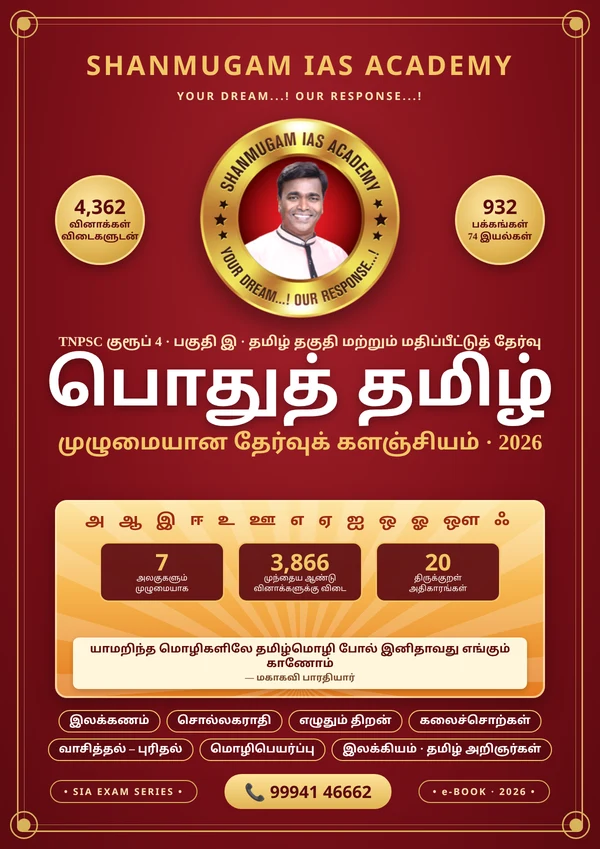 TNPSC குரூப் 4 பொதுத் தமிழ் – முழுமையான தேர்வுக் களஞ்சியம் 2026
₹249
 பொதுத் தமிழ் — முந்தைய ஆண்டு வினா – விடை – விளக்கம் (புதிய பாடத்திட்டம்)
₹199
TNPSC குரூப் 1, 2/2A, 4 – நேரடி வகுப்புகள் · கோவை & மதுரை
2006 முதல் சண்முகம் IAS அகாடமி · Classroom & online coaching in Coimbatore and Madurai
