

Mains Analysis: Data centre boom – big money, few jobs?
26 November 2026 · English Infrastructure & Energy
⬇ Download this analysis as free PDF
Topics: Indian Economy – Investment, Infrastructure, Employment · GS-III · UPSC Mains Analysis

Faculty view: U. Shunmugam – Founder, Shanmugam IAS Academy (since 2006); faced the UPSC Civil Services (IAS) Interview
Key takeaways
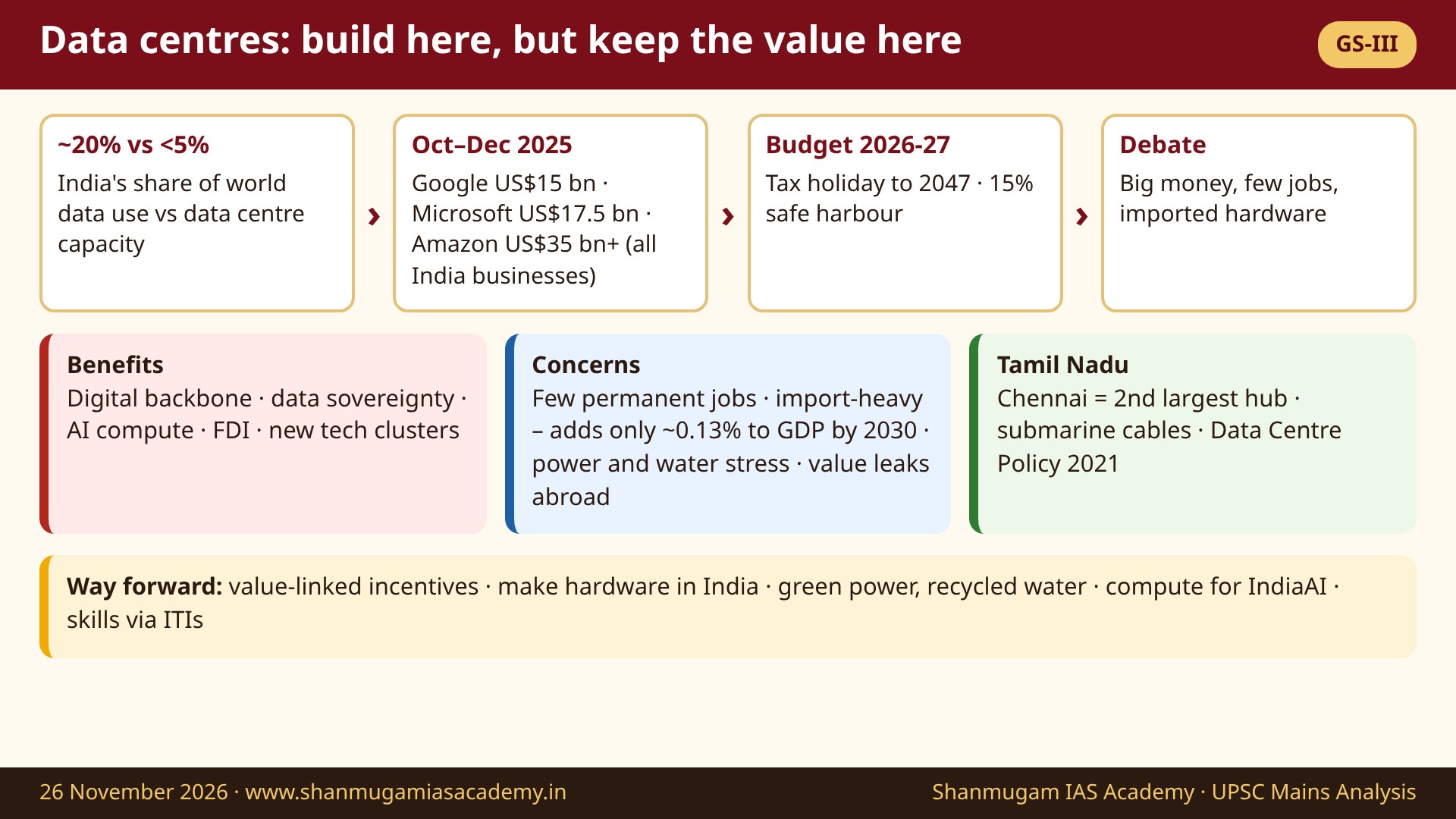
- India uses nearly 20% of the world's data but has less than 5% of global data centre capacity (about 1.3–1.5 GW in 2026). Big announcements: Google US$15 billion AI hub at Visakhapatnam (Oct 2025), Microsoft US$17.5 billion for cloud and AI and Amazon over US$35 billion by 2030 across all its India businesses (Dec 2025).
- Budget 2026-27 offered a tax holiday up to 2047 to notified foreign cloud companies serving global customers from Indian data centres (Indian customers through an Indian reseller) and a 15% cost-plus safe harbour. Concern: few permanent jobs, imported hardware – Moody's estimates only ~0.13% of GDP by 2030 – and heavy power and water use.
- Answer = conditional support: link incentives to Indian users, local manufacturing, skills and green power/recycled water; reserve compute for IndiaAI. Tamil Nadu: Chennai is the 2nd largest hub (submarine cables), Data Centre Policy 2021. PYQ: GS-III 2023, Prelims 2018.

Why in news
India is in the middle of a data centre rush. Global technology companies and Indian groups have announced tens of billions of dollars for cloud and AI data centres, and States compete to host them with cheap land, power and tax waivers. A debate has now opened: these projects are very large in money but small in jobs, and much of the equipment is imported. Is India building digital infrastructure for itself, or renting out land, power and water to serve computing demand abroad?
Key facts
| Item | Details |
|---|---|
| Capacity | About 1.3–1.5 GW of data centre capacity in 2026 as per industry estimates; expected to grow four to five times by 2030 |
| Data vs capacity | India uses nearly 20% of the world's data but has less than 5% of global data centre capacity |
| Big announcements | Google – US$15 billion AI hub at Visakhapatnam (October 2025, with Indian partners); Microsoft – US$17.5 billion for cloud and AI (December 2025); Amazon – over US$35 billion by 2030 across all its India businesses, including AWS cloud (December 2025) |
| Budget 2026-27 | Tax holiday up to 2047 for notified foreign cloud companies serving global customers from Indian data centres; sales to Indian customers must go through an Indian reseller company; 15% cost-plus safe harbour for related Indian data centre firms |
| Hubs | Mumbai and Chennai hold about two-thirds of operating capacity; Chennai is the second largest hub, helped by submarine cable landings |
| Power | AI data centres need many times more power per rack than older ones; their share of India's electricity use is expected to rise sharply by 2030 |
Background: what a data centre is
- A data centre is a secure building full of servers, storage and network equipment that stores data and runs applications – from UPI payments and video streaming to training and running AI models. It needs round-the-clock power, cooling (often water-based) and fibre connectivity.
- Why now: AI models need far more computing power; India's own data use is rising fast; some sector rules (such as RBI's 2018 payment data storage rule) require data to be stored in India, while the Digital Personal Data Protection Act, 2023 allows transfer abroad except to countries the Centre restricts.
- Policy support: IndiaAI Mission (2024) for shared GPU computing; infrastructure status for data centres (2022) for easier loans; State data centre policies (Tamil Nadu, Uttar Pradesh, Telangana and others).
Analysis: benefits and concerns
| Benefits | Concerns |
|---|---|
| Digital backbone: faster, safer services for UPI, Aadhaar, e-governance, start-ups and AI | Few jobs: highly capital-intensive – construction jobs are temporary; permanent jobs are few and specialised |
| Data sovereignty: Indian data stored and processed under Indian law | Import-heavy: servers, chips, cooling and power gear mostly imported – Moody's estimates the boom may add only about 0.13% to GDP by 2030 |
| Investment and FDI: large, long-term capital; boosts construction, power and fibre networks | Power and water stress: heavy, round-the-clock demand on grids and local water, often in already water-stressed cities |
| AI capacity: local computing for Indian languages and public AI tools | Value leaks abroad: if compute mainly serves foreign customers, profits and know-how stay with foreign firms while India bears the resource cost |
| State revenue and clusters: new tech hubs (Chennai, Navi Mumbai, Hyderabad, Visakhapatnam) | Race to the bottom: States compete with land, power and tax waivers – public cost per job can be very high |
The core question: a data centre is like a port or a power plant – essential infrastructure. But public support should be judged by what stays in India: Indian users served, Indian-made equipment, skills, tax and clean energy – not by headline investment alone.
Static syllabus link
- GS-III: Indian economy – mobilisation of resources, growth, development and employment; investment models; infrastructure – energy; awareness in IT, computers; challenges to internal security through communication networks (data security).
- GS-II: government policies and interventions; Centre–State cooperation and competition (State incentive policies).
Tamil Nadu angle
- Chennai is India's second largest data centre hub after Mumbai, because of submarine cable landing stations on the coast, reliable power and a large IT workforce. Tamil Nadu released a dedicated Data Centre Policy in 2021.
- The State's lesson: link incentives to local value – renewable power purchase, treated or recycled water for cooling instead of groundwater, training for Tamil Nadu ITI and polytechnic students in data centre operations, and local manufacturing of electrical and cooling equipment around the hubs.
Faculty view
Avoid a one-sided answer. Examiners want a balance: (1) India needs data centres – it uses about 20% of the world's data but has under 5% of capacity; (2) but they create few jobs, are import-heavy and use a lot of power and water; (3) so the answer is "conditional support" – link incentives to Indian users, domestic manufacturing, skills and green energy. Use the Budget 2026-27 tax holiday up to 2047 and the Moody's 0.13% of GDP estimate as two sharp facts. Add a Chennai example.
Way forward
- Value-linked incentives: tie tax and land benefits to measurable outcomes – Indian customers served, local procurement, jobs and skills.
- Make the hardware here: use electronics and semiconductor schemes to make servers, racks, cooling and power equipment in India.
- Green and water-wise: require renewable power and water-efficient or recycled-water cooling; publish energy and water use.
- Compute for India: reserve a share of capacity for IndiaAI, public research and start-ups at fair prices.
- Grid planning: plan transmission and storage with data centre clusters so that households and farms are not hit.
- Skills: courses for electricians, cooling technicians, network and security staff through ITIs and polytechnics.
Glossary – Hyperscaler
A hyperscaler is a very large cloud company that runs huge networks of data centres and can quickly scale computing power and storage up or down for millions of users across the world – for example the cloud arms of Amazon, Microsoft and Google. A hyperscale data centre holds thousands of servers and draws tens or hundreds of megawatts of electricity. For India the question is not only how many hyperscale facilities come here, but how much value stays here – in jobs, Indian-made equipment, tax and control over data. Budget 2026-27 offered a tax holiday up to 2047 to notified foreign cloud companies that serve global customers from data centres in India.
Asked before in UPSC
1. Mains, GS-III 2023: "Most of the unemployment in India is structural in nature. Examine the methodology adopted to compute unemployment in the country and suggest improvements."
2. Prelims 2018: a question on the aims of the "Digital India" plan – one statement said it aims to encourage overseas companies that collect Big Data to build large data centres in India; that statement was not among the plan's aims (connecting villages to the Internet and Wi-Fi in schools and public places was).
Mains practice question
"India's data centre boom brings large investment but limited employment and domestic value." Critically examine, and suggest how public policy can maximise the benefits for India. (15 marks, 250 words)
FAQ
What is a data centre?
A data centre is a secure building with servers, storage and network equipment that stores data and runs online services and AI models. It needs constant power, cooling and fibre connectivity.
What did Budget 2026-27 offer data centres?
A tax holiday up to 2047 for notified foreign cloud companies that serve global customers using data centres in India, with sales to Indian customers routed through an Indian reseller company, and a 15% cost-plus safe harbour for related Indian data centre firms.
Why do data centres create few jobs?
They are capital-intensive: most money goes into land, buildings, imported servers, chips and cooling. Construction jobs are temporary and permanent staff are few and highly skilled.
How much data centre capacity does India have?
Around 1.3–1.5 GW in 2026 by industry estimates, expected to grow several times by 2030. India uses nearly 20% of the world's data but has less than 5% of global data centre capacity.
Why is Chennai a data centre hub?
Chennai has submarine cable landing stations, reliable power and a large IT workforce; it is the second largest hub after Mumbai, and Tamil Nadu has a Data Centre Policy (2021).
Related on our site: UPSC Mains Analysis – all articles · UPSC glossary · UPSC Mains answer-writing practice · Free PDF downloads
Add us as a preferred source on Google
Link to this page from your website / blog (HTML code)
TNPSC Achievers
-

MOHAMMAD ALI
TNPSC TNPSC
27 November 2026 Current Affairs in Tamil | நடப்பு நிகழ்வுகள் | TNPSC Group 4 வினா விடை
📚 TNPSC குரூப் 4 / 2 / 2A – பொதுத்தமிழ், பொது அறிவு நூல்கள்
PDF நூல்கள் · ₹149 முதல் · ஒவ்வொன்றுக்கும் 50 பக்க இலவச மாதிரி · UPI-இல் பணம் செலுத்தியதும் உடனே பதிவிறக்கம்
 பொதுத் தமிழ் — முழுமையான கையேடு (TNPSC குரூப் 2 · 2A · 4)
₹199
 TNPSC முழுமையான பாடநூல்கள் – முழுத் தொகுப்பு (9 நூல்கள்)
₹1599
 TNPSC குரூப் 4 பொதுத் தமிழ் – முழுமையான தேர்வுக் களஞ்சியம் 2026
₹249
 பொதுத் தமிழ் — முந்தைய ஆண்டு வினா – விடை – விளக்கம் (புதிய பாடத்திட்டம்)
₹199
TNPSC குரூப் 1, 2/2A, 4 – நேரடி வகுப்புகள் · கோவை & மதுரை
2006 முதல் சண்முகம் IAS அகாடமி · Classroom & online coaching in Coimbatore and Madurai
