

Mains Analysis: US tariffs on India – Section 301 move explained
27 November 2026 · English International
⬇ Download this analysis as free PDF
Topics: International Relations – India–US Relations, Trade Policy · GS-II · UPSC Mains Analysis

Faculty view: U. Shunmugam – Founder, Shanmugam IAS Academy (since 2006); faced the UPSC Civil Services (IAS) Interview
Key takeaways
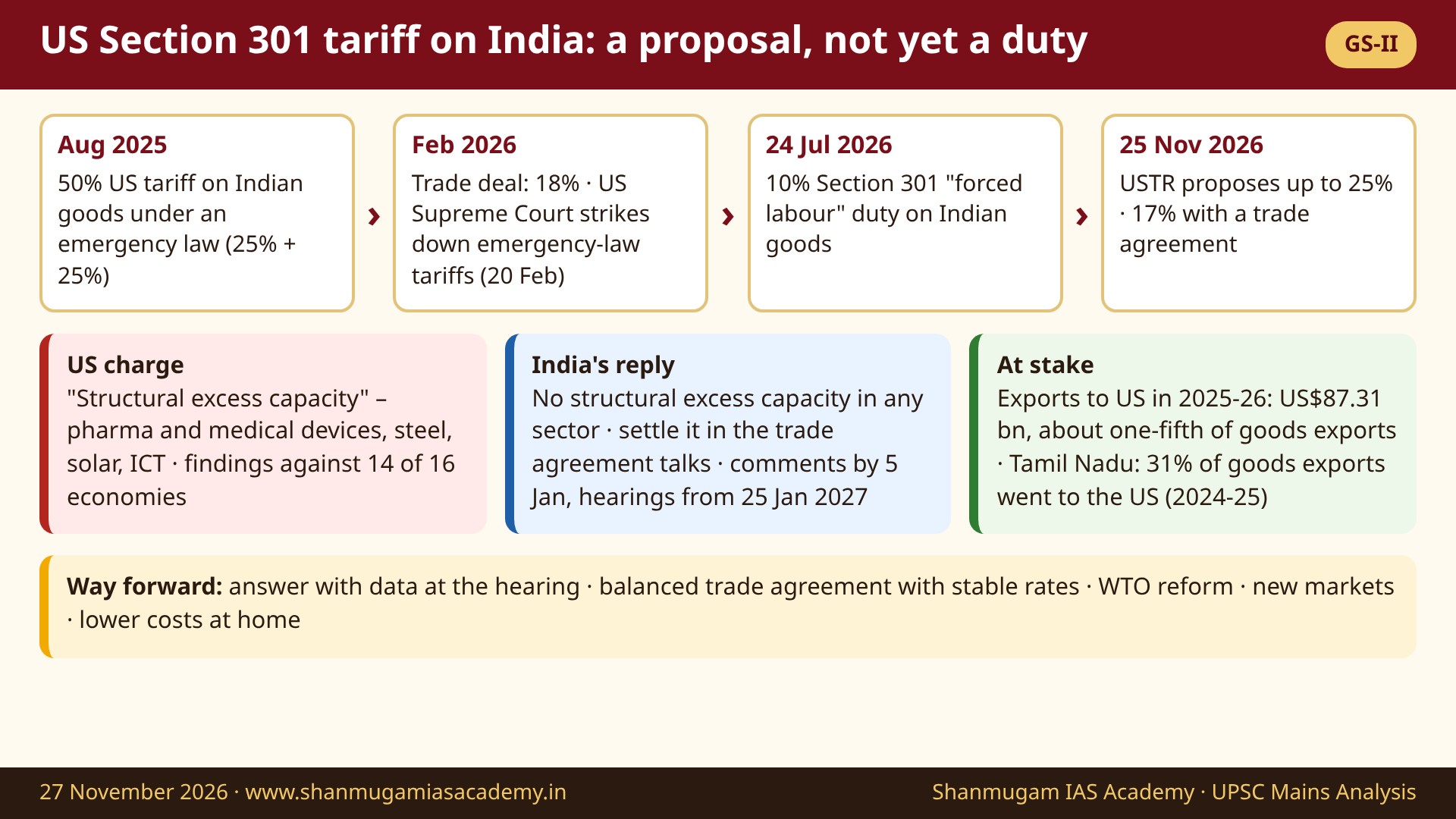
- On 25 November 2026 the USTR proposed tariffs of up to 25% on Indian goods under Section 301, or 17% if India signs a trade agreement; it is not yet in force. It found "structural excess capacity" in manufacturing in 14 economies, including India (16 were investigated from 11 March 2026). Comments are due by 5 January 2027 and public hearings begin on 25 January 2027.
- India's Department of Commerce rejected the charge the same day – no structural excess capacity in any sector – and wants the matter settled in the Bilateral Trade Agreement talks. Background: the 2025 emergency-law tariffs (50% on India, cut to 18% in February 2026) were struck down by the US Supreme Court on 20 February 2026; a 10% Section 122 tariff lapsed on 24 July 2026; a 10% Section 301 "forced labour" duty has applied since then.
- At stake: exports of US$87.31 billion to the US in 2025-26, about one-fifth of India's goods exports; 31% of Tamil Nadu's goods exports went to the US in 2024-25. Answer = reply with data at the hearing, close a balanced agreement with stable rates, press for WTO reform, find new markets, become more competitive. PYQ: GS-II 2018, GS-III 2018.

Why in news
On 25 November 2026 the Office of the United States Trade Representative (USTR) announced its findings in 14 investigations under Section 301 of the US Trade Act of 1974. It held that the policies of 14 economies, including India, create "structural excess capacity" in manufacturing and burden US commerce. For India it proposed an additional tariff of up to 25% on all goods, with some exemptions. The rate may be brought down to 17% if India signs a trade agreement that answers these findings.
India's Department of Commerce replied the same day: India does not have structural excess capacity in any sector, the US notice is being examined, and trade concerns should be settled within the ongoing talks on the India–US Bilateral Trade Agreement (BTA). The tariff is still only a proposal. Written comments are due by 5 January 2027 and public hearings begin on 25 January 2027.
Key facts
| Item | Details |
|---|---|
| Legal tool | Section 301(b) of the US Trade Act of 1974 – allows the USTR to act against a foreign policy or practice that it finds "unreasonable or discriminatory" and a burden on US commerce |
| Investigations | Opened on 11 March 2026 against 16 economies. Findings on 25 November 2026 against 14: China, the European Union, Singapore, Switzerland, Indonesia, Malaysia, Cambodia, Thailand, South Korea, Vietnam, Taiwan, Bangladesh, Japan and India. Mexico and Norway are not included for now |
| USTR's charges against India | Government plans to expand manufacturing; weak labour protections; "financial repression"; long-standing market access barriers; failure to deal with global excess capacity. Sectors named: pharmaceuticals and medical devices, steel, solar, and information and communications technology (ICT) |
| Proposal for India | Additional tariff of up to 25% on all Indian goods, "net of" the existing Section 301 duty (the existing duty is counted within this rate, not added over it). May be adjusted to 17% if India concludes a trade agreement that addresses the findings |
| Exemptions | Goods already under Section 232 national-security tariffs (such as steel, aluminium, copper, vehicles and their parts) and a list of exempt products given in the notice |
| Proposals for others | Vietnam up to 35% (20% with an agreement); China up to 20%; Singapore up to 20% (10% with an agreement); Bangladesh, Cambodia, Indonesia, Malaysia and Thailand up to 18%; the European Union 15%; Japan, South Korea, Switzerland and Taiwan up to 15% |
| Next steps | Written comments and requests to appear by 5 January 2027; public hearings from 25 January 2027. No date has been fixed for the tariff to start |
| Trade at stake | India's goods exports to the US in 2025-26: US$87.31 billion – about one-fifth of India's total goods exports (US$441.78 billion). Imports from the US: US$52.90 billion. The US is India's largest export market |
Background: how the tariff returned under a different law
| Date | What happened |
|---|---|
| August 2025 | The US imposed a 25% "reciprocal" tariff on Indian goods from 7 August and a further 25% from 27 August for India's purchase of Russian oil – 50% in all – using an emergency law, the International Emergency Economic Powers Act (IEEPA), 1977 |
| 2 and 7 February 2026 | India and the US announced a trade deal; the US rate on Indian goods was cut to 18%. A Joint Statement of 7 February set out the framework for an Interim Agreement: India would remove or reduce tariffs on all US industrial goods and many US farm products, and intends to buy US$500 billion of US energy, aircraft, technology products and other goods over five years |
| 20 February 2026 | The US Supreme Court held, by 6–3, in Learning Resources v. Trump that IEEPA does not allow the President to impose tariffs. The "reciprocal" tariffs lost their legal basis |
| 24 February 2026 | A 10% global tariff was imposed under Section 122 of the Trade Act of 1974, which permits such a tariff for only 150 days. It lapsed on 24 July 2026 |
| March 2026 | The USTR opened Section 301 investigations – on structural excess capacity (16 economies, 11 March) and on failure to ban imports made with forced labour (60 economies) |
| 24 July 2026 | A 10% Section 301 "forced labour" duty began on Indian goods (12.5% had been proposed). About 45% of India's exports to the US, including generic medicines and smartphones, fall outside it |
| 25 November 2026 | Excess-capacity findings against 14 economies; up to 25% proposed for India, 17% with a trade agreement |
The pattern: the tariff that the court struck down in February is coming back through other laws – first Section 122, then Section 301. For an Indian exporter the legal label has changed, but the uncertainty has not.
Four US tariff laws at a glance
| Law | Ground | Main feature |
|---|---|---|
| Section 301, Trade Act of 1974 | Unfair foreign trade practices | The USTR investigates, holds hearings and can then impose tariffs on a country's goods; the law fixes no ceiling on the rate |
| Section 232, Trade Expansion Act of 1962 | National security | Sector-wise tariffs after a Commerce Department inquiry – steel, aluminium, copper, vehicles |
| Section 122, Trade Act of 1974 | Balance-of-payments problems | Up to 15% for a maximum of 150 days unless the US Congress extends it |
| IEEPA, 1977 | National emergency | Used for the 2025 "reciprocal" tariffs; the US Supreme Court ruled on 20 February 2026 that it does not authorise tariffs |
Analysis: what it means for India
| Issue | What it means |
|---|---|
| A contested charge | The USTR points to industrial plans such as Make in India and Production Linked Incentives, and India does sell more goods to the US than it buys (exports of US$87.31 billion against imports of US$52.90 billion in 2025-26). India replies that it has no structural excess capacity in any sector, and it buys far more from the world than it sells: its overall merchandise trade deficit was US$333.19 billion in 2025-26 |
| A bargaining tool | Two rates – 25% without an agreement, 17% with one – turn the tariff into pressure to sign quickly. The February 2026 framework was built on an 18% rate that the court ruling of 20 February 2026 later removed, which delayed the final talks |
| A thin edge over rivals | With an agreement India would pay 17%, against up to 18% proposed for Bangladesh, Cambodia, Indonesia, Malaysia and Thailand, and 20% for Vietnam if it signs an agreement – a small advantage. Without an agreement, 25% would put Indian textiles, leather and other labour-intensive goods well behind |
| Which goods are exposed | In January–March 2026, electrical and electronic goods made up about 32% of India's exports to the US, medicines about 10%, machinery about 8% and gems and jewellery about 6%. Much depends on which goods stay on the exemption list |
| Unilateral action and the WTO | Under Article 23 of the WTO's dispute rules, members must bring trade complaints to the WTO and not decide violations on their own. In 2020 a WTO panel held that US Section 301 tariffs on Chinese goods broke the most-favoured-nation (MFN) rule and the US tariff ceilings. The US appealed; as the WTO Appellate Body has not functioned since December 2019, the case is still open |
| Uncertainty itself is a cost | Since August 2025 the US duty on Indian goods has moved from 50% to 18%, then to 10%, and may now rise again. Buyers and exporters cannot plan orders, prices or investment |
India's response so far
- Statement of 25 November 2026: the Department of Commerce said India had engaged constructively throughout the investigation and had told the USTR that India has no structural excess capacity in any sector. It said trade concerns should be handled within the bilateral trade negotiations and reaffirmed its commitment to an early conclusion of the BTA announced on 2 February 2026.
- Trade agreement talks: in October 2026 Commerce Minister Piyush Goyal said the first tranche of the agreement had been finalised and the legal text was being drafted. It has not yet been signed.
- Forced-labour investigation: in the final US measures of July 2026 India was placed in the lower 10% tier instead of the 12.5% first proposed.
- Other markets: India signed a trade agreement with the United Kingdom in July 2025 (in force since 15 July 2026), its agreement with the four EFTA countries came into force on 1 October 2025, and negotiations for a free trade agreement with the European Union were concluded on 27 January 2026.
Static syllabus link
- GS-II: bilateral agreements involving India; effect of policies and politics of developed countries on India's interests; important international institutions – the WTO and its dispute settlement system.
- GS-III: Indian economy – external sector, exports, effects of liberalisation; changes in industrial policy (Make in India, Production Linked Incentive schemes).
Tamil Nadu angle
- Tamil Nadu depends on the US market more than India as a whole. According to figures given by the State government in August 2025, 31% of the State's goods exports of US$52.1 billion in 2024-25 went to the US, against 20% for India; the State also accounted for 28% of India's textile exports.
- The exposed clusters are well known: knitwear in Tiruppur, home textiles in Karur, leather and footwear in Ambur and Ranipet, and auto components and electronics around Chennai and Hosur. A 25% rate, when up to 18% is proposed for Bangladesh, Cambodia, Indonesia, Malaysia and Thailand (Vietnam: up to 35%, or 20% with an agreement), would hurt these labour-intensive units first; a 17% rate would give only a narrow edge.
- What the State can do: help small exporters find new markets, speed up refunds and credit, and cut power and logistics costs so that units can absorb tariff shocks.
Faculty view
Do not write this answer in an angry tone, and do not treat the 25% as already imposed. Write three clear parts: (1) What – Section 301 findings of 25 November 2026 against 14 economies; up to 25% proposed for India, 17% with a trade agreement; hearings from 25 January 2027. (2) Why it is questionable – India denies any structural excess capacity; the US is acting alone instead of going to the WTO; and a country-wide tariff has returned under a different law after the US Supreme Court ruling of 20 February 2026. (3) What India should do – answer with data at the hearing, close a balanced trade agreement with stable rates, widen export markets and become more competitive at home. One date, one number and one WTO point in each part will earn marks.
Way forward
- Use the process: the government and exporters' bodies should file sector-wise data before 5 January 2027 and speak at the hearings to show that India has no surplus capacity aimed at the US market.
- Conclude the trade agreement, but with certainty: seek a clear, all-inclusive rate and a commitment that new duties under other US laws will not be added later; protect sensitive farm and dairy interests.
- Keep the WTO route alive: work with other affected economies for WTO reform and the revival of the Appellate Body, so that trade disputes are decided by rules and not by power.
- Spread the risk: use the agreements with the UK and the EFTA countries, and sign and bring into force the agreement concluded with the EU, to reduce dependence on a single market.
- Answer the labour and market-access points on merit: implement the four Labour Codes, in force since 21 November 2025, and review trade barriers that also hurt Indian consumers and exporters.
- Raise competitiveness: cheaper logistics and power, faster refunds and easy credit help small exporters more than any temporary relief.
Glossary – Structural excess capacity
Structural excess capacity means factory capacity that stays far above what buyers at home and abroad actually need – not for a season, but year after year – because government support (subsidies, cheap loans, low wages, protected markets) keeps the factories running. The extra output is pushed into export markets, often at low prices, and creates trade surpluses for the producer and pressure on industries elsewhere. The term has been used most often for steel, aluminium and solar equipment. On 25 November 2026 the US Trade Representative used it against 14 economies, including India, under Section 301 of the US Trade Act of 1974 and proposed extra tariffs. India rejects the charge: its Department of Commerce says India has no structural excess capacity in any sector.
Asked before in UPSC
1. Mains, GS-II 2018: "What are the key areas of reform if the WTO has to survive in the present context of 'Trade War', especially keeping in mind the interest of India?"
2. Mains, GS-III 2018: "How would the recent phenomena of protectionism and currency manipulations in world trade affect macroeconomic stability of India?"
Mains practice question
"Unilateral trade measures such as the US Section 301 tariff proposals test both India's trade diplomacy and the WTO's rules-based order." Discuss, and suggest how India should respond. (15 marks, 250 words)
FAQ
What is Section 301 of the US Trade Act?
Section 301 of the US Trade Act of 1974 allows the US Trade Representative (USTR) to investigate the trade practices of other countries. If it finds them unfair – for example unreasonable or discriminatory and a burden on US commerce – it can impose tariffs or other restrictions on that country's goods.
What tariff has the US proposed on India?
On 25 November 2026 the USTR proposed an additional tariff of up to 25% on all Indian goods, with some exemptions, saying that India's policies create structural excess capacity in manufacturing. The rate may be adjusted to 17% if India concludes a trade agreement that addresses the findings.
Is the 25% US tariff on India already in force?
No. It is a proposal. Written comments are due by 5 January 2027 and public hearings begin on 25 January 2027. No starting date has been fixed.
What US tariff do Indian goods face now?
Since 24 July 2026 an additional 10% Section 301 "forced labour" duty applies over the normal duty. About 45% of India's exports to the US, such as generic medicines and smartphones, are outside it, and goods such as steel and aluminium face separate Section 232 tariffs.
How did India respond to the US tariff proposal?
India's Department of Commerce said on 25 November 2026 that India has no structural excess capacity in any sector and that the US notice is being examined. It added that trade concerns should be settled within the talks on the India–US Bilateral Trade Agreement.
Related on our site: UPSC Mains Analysis – all articles · UPSC glossary · UPSC Mains answer-writing practice · Free PDF downloads
Add us as a preferred source on Google
Link to this page from your website / blog (HTML code)
SI/POLICE Achievers
-

RAMA KRISHNA PERUMAL
SI/POLICE SI/POLICE
27 November 2026 Current Affairs in Tamil | நடப்பு நிகழ்வுகள் | TNPSC Group 4 வினா விடை
📚 TNPSC குரூப் 4 / 2 / 2A – பொதுத்தமிழ், பொது அறிவு நூல்கள்
PDF நூல்கள் · ₹149 முதல் · ஒவ்வொன்றுக்கும் 50 பக்க இலவச மாதிரி · UPI-இல் பணம் செலுத்தியதும் உடனே பதிவிறக்கம்
 பொதுத் தமிழ் — முழுமையான கையேடு (TNPSC குரூப் 2 · 2A · 4)
₹199
 TNPSC முழுமையான பாடநூல்கள் – முழுத் தொகுப்பு (9 நூல்கள்)
₹1599
 TNPSC குரூப் 4 பொதுத் தமிழ் – முழுமையான தேர்வுக் களஞ்சியம் 2026
₹249
 பொதுத் தமிழ் — முந்தைய ஆண்டு வினா – விடை – விளக்கம் (புதிய பாடத்திட்டம்)
₹199
TNPSC குரூப் 1, 2/2A, 4 – நேரடி வகுப்புகள் · கோவை & மதுரை
2006 முதல் சண்முகம் IAS அகாடமி · Classroom & online coaching in Coimbatore and Madurai
