

Mains Analysis: Urea policy 2026 (NIPU-2026) – six new plants
27 November 2026 · English Agriculture
⬇ Download this analysis as free PDF
Topics: Indian Economy – Agriculture, Fertiliser Subsidy, Industry · GS-III · UPSC Mains Analysis

Faculty view: U. Shunmugam – Founder, Shanmugam IAS Academy (since 2006); faced the UPSC Civil Services (IAS) Interview
Key takeaways
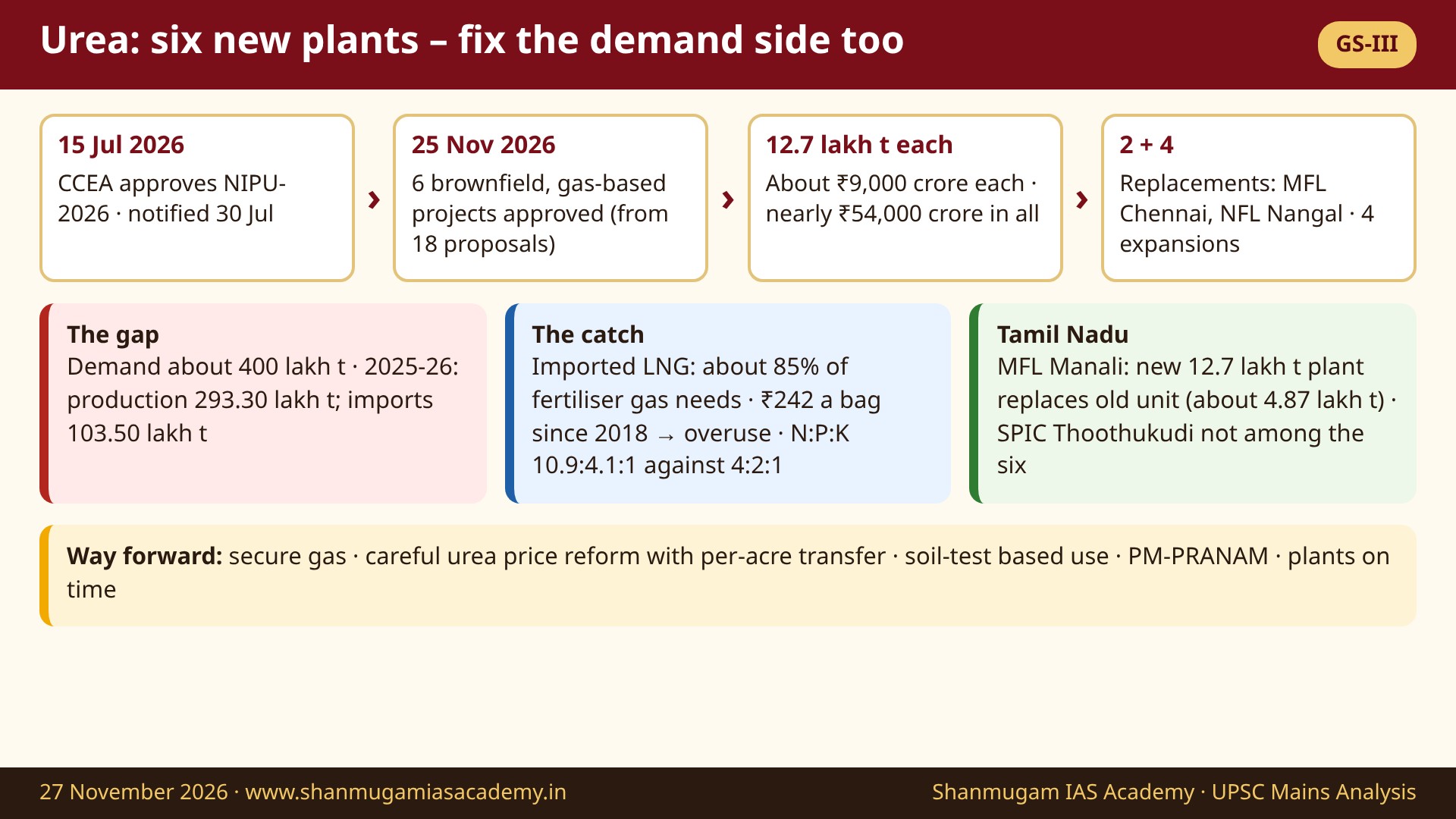
- On 25 November 2026 the Centre approved six brownfield, gas-based urea projects of 12.7 lakh tonnes each under NIPU-2026, at a cost of nearly ₹54,000 crore. Two replace old public-sector units (MFL Chennai, NFL Nangal); four add capacity at Shahjahanpur, Jagdishpur, Panagarh and Gadepan. NIPU-2026: CCEA approval on 15 July 2026, notified on 30 July 2026, Return on Equity band of 12–16%.
- Why: demand is about 400 lakh tonnes a year; production was 293.30 lakh tonnes in 2025-26 and imports rose to 103.50 lakh tonnes (56.47 lakh tonnes in 2024-25). The catch: imported LNG meets about 85% of the fertiliser sector's gas needs according to an ICRA estimate, and urea at ₹242 for a 45-kg bag is overused – the N:P:K ratio was about 10.9:4.1:1 in 2023-24 against the advised 4:2:1.
- Answer = build the plants and secure the gas, but also correct the demand side: careful price reform with a per-acre transfer as the Economic Survey 2025-26 suggested, soil-test based use, PM-PRANAM, nano urea backed by field trials. Tamil Nadu: a new 12.7 lakh tonne plant replaces MFL Manali's old unit (about 4.87 lakh tonnes); SPIC Thoothukudi is not among the six. PYQ: GS-III 2023, Prelims 2020.

Why in news
On 25 November 2026 the Centre announced the approval of six new brownfield, gas-based urea projects under the National Investment Policy for Urea-2026 (NIPU-2026). Of the 18 proposals received, these six have been taken forward. Each plant will make 12.7 lakh tonnes (1.27 million tonnes) of urea a year and cost about ₹9,000 crore – nearly ₹54,000 crore in all.
Two of them replace old public-sector units – Madras Fertilizers Limited (MFL), Chennai and National Fertilizers Limited (NFL), Nangal. The other four add capacity at existing private and cooperative plants. The aim is self-reliance in urea, which India still imports in large quantities.
The six projects
| Project | State | Sector | Nature |
|---|---|---|---|
| MFL, Manali (Chennai) | Tamil Nadu | Public sector | Replaces the existing old unit |
| NFL, Nangal | Punjab | Public sector | Replaces an old unit of 4.73 lakh tonnes a year |
| KRIBHCO (KFL), Shahjahanpur | Uttar Pradesh | Cooperative | Expands a unit commissioned in 1995 |
| Indorama India (IIPL), Jagdishpur | Uttar Pradesh | Private | Adds capacity at a plant set up in 1988 |
| Matix, Panagarh | West Bengal | Private | Adds to a plant commissioned in 2017 – the State's only urea plant |
| Chambal Fertilisers (CFCL), Gadepan, Kota | Rajasthan | Private | Expands a complex working since 1994 |
Six plants of 12.7 lakh tonnes each mean 76.2 lakh tonnes of new capacity. The net addition will be lower, because the two old units at Chennai and Nangal will be replaced.
Key facts
| Item | Details |
|---|---|
| The policy | NIPU-2026 was approved by the Cabinet Committee on Economic Affairs (CCEA) on 15 July 2026 and notified on 30 July 2026. It is meant for new gas-based urea units and follows the New Investment Policy-2012, whose window for new investment closed in October 2019 |
| What is new in it | Fixed and variable costs are shown separately; a Return on Equity (RoE) band of 12% to 16%; fixed cost is converted into rupees after four years to reduce exchange-rate risk; the government expects to save over ₹250 crore per plant compared with the 2012 policy |
| Demand and production | Demand is about 400 lakh tonnes a year. Production rose from 225 lakh tonnes (2014-15) to a record 314.07 lakh tonnes (2023-24), but was 293.30 lakh tonnes in 2025-26. India has 33 working urea units with a reassessed capacity of 269.42 lakh tonnes |
| Imports | 56.47 lakh tonnes in 2024-25; 103.50 lakh tonnes in 2025-26. Subsidy spent on imported urea rose from ₹21,000 crore to ₹47,956 crore |
| Energy use | The new norm is 5 Gcal of energy per tonne of urea. The industry's weighted average is 5.95 Gcal; the old Nangal unit uses 6.498 Gcal |
| Also under way | Two more plants of 12.7 lakh tonnes each: Talcher, Odisha (coal-gasification route, expected by December 2027) and Namrup, Assam |
Background: urea and its price
- What urea is: the most used fertiliser in India and the main source of nitrogen for crops (about 46% nitrogen). It is made from ammonia and carbon dioxide; the ammonia is made by the Haber–Bosch process using hydrogen from natural gas. So gas is the key raw material.
- Controlled price: urea is sold at a maximum retail price fixed by law – ₹242 for a 45-kg bag (before neem-coating charges and taxes), unchanged since March 2018. The Centre pays makers and importers the gap between cost and this price. Union Budget 2026-27 provided about ₹1.71 lakh crore for fertiliser subsidy (urea and other fertilisers together).
- Other fertilisers: phosphatic and potassic fertilisers have been under the Nutrient Based Subsidy scheme since 2010 – a fixed subsidy per kg of nutrient, with retail prices set by companies. They cost the farmer much more than urea.
- Earlier steps: the New Investment Policy-2012 (announced on 2 January 2013) led to six plants of 12.7 lakh tonnes each – Ramagundam, Gorakhpur, Sindri and Barauni through public-sector joint ventures, and Gadepan and Panagarh in the private sector. All urea has been neem-coated since 2015 to slow the release of nitrogen and stop diversion to industry. IFFCO began commercial production of liquid nano urea on 1 August 2021. Under One Nation One Fertiliser (2022), subsidised fertilisers are sold under the single brand "Bharat". PM-PRANAM, approved on 28 June 2023, gives a State 50% of the subsidy it saves when it uses less chemical fertiliser than its average of the previous three years.
Analysis: gains and gaps
| Gains | Gaps |
|---|---|
| Fewer imports: imports met about 27% of the urea requirement in 2025-26, by ICRA's estimate. The new plants (gross capacity 76.2 lakh tonnes; the net addition is lower because two of them replace old units) can cover a large part of this and save foreign exchange | Imported gas: ICRA estimates that imported LNG met about 85% of the fertiliser sector's gas needs in 2025-26, up from 64% in 2020-21. India may stop importing urea but will import more gas to make it |
| Safety in a crisis: plants at home protect farmers when world prices jump or shipping is disrupted | Same risk, new form: in March 2026, when LNG supplies fell during the West Asia crisis, urea output was nearly 27% lower than a year earlier |
| Efficiency: the new energy norm is 5 Gcal per tonne, against 6.498 Gcal at the old Nangal unit – less gas and less subsidy for every tonne | Time: ICRA expects such plants to take about 3.5 to 4 years; self-sufficiency improves in a real sense only from 2030-31 |
| Brownfield advantage: land, utilities, logistics and trained staff already exist; the government estimates annual savings of about ₹225 crore from these advantages | Overuse untouched: cheap urea has pushed the N:P:K ratio from 4:3.2:1 (2009-10) to 7:2.8:1 (2019-20) and about 10.9:4.1:1 (2023-24), against the advised 4:2:1. More urea at ₹242 a bag does not heal the soil |
| Balanced spread: projects in five States – Tamil Nadu, Punjab, Uttar Pradesh, West Bengal and Rajasthan – by public, private and cooperative units | Fiscal and environmental cost: assured returns are paid through subsidy; excess nitrogen lowers soil organic matter, sends nitrate into groundwater and releases nitrous oxide, a greenhouse gas |
The core point: self-sufficiency in making urea is not the same as sustainability in using it. The Economic Survey 2025-26 noted that in several irrigated belts the yield response to fertiliser has flattened or fallen even as use has risen. It suggested a modest increase in the retail price of urea with an equal amount paid to cultivators per acre, using the PM-KISAN platform and starting with pilots in a few agro-climatic regions.
Static syllabus link
- GS-III: issues related to direct and indirect farm subsidies; agricultural inputs and cropping patterns; infrastructure – energy (natural gas); changes in industrial policy; environmental pollution and degradation (soil and water).
- GS-II: government policies and interventions for development; Centre–State cooperation (PM-PRANAM).
Tamil Nadu angle
- MFL at Manali, Chennai is a central public sector undertaking. It was incorporated on 8 December 1966 and began commercial production on 1 November 1971. Its urea plant can make about 4.87 lakh tonnes a year. It ran on naphtha until April 2019 and moved to regasified LNG, supplied from the Ennore LNG terminal, in July 2019.
- The new 12.7 lakh tonne plant will be more than two and a half times the size of the present unit. For farmers in Tamil Nadu and neighbouring States it means more urea from a nearby plant.
- The SPIC urea plant at Thoothukudi, a private unit that has also moved fully to natural gas, is not among the six projects.
- Tamil Nadu's task goes beyond supply: soil-test based advice in the Cauvery delta and other paddy areas, and wider use of organic manure and bio-fertilisers, so that urea is used in the right dose.
Faculty view
A common mistake is to write only the "good news" – six plants, ₹54,000 crore, self-reliance. The examiner wants the second half too. Write it as supply side and demand side. Supply: NIPU-2026 (CCEA, 15 July 2026), six brownfield plants of 12.7 lakh tonnes, imports of 103.50 lakh tonnes in 2025-26 to be cut; but the gas is largely imported. Demand: urea at ₹242 a bag since 2018, N:P:K ratio of about 10.9:4.1:1 against 4:2:1, falling soil health. End with a balanced line: build the plants, secure the gas, and correct the price signal step by step without hurting the farmer. Add MFL Manali as the Tamil Nadu example.
Way forward
- Secure the gas: long-term LNG contracts from varied suppliers, priority for domestic gas, and steady work on other routes – coal gasification (Talcher) and green ammonia.
- Correct the price signal carefully: test the Economic Survey's idea – a modest rise in the urea price with an equal per-acre transfer – in pilot regions, taking care that tenant farmers are not left out.
- Balance the nutrients: soil-test based recommendations through Soil Health Cards; narrow the price gap between urea and phosphatic and potassic fertilisers.
- Use less, use better: PM-PRANAM incentives for States, nano urea backed by independent field trials, organic manure and bio-fertilisers.
- Stop leakage: neem coating and Aadhaar-linked sales at fertiliser shops to check diversion of subsidised urea to non-farm use.
- Build on time and to the norm: fix clear timelines for the six projects and hold every plant to the 5 Gcal energy norm.
Glossary – Nutrient Based Subsidy (NBS)
Under the Nutrient Based Subsidy (NBS) scheme, in force since 1 April 2010 for phosphatic and potassic (P&K) fertilisers such as DAP and MOP, the Centre fixes a subsidy per kilogram of each nutrient – nitrogen (N), phosphorus (P), potassium (K) and sulphur (S) – and the companies set the retail price. Urea is outside NBS: its maximum retail price is fixed by law at ₹242 for a 45-kg bag (before neem-coating charges and taxes), and the Centre pays the rest of the cost as subsidy. Because urea stays far cheaper than other fertilisers, farmers apply too much nitrogen. The N:P:K use ratio, which should be about 4:2:1, had moved to about 10.9:4.1:1 by 2023-24. This is why new urea plants alone cannot solve India's fertiliser problem.
Asked before in UPSC
1. Mains, GS-III 2023: "What are the direct and indirect subsidies provided to farm sector in India? Discuss the issues raised by the World Trade Organization (WTO) in relation to agricultural subsidies."
2. Prelims 2020: a question on chemical fertilisers in India. Two statements were correct – ammonia, an input of urea, is produced from natural gas; and sulphur, a raw material for phosphoric acid fertiliser, is a by-product of oil refineries. The statement that the retail price of chemical fertilisers is market-driven and not administered by the Government was wrong.
Mains practice question
"New urea plants can end India's dependence on imported urea, but not its fertiliser problem." Examine in the light of the National Investment Policy for Urea-2026 and suggest reforms for balanced fertiliser use. (15 marks, 250 words)
FAQ
What is NIPU-2026?
The National Investment Policy for Urea-2026 is the Centre's policy to attract investment in new gas-based urea plants and make India self-reliant in urea. The Cabinet Committee on Economic Affairs approved it on 15 July 2026 and it was notified on 30 July 2026. It offers a Return on Equity band of 12% to 16%.
Which six urea projects were approved on 25 November 2026?
MFL at Manali, Chennai and NFL at Nangal, Punjab (both replace old public-sector units); KRIBHCO at Shahjahanpur and Indorama India at Jagdishpur in Uttar Pradesh; Matix at Panagarh, West Bengal; and Chambal Fertilisers at Gadepan, Rajasthan. Each will make 12.7 lakh tonnes a year; the total investment is nearly ₹54,000 crore.
How much urea does India produce and import?
Demand is about 400 lakh tonnes a year. Production was 293.30 lakh tonnes in 2025-26, after a record 314.07 lakh tonnes in 2023-24. Imports were 103.50 lakh tonnes in 2025-26, up from 56.47 lakh tonnes in 2024-25.
Why is urea overused in India?
Its retail price is fixed by law at ₹242 for a 45-kg bag and has not changed since March 2018, while other fertilisers cost much more. So farmers apply too much nitrogen: the N:P:K ratio was about 10.9:4.1:1 in 2023-24 against the advised 4:2:1.
Which Tamil Nadu urea plant is among the six projects?
The Madras Fertilizers Limited (MFL) plant at Manali, Chennai. A new 12.7 lakh tonne plant will replace its existing urea unit of about 4.87 lakh tonnes. The SPIC plant at Thoothukudi is not among the six.
Related on our site: UPSC Mains Analysis – all articles · UPSC glossary · UPSC Mains answer-writing practice · Free PDF downloads
Add us as a preferred source on Google
Link to this page from your website / blog (HTML code)
BANK Achievers
-

KIRUBA
BANK BANK
27 November 2026 Current Affairs in Tamil | நடப்பு நிகழ்வுகள் | TNPSC Group 4 வினா விடை
📚 TNPSC குரூப் 4 / 2 / 2A – பொதுத்தமிழ், பொது அறிவு நூல்கள்
PDF நூல்கள் · ₹149 முதல் · ஒவ்வொன்றுக்கும் 50 பக்க இலவச மாதிரி · UPI-இல் பணம் செலுத்தியதும் உடனே பதிவிறக்கம்
 பொதுத் தமிழ் — முழுமையான கையேடு (TNPSC குரூப் 2 · 2A · 4)
₹199
 TNPSC முழுமையான பாடநூல்கள் – முழுத் தொகுப்பு (9 நூல்கள்)
₹1599
 TNPSC குரூப் 4 பொதுத் தமிழ் – முழுமையான தேர்வுக் களஞ்சியம் 2026
₹249
 பொதுத் தமிழ் — முந்தைய ஆண்டு வினா – விடை – விளக்கம் (புதிய பாடத்திட்டம்)
₹199
TNPSC குரூப் 1, 2/2A, 4 – நேரடி வகுப்புகள் · கோவை & மதுரை
2006 முதல் சண்முகம் IAS அகாடமி · Classroom & online coaching in Coimbatore and Madurai
