

Mains Analysis: Lok Sabha delimitation – 131st vs 132nd Bills
28 November 2026 · English Polity & Governance
⬇ Download this analysis as free PDF
Topics: Indian Polity – Parliament, Federalism, Constitutional Amendments · GS-II · UPSC Mains Analysis

Faculty view: U. Shunmugam – Founder, Shanmugam IAS Academy (since 2006); faced the UPSC Civil Services (IAS) Interview
Key takeaways
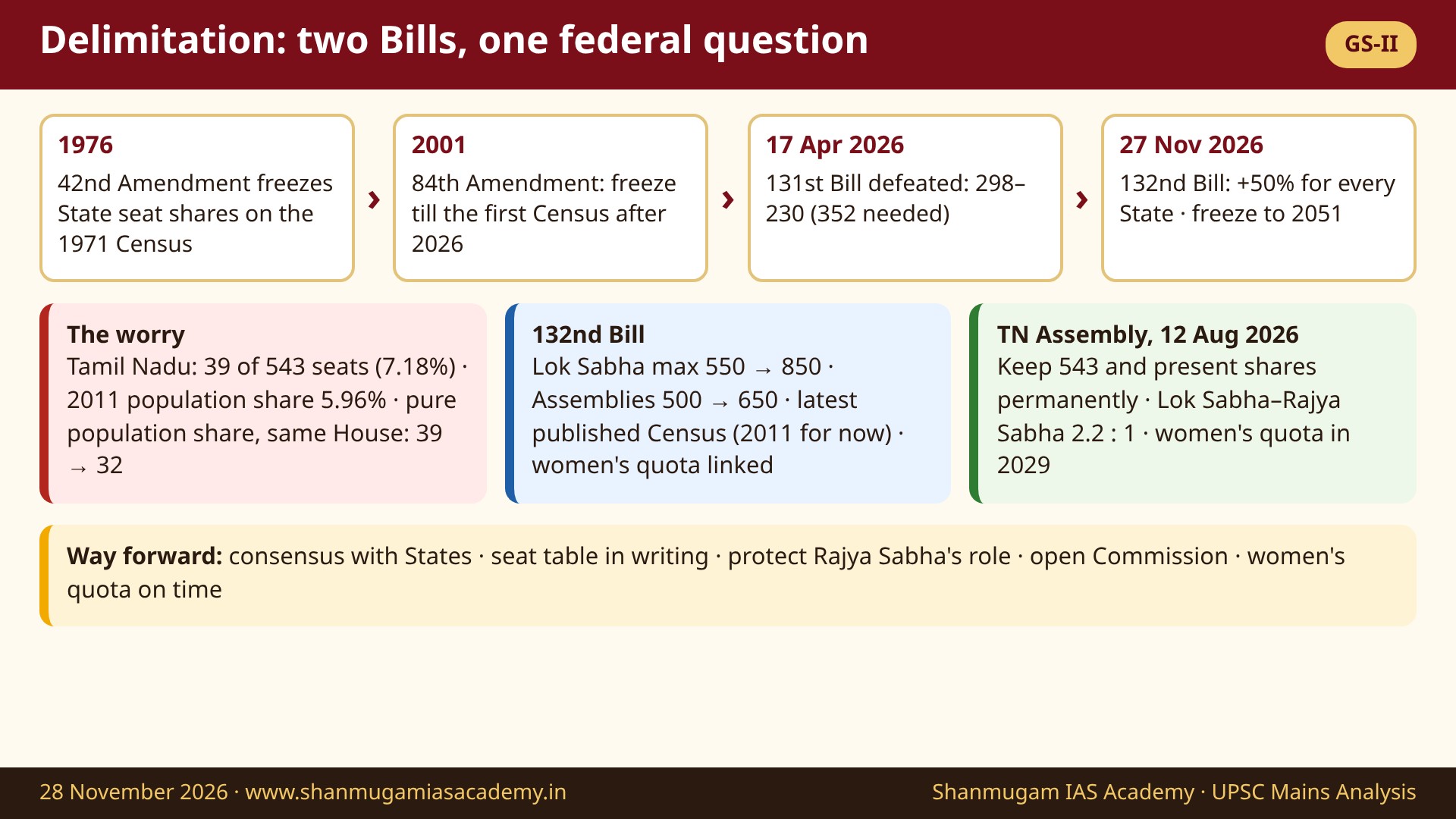
- The Constitution (132nd Amendment) Bill, made public on 27 November 2026, would raise every State's Lok Sabha seats by 50% and freeze the shares till 2051. The maximum Lok Sabha size would rise from 550 to 850 and the Assembly ceiling from 500 to 650; constituencies would be redrawn on the latest published Census (2011 until Census 2027 figures come). It is expected in the Lok Sabha on 30 November 2026.
- It replaces the 131st Amendment Bill, defeated in the Lok Sabha on 17 April 2026 (298 for, 230 against; 352 needed), which would have shared seats by population. The freeze dates from the 42nd Amendment (1976, 1971 Census), extended by the 84th (2001) and adjusted by the 87th (2003). Key Articles: 81, 82, 170, 330, 332.
- The clash: equal value of every vote (an Uttar Pradesh MP represents about 25.0 lakh people, a Keralam MP 16.7 lakh) against fairness to States that controlled population (Tamil Nadu 39 → 32 seats on a pure 2011 population share). Tamil Nadu Assembly, 12 August 2026: keep 543 and the present shares permanently. Answer = consensus, written seat table, Rajya Sabha balance, women's reservation on time.

Why in news
On 27 November 2026 the Union government made public the Constitution (132nd Amendment) Bill, 2026 and a new Delimitation Bill. The amendment Bill proposes to raise the Lok Sabha and Assembly seats of every State by the same 50%, to redraw constituencies on the latest published Census, and then to freeze the inter-State share of seats until 2051. It is expected in the Lok Sabha on 30 November 2026.
It follows the defeat of the Constitution (131st Amendment) Bill, 2026 in the Lok Sabha on 17 April 2026: it got 298 votes for and 230 against, short of the two-thirds of members present and voting (352 of 528) that a constitutional amendment needs. The Delimitation Bill introduced with it was then withdrawn. The question behind both Bills is old: how to share seats fairly among States whose populations have grown at very different speeds.
The two Bills side by side
| Item | 131st Amendment Bill (April 2026) | 132nd Amendment Bill (November 2026) |
|---|---|---|
| Status | Introduced in the Lok Sabha on 16 April 2026; defeated on 17 April 2026 (298–230) | Made public on 27 November 2026; expected in the Lok Sabha on 30 November 2026 |
| Maximum size of the Lok Sabha | 550 → 850 (States up to 815, Union Territories up to 35) | Same: 550 → 850 (States 530 → 815; Union Territories 20 → 35) |
| How seats are shared among States | In proportion to population – the freeze on inter-State shares removed. A uniform 50% rise was promised in the House but was not written into the Bill | Every State's seats rise by the same 50% over its present number, so the shares among States stay as they are |
| Freeze | Removed | Extended to 2051 – Articles 81 and 82 to say "until the year 2051" in place of the first Census after 2026 |
| Census used | Parliament to decide by law; the companion Delimitation Bill used the latest published Census, that is, 2011 | Latest published Census figures on the date of commencement – 2011 until the Census 2027 figures are published |
| Women's reservation | Removed the condition that the one-third reservation must wait for delimitation on the first Census after 2023 | Links the one-third reservation for women (including SC and ST women) to this delimitation; for 15 years, with rotation |
The 132nd Bill also raises the ceiling for a State Assembly in Article 170 from 500 to 650. On the 50% rule, Tamil Nadu's 234-member Assembly would grow to about 351.
The constitutional base
| Provision | What it says |
|---|---|
| Article 81 | Lok Sabha: up to 530 members from States and 20 from Union Territories (maximum 550). Seats are allotted so that the ratio of seats to population is, as far as practicable, the same for every State – this rule does not apply to States with a population of up to 60 lakh |
| Article 82 | After every Census, seats and constituencies are readjusted by an authority that Parliament decides by law – the Delimitation Commission |
| Article 170 | State Assemblies: not more than 500 and not less than 60 members; readjusted after each Census |
| Articles 330 and 332 | Seats reserved for Scheduled Castes and Scheduled Tribes in the Lok Sabha and the Assemblies, in proportion to their population |
| Article 329(a) | A law on delimitation of constituencies or allotment of seats cannot be questioned in any court |
| 106th Amendment (2023) | One-third of seats in the Lok Sabha and Assemblies for women (Articles 330A, 332A, 334A), to begin after delimitation on the first Census after the Act, for 15 years |
How the freeze came about
| Year | Step | Effect |
|---|---|---|
| 1952, 1963, 1973 | Delimitation Commissions under the Acts of 1952, 1962 and 1972 | Seats readjusted after the Censuses of 1951, 1961 and 1971; the present 543-seat Lok Sabha rests on the 1971 Census |
| 1976 | 42nd Amendment | Froze the allocation of seats to States on the 1971 Census until the first Census after 2000, so that States carrying out family planning would not lose seats |
| 2001 | 84th Amendment | Extended the freeze until the first Census after 2026; allowed boundaries inside States to be redrawn |
| 2003 | 87th Amendment | Made the 2001 Census the base for redrawing boundaries inside States |
| 2002–2008 | Delimitation Commission (Justice Kuldip Singh) | Redrew constituencies inside States on the 2001 Census; seats per State unchanged; Lok Sabha seats reserved: 84 for SCs, 47 for STs |
Why the numbers matter
- Tamil Nadu has 39 of the 543 Lok Sabha seats – 7.18%. Its share of India's population in the 2011 Census was 5.96% (7,21,47,030 of 1,21,08,54,977).
- An estimate by PRS Legislative Research (April 2026) shows what a purely population-based share on the 2011 Census would do with an unchanged House: Tamil Nadu 39 → 32, Keralam 20 → 15, Uttar Pradesh 80 → 89, Bihar 40 → 46. Even in a House 50% larger, a population-based share would give Tamil Nadu about 48 seats (about 5.9%).
- The five southern States – Andhra Pradesh, Karnataka, Keralam, Tamil Nadu and Telangana – now hold 129 of 543 seats (about 23.8%). A uniform 50% rise keeps this share; a population-based rise would cut it.
- The other side of the ledger: on the 2011 Census an MP from Uttar Pradesh represents about 25.0 lakh people and one from Rajasthan about 27.4 lakh, against about 18.5 lakh in Tamil Nadu and 16.7 lakh in Keralam. A vote in a large constituency carries less weight.
Each side's stated position
| Who | Stated position |
|---|---|
| Union government | The Bills are meant to bring in the one-third reservation for women; in April 2026 the Home Minister assured the House of a uniform 50% rise for all States, which the 132nd Bill now puts in writing. The Law Minister said the seats reserved for women would come in addition to the existing allocation |
| Opposition parties (April 2026) | Supported women's reservation, but opposed changing the strength of the Lok Sabha and linking it to a Census-based delimitation in the form proposed |
| Tamil Nadu Assembly (12 August 2026) | Government resolution moved by Chief Minister C. Joseph Vijay: keep the Lok Sabha at 543 and the inter-State distribution of seats permanently; keep the Lok Sabha–Rajya Sabha ratio at 2.2 : 1; give 33% reservation to women in the 2029 election; no delimitation on any Census after 1971 that would hurt States which controlled population. Passed with the support of the DMK and other parties; the AIADMK objected but backed the women's reservation part; the DMDK, BJP and PMK opposed. The Chief Minister wrote to the Prime Minister on 13 August 2026 |
| The equal-vote principle | Article 81 itself asks for seats in proportion to population, so that every vote carries similar weight – the case for updating seats to the latest Census |
Analysis: the federal questions
| Issue | What it means |
|---|---|
| Fairness to whom? | Two fair-sounding principles clash: equal value of each vote, and no penalty for States that slowed population growth. The 131st Bill leaned to the first; the 132nd Bill leans to the second |
| An 80-year freeze | If the freeze runs to 2051, the inter-State share of seats will have rested on the 1971 Census for 80 years. The gap in population per MP will keep widening |
| A much larger House | About 815 seats from the States. The cap on ministers under Article 75(1A) – 15% of the Lok Sabha – would rise from about 81 to about 122; each MP gets less time for questions and debate |
| Rajya Sabha balance | The Rajya Sabha stays capped at 250. The Lok Sabha–Rajya Sabha ratio would move from about 2.2 : 1 to about 3.3 : 1, giving the Lok Sabha more weight in joint sittings under Article 108 |
| Timing | The last Commission took six years (2002–2008). Census 2027 has a reference date of 1 March 2027. Tying women's reservation to delimitation ties its start to this timeline |
| Trust in the process | In April the 50% assurance was oral; the Bill's text decides what States actually get. Courts seldom interfere with delimitation orders (Article 329(a) and the Delimitation Act) – since 2024 only a manifestly arbitrary order can be struck down – so the law and the Commission's rules must be clear before it begins |
Static syllabus link
- GS-II: Parliament and State Legislatures – structure, functioning; amendment of the Constitution (Article 368); federal structure and Centre–State issues; Representation of the People and delimitation; issues of vulnerable sections – reservation for SCs, STs and women.
- GS-I: population and associated issues – different rates of population growth across States.
Tamil Nadu angle
- Tamil Nadu (39 seats, 7.18%) and Keralam (20 seats) are among the States with the most to lose from a purely population-based share, and the least from a uniform rise.
- The State's formal position is the Assembly resolution of 12 August 2026 and the Chief Minister's letter of 13 August 2026: a permanent freeze at 543 with the present distribution of seats, the 2.2 : 1 ratio with the Rajya Sabha, and women's reservation in 2029.
- The 132nd Bill meets the demand to keep the State's share, but differs from the resolution on the size of the House (850, not 543) and on the ratio with the Rajya Sabha.
Faculty view
This is a federalism question, not a party question – write it without taking sides. Use three parts: (1) The provisions – Articles 81, 82 and 170; the 42nd (1976), 84th (2001) and 87th (2003) Amendments; the 131st Bill (defeated 298–230 on 17 April 2026) and the 132nd Bill (50% for every State, freeze to 2051). (2) The two principles – equal value of every vote against fairness to States that controlled population; give one number for each (Uttar Pradesh about 25.0 lakh people per MP against Keralam 16.7 lakh; Tamil Nadu 39 → 32 on a pure population share). (3) The way forward – consensus, a written seat table, protection of the Rajya Sabha's role and a time-bound women's reservation. Examiners reward balance and accurate dates.
Way forward
- Build consensus first: discuss the formula with all States – for example in the Inter-State Council – and let a Joint Parliamentary Committee examine the Bills before the vote.
- Put the numbers in writing: publish a State-wise seat table with the Bill, so that no State depends on an oral assurance.
- Protect the federal balance: look at the role of the Rajya Sabha and the Lok Sabha–Rajya Sabha ratio, and at rules such as the limit on ministers, before the House grows.
- Keep the Commission open: public hearings in every State, full use of the associate members drawn from Parliament and the Assemblies, and clear criteria, because court review of its orders is very limited.
- Do not delay women's reservation: fix a clear date so that it does not keep moving with the delimitation timetable.
- Plan for after 2051: a lasting formula that respects both equal votes and the results of population control is better than one freeze after another.
Glossary – Delimitation freeze
A delimitation freeze keeps the number of Lok Sabha and Assembly seats given to each State fixed on an old Census, even after newer Census figures are published. The 42nd Amendment (1976) froze the allocation on the 1971 Census until the first Census after 2000; the 84th Amendment (2001) extended it until the first Census after 2026, while allowing boundaries inside each State to be redrawn – on the 2001 Census after the 87th Amendment (2003). The aim was that States which slowed population growth should not lose seats. The Constitution (132nd Amendment) Bill, 2026 proposes to raise every State's seats by 50% and to extend the freeze to 2051.
Asked before in UPSC
We could not verify an earlier UPSC question on this exact topic against UPSC's own question paper for this article, so none is listed here. The related static areas – Articles 81, 82, 170, 330, 332 and 368, and the Delimitation Commission – are asked often; revise them with the tables above.
Mains practice question
"The delimitation debate sets the equal value of every vote against fairness to States that controlled population growth." Examine with reference to the Constitution (131st and 132nd Amendment) Bills, 2026, and suggest a way forward. (15 marks, 250 words)
FAQ
What is delimitation?
Delimitation is the fixing of the number of seats for each State in the Lok Sabha and Assemblies and the drawing of constituency boundaries, based on Census figures. Under Article 82 it is done by an authority set up by Parliament – the Delimitation Commission. Its orders have the force of law and courts seldom interfere, but in 2024 (Kishorchandra Chhanganlal Rathod v. Union of India) the Supreme Court held that a constitutional court can review an order that is manifestly arbitrary.
What does the Constitution (132nd Amendment) Bill, 2026 propose?
Made public on 27 November 2026, it proposes to raise the Lok Sabha and Assembly seats of every State by the same 50%, to raise the maximum Lok Sabha size from 550 to 850, and to freeze the inter-State share of seats until 2051. Constituencies would be redrawn on the latest published Census, which is 2011 until the Census 2027 figures are published.
How is the 132nd Amendment Bill different from the 131st?
The 131st Bill, defeated in the Lok Sabha on 17 April 2026 by 298 votes to 230, would have shared seats among States in proportion to population and removed the freeze; the promised uniform 50% rise was not in its text. The 132nd Bill writes the 50% rise for every State into the Constitution and extends the freeze to 2051.
Why are southern States worried about delimitation?
Seats have been frozen on the 1971 Census, and southern States have grown more slowly since then. A purely population-based share on the 2011 Census would cut Tamil Nadu from 39 to about 32 seats and Keralam from 20 to about 15 in a House of the same size, while Uttar Pradesh and Bihar would gain.
What did the Tamil Nadu Assembly resolve on delimitation?
On 12 August 2026 the Assembly passed a government resolution asking that the Lok Sabha be kept permanently at 543 with the present distribution of seats among States, that the Lok Sabha–Rajya Sabha ratio stay at 2.2 : 1, and that 33% reservation for women be given in the 2029 election.
Related on our site: UPSC Mains Analysis – all articles · UPSC glossary · UPSC Mains answer-writing practice · Free PDF downloads
Add us as a preferred source on Google
Link to this page from your website / blog (HTML code)
TNPSC Achievers
-

ANANDHAN
TNPSC TNPSC
28 November 2026 TNPSC Current Affairs in Tamil | நடப்பு நிகழ்வுகள் | TNPSC Group 4 வினா விடை
📚 TNPSC குரூப் 4 / 2 / 2A – பொதுத்தமிழ், பொது அறிவு நூல்கள்
PDF நூல்கள் · ₹149 முதல் · ஒவ்வொன்றுக்கும் 50 பக்க இலவச மாதிரி · UPI-இல் பணம் செலுத்தியதும் உடனே பதிவிறக்கம்
 பொதுத் தமிழ் — முழுமையான கையேடு (TNPSC குரூப் 2 · 2A · 4)
₹199
 TNPSC முழுமையான பாடநூல்கள் – முழுத் தொகுப்பு (9 நூல்கள்)
₹1599
 TNPSC குரூப் 4 பொதுத் தமிழ் – முழுமையான தேர்வுக் களஞ்சியம் 2026
₹249
 பொதுத் தமிழ் — முந்தைய ஆண்டு வினா – விடை – விளக்கம் (புதிய பாடத்திட்டம்)
₹199
TNPSC குரூப் 1, 2/2A, 4 – நேரடி வகுப்புகள் · கோவை & மதுரை
2006 முதல் சண்முகம் IAS அகாடமி · Classroom & online coaching in Coimbatore and Madurai
