

Mains Analysis: Front-of-pack food warnings – what the SC ordered
28 November 2026 · English Polity & Governance
⬇ Download this analysis as free PDF
Topics: Governance – Health, Food Regulation, Consumer Rights · GS-II · UPSC Mains Analysis

Faculty view: U. Shunmugam – Founder, Shanmugam IAS Academy (since 2006); faced the UPSC Civil Services (IAS) Interview
Key takeaways
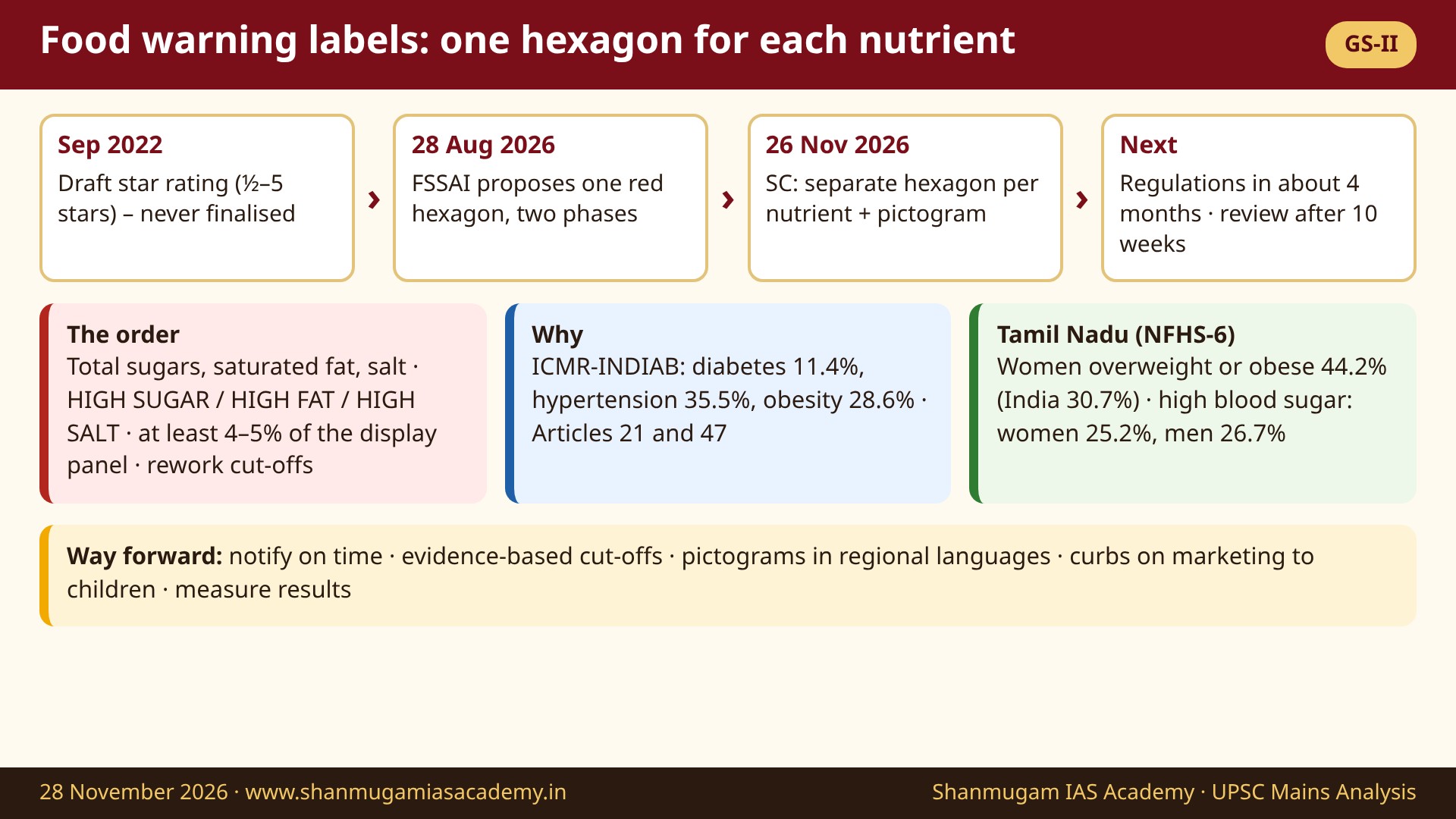
- On 26 November 2026 the Supreme Court ordered a separate front-of-pack hexagon warning – HIGH SUGAR, HIGH FAT or HIGH SALT – for each nutrient on food packs. The Bench of Justices J.B. Pardiwala and K. Vinod Chandran (3S and Our Health Society case) asked for total sugars and saturated fat in place of added sugar and added fat, a standard pictogram, at least 4–5% of the display panel, reworked cut-offs, regulations in about four months and a progress report after ten weeks.
- Background: FSSAI's 2022 star rating (½ to 5 stars, voluntary for 48 months) was never finalised; in August 2026 FSSAI proposed one red hexagon, and the Court chose separate warnings. The burden: ICMR-INDIAB found diabetes 11.4%, hypertension 35.5% and generalised obesity 28.6%; NFHS-6 shows 44.2% of women in Tamil Nadu overweight or obese against 30.7% for India.
- Evidence: in Chile, purchases of "high in" beverages fell 23.7% after its 2016 law, which also curbed marketing to children. Limits: cut-offs, unpackaged and restaurant food, reformulation, literacy, enforcement. Answer = notify on time, evidence-based cut-offs, readable pictograms, marketing curbs, school nutrition literacy, measure results.

Why in news
On 26 November 2026 – Constitution Day – a Bench of Justices J.B. Pardiwala and K. Vinod Chandran of the Supreme Court decided a public interest petition filed under Article 32 by 3S and Our Health Society. It directed the Food Safety and Standards Authority of India (FSSAI) to put a separate front-of-pack warning for each nutrient of concern – a hexagon with a standard pictogram and the words HIGH SUGAR, HIGH FAT or HIGH SALT – in place of the single combined warning that FSSAI had proposed.
The Court accepted FSSAI's own timeline of about four months to complete the regulations, ordered strict adherence to it, and asked for a progress report after ten weeks. The question before it was whether the right to life under Article 21 – read as the right to health, food and informed choice – requires the State to adopt front-of-pack nutrition labelling.
What the judgment says
| Item | Direction |
|---|---|
| Design | A separate hexagon for each nutrient of concern, not one combined symbol; each with a standard pictogram and the words HIGH SUGAR, HIGH FAT or HIGH SALT |
| Size and legibility | Each hexagon to cover at least 4–5% of the principal display panel; text prominent and legible under normal conditions of purchase and use |
| Nutrients | Total sugars, saturated fat and salt – not only "added" sugar and "added" fat, as FSSAI had proposed |
| Thresholds | FSSAI to rework the cut-offs on scientific evidence. Table 15.1 of the Dietary Guidelines for Indians, 2024 is not to be adopted as it stands, because it was worked out for added sugar and added fat. Cut-offs set too low would put a warning on almost every pack; set too high, unhealthy products would escape |
| Timeline | A single phase, as FSSAI later proposed; the regulatory process of about four months – draft, 60 days of public and WTO comments, approval, Gazette notification – to be followed strictly |
| Other directions | Strict enforcement of the FSS (Advertising and Claims) Regulations, 2018; nutrition literacy in school curricula through workshops and co-curricular activities. The matter will be listed again after ten weeks |
Note: the date from which companies must print the warnings will be fixed in the final regulations. FSSAI had proposed a 365-day period after notification; the Court questioned this long window at the hearing before it reserved judgment. The red hexagon on a white square is FSSAI's proposed design.
How the case reached here
| Date | Step |
|---|---|
| 2006 | Food Safety and Standards Act enacted – the law under which FSSAI works; Section 23 governs the packaging and labelling of food |
| 2020 | FSS (Labelling and Display) Regulations, 2020: nutrition facts printed, usually on the back of the pack |
| September 2022 | FSSAI's draft "Indian Nutrition Rating" – ½ star to 5 stars on the front of the pack, voluntary for 48 months; comments invited till 28 November 2022. It was not finalised |
| 6 July 2024 | The Food Authority (44th meeting) approved a draft to print total sugar, salt and saturated fat in bold and in a larger font on labels |
| 13 August 2026 | The Supreme Court gave the Union two weeks to place its final decision on record, citing Articles 21 and 47; otherwise the Court would issue directions itself |
| 28 August 2026 | FSSAI proposed one red hexagon with HIGH FAT / HIGH SUGAR / HIGH SALT, in two phases; single-ingredient foods and foods high by nature such as ghee, sugar and honey to be exempt |
| 10 September 2026 | The Court raised 13 questions – colour (red is linked with the non-vegetarian mark), separate hexagons, pictograms, total versus added nutrients, timeline |
| 23 September 2026 | FSSAI moved to a single phase, about four months for the regulations and a 365-day voluntary period for companies |
| 26 November 2026 | Judgment: separate hexagon per nutrient, total sugars and saturated fat, rework of thresholds, report after ten weeks |
Star rating or warning? The design choice
| Type of label | How it works | Strength | Weakness |
|---|---|---|---|
| Summary rating (the 2022 Indian Nutrition Rating draft) | One score of ½ to 5 stars. Energy, saturated fat, total sugars and sodium lower it; fruits and vegetables, nuts, legumes and millets, fibre and protein raise it | Easy to compare products | Good ingredients can offset high sugar or salt, so a product high in them may still show stars; the draft was voluntary for 48 months |
| Nutrient-specific warning (Chile, Mexico; ordered for India) | A symbol for each nutrient above a cut-off | Quick to read; with pictograms it helps buyers who cannot read well; no "health halo" | Everything depends on the cut-offs; firms may reformulate with sweeteners or additives |
| Back-of-pack nutrition table | Numbers per 100 g and per serving | Complete information | Hard to read in a few seconds at the shop |
The evidence and the global picture
- WHO: its 2019 guiding principles treat front-of-pack labelling as part of a wider healthy-diet policy, ask for a single system in each country and make mandatory nutrition declarations a pre-condition. In 2021 WHO said it could not yet recommend one scheme over another.
- Chile: its food labelling law (Law 20.606) took effect in June 2016 with black "high in" warnings, limits on marketing to children and a ban on selling such foods in schools. A study in PLOS Medicine (2020) found purchases of "high in" beverages fell by 23.7% in volume and 27.5% in calories compared with the pre-law trend (study period 2015–2017) – the effect of the three measures together.
- Mexico: black octagon warnings since 2020.
- The lesson: warnings work best as part of a package – marketing limits, school food rules and public awareness.
Why it matters: the NCD burden
| Indicator | Figure |
|---|---|
| ICMR-INDIAB study (published June 2023; 1,13,043 people surveyed, 2008–2020) | Diabetes 11.4%; prediabetes 15.3%; hypertension 35.5%; generalised obesity 28.6%; abdominal obesity 39.5% |
| NFHS-6 (2023-24), India | Women aged 15–49 overweight or obese: 30.7% |
| NFHS-6 (2023-24), Tamil Nadu | Women overweight or obese 44.2%; men 38.8%; high blood sugar or on diabetes medicine – women 25.2%, men 26.7% – all higher than in NFHS-5 (2019-21) |
Analysis: what labels can and cannot do
| Issue | What it means |
|---|---|
| Right to informed choice | The Court reads Article 21 as including health, food and informed choice, and Article 47 asks the State to raise nutrition and public health. A clear warning turns that into something a buyer can use in seconds |
| Thresholds decide everything | The same label is strong or weak depending on its cut-offs. Too strict, and buyers stop noticing warnings; too loose, and the worst products carry none |
| Reach | Only packaged foods are covered. Loose sweets and snacks, street food and restaurant meals stay outside, and much of the daily diet is bought this way |
| Reformulation | Companies may cut sugar but add sweeteners, emulsifiers or preservatives – a concern the Court raised in September |
| Literacy and language | Pictograms help, but buyers must also understand them – hence the direction on school curricula |
| Enforcement | Online listings, small units and imports need checks; FSSAI and State food safety departments need staff and testing capacity |
Static syllabus link
- GS-II: issues relating to the development and management of the health sector; government policies and interventions; statutory and regulatory bodies (FSSAI); the role of the judiciary – Articles 21, 32 and 47.
- GS-III: food processing and related industries in India; issues of food security.
Tamil Nadu angle
- NFHS-6 shows the State ahead of the national level in the conditions linked to unhealthy diets: 44.2% of women overweight or obese against 30.7% for India, and about one in four adults with high blood sugar or on diabetes medicine (women 25.2%, men 26.7%).
- Tamil Nadu's Makkalai Thedi Maruthuvam (2021) takes care for diabetes and hypertension to people's homes; clear labels help on the prevention side.
- The State's food safety department, its school network and its primary health centres can carry the message on reading labels in Tamil.
Faculty view
Do not stop at "the Court ordered warning labels". Write three parts: (1) What – judgment of 26 November 2026, separate hexagon per nutrient, total sugars, saturated fat and salt, about four months for the regulations. (2) Why – Article 21 and Article 47; one data point (ICMR-INDIAB diabetes 11.4%, or Tamil Nadu women overweight 44.2%); why warnings were preferred to a star score. (3) Limits and way forward – cut-offs, unpackaged food, reformulation, literacy, enforcement. One line on Chile (purchases of "high in" beverages down 23.7%) shows you know the evidence.
Way forward
- Notify on time: FSSAI should keep to the four-month timeline and fix a short, clear compliance date for companies.
- Evidence-based cut-offs: work with ICMR-NIN on cut-offs for total sugars, saturated fat and salt, test them on real products and review them on a fixed schedule.
- Labels people can read: standard pictograms, enough size and regional languages; the same warning on online product pages.
- Wider package: strict enforcement of advertising rules, especially for children; healthier school canteens through Eat Right India (2018) and Eat Right School; public awareness.
- Help small firms: templates and time-bound support so that small producers can change packs without heavy cost.
- Measure results: track purchases and reformulation, and link the labels to NCD data from NFHS and ICMR studies.
Glossary – Nutrient profile model
A nutrient profile model is the set of cut-off values – for sugar, salt, fat and similar nutrients, usually per 100 g or 100 ml or as a share of energy – that a regulator uses to decide whether a food is "high in" a nutrient. In a warning-label system it decides which packs must carry a warning. In the Supreme Court case of 2026, FSSAI had proposed cut-offs drawn from ICMR-NIN's Dietary Guidelines for Indians, 2024, based on added sugar and added fat. On 26 November 2026 the Court asked it to rework them on total sugars and saturated fat, and to set them neither so low that almost every pack is labelled nor so high that unhealthy products escape.
Asked before in UPSC
We could not verify an earlier UPSC question on front-of-pack labelling against UPSC's own question paper for this article, so none is listed here. The related areas – FSSAI and food regulation, the right to health under Article 21, and non-communicable diseases – are part of GS-II; use the practice question below.
Mains practice question
"Front-of-pack warning labels can nudge healthier choices, but labels alone cannot reverse India's rising burden of non-communicable diseases." Discuss with reference to the Supreme Court judgment of November 2026. (15 marks, 250 words)
FAQ
What did the Supreme Court order on front-of-pack labels on 26 November 2026?
A Bench of Justices J.B. Pardiwala and K. Vinod Chandran directed FSSAI to put a separate hexagonal warning for each nutrient of concern on packaged food, with a standard pictogram and the words HIGH SUGAR, HIGH FAT or HIGH SALT. It asked FSSAI to use total sugars and saturated fat, to rework the cut-offs and to finish the regulations in about four months.
What is front-of-pack nutrition labelling?
Front-of-pack nutrition labelling (FOPNL) puts a simple symbol on the front of a food pack so that buyers can see at a glance whether it is high in sugar, fat or salt. The detailed nutrition table on the back of the pack stays as well.
Why did India not adopt the star rating proposed in 2022?
FSSAI's 2022 draft "Indian Nutrition Rating" gave ½ to 5 stars, but it was not finalised. A summary score lets good ingredients offset high sugar or salt, while a warning names each problem nutrient directly; in 2026 FSSAI proposed warnings and the Court chose separate warnings for each nutrient.
When will the warning labels appear on packaged food?
FSSAI has about four months to complete the regulations, and the Court will review progress after ten weeks. The date from which companies must print the warnings will be fixed in the final regulations; FSSAI had proposed a 365-day period, which the Court questioned at the hearing.
Which law gives FSSAI the power to regulate food labels?
The Food Safety and Standards Act, 2006 – Section 23 deals with the packaging and labelling of food, and FSSAI makes regulations under the Act. The present rules are the FSS (Labelling and Display) Regulations, 2020, which will be amended for the warnings.
Related on our site: UPSC Mains Analysis – all articles · UPSC glossary · UPSC Mains answer-writing practice · Free PDF downloads
Add us as a preferred source on Google
Link to this page from your website / blog (HTML code)
TNPSC Achievers
-

MAHESWARI
TNPSC TNPSC
28 November 2026 TNPSC Current Affairs in Tamil | நடப்பு நிகழ்வுகள் | TNPSC Group 4 வினா விடை
📚 TNPSC குரூப் 4 / 2 / 2A – பொதுத்தமிழ், பொது அறிவு நூல்கள்
PDF நூல்கள் · ₹149 முதல் · ஒவ்வொன்றுக்கும் 50 பக்க இலவச மாதிரி · UPI-இல் பணம் செலுத்தியதும் உடனே பதிவிறக்கம்
 பொதுத் தமிழ் — முழுமையான கையேடு (TNPSC குரூப் 2 · 2A · 4)
₹199
 TNPSC முழுமையான பாடநூல்கள் – முழுத் தொகுப்பு (9 நூல்கள்)
₹1599
 TNPSC குரூப் 4 பொதுத் தமிழ் – முழுமையான தேர்வுக் களஞ்சியம் 2026
₹249
 பொதுத் தமிழ் — முந்தைய ஆண்டு வினா – விடை – விளக்கம் (புதிய பாடத்திட்டம்)
₹199
TNPSC குரூப் 1, 2/2A, 4 – நேரடி வகுப்புகள் · கோவை & மதுரை
2006 முதல் சண்முகம் IAS அகாடமி · Classroom & online coaching in Coimbatore and Madurai
