

Daily Environment quiz – 21 November 2026
Tap an option – the right answer and a short explanation appear at once. Your score is at the bottom. (TNPSC / UPSC Prelims)
It was signed on 2 February 1971 at Ramsar, a town in Iran on the Caspian Sea; 2 February is World Wetlands Day. India became a party in 1982; Chilika (Odisha) and Keoladeo (Rajasthan) were India's first Ramsar sites (1981).
All three are correct. The criteria (Norman Myers; Conservation International) are 1,500 endemic vascular plants and 70% habitat loss. India's four: the Himalaya, Indo-Burma, Western Ghats and Sri Lanka, and Sundaland (Nicobar Islands).
Kaziranga – Assam (one-horned rhinoceros); Gir – Gujarat (the only wild home of the Asiatic lion); Silent Valley – Keralam (lion-tailed macaque; the 1970s 'Save Silent Valley' movement stopped a hydel project); Sundarbans – West Bengal (mangrove tigers).
Both are true and R explains A. In-situ conservation protects species in their natural homes (national parks, sanctuaries, biosphere reserves, sacred groves); ex-situ conservation keeps them outside (zoos, botanical gardens, seed and gene banks, cryopreservation).
Chipko began in 1973 in the Chamoli region of the Garhwal Himalaya, then in Uttar Pradesh and now in Uttarakhand. Gaura Devi led the women of Reni village (1974); Chandi Prasad Bhatt and Sunderlal Bahuguna were associated with it.
All three. 'Blue carbon' is carbon captured and stored by coastal and marine ecosystems – mainly mangroves, seagrass meadows and tidal salt marshes – largely in their waterlogged soils, where it can stay for centuries. The Gulf of Mannar and Palk Bay have large seagrass beds.
SO2 and NOx from burning coal and oil react with water vapour to form sulphuric and nitric acids; rain with pH below about 5.6 is called acid rain. It damages forests, lakes and monuments – the 'marble cancer' of the Taj Mahal from the Mathura refinery debate is a classic example.
Lichens colonise bare rock first; their acids weather the rock and help form a thin soil, which allows mosses, then herbs, shrubs and finally a climax forest. On water (hydrarch succession) the pioneers are phytoplankton.
Statements 1 and 2 are correct. The Nilgiri tahr lives only in the Western Ghats of Tamil Nadu and Keralam – its largest population is in Eravikulam National Park; it is Endangered on the IUCN Red List. The Himalayan tahr is a different species. Tamil Nadu launched 'Project Nilgiri Tahr' in 2023.
Both are true and R explains A. BOD is the oxygen that micro-organisms need to break down the organic matter in a litre of water (usually measured over five days at 20 °C). Sewage raises BOD, dissolved oxygen falls and fish die; clean water has a low BOD.
Frequently asked questions
What is the daily subject quiz?
Ten questions every day from one subject – Monday History, Tuesday Polity, Wednesday Geography, Thursday Economy, Friday Science & Technology, Saturday Environment, Sunday Tamil Nadu – with instant answers and explanations.
Do I need to sign up?
No. Tap an option to see the answer; your score is shown at the end. A free PDF of the day's questions with answers is also available.
Which exams is it for?
TNPSC Group 1, 2, 2A and 4 Prelims and UPSC Prelims; useful for SSC and bank general awareness too.
Link to this page from your website / blog (HTML code)
Free daily practice
- UPSC Mains answer practice
- Weekly Top 20 current affairs
- Daily subject quiz
- Knowledge nugget
- TNPSC Mains Practice
- All free PDFs
Classroom & online coaching – TNPSC, UPSC – Coimbatore, Madurai.
Courses & fees 99941 46662நடப்பு நிகழ்வுகள் 26 நவம்பர் 2026 | Today Current Affairs in Tamil | TNPSC Group 4 வினா விடை
📚 TNPSC குரூப் 4 / 2 / 2A – பொதுத்தமிழ், பொது அறிவு நூல்கள்
PDF நூல்கள் · ₹149 முதல் · ஒவ்வொன்றுக்கும் 50 பக்க இலவச மாதிரி · UPI-இல் பணம் செலுத்தியதும் உடனே பதிவிறக்கம்
 பொதுத் தமிழ் — முழுமையான கையேடு (TNPSC குரூப் 2 · 2A · 4)
₹199
 TNPSC முழுமையான பாடநூல்கள் – முழுத் தொகுப்பு (9 நூல்கள்)
₹1599
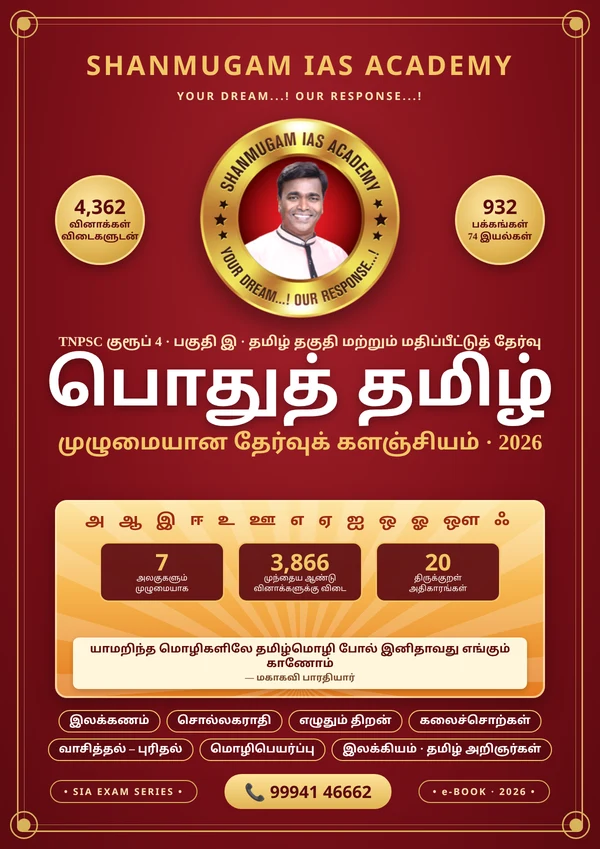 TNPSC குரூப் 4 பொதுத் தமிழ் – முழுமையான தேர்வுக் களஞ்சியம் 2026
₹249
 பொதுத் தமிழ் — முந்தைய ஆண்டு வினா – விடை – விளக்கம் (புதிய பாடத்திட்டம்)
₹199
TNPSC குரூப் 1, 2/2A, 4 – நேரடி வகுப்புகள் · கோவை & மதுரை
2006 முதல் சண்முகம் IAS அகாடமி · Classroom & online coaching in Coimbatore and Madurai
