

Group 2A Mains – Daily Practice 17 (18 November 2026)
Group 2A Mains – Daily Practice 17 (18 November 2026) – 30 வினாக்கள், பாடம்: குரூப் 2A Mains. ஒவ்வொரு வினாவுக்கும் சரியான விடையும் இரண்டு வரி விளக்கமும் உண்டு; "Show Answer" அழுத்திப் பாருங்கள். TNPSC குரூப் 1, 2, 2A, 4, SI, TET தேர்வுகளுக்கான இலவசப் பயிற்சி – சண்முகம் ஐ.ஏ.எஸ். அகாடமி, கோயம்புத்தூர்.
உங்கள் இணையதளம் / Blog-இல் இணைக்க (HTML code)
1. Babur founded the Mughal Empire after defeating Ibrahim Lodi in the First Battle of Panipat in 1526.
2. Akbar introduced the Mansabdari system.
3. Aurangzeb built the Taj Mahal at Agra.
Which of the above are correct?
Correct Answer: B [1 and 2 only]
விளக்கம்:
1 and 2 are correct. In the First Battle of Panipat (1526) Babur defeated Ibrahim Lodi, the Sultan of Delhi, and began Mughal rule. The Mansabdari system was Akbar's administrative-cum-military system that ranked officers by 'zat' (personal rank) and 'sawar' (the number of horsemen to be maintained). The Taj Mahal was built by Shah Jahan in memory of his wife Mumtaz Mahal, on the Yamuna at Agra; it became a UNESCO World Heritage Site in 1983. So 3 is wrong.
(a) Lord Dalhousie – 1. Vernacular Press Act (1878)
(b) Lord Ripon – 2. Partition of Bengal (1905)
(c) Lord Curzon – 3. Doctrine of Lapse
(d) Lord Lytton – 4. Resolution on local self-government (1882)
Correct Answer: C [(a)-3, (b)-4, (c)-2, (d)-1]
விளக்கம்:
Dalhousie is linked with the Doctrine of Lapse, Ripon with the Resolution on local self-government (1882), Curzon with the Partition of Bengal (1905) and Lytton with the Vernacular Press Act (1878), which gives (a)-3, (b)-4, (c)-2, (d)-1. Ripon, called the father of local self-government in India, also repealed the Vernacular Press Act in 1882.
Reason (R): All seven members of the commission were British; not a single Indian was included.
Correct Answer: A [Both (A) and (R) are true and (R) is the correct explanation of (A)]
விளக்கம்:
Both are true and (R) correctly explains (A). Set up in November 1927 under Sir John Simon to review the working of the 1919 Act, the commission had only seven British members of Parliament (including Clement Attlee). The Madras session of the Congress in December 1927 (presided over by M.A. Ansari) resolved to boycott it. When it arrived in February 1928 it was met with black flags; Lala Lajpat Rai, injured in the lathi charge at Lahore, died on 17 November 1928.
1. The Mountbatten Plan
2. The August Offer
3. The Cabinet Mission
4. The Simla Conference (Wavell Plan)
Correct Answer: D [2, 4, 3, 1]
விளக்கம்:
August Offer – 8 August 1940 (Viceroy Linlithgow); Simla Conference (Wavell Plan) – June–July 1945; Cabinet Mission – March–June 1946 (Pethick-Lawrence, Stafford Cripps, A.V. Alexander); Mountbatten Plan – 3 June 1947 (independence with partition). So 2, 4, 3, 1.
Correct Answer: D [He was elected Speaker of the Madras Legislative Assembly in 1937]
விளக்கம்:
When the Rajaji ministry took office in 1937, the Speaker of the Madras Legislative Assembly was Bulusu Sambamurti, not Satyamurti. Satyamurti (1887–1943), born at Thirumayam, was an outstanding parliamentarian as deputy leader of the Congress party in the Central Legislative Assembly and the political guru of Kamaraj. As Mayor he pushed the Poondi reservoir project for Madras's drinking water. The Tamil Nadu Congress headquarters, 'Sathyamurthy Bhavan', bears his name.
1. It is a statutory body set up under the Protection of Human Rights Act, 1993.
2. Only a person who has been Chief Justice of India can be appointed its Chairperson.
3. The Chairperson and members are appointed by the President on the recommendation of a committee headed by the Prime Minister.
Which of the above are correct?
Correct Answer: C [1 and 3 only]
விளக்கம்:
1 and 3 are correct. The NHRC, set up on 12 October 1993, is a statutory (non-constitutional) body. Since the 2019 amendment, a former judge of the Supreme Court – not only a former Chief Justice of India – can be Chairperson, so 2 is wrong. The selection committee: the Prime Minister (chair), the Lok Sabha Speaker, the Union Home Minister, the Leaders of the Opposition in both Houses and the Deputy Chairman of the Rajya Sabha. Tenure: 3 years or up to 70 years of age, whichever is earlier. States have State Human Rights Commissions under the same Act.
(a) Permanent President – 1. B.N. Rau
(b) Chairman of the Drafting Committee – 2. Sachchidananda Sinha
(c) Temporary President of the first meeting – 3. Dr Rajendra Prasad
(d) Constitutional Adviser – 4. Dr B.R. Ambedkar
Correct Answer: B [(a)-3, (b)-4, (c)-2, (d)-1]
விளக்கம்:
The Constituent Assembly first met on 9 December 1946 with the senior-most member Sachchidananda Sinha as temporary President; on 11 December 1946 Dr Rajendra Prasad was elected permanent President. The Drafting Committee set up on 29 August 1947 was chaired by Dr B.R. Ambedkar. Sir B.N. Rau, the Constitutional Adviser, prepared the first draft. The Constitution was adopted on 26 November 1949 (Constitution Day) and came into force on 26 January 1950.
Reason (R): Under Article 3, the President must refer such a Bill to the legislature of the State concerned for its views, and those views are binding on Parliament.
Correct Answer: C [(A) is true but (R) is false]
விளக்கம்:
(A) is true; (R) is false. Under Article 3, a Bill to form a new State or to change the boundaries or name of a State can be introduced only on the President's recommendation, and the President must refer it to the State legislature for its views – but those views do not bind Parliament. Such a law is passed by a simple majority and, under Article 4, is not deemed an amendment of the Constitution under Article 368. Madras State became 'Tamil Nadu' this way – the Madras State (Alteration of Name) Act, 1968, effective 14 January 1969.
Correct Answer: A [He can be removed from office by a resolution of the Lok Sabha alone]
விளக்கம்:
Under Article 67(b), the Vice-President can be removed only by a resolution of the Rajya Sabha passed by a majority of all its then members and agreed to by the Lok Sabha (with 14 days' notice) – not by the Lok Sabha alone. The other three are correct: election – Article 66 (all members of both Houses; State legislatures have no part); five-year term – Article 67; minimum age 35 – Article 66(3). He is the ex-officio Chairman of the Rajya Sabha (Article 64).
Correct Answer: C [Article 20]
விளக்கம்:
Article 20 – protection in respect of conviction for offences: 20(1) punishment only under the law in force when the act was committed (no ex post facto criminal law); 20(2) no double jeopardy; 20(3) no person accused of an offence shall be compelled to be a witness against himself. Under the 44th Amendment (1978), Articles 20 and 21 cannot be suspended even during a National Emergency. Article 22 deals with protection against arrest and detention.
1. An adult human body has 206 bones.
2. The femur (thigh bone) is the longest bone of the body.
3. The stapes, the smallest bone of the body, is in the nose.
Which of the above are correct?
Correct Answer: B [1 and 2 only]
விளக்கம்:
1 and 2 are correct. The stapes is in the middle ear, not the nose, so 3 is wrong. The three ossicles of the middle ear – malleus, incus and stapes – pass the vibrations of the eardrum to the inner ear. A newborn has about 300 bones; many fuse during growth, leaving 206 in an adult.
(a) Malaria – 1. Fungus
(b) Tuberculosis – 2. Virus
(c) Polio – 3. Protozoan
(d) Ringworm – 4. Bacterium
Correct Answer: A [(a)-3, (b)-4, (c)-2, (d)-1]
விளக்கம்:
Malaria is caused by a protozoan (Plasmodium), tuberculosis by a bacterium (Mycobacterium tuberculosis), polio by a virus and ringworm by a fungus, which gives (a)-3, (b)-4, (c)-2, (d)-1. Despite its name, ringworm is a skin infection caused by fungi called dermatophytes, not by a worm.
Reason (R): A white surface reflects most of the heat radiation falling on it.
Correct Answer: A [Both (A) and (R) are true and (R) is the correct explanation of (A)]
விளக்கம்:
Both are true and (R) correctly explains (A). Because white reflects most of the Sun's heat, the body warms up less; black absorbs more heat, which is why dark clothes suit winter. For the same reason roofs in hot regions are painted white ('cool roofs').
Correct Answer: D [Action and reaction act on the same body]
விளக்கம்:
Action and reaction are equal and opposite but act on two different bodies – that is why they do not cancel each other. A rocket pushes gases downward (action) and the gases push the rocket upward (reaction). Newton published these laws in the 'Principia' in 1687.
Correct Answer: B [Satyendra Nath Bose]
விளக்கம்:
In 1924 Satyendra Nath Bose worked out a statistical method for light particles (photons) and sent it to Einstein; it is known as 'Bose–Einstein statistics'. Particles that obey it are called 'bosons' – including the Higgs boson confirmed at CERN in 2012. He was awarded the Padma Vibhushan in 1954.
1. Employing children below 14 years in any occupation is prohibited (except for exceptions such as helping in a family enterprise after school hours or working as an artist in the audio-visual entertainment industry).
2. Under the Act, 'adolescents' are persons aged 14 to 21 years.
3. Employing adolescents in hazardous occupations and processes is prohibited.
Which of the above are correct?
Correct Answer: C [1 and 3 only]
விளக்கம்:
1 and 3 are correct. The 2016 amendment renamed the 1986 Act and banned the employment of children below 14 in all occupations (with a few exceptions); 'adolescents' are persons aged 14 to below 18 – not 21 – so 2 is wrong. Adolescents may not be employed in hazardous occupations. Constitutional basis: Article 24 (no child below 14 in factories, mines or hazardous work) and Article 21A (free and compulsory education for 6–14 years). 12 June is the World Day Against Child Labour.
(a) Human Development Report – 1. World Economic Forum (WEF)
(b) World Development Report – 2. International Monetary Fund (IMF)
(c) World Economic Outlook – 3. United Nations Development Programme (UNDP)
(d) Global Gender Gap Report – 4. World Bank
Correct Answer: D [(a)-3, (b)-4, (c)-2, (d)-1]
விளக்கம்:
The Human Development Report is published by UNDP, the World Development Report by the World Bank, the World Economic Outlook by the IMF and the Global Gender Gap Report by the World Economic Forum, which gives (a)-3, (b)-4, (c)-2, (d)-1. The Human Development Report began in 1990 with the Human Development Index shaped by Mahbub ul Haq and Amartya Sen.
Reason (R): Subsidies neither create any asset for the government nor reduce any of its liabilities.
Correct Answer: A [Both (A) and (R) are true and (R) is the correct explanation of (A)]
விளக்கம்:
Both are true and (R) correctly explains (A). Spending that creates no asset and reduces no liability is revenue expenditure – interest, salaries, pensions and subsidies (food, fertiliser, cooking gas). Spending that creates assets or reduces liabilities is capital expenditure – roads, dams, buildings, loans to States and repayment of debt. When revenue expenditure exceeds revenue receipts, the gap is the 'revenue deficit'.
Correct Answer: B [NDP = GDP + depreciation]
விளக்கம்:
Net Domestic Product (NDP) = GDP − depreciation (wear and tear of capital goods); depreciation is subtracted, not added. The other three are correct. 'Net' = after deducting depreciation; 'National' = after adding net factor income from abroad. NNP at factor cost is what is called 'national income'. In India, national income estimates are released by the National Statistics Office (NSO) of the Union Ministry of Statistics.
Correct Answer: D [₹20]
விளக்கம்:
PMSBY (launched on 9 May 2015) is for bank / post-office account holders aged 18 to 70: ₹2 lakh for accidental death or full disability and ₹1 lakh for partial disability. The annual premium was raised from ₹12 to ₹20 from 1 June 2022. Compare: the Pradhan Mantri Jeevan Jyoti Bima Yojana (PMJJBY) gives ₹2 lakh life cover for death from any cause; its premium is ₹436 (earlier ₹330).
1. The Lakshadweep islands are of coral origin.
2. The Andaman Islands and the Nicobar Islands are separated by the Ten Degree Channel.
3. Barren Island, India's only active volcano, is in Lakshadweep.
Which of the above are correct?
Correct Answer: B [1 and 2 only]
விளக்கம்:
1 and 2 are correct. Barren Island lies in the Andaman Sea, in the Union Territory of Andaman and Nicobar Islands – not in Lakshadweep – so 3 is wrong. The Lakshadweep islands in the Arabian Sea are coral islands (capital Kavaratti); the Eight Degree Channel separates Minicoy from the Maldives. India's southernmost point, Indira Point, is on Great Nicobar.
(a) Bhakra Nangal – 1. Mahanadi
(b) Hirakud – 2. Sutlej
(c) Nagarjuna Sagar – 3. Bhagirathi
(d) Tehri – 4. Krishna
Correct Answer: A [(a)-2, (b)-1, (c)-4, (d)-3]
விளக்கம்:
Bhakra Nangal – Sutlej (Himachal Pradesh–Punjab); Hirakud – Mahanadi (Odisha; one of the longest earthen dams in the world); Nagarjuna Sagar – Krishna (Telangana–Andhra Pradesh border); Tehri – Bhagirathi (Uttarakhand; India's tallest dam). Nehru called multipurpose projects the 'temples of modern India'.
Reason (R): The Aravalli range lies perpendicular to the direction of the south-west monsoon winds and blocks them.
Correct Answer: C [(A) is true but (R) is false]
விளக்கம்:
(A) is true; (R) is false. The Aravallis lie parallel to the direction of the Arabian Sea branch of the south-west monsoon; since they do not obstruct and lift the winds, little rain falls. The Bay of Bengal branch, too, has lost most of its moisture by the time it reaches the west. So western Rajasthan is among the driest parts of India. Compare: the Western Ghats lie across the winds, so their windward side gets heavy rain.
Correct Answer: C [Humboldt (Peru) Current – warm current]
விளக்கம்:
The Humboldt (Peru) Current is a cold current flowing north along the west coast of South America (Peru, Chile). Upwelling of deep water there makes it rich in fish, and it also helps explain the Atacama Desert. The warm Gulf Stream meets the cold Labrador Current near Newfoundland, giving dense fog and the 'Grand Banks' fishing ground. The Kuroshio is a warm current off Japan.
1. Kamarajar Port at Ennore is India's first major port to be corporatised (registered as a company).
2. Chennai Port is an artificial harbour.
3. Kattupalli Port is a major port administered by the Union Government.
Which of the above are correct?
Correct Answer: A [1 and 2 only]
விளக்கம்:
1 and 2 are correct. Tamil Nadu's three major ports are Chennai, Kamarajar (Ennore) and V.O. Chidambaranar (Thoothukudi). Kamarajar Port (formerly Ennore Port, operational from 2001) was India's first corporatised major port. Chennai Port is an artificial harbour, built with breakwaters on a straight coast with no natural bay. Kattupalli is a privately operated minor port (under the Tamil Nadu Maritime Board), not a major port – so 3 is wrong.
3, 6, 18, 72, 360, ?
Correct Answer: B [2,160]
விளக்கம்:
Each number is multiplied by 2, 3, 4, 5 in turn: 3 × 2 = 6, 6 × 3 = 18, 18 × 4 = 72, 72 × 5 = 360. The next is 360 × 6 = 2,160.
Correct Answer: D [46]
விளக்கம்:
Total age of 30 students = 30 × 15 = 450. Total for 31 persons with the teacher = 31 × 16 = 496. Teacher's age = 496 − 450 = 46. Shortcut: 15 + 31 × 1 = 46.
Correct Answer: C [20]
விளக்கம்:
Speed = 216 ÷ 3 = 72 km/h. To convert km/h to m/s multiply by 5/18: 72 × 5/18 = 20 m/s.
Correct Answer: A [216 cu cm]
விளக்கம்:
Total surface area = 6a² = 216 → a² = 36 → side a = 6 cm. Volume = a³ = 6 × 6 × 6 = 216 cu cm.
Correct Answer: D [24]
விளக்கம்:
R, A, I, N are four different letters. Number of arrangements = 4! = 4 × 3 × 2 × 1 = 24.
Today Current Affairs in Tamil | 23 நவம்பர் 2026 | TNPSC Group 4 முக்கிய வினாக்கள்
📚 TNPSC குரூப் 2 / 2A Mains – மாதிரி விடைகளுடன் நூல்கள்
PDF நூல்கள் · ₹149 முதல் · ஒவ்வொன்றுக்கும் 50 பக்க இலவச மாதிரி · UPI-இல் பணம் செலுத்தியதும் உடனே பதிவிறக்கம்
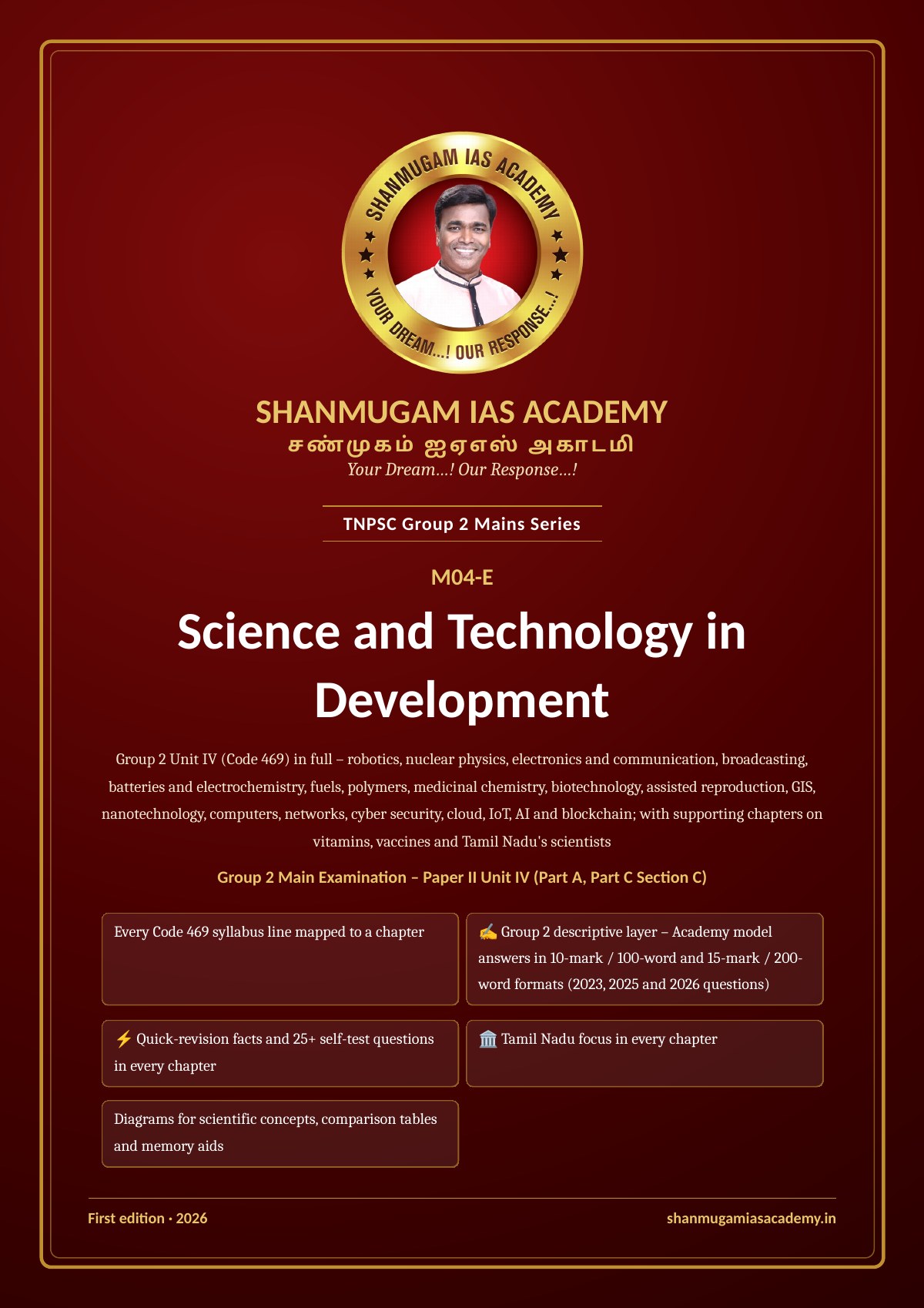 M04-E · Science & Technology – TNPSC Group 2/2A Mains (English)
₹249
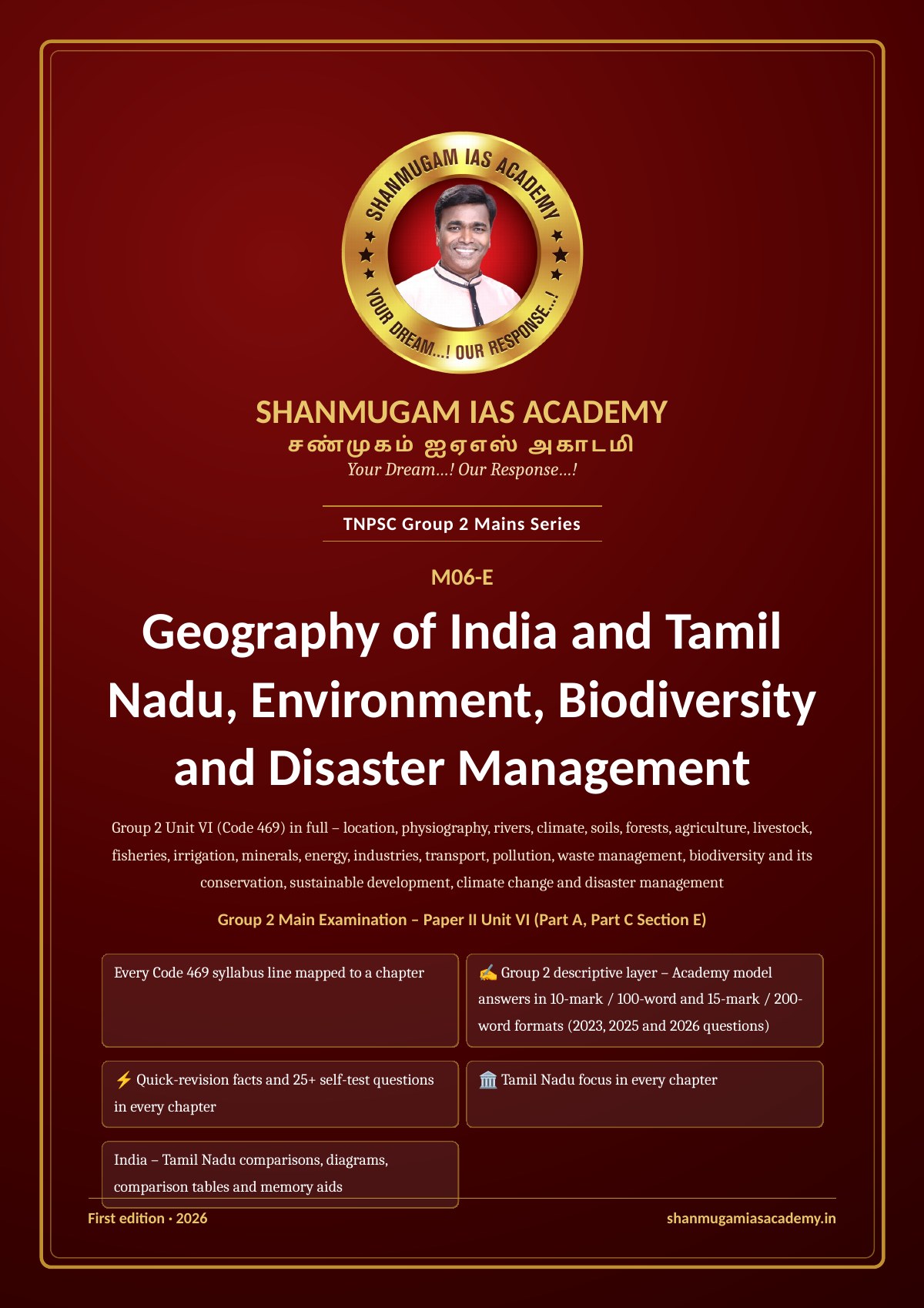 M06-E · Geography & Environment – TNPSC Group 2/2A Mains (English)
₹249
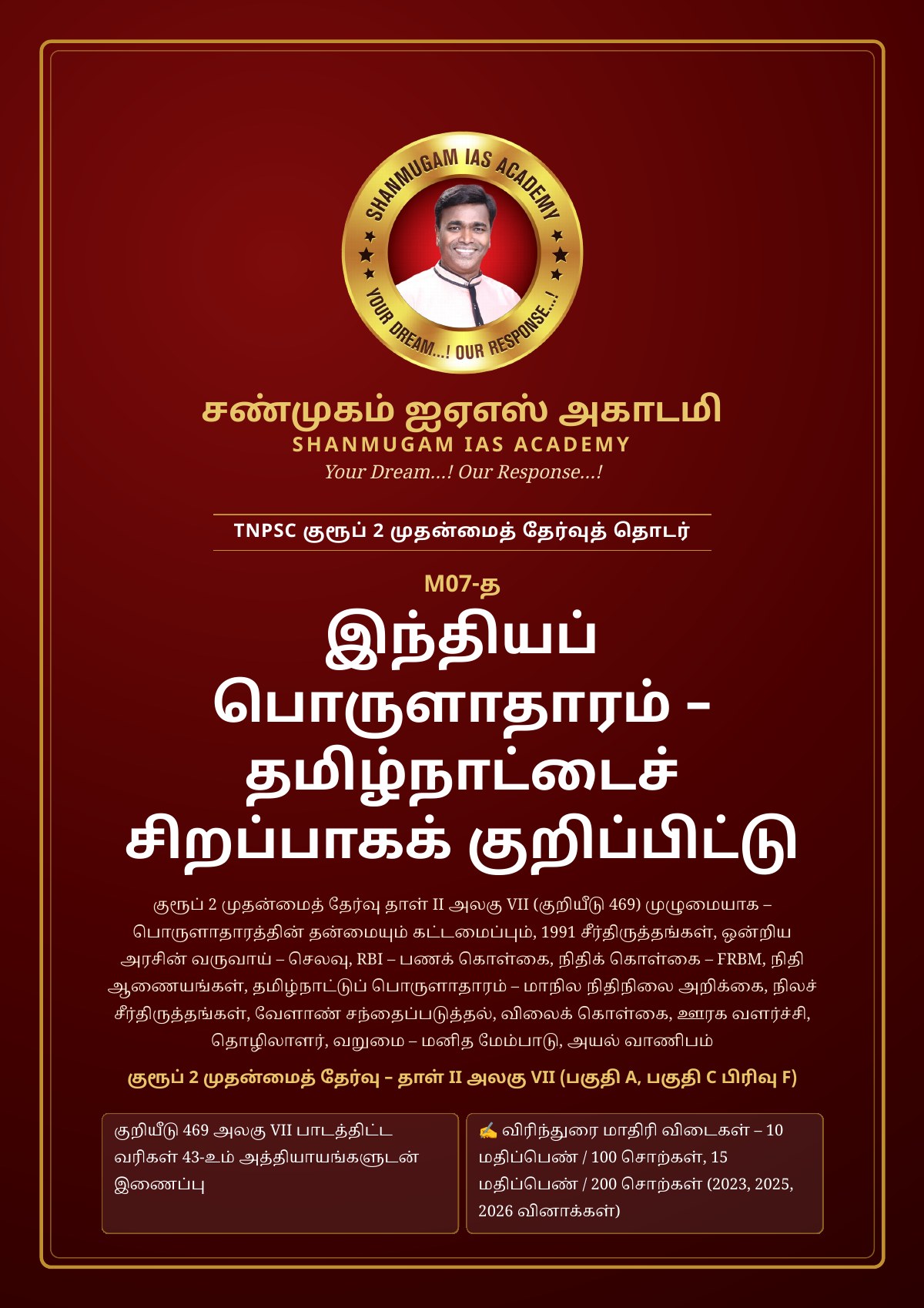 M07-த · இந்தியப் பொருளாதாரம் – TNPSC குரூப் 2/2A Mains (தமிழ்)
₹249
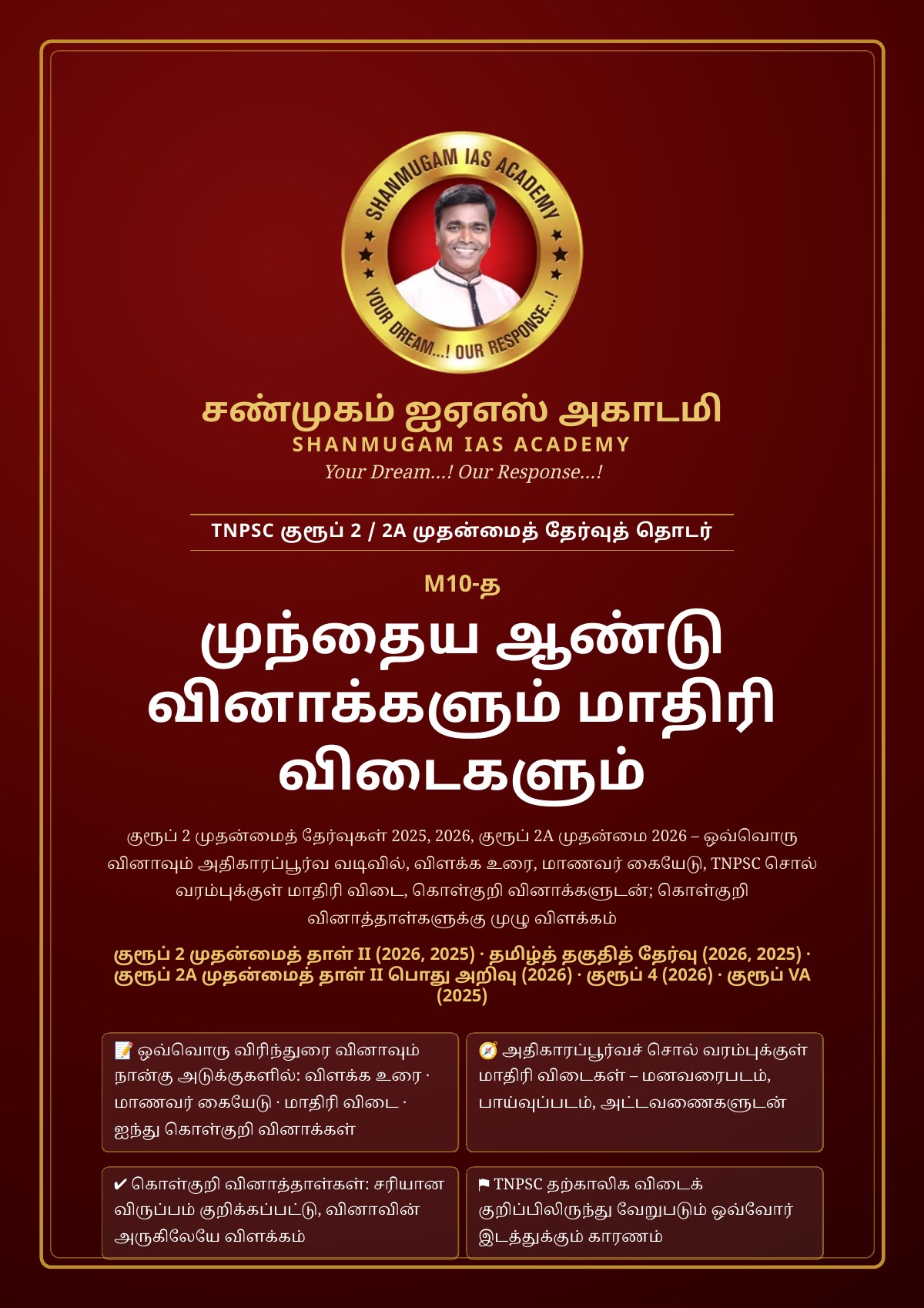 M10-த · குரூப் 2/2A Mains முந்தைய வினா & மாதிரி விடை (தமிழ்)
₹249
TNPSC குரூப் 1, 2/2A, 4 – நேரடி வகுப்புகள் · கோவை & மதுரை
2006 முதல் சண்முகம் IAS அகாடமி · Classroom & online coaching in Coimbatore and Madurai
