

IBPS Clerk English – Prelims Sectional Mock 1 – English Language – Prelims Sectional Mock 1 · English Language
IBPS Clerk English – Prelims Sectional Mock 1 – English Language – Prelims Sectional Mock 1 · English Language – 28 questions, subject: English Language. Every question has the correct answer with a two-line explanation; tap "Show Answer". Free practice for IBPS Clerk, IBPS PO, SBI, RRB exams – Shanmugam IAS Academy, Coimbatore.
Link to this page from your website / blog (HTML code)
Directions (Q 1–8): Read the passage Working in the Heat and answer the questions.
For millions of people who work outdoors – construction workers, street vendors, delivery riders and farm labourers – a hot afternoon is not an inconvenience but a danger. When the air is hotter than the body, the body can no longer lose heat easily, and sweating becomes its main defence. Sweat cools the skin only when it evaporates. In humid weather it evaporates slowly, which is why a humid day at a lower temperature can be more dangerous than a dry day that feels hotter.
The risks are not limited to heat stroke, the most serious form of heat illness. Long hours in the heat also cause exhaustion, cramps and dehydration, and they reduce concentration. A tired worker on a scaffold or a busy road is more likely to have an accident. Productivity falls as well: tasks take longer, and many workers lose income because they simply cannot work through the hottest hours.
Simple measures can reduce much of this harm. Drinking water at regular intervals, before thirst sets in, keeps the body supplied. Shaded rest areas allow the body to cool down. Shifting heavy work to the early morning and the evening avoids the worst heat of the day. Some cities have prepared heat action plans that warn residents when a heat wave is expected and ask employers to adjust working hours.
Such plans work only if they reach the people they are meant for. A warning on a website is of little use to a labourer who does not read the news, and advice to rest in the afternoon means nothing to a daily-wage worker who will not be paid for the hours he rests. For this reason, the most successful efforts combine warnings with practical support: drinking-water points at work sites, cool shelters in markets and agreements with employers that protect wages when work is paused.
Heat waves are expected to become more frequent as the climate warms. Protecting outdoor workers is therefore not a matter of charity but of planning – for their health, for the safety of everyone around them and for the economy that depends on their labour.
Correct Answer: B [to argue that protecting outdoor workers from heat needs planned, practical measures]
Explanation:
The passage describes the dangers of heat for outdoor workers and ends by saying their protection is 'a matter of planning', so its main purpose is to argue for planned, practical measures. The other options are either false or cover only a minor detail.
According to the passage, why can a humid day be more dangerous than a hotter dry day?
Correct Answer: E [Sweat evaporates slowly, so the body is cooled less.]
Explanation:
Sweat cools the skin only when it evaporates, and in humid air it evaporates slowly, so the body is cooled less. That is why a humid day at a lower temperature can be more dangerous than a drier day that feels hotter.
Which of the following is NOT mentioned as an effect of long hours in the heat?
Correct Answer: D [loss of eyesight]
Explanation:
The passage lists exhaustion, cramps, dehydration and reduced concentration as effects of long hours in the heat, but it never mentions loss of eyesight. In 'NOT mentioned' questions, check each option against the text and pick the one absent from it.
Why, according to the passage, is a warning on a website of little use to some workers?
Correct Answer: A [It may not reach workers who do not follow the news.]
Explanation:
The passage says a website warning is of little use to a labourer 'who does not read the news', so it may not reach such workers. This is why successful efforts combine warnings with practical support such as water points and cool shelters.
Why might a daily-wage worker ignore advice to rest in the afternoon?
Correct Answer: C [He would lose pay for the hours he rests.]
Explanation:
The passage says advice to rest in the afternoon means nothing to a daily-wage worker 'who will not be paid for the hours he rests'. Loss of wages, not lack of feeling the heat, is the reason he may keep working.
Which word is closest in meaning to inconvenience as used in the passage?
Correct Answer: D [a minor trouble]
Explanation:
The passage says a hot afternoon is 'not an inconvenience but a danger', so inconvenience here means a minor trouble. The contrast with 'danger' shows it is something small and annoying, not a serious illness or legal duty.
Which word is most nearly OPPOSITE in meaning to frequent as used in the passage?
Correct Answer: B [rare]
Explanation:
In the passage, heat waves will become more 'frequent', meaning happening often, so the opposite is 'rare'. 'Common', 'regular', 'constant' and 'usual' are all close in meaning to frequent, not opposite.
Which of the following is/are true according to the passage?
I. Heat can make accidents more likely.
II. Heat action plans may ask employers to adjust working hours.
III. Heat stroke is the only risk of working in the heat.
Correct Answer: C [Only I and II]
Explanation:
The passage says tired workers are more likely to have accidents (I) and that heat action plans ask employers to adjust working hours (II), so only I and II are true. Statement III is false because the passage says the risks are 'not limited to heat stroke'.
Directions (Q 9–14): In the passage below, each blank is numbered. Choose the word that best fits each blank.
Offices that have moved to digital files often find that their paper use has not fallen as much as they (9) ________. Printed copies are still made for meetings, for signatures and simply out of (10) ________.
A small change in default settings can make a large (11) ________: printers set to print on both sides of the page use far less paper without anyone having to (12) ____ to choose that option. Paper that is used should be (13) ________ separately, because paper mixed with food waste or plastic is difficult to recycle. Recycled paper, in turn, needs less water and energy to produce than paper made from fresh wood pulp, so every sheet saved or recycled (14) ________ the pressure on forests and water.
Correct Answer: A [expected]
Explanation:
Paper use has not fallen 'as much as they expected', which shows a gap between hope and result. 'Accepted', 'excepted', 'exported' and 'expired' are look-alike words that do not make sense here.
Blank (10)
Correct Answer: C [habit]
Explanation:
Copies are printed 'simply out of habit', meaning by routine rather than need, and 'out of' needs a noun. 'Habitat' is a natural home, 'inhabit' and 'inhibit' are verbs, and 'habitual' is an adjective.
Blank (11)
Correct Answer: E [difference]
Explanation:
The fixed phrase is 'make a (large) difference', meaning have a big effect, and the article 'a' needs a noun. 'Different' and 'differently' are an adjective and an adverb, and 'deference' means respect, so they do not fit.
Blank (12)
Correct Answer: D [remember]
Explanation:
Printers set to print on both sides work 'without anyone having to remember to choose that option', so 'remember' (a base verb after 'to') fits. 'Remind' needs an object (remind someone), and 'reminder' or 'memory' are nouns.
Blank (13)
Correct Answer: A [collected]
Explanation:
Used paper 'should be collected separately', so the passive needs the past participle 'collected'. The sentence explains that paper mixed with food waste or plastic is hard to recycle, which is why separate collection matters.
Blank (14)
Correct Answer: B [eases]
Explanation:
Saving or recycling paper 'eases' (reduces) the pressure on forests and water, which fits the meaning of the sentence. 'Ceases' means stops and cannot take an object this way, and 'seizes' or 'raises' give the opposite or wrong sense.
Directions (Q 15–19): Read each sentence to find whether there is a grammatical error in it. The error, if any, is in one part. Choose that part; if there is no error, choose ‘No error’.
Correct Answer: C [(C)]
Explanation:
The verb 'works' must be modified by an adverb, not an adjective. So 'quick' should be 'quickly', matching 'accurately': 'works very quickly and accurately'.
The bank has (A) / decided opening (B) / a new branch (C) / in Hosur. (D)
Correct Answer: B [(B)]
Explanation:
The verb 'decide' is followed by a to-infinitive, so part (B) should read 'decided to open'. Verbs like decide, agree, plan and refuse take 'to + verb', not the -ing form.
The training covers (A) / counting cash, (B) / filling forms and (C) / to talk to customers politely. (D)
Correct Answer: D [(D)]
Explanation:
Items in a series must be parallel in form: 'counting cash, filling forms and talking to customers politely'. So 'to talk' in part (D) should be 'talking'.
You (A) / must not (B) / bring your passbook; (C) / the ATM card is enough. (D)
Correct Answer: B [(B)]
Explanation:
'Must not' means something is forbidden, but the sense here is that the passbook is unnecessary, so part (B) should be 'need not' or 'do not have to'. The clause 'the ATM card is enough' shows there is no prohibition, only no necessity.
Directions (Q 20–24): Rearrange the five sentences (A)–(E) to form a meaningful paragraph and answer the questions.
(A) Without one, the family may have to produce legal papers that take months to obtain.
(B) If a nominee has been named, the bank can pay that person the money with fewer documents.
(C) Yet it becomes important the day an account holder dies.
(D) They see it as an unnecessary formality.
(E) Many account holders never fill in the nomination section of their account opening form.
Correct Answer: E [(E)]
Explanation:
(E). Sequence EDCBA. Opener names the account holders; ‘They’ see it as a formality; ‘Yet’ it matters at death; ‘If a nominee’ → easy payment; ‘Without one’ → the contrast closes.
(Nomination) Which sentence is SECOND in the rearranged paragraph?
Correct Answer: D [(D)]
Explanation:
(D). Sequence EDCBA. Opener names the account holders; ‘They’ see it as a formality; ‘Yet’ it matters at death; ‘If a nominee’ → easy payment; ‘Without one’ → the contrast closes.
(Nomination) Identify the FOURTH sentence of the meaningful paragraph.
Correct Answer: B [(B)]
Explanation:
(B). Sequence EDCBA. Opener names the account holders; ‘They’ see it as a formality; ‘Yet’ it matters at death; ‘If a nominee’ → easy payment; ‘Without one’ → the contrast closes.
(Nomination) Which one is the FIFTH sentence once the sentences are rearranged?
Correct Answer: A [(A)]
Explanation:
(A). Sequence EDCBA. Opener names the account holders; ‘They’ see it as a formality; ‘Yet’ it matters at death; ‘If a nominee’ → easy payment; ‘Without one’ → the contrast closes.
Directions (Q 25–27): Choose the word that best fills the blank.
Correct Answer: E [launched]
Explanation:
'Has' forms the present perfect tense, which needs the past participle, so 'has launched' is correct. 'Lunched' is a spelling trap meaning 'ate lunch', and 'launch', 'launches' or 'launching' cannot follow 'has' here.
The auditor found several ________ in the accounts.
Correct Answer: C [discrepancies]
Explanation:
After 'several' we need a plural countable noun, so 'discrepancies' (mismatches or differences) completes the sentence. 'Discrepancy' is singular, 'discrepant' is an adjective, and 'discreet' or 'discretion' mean careful judgement, not a mismatch.
The officer was ________ about the customer's request and promised to help.
Correct Answer: B [sympathetic]
Explanation:
An adjective is needed after 'was', and an officer who promised to help felt 'sympathetic' (understanding and kind). 'Apathetic' means not caring, which contradicts the promise, and 'sympathise' and 'sympathy' are a verb and a noun.
Directions (Q 28–30): Choose the phrase that should replace the part in bold to make the sentence correct. If no change is needed, choose ‘No improvement required’.
Correct Answer: C [interest in politics]
Explanation:
The noun 'interest' takes the preposition 'in', so the correct phrase is 'He has no interest in politics'. 'Interest on' is used only for money, as in 'interest on a loan'.
The cheque was sign by the manager.
Correct Answer: A [was signed]
Explanation:
The passive voice needs 'be + past participle', so the sentence should be 'The cheque was signed by the manager'. 'Was sign', 'is sign' and 'has sign' use the base form wrongly, and 'was signing' is active.
The goods were delivered on time.
Correct Answer: E [No improvement required]
Explanation:
'On time' means punctually, at the agreed time, so 'The goods were delivered on time' is already correct. 'In time' would mean early enough, while 'by time', 'at time' and 'on timely' are not correct English phrases.
Today Current Affairs in Tamil | 23 நவம்பர் 2026 | TNPSC Group 4 முக்கிய வினாக்கள்
📚 IBPS Clerk 2026 Books
PDF நூல்கள் · ₹149 முதல் · ஒவ்வொன்றுக்கும் 50 பக்க இலவச மாதிரி · UPI-இல் பணம் செலுத்தியதும் உடனே பதிவிறக்கம்
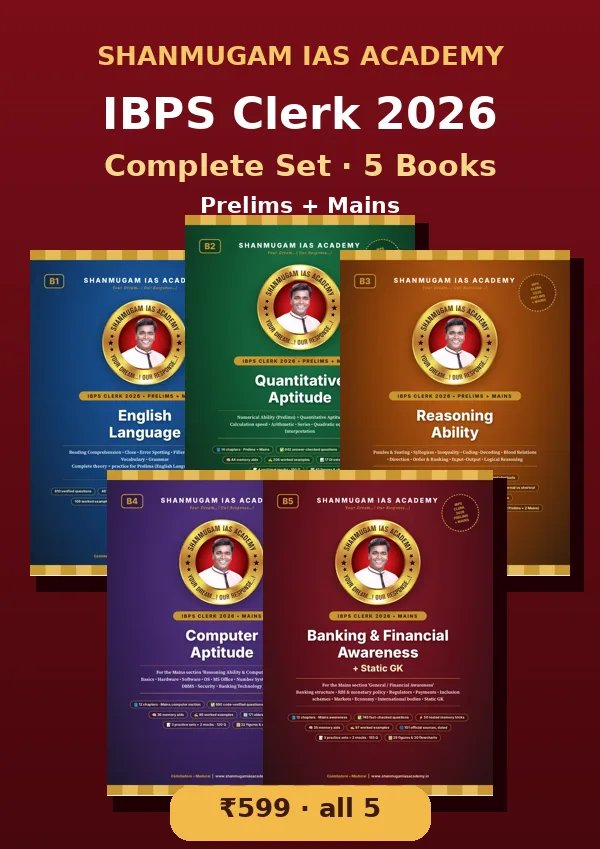 IBPS Clerk 2026 – Complete Set (5 Books, Prelims + Mains)
₹599
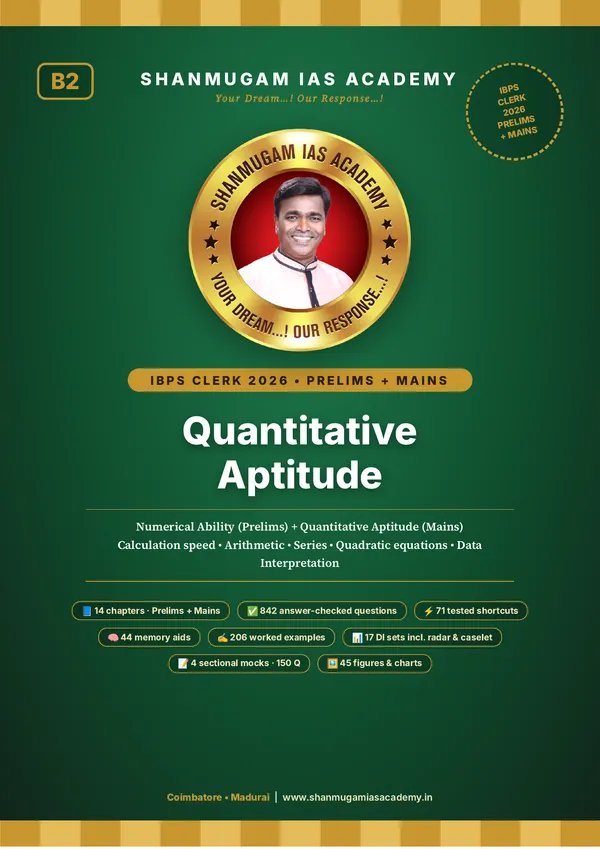 IBPS Clerk 2026 – Quantitative Aptitude (Prelims + Mains)
₹149
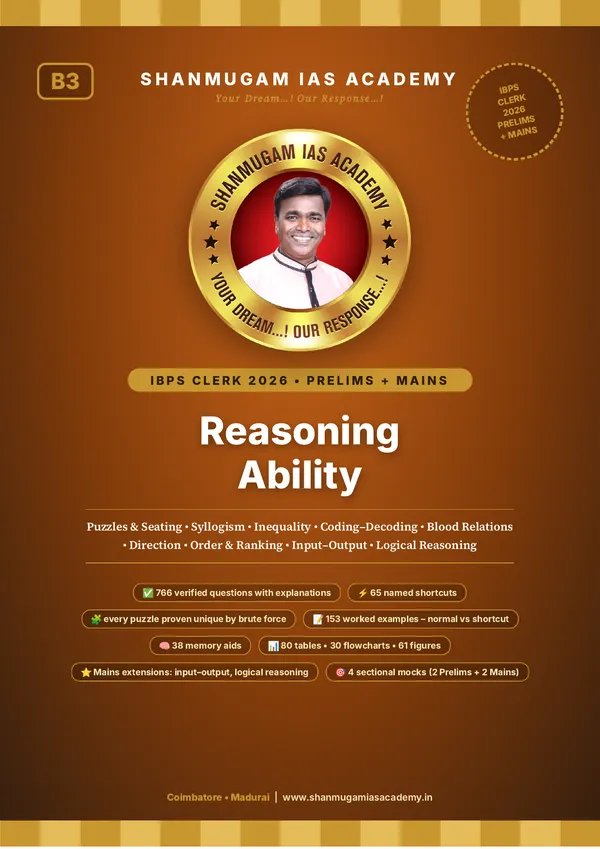 IBPS Clerk 2026 – Reasoning Ability (Prelims + Mains)
₹149
 IBPS Clerk 2026 – English Language (Prelims + Mains)
₹149
TNPSC குரூப் 1, 2/2A, 4 – நேரடி வகுப்புகள் · கோவை & மதுரை
2006 முதல் சண்முகம் IAS அகாடமி · Classroom & online coaching in Coimbatore and Madurai
