

IBPS Clerk English – Speed Drills and Mixed Sets – Mains-Level Mixed Set
IBPS Clerk English – Speed Drills and Mixed Sets – Mains-Level Mixed Set – 11 questions, subject: English Language. Every question has the correct answer with a two-line explanation; tap "Show Answer". Free practice for IBPS Clerk, IBPS PO, SBI, RRB exams – Shanmugam IAS Academy, Coimbatore.
Link to this page from your website / blog (HTML code)
Directions (Q 39–43): Choose the word that best fits each numbered blank in the passage.
Banking rests on a promise that is rarely spoken aloud: money deposited today will be returned on (39) ________. This promise is not (40) ________ by the cash in the vault alone, for a bank lends out much of what it receives.
It is backed by (41) ________ – the belief of depositors that their money is safe. When that belief is shaken, even a sound bank can face a rush of withdrawals that it cannot (42) ________ at once. Regulation, deposit insurance and honest disclosure are therefore not burdens on banking but its (43) ________.
Correct Answer: A [demand]
Explanation:
Money deposited today 'will be returned on demand', a fixed banking phrase meaning whenever the depositor asks for it. Demand deposits such as savings and current accounts can be withdrawn this way; 'desire' or 'wish' do not form the phrase.
Blank (40)
Correct Answer: D [backed]
Explanation:
The sentence is passive: 'This promise is not backed by the cash in the vault alone', so the past participle 'backed' is needed after 'is not'. The next sentence repeats the same verb: 'It is backed by confidence'.
Blank (41)
Correct Answer: C [confidence]
Explanation:
The passage says the promise is backed by 'the belief of depositors that their money is safe', which is the meaning of 'confidence'. 'Conference', 'confession', 'consequence' and 'condolence' are look-alike words with unrelated meanings.
Blank (42)
Correct Answer: E [honour]
Explanation:
A bank 'honours' withdrawals when it pays them out, so 'cannot honour at once' fits after 'cannot', which needs a base verb. 'Honest', 'honourable' and 'honesty' are adjective and noun forms, and 'honoured' is wrong after 'cannot'.
Blank (43)
Correct Answer: B [foundations]
Explanation:
Regulation, deposit insurance and honest disclosure are 'not burdens on banking but its foundations', meaning they are what banking rests on. The contrast 'not ... but' needs a positive word, and 'fractures' or 'fringes' give the wrong sense.
Correct Answer: E [lucid, grasp]
Explanation:
'Lucid' means clear and easy to understand, so even untrained readers could 'grasp' (understand) the main argument; after 'could' we need the base form. 'Obscure' and 'verbose' contradict the sense, and 'grasping' is the wrong verb form.
Correct Answer: C [solving, worsened]
Explanation:
'Far from' is a preposition, so it is followed by a gerund ('solving'), and the second blank needs a past tense verb ('worsened') to match the past decision. The sentence means the hasty decision did the opposite of solving the problem.
Correct Answer: D [(D)]
Explanation:
In a time clause beginning with 'after', 'when' or 'before', the simple present is used for a future meaning, so part (D) should be 'is published'. The future tense 'will come into force' stays only in the main clause.
Correct Answer: B [(B)]
Explanation:
Part (B): has → have. Rule: ‘one of those + plural noun + who’ – who refers to the plural noun, so the verb is plural.
Correct Answer: D [No sooner had the audit begun than two discrepancies were found.]
Explanation:
'No sooner' at the start of a sentence takes inversion with the past perfect ('had the audit begun') and is always paired with 'than', so option (d) is correct. 'When' cannot replace 'than', and 'began' is wrong after 'had'.
Correct Answer: A [The survey elicited a wide range of responses from customers.]
Explanation:
'Elicit' means to draw out a reply or reaction, so 'The survey elicited a wide range of responses' uses it correctly. Options (b) and (c) need 'illicit' (illegal), and in (e) the intended word is 'exited' or 'left'.
Today Current Affairs in Tamil | 23 நவம்பர் 2026 | TNPSC Group 4 முக்கிய வினாக்கள்
📚 IBPS Clerk 2026 Books
PDF நூல்கள் · ₹149 முதல் · ஒவ்வொன்றுக்கும் 50 பக்க இலவச மாதிரி · UPI-இல் பணம் செலுத்தியதும் உடனே பதிவிறக்கம்
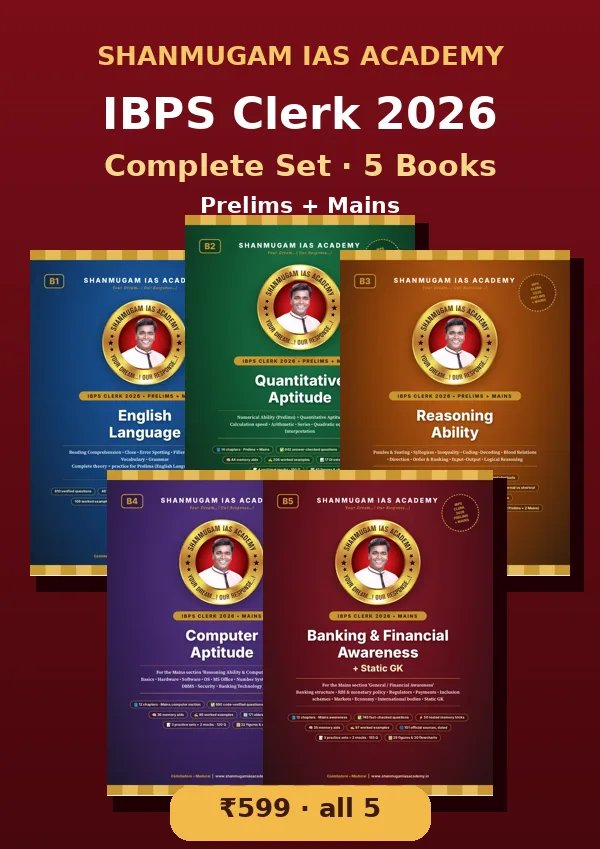 IBPS Clerk 2026 – Complete Set (5 Books, Prelims + Mains)
₹599
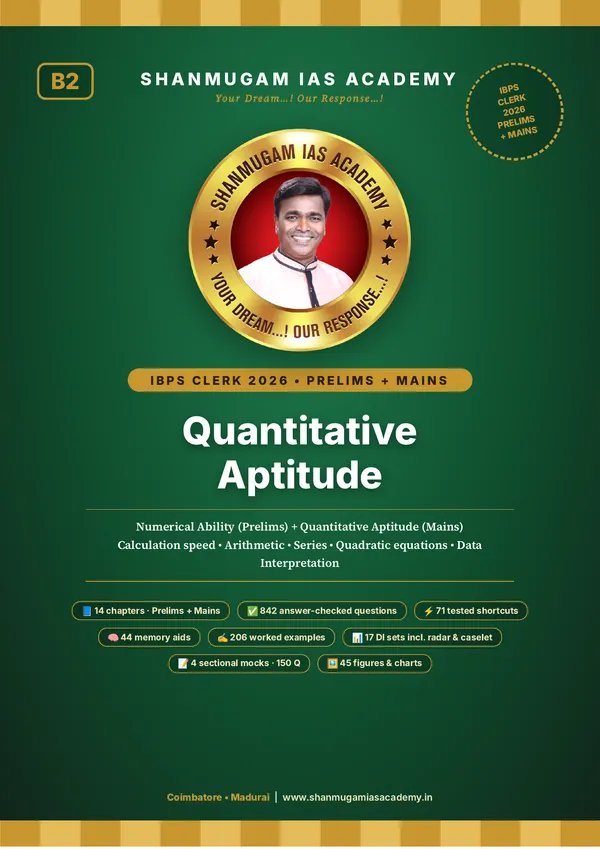 IBPS Clerk 2026 – Quantitative Aptitude (Prelims + Mains)
₹149
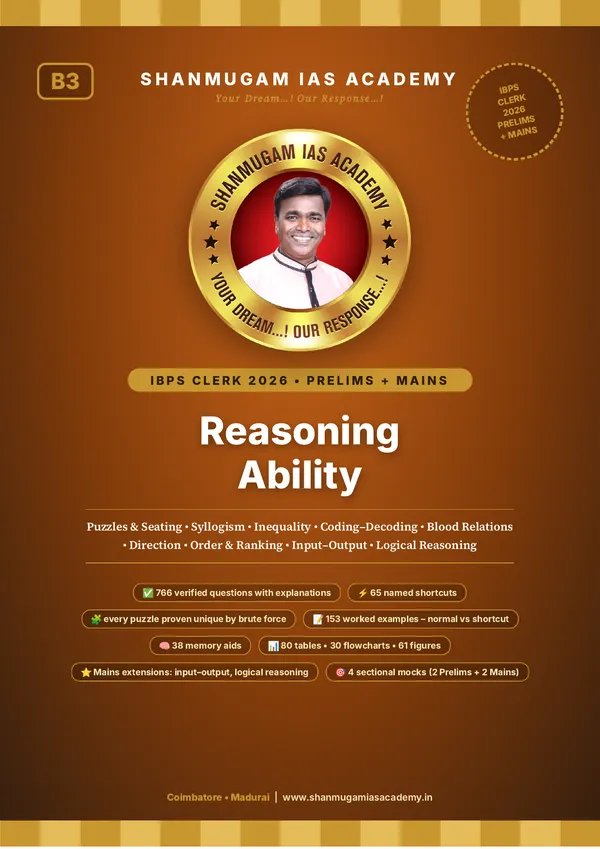 IBPS Clerk 2026 – Reasoning Ability (Prelims + Mains)
₹149
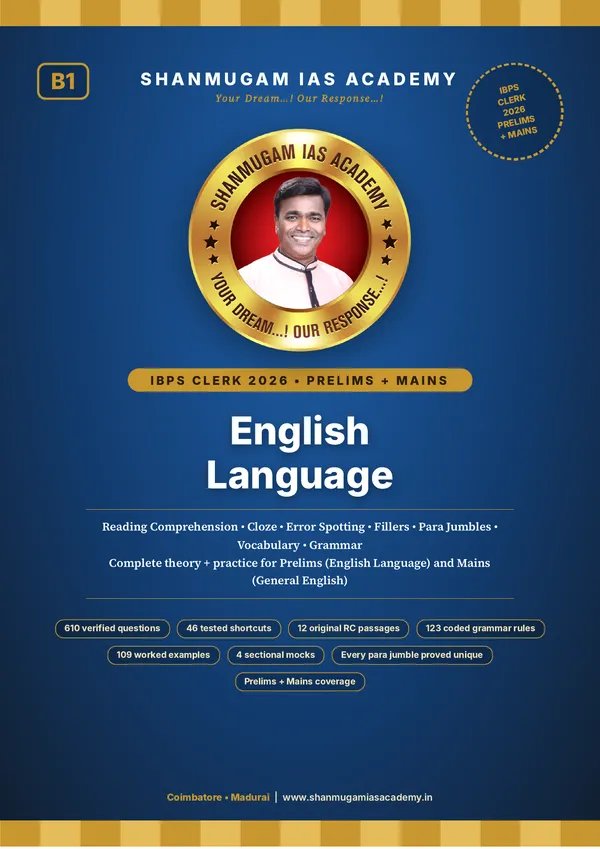 IBPS Clerk 2026 – English Language (Prelims + Mains)
₹149
TNPSC குரூப் 1, 2/2A, 4 – நேரடி வகுப்புகள் · கோவை & மதுரை
2006 முதல் சண்முகம் IAS அகாடமி · Classroom & online coaching in Coimbatore and Madurai
