

IBPS Clerk Quant – Mixtures & Alligation – Mains Level · Multi-vessel and replacement sets, Quantity comparison, Data sufficiency
IBPS Clerk Quant – Mixtures & Alligation – Mains Level · Multi-vessel and replacement sets, Quantity comparison, Data sufficiency – 12 questions, subject: Quantitative Aptitude. Every question has the correct answer with a two-line explanation; tap "Show Answer". Free practice for IBPS Clerk, IBPS PO, SBI, RRB exams – Shanmugam IAS Academy, Coimbatore.
Link to this page from your website / blog (HTML code)
Directions (Q 39–42): Vessel P has 60 L of milk and water in the ratio 3 : 1. Vessel Q has 40 L in the ratio 1 : 1. Vessel R has 50 L in the ratio 2 : 3. An empty vessel S is large enough for any amount.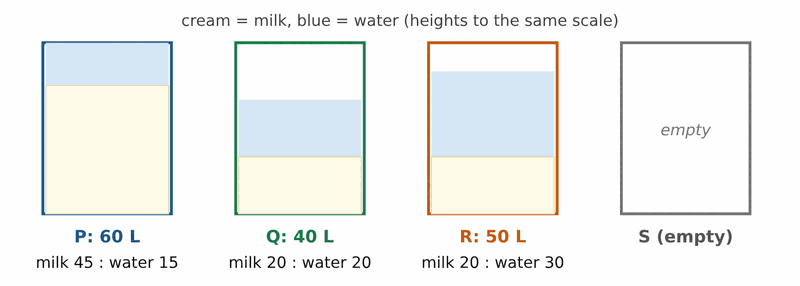
Correct Answer: D [13 : 7]
Explanation:
P (60 L, 3 : 1) has 45 L milk and 15 L water; Q (40 L, 1 : 1) has 20 L of each. In S: milk 65, water 35, so the ratio is 65 : 35 = 13 : 7.
Then 20 L of the mixture in S is taken out and replaced with water. How much milk is now in S?
Correct Answer: B [52 L]
Explanation:
S has P and Q together: 100 L with 65 L milk (45 + 20). Removing 20 L, i.e. one-fifth, leaves 4/5 x 65 = 52 L milk, and adding water does not change the milk.
Next, half of vessel R is poured into S. What percentage of the mixture in S is now milk?
Correct Answer: C [49.6%]
Explanation:
After the earlier steps S has 100 L with 52 L milk; half of R (25 L in ratio 2 : 3) adds 10 L milk and 15 L water. Milk = 62 L in 125 L, i.e. 62/125 x 100 = 49.6%.
Instead, how many litres of pure milk must be added to the full vessel R (50 L) to make it 60% milk?
Correct Answer: A [25 L]
Explanation:
Vessel R has 50 L in the ratio 2 : 3, i.e. 20 L milk and 30 L water. Adding milk keeps water at 30 L, which must be 40% of the new total, so total = 75 L and 25 L of milk is added.
Quantity II: 73
Correct Answer: B [Quantity I < Quantity II]
Explanation:
I: 100 × 0.9³ = 72.9 L. 72.9 < 73.
I. 20 L of a 4 : 1 milk–water mixture is mixed with 30 L of a 3 : 2 milk–water mixture.
II. The final mixture is 50 L.
Correct Answer: A [Statement I alone is sufficient]
Explanation:
Statement I alone gives milk = 16 + 18 = 34 L and water = 4 + 12 = 16 L, so the ratio is 34 : 16 = 17 : 8. Statement II only states the total volume and cannot give the ratio, so I alone is sufficient.
Correct Answer: A [43 : 21]
Explanation:
Start: milk 60, water 20; removing 20 L (1/4) leaves 45 and 15, and adding water gives 45 and 35. Removing 20 L again leaves 33.75 and 26.25; adding milk gives 53.75 : 26.25 = 43 : 21.
Correct Answer: E [5]
Explanation:
After n operations the milk fraction is (4/5)^n: 0.8, 0.64, 0.512, 0.4096 and then 0.32768. It first falls below 40% after the 5th operation (after 4 it is still 40.96%).
Correct Answer: B [₹ 175]
Explanation:
Total value = 2 x 110 + 1 x 130 + 2x = 5 x 140 = 700. So 350 + 2x = 700 and x = Rs 175 per kg.
Correct Answer: C [5 L]
Explanation:
Selling at Rs 48 with 20% profit means the cost of 1 L of mixture is 48/1.2 = Rs 40, while pure milk costs Rs 50. Since water is free, water : milk = (50 - 40) : 40 = 1 : 4, so 25 L has 1/5 x 25 = 5 L water.
Quantity II: Litres of pure milk to be replaced with water, once, in a 60 L can of pure milk so that 40 L of milk remains.
Correct Answer: E [Quantity I = Quantity II or relation cannot be established]
Explanation:
I: 60 L in 5 : 1 has 50 L milk and 10 L water; for 5 : 3 the water must be 30 L, so 20 L is added. II: replacing 20 L of 60 L pure milk leaves 40 L milk; both are 20, so Quantity I = Quantity II.
Correct Answer: D [59%]
Explanation:
Milk = 4/5 of 25 + 3/5 of 35 + 9/20 of 40 = 20 + 21 + 18 = 59 L. The tank holds 25 + 35 + 40 = 100 L, so milk is 59%.
நடப்பு நிகழ்வுகள் 24 நவம்பர் 2026 | Today Current Affairs in Tamil | TNPSC Group 4 வினா விடை
📚 IBPS Clerk 2026 Books
PDF நூல்கள் · ₹149 முதல் · ஒவ்வொன்றுக்கும் 50 பக்க இலவச மாதிரி · UPI-இல் பணம் செலுத்தியதும் உடனே பதிவிறக்கம்
 IBPS Clerk 2026 – Complete Set (5 Books, Prelims + Mains)
₹599
 IBPS Clerk 2026 – Quantitative Aptitude (Prelims + Mains)
₹149
 IBPS Clerk 2026 – Reasoning Ability (Prelims + Mains)
₹149
 IBPS Clerk 2026 – English Language (Prelims + Mains)
₹149
TNPSC குரூப் 1, 2/2A, 4 – நேரடி வகுப்புகள் · கோவை & மதுரை
2006 முதல் சண்முகம் IAS அகாடமி · Classroom & online coaching in Coimbatore and Madurai
