

UPSC CSAT Reasoning – Chapter 3: Syllogisms and Categorical Statements (28 MCQs)
UPSC CSAT Reasoning – Chapter 3: Syllogisms and Categorical Statements (28 MCQs) – 27 questions, subject: CSAT Reasoning. Every question has the correct answer with a two-line explanation; tap "Show Answer". Free practice for TNPSC, UPSC, SSC, Bank and RRB exams – Shanmugam IAS Academy, Coimbatore.
Link to this page from your website / blog (HTML code)
Correct Answer: C [O]
Explanation:
'Some S are not P' is the O form, the particular negative statement. A is universal affirmative, E universal negative and I particular affirmative.
Correct Answer: D [O]
Explanation:
The O form 'Some S are not P' cannot be converted: 'some animals are not dogs' is true, but 'some dogs are not animals' is false. A converts only in a limited way, while E and I convert simply.
Correct Answer: D [all members are students]
Explanation:
The term after 'none but' becomes the predicate, so the sentence means 'All members are students'. It does not say that all students are members.
Correct Answer: A [No rose is a stone]
Explanation:
Every rose is a flower and no flower is a stone, so no rose can be a stone. The other options turn the statements around and do not follow.
Correct Answer: B [both be true]
Explanation:
I ('Some S are P') and O ('Some S are not P') are sub-contraries, which can both be true, for example when some S are P and other S are not. They cannot both be false.
Correct Answer: C [no definite conclusion about A and C]
Explanation:
The A-part of B and the C-part of B may be different members, so A and C may or may not overlap. Two particular ('some') statements give no definite conclusion.
Correct Answer: C [Either I or II follows]
Explanation:
Neither conclusion is certain, but I and II cannot both be false: if no king is a joker, II holds; if some king is a joker, I holds. So either I or II follows.
Correct Answer: C [false]
Explanation:
"No S is P" (E) and "Some S are P" (I) are contradictories, so if one is true the other must be false. Contradictory statements can never both be true or both be false.
Correct Answer: A [some A are C]
Explanation:
The members that are both A and B are C, because all B are C. So at least some A are C; 'all A are C' does not follow.
Correct Answer: A [Both A and R are true, and R is the correct explanation of A]
Explanation:
A doctor who is a teacher must be an engineer, because all teachers are engineers, so at least one engineer is a doctor. Thus A is true and R gives the exact reason for it.
Correct Answer: C [contraries – both cannot be true]
Explanation:
A ('All S are P') and E ('No S is P') on the same terms are contraries: they cannot both be true. Both can be false, for example when some S are P and some are not.
Correct Answer: B [Some S are not P]
Explanation:
'Not all S are P' denies the universal affirmative 'All S are P', so it equals its contradictory, the O form. The O form is written 'Some S are not P'.
Correct Answer: D [Neither I nor II follows]
Explanation:
The unemployed graduates may lie wholly outside the teachers, so I is not certain. 'All teachers are graduates' cannot be reversed to 'all graduates are teachers', so neither conclusion follows.
Correct Answer: B [true in at least one allowed diagram]
Explanation:
'May' marks a possibility conclusion, which follows if it is true in at least one diagram the statements allow. A definite conclusion, in contrast, must be true in every allowed diagram.
Correct Answer: A [Only I follows]
Explanation:
Mobiles lie inside gadgets, which lie inside machines, so all mobiles are machines. The toys among the machines may lie outside the mobiles, so II is not certain.
Correct Answer: A [Only I follows]
Explanation:
All stones are hard and no stone is a bird, so the hard stones are things that are not birds; I follows. Birds may still be hard in other cases, so 'no bird is hard' does not follow.
Correct Answer: C [Both I and II follow]
Explanation:
'Only pilots are members' means all members are pilots, so the members who sing are pilots. Hence some singers are pilots and, by conversion, some pilots are singers; both follow.
Correct Answer: A [students]
Explanation:
'Only students can participate' in standard form is 'All participants are students'. Here 'participants' is the subject and 'students' is the predicate.
Correct Answer: B [Some dancers are not doctors]
Explanation:
The dancers who are singers can never be doctors, since no doctor is a singer. So at least some dancers are not doctors; 'no dancer is a doctor' is not certain.
Correct Answer: D [1 is false]
Explanation:
"Some colours are not pleasant" (O) is the contradictory of "All colours are pleasant" (A), so statement 1 must be false. Statements 2 and 3 cannot be settled from statement 4 alone.
Correct Answer: D [All those who travel by air are rich.]
Explanation:
'None but the rich can afford air travel' means everyone who travels by air is rich. The statements do not say that all the rich travel by air or that all air travellers fall sick.
Correct Answer: B [All married students are invited for dance]
Explanation:
Married students are married persons, and all married persons are invited for the dance, so all married students are invited. The statements say nothing about unmarried students or that all members are married.
Correct Answer: C [Only III]
Explanation:
'Some rats are cats' can be converted into 'some cats are rats', so III follows. Conclusions I and II are not certain, because the cats and rats outside the dogs may still be cows or dogs respectively.
Correct Answer: D [Neither Conclusion-I nor Conclusion-II]
Explanation:
'Some computers are watches' does not say which computers, so the watches may lie outside both the radios and the mobiles. Hence neither 'some radios are watches' nor 'some mobiles are watches' is certain.
Correct Answer: C [Both Conclusion-I and Conclusion-II]
Explanation:
Some almirahs are chairs and all chairs are tables, so certainly some almirahs are tables. 'Some cats may not be chairs' is a possibility allowed by the statements, so both conclusions follow.
Correct Answer: D [None of the Conclusion follows.]
Explanation:
No chair is a pen, so 'some chairs are pens' is impossible, and since all pens are books, 'all books are chairs' would make pens chairs, which is also impossible. Conclusions I and IV are only possibilities, so none of the conclusions follows.
Correct Answer: C [Both Conclusion-I and Conclusion-III]
Explanation:
the doctor-teachers are engineers and scientists.
➤ Full notes, maps, tables, a reason for every option and Mains PYQs – U24 · CSAT Reasoning (UPSC book, ₹249): www.shanmugamiasacademy.in/study-materials/upsc-csat-reasoning
Today Current Affairs in Tamil | 23 நவம்பர் 2026 | TNPSC Group 4 முக்கிய வினாக்கள்
📚 UPSC Civil Services Books (Prelims & Mains)
PDF நூல்கள் · ₹149 முதல் · ஒவ்வொன்றுக்கும் 50 பக்க இலவச மாதிரி · UPI-இல் பணம் செலுத்தியதும் உடனே பதிவிறக்கம்
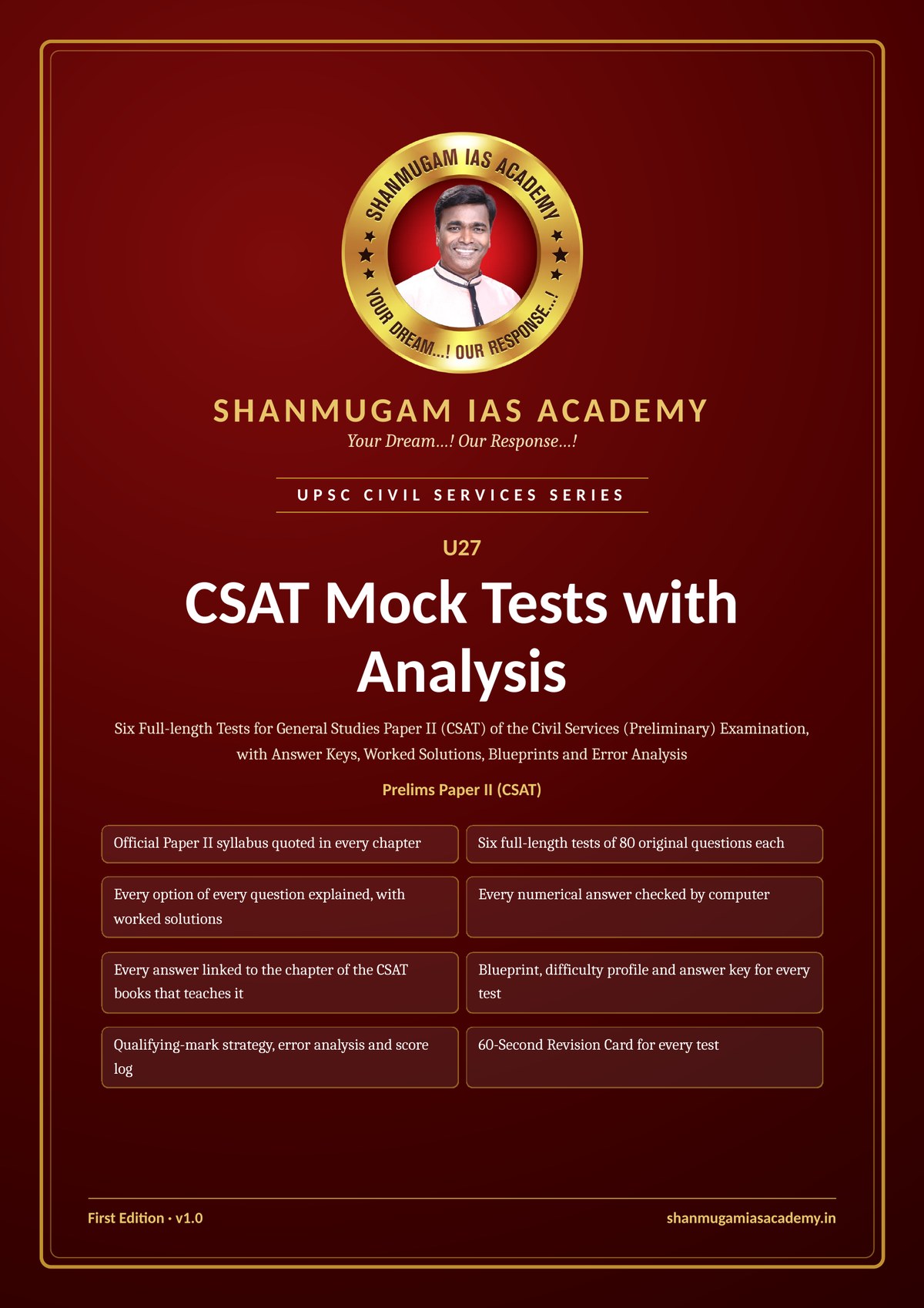 U27 · CSAT Mock Tests with Analysis – UPSC Civil Services (Prelims Paper II – CSAT)
₹249
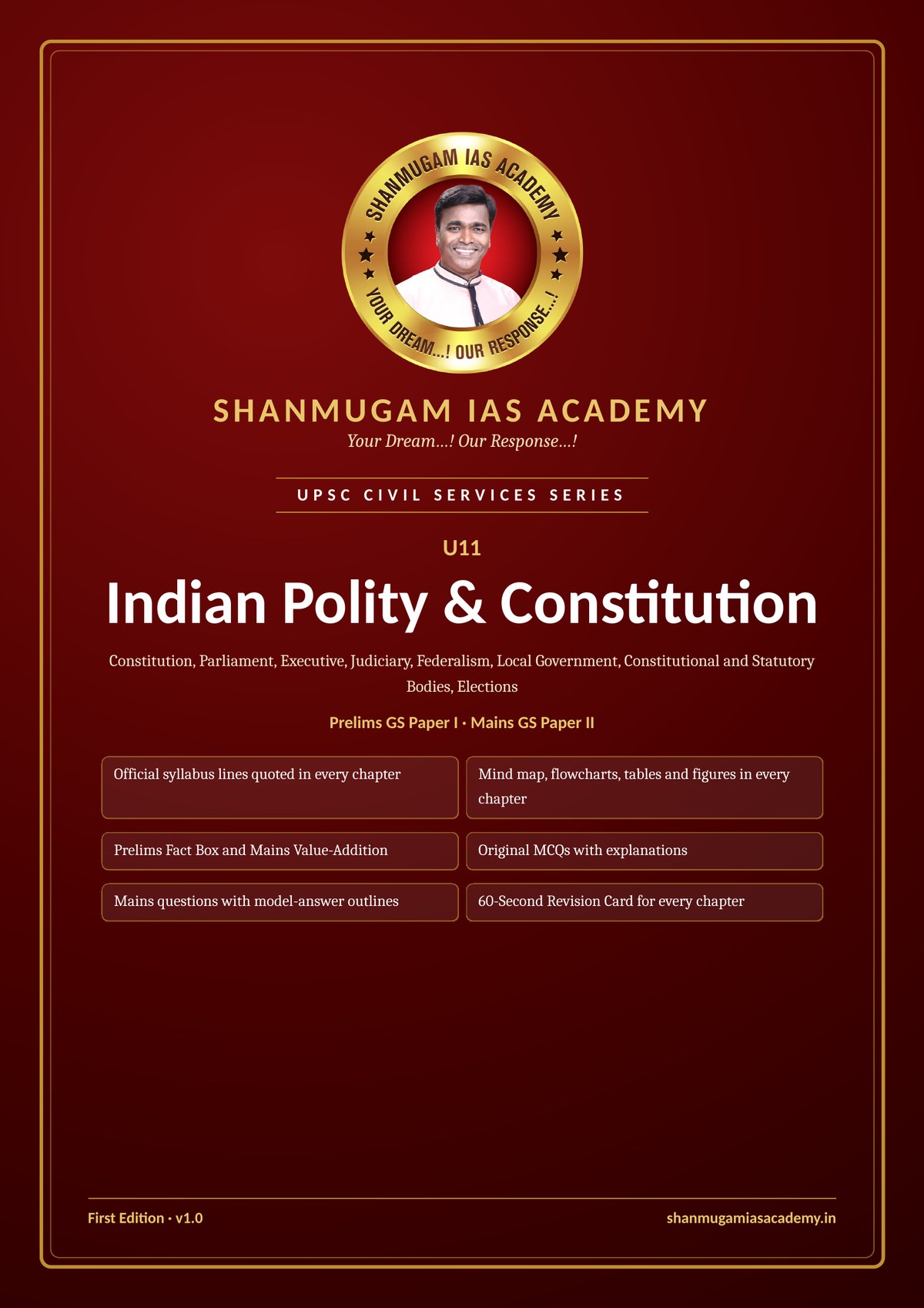 U11 · Indian Polity & Constitution – UPSC Civil Services (Prelims & Mains)
₹249
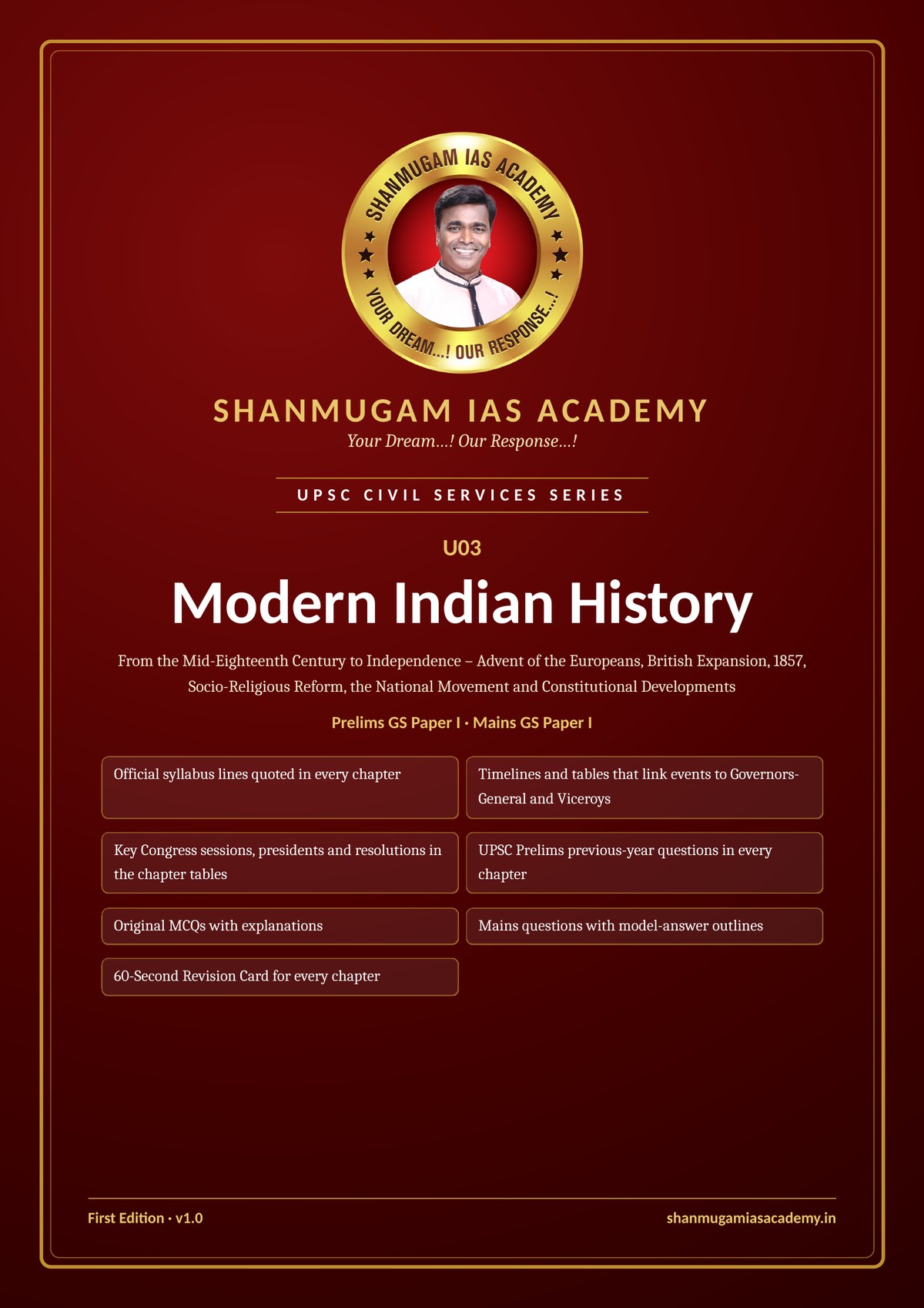 U03 · Modern Indian History – UPSC Civil Services (Prelims & Mains)
₹249
 U15 · Indian Economy – UPSC Civil Services (Prelims & Mains)
₹249
TNPSC குரூப் 1, 2/2A, 4 – நேரடி வகுப்புகள் · கோவை & மதுரை
2006 முதல் சண்முகம் IAS அகாடமி · Classroom & online coaching in Coimbatore and Madurai
