

UPSC CSAT Reasoning – Chapter 8: Puzzles – Grouping Selection and Scheduling (36 MCQs)
UPSC CSAT Reasoning – Chapter 8: Puzzles – Grouping Selection and Scheduling (36 MCQs) – 27 questions, subject: CSAT Reasoning. Every question has the correct answer with a two-line explanation; tap "Show Answer". Free practice for TNPSC, UPSC, SSC, Bank and RRB exams – Shanmugam IAS Academy, Coimbatore.
Link to this page from your website / blog (HTML code)
Correct Answer: D [Bala, Chennai]
Explanation:
Chitra lives in Delhi and Bala not in Pune, so Bala is in Chennai and Anil in Pune. The Pune resident keeps the cat (Anil); the parrot owner is not in Chennai, so Chitra keeps the parrot and Bala the dog.
Correct Answer: D [exactly one tick]
Explanation:
In a one-to-one match each person gets exactly one item, so each row of the grid carries exactly one tick. Likewise each column also has exactly one tick.
Correct Answer: C [T lives on floor 5]
Explanation:
The top floor cannot go to S (stated), P (floor 2), R (below Q) or Q (below T), so T must live on floor 5. The others can vary, for example R on floor 1 or 3, so only (c) is definitely true.
Correct Answer: D [negative clue]
Explanation:
'A does not belong to Hyderabad' only rules out one pairing, so it is a negative clue, marked with a cross in the grid. It does not fix A's city by itself, unlike a definite clue.
Correct Answer: D [Monday]
Explanation:
With C on Wednesday and D on Saturday, F and A need two adjacent free days: Monday–Tuesday or Thursday–Friday. Thursday–Friday would leave Monday and Tuesday for E and B; E cannot be on Monday, so B would come before E – not allowed. So F is on Monday.
Correct Answer: C [18]
Explanation:
restricted slot first: Task 1 has 3 choices, the other three tasks 3! = 6; 3 × 6 = 18 (code-checked).
Correct Answer: A [36]
Explanation:
P can receive any one of the 3 prizes in 3 ways. The other two prizes go to two of the remaining four students in 4 × 3 = 12 ways, so the total is 3 × 12 = 36.
Correct Answer: B [6]
Explanation:
Of the 12 teams of four with at least two women, removing those with both A and P and those with B but not Q leaves 6. They are ABQR, ACQR, BCPQ, BCQR, BPQR and CPQR.
Correct Answer: C [10]
Explanation:
Choosing 3 of 6 for one team gives 6C3 = 20 ways, but each split is counted twice (team X with team Y is the same as team Y with team X). So the number of divisions is 20 ÷ 2 = 10.
Correct Answer: B [2 and 3 only]
Explanation:
English is on Tuesday or Wednesday. Tuesday would put Maths on Thursday and leave Friday for Science (Hindi and History cannot be on Friday), but Science must come before Hindi – impossible. So English is on Wednesday and Maths on Friday in every arrangement; Science can be on Monday or Tuesday.
Correct Answer: A [Both A and R are true, and R is the correct explanation of A]
Explanation:
With only 12 months, 13 birthdays cannot all fall in different months, so at least two share a month. This is the pigeonhole principle, and R states exactly the reason for A.
Correct Answer: A [X]
Explanation:
If X broke it, X's statement is false, Y's is true and Z's is false – exactly one true, as required. If Y broke it, X's and Z's statements are both true, and if Z broke it, Y's and Z's are both true, so both cases fail.
Correct Answer: B [Hari ordered juice]
Explanation:
Hari ordered neither tea nor coffee, and milk went to Indu or Jaya, so Hari must have ordered juice. The other drinks can be shared in two ways (Jaya milk or Jaya coffee), so only Hari's juice is certain.
Correct Answer: C [Blue]
Explanation:
Yellow is at the bottom and green sits just above red, with blue somewhere above green. White cannot be at the top and red and green are below blue, so only blue can be at the top.
Correct Answer: B [Anu]
Explanation:
Bala is on 4 and Chitra on 3, so Anu and Deepa share floors 1 and 2; the dog owner is on floor 1 and Anu keeps no dog, so Anu is on floor 2 and Deepa on floor 1 with the dog. Anu cannot keep the rabbit (the parrot would then be Deepa's), so Anu keeps the parrot and Chitra the rabbit.
Correct Answer: D [9]
Explanation:
This is the number of derangements of 4 items: 4!(1 − 1 + 1/2 − 1/6 + 1/24) = 24 − 24 + 12 − 4 + 1 = 9. Check: of 24 orders, 1 has all right, 6 have exactly two right and 8 exactly one right, leaving 24 − 15 = 9.
Correct Answer: A [12]
Explanation:
Four teams playing each other once make 4 × 3 ÷ 2 = 6 matches. Each match gives out 2 points in total (2 + 0 or 1 + 1), so the total is 6 × 2 = 12 regardless of the number of draws.
Correct Answer: B [R]
Explanation:
P is older than the engineer, so P is not the engineer; if Q were the engineer, R would be the doctor and P the lawyer, but the lawyer is the youngest and P is older than Q, a contradiction. So R is the engineer, P the doctor and Q the youngest, the lawyer.
Correct Answer: B [S]
Explanation:
With R on Wednesday, P–Q must be Monday–Tuesday or Thursday–Friday; Thursday–Friday would leave S and T on Monday–Tuesday with S on Tuesday and T before it, which breaks the rules. So P and Q take Monday and Tuesday, S takes Thursday and T Friday.
Correct Answer: B [192]
Explanation:
2 choices for Task 1, then 4 for Task 2, then 4! = 24: 2 × 4 × 24 = 192.
Correct Answer: D [Oranges]
Explanation:
Oranges are the only fruit eaten by both B and C (the sick ones) and by neither A nor D (the healthy ones). Grapes, pineapple and apple were all eaten by at least one person who did not fall sick.
Correct Answer: C [Mathematics]
Explanation:
Chemistry is on day 3; the test right after Biology must be preceded by Physics, which works only with Physics on day 1, Biology on day 2 and Chemistry on day 3. Mathematics then takes day 4, the last test.
Correct Answer: D [One of those who can drive a car speaks Tamil.]
Explanation:
Shabnam speaks Marathi and Anil speaks Tamil, so the second Tamil speaker is Rekha or David, and both of them drive. Since only one man drives and David drives, Anil cannot drive, so exactly one driver speaks Tamil.
Correct Answer: C [Nirmala]
Explanation:
Amala and Komala are unemployed, so the two Sociology postgraduates who are bank employees are Kamla and Nirmala. Nirmala is also a tennis player, so she is both a tennis player and a bank employee.
Correct Answer: C [24]
Explanation:
Task-2 can go to person-3 or person-4 (2 ways), then Task-1 can go to the remaining two of persons 3, 4, 5 (2 ways), and the other three tasks to three persons in 3! = 6 ways. Total = 2 x 2 x 6 = 24.
Correct Answer: D [Cannot be concluded]
Explanation:
The item gives no rule about who tells the truth. If P is the thief, only P lies; if Q is the thief, only Q lies; if R is the thief, all three lie. Each case fits the statements, so the thief cannot be identified.
Correct Answer: C [Both I and II]
Explanation:
Points 3, 2, 1 with one goal each force a single result table: P beat R 1 – 0, P and Q drew 0 – 0, and Q and R drew 1 – 1. So the P–Q match was a 0 – 0 draw and R scored its goal against Q.
➤ Full notes, maps, tables, a reason for every option and Mains PYQs – U24 · CSAT Reasoning (UPSC book, ₹249): www.shanmugamiasacademy.in/study-materials/upsc-csat-reasoning
Today Current Affairs in Tamil | 23 நவம்பர் 2026 | TNPSC Group 4 முக்கிய வினாக்கள்
📚 UPSC Civil Services Books (Prelims & Mains)
PDF நூல்கள் · ₹149 முதல் · ஒவ்வொன்றுக்கும் 50 பக்க இலவச மாதிரி · UPI-இல் பணம் செலுத்தியதும் உடனே பதிவிறக்கம்
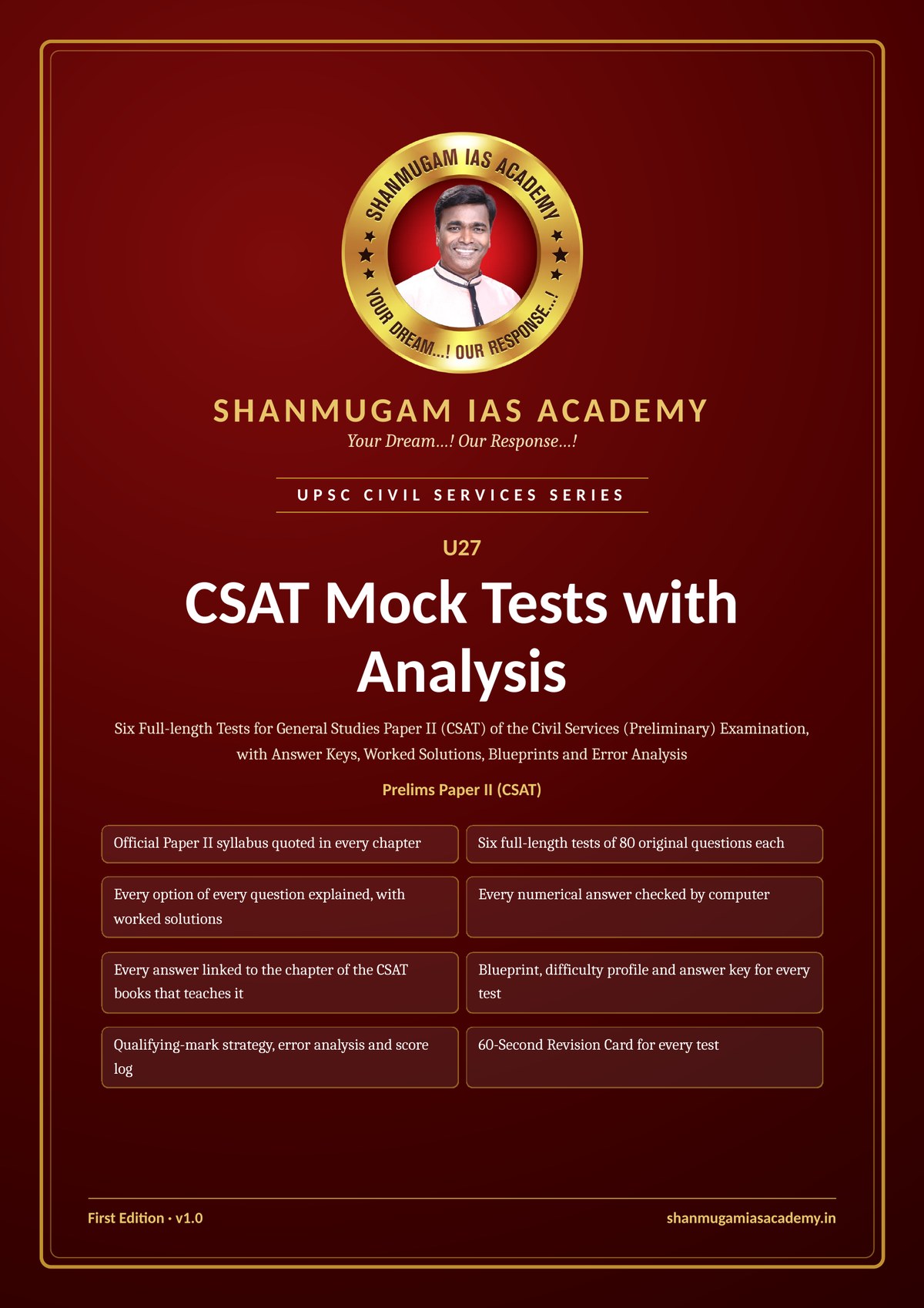 U27 · CSAT Mock Tests with Analysis – UPSC Civil Services (Prelims Paper II – CSAT)
₹249
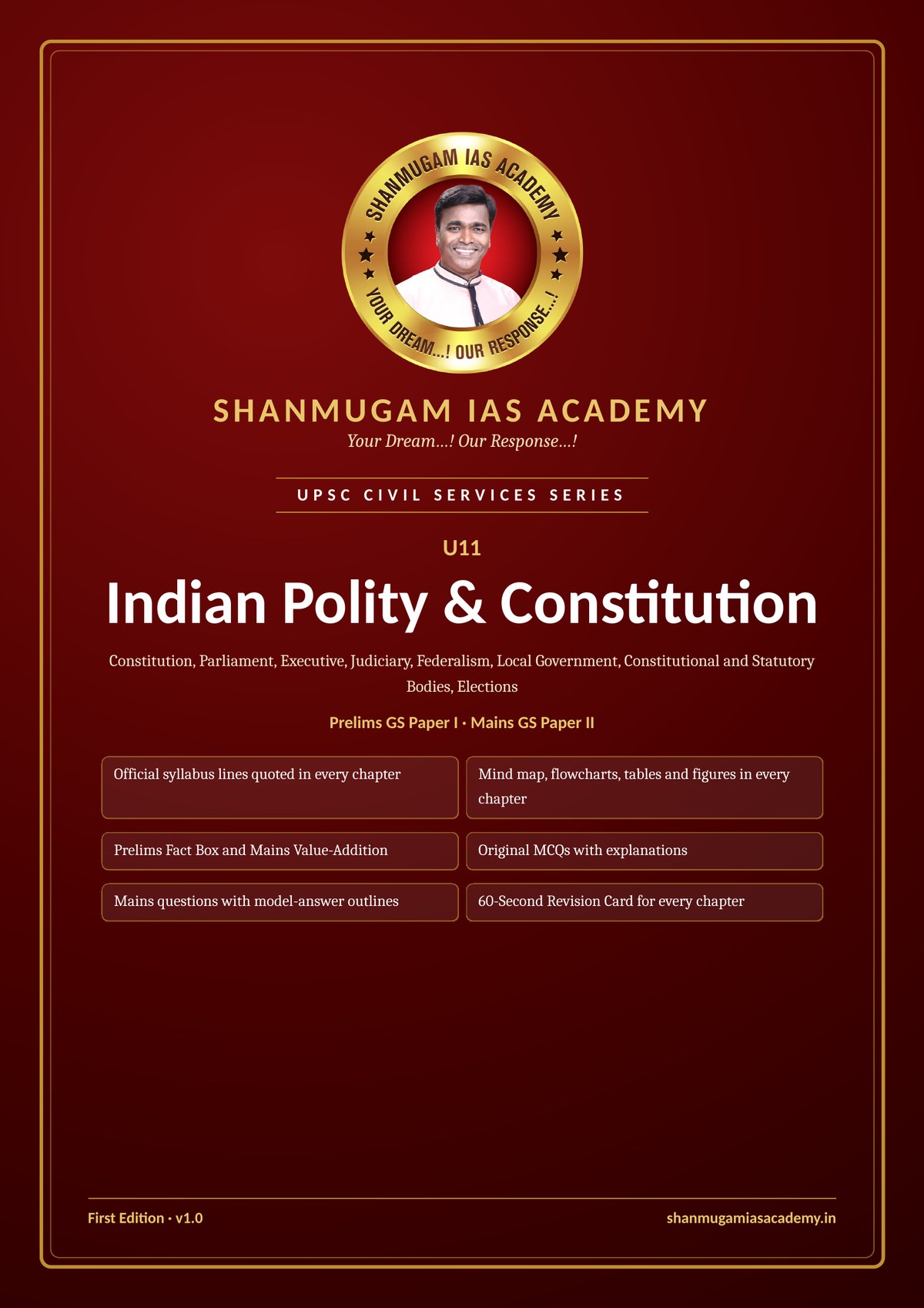 U11 · Indian Polity & Constitution – UPSC Civil Services (Prelims & Mains)
₹249
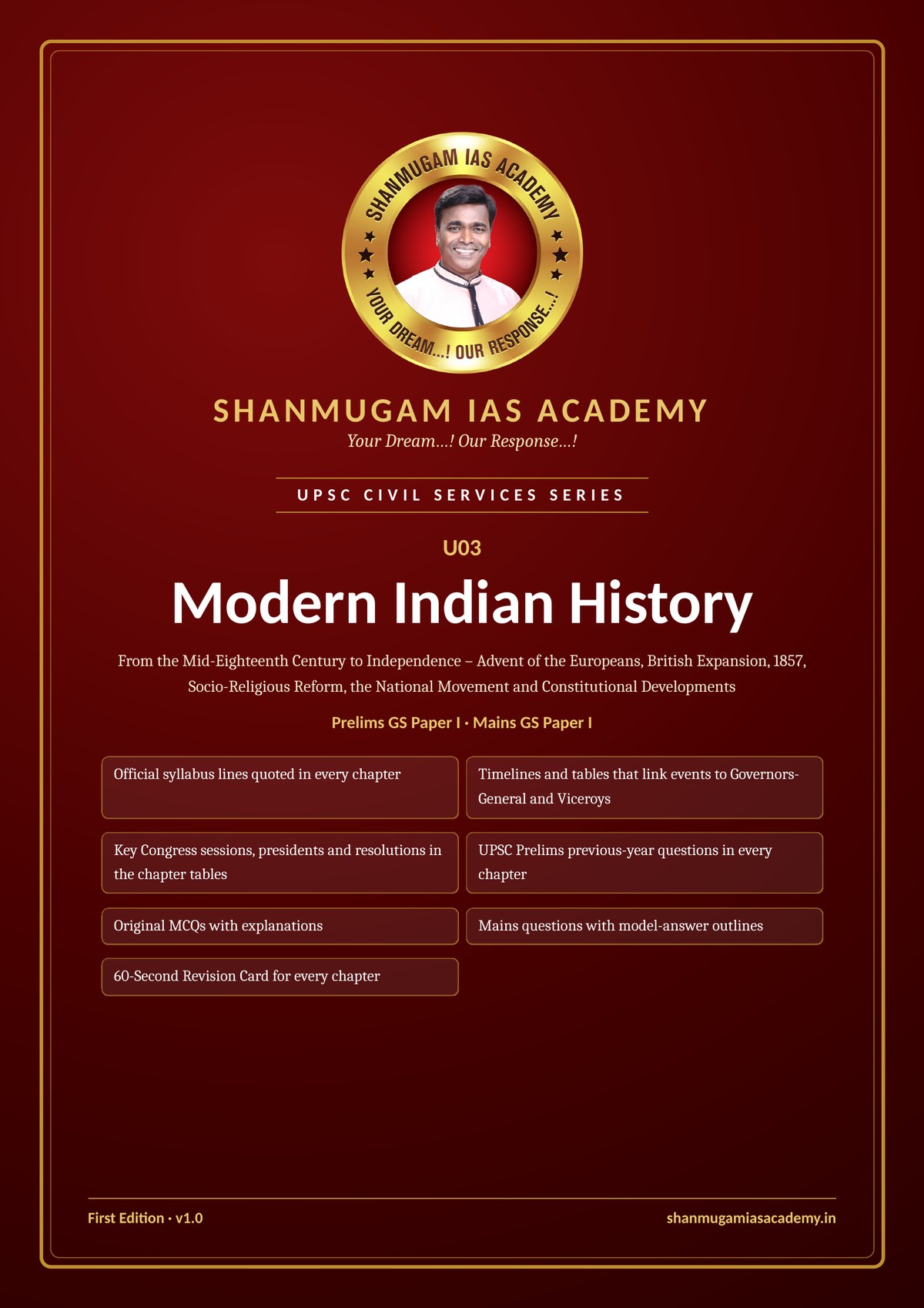 U03 · Modern Indian History – UPSC Civil Services (Prelims & Mains)
₹249
 U15 · Indian Economy – UPSC Civil Services (Prelims & Mains)
₹249
TNPSC குரூப் 1, 2/2A, 4 – நேரடி வகுப்புகள் · கோவை & மதுரை
2006 முதல் சண்முகம் IAS அகாடமி · Classroom & online coaching in Coimbatore and Madurai
