

UPSC Essay – Chapter 6: Women, Gender and the Family (20 MCQs)
UPSC Essay – Chapter 6: Women, Gender and the Family (20 MCQs) – 19 questions, subject: Essay. Every question has the correct answer with a two-line explanation; tap "Show Answer". Free practice for TNPSC, UPSC, SSC, Bank and RRB exams – Shanmugam IAS Academy, Coimbatore.
Link to this page from your website / blog (HTML code)
Correct Answer: A [2016]
Explanation:
'If development is not engendered, it is endangered' was set in Section A of the UPSC Essay paper of 2016. The topic links gender equality directly to the success of development.
Correct Answer: B [943]
Explanation:
Census 2011 counted 943 females per 1,000 males for India as a whole. The child sex ratio (0-6 years) in the same census was lower, at 919.
Correct Answer: C [partly real and partly myth – growing but unequal across class, caste and region]
Explanation:
The thesis adopted is balanced: the fulfilment of the 'new woman' is partly real and partly a myth, growing but unequal across class, caste and region. Options a and b are one-sided extremes that a good essay avoids.
Correct Answer: C [74]
Explanation:
In the 2024 General Election, 74 women were elected to the Lok Sabha, about 13.6% of the 543 seats. This was four fewer than the 78 women elected in 2019.
Correct Answer: C [a male relative acting for an elected woman in a panchayat]
Explanation:
The essay cites a male relative acting for an elected woman in a panchayat to show how old norms can bend new institutions. Such a 'proxy' leader defeats the purpose of reservation for women under the 73rd Amendment.
Correct Answer: B [2005]
Explanation:
The Hindu Succession (Amendment) Act, 2005 made daughters coparceners by birth, with the same rights in joint family property as sons. In 2020 the Supreme Court held that this right applies even if the father died before 2005.
Correct Answer: D [one-third seats for women in the Lok Sabha and State Assemblies]
Explanation:
The 106th Constitutional Amendment (2023) reserves one-third of seats for women in the Lok Sabha, State Assemblies and the Delhi Assembly. The reservation will take effect after the delimitation that follows the next census.
Correct Answer: D [The 2023 topic]
Explanation:
The 2023 topic 'Girls are weighed down by restrictions, boys with demands - two equally harmful disciplines' names both girls and boys. It asks the writer to show how gender norms harm both sexes, though in different ways.
Correct Answer: A [929]
Explanation:
The National Family Health Survey-5 (2019-21) estimated a sex ratio at birth of 929 girls per 1,000 boys for children born in the five years before the survey. In contrast, 943 is the overall sex ratio of Census 2011.
Correct Answer: B [1 and 2 only]
Explanation:
The 73rd Amendment provides at least one-third reservation for women in panchayats, and the Protection of Women from Domestic Violence Act was enacted in 2005, so statements 1 and 2 are correct. Statement 3 is wrong because the Justice Verma Committee was set up in December 2012.
Correct Answer: A [Both A and R are true, and R is the correct explanation of A]
Explanation:
Both statements are true, and R explains A: norms learnt early and enforced with affection seem natural, so patriarchy often goes unnoticed. Because it works inside families rather than through open force, it is harder to see than other inequalities.
Correct Answer: C [evidence of gains from girls' schooling and women's work]
Explanation:
The outline answers 'growth first, equality later' with evidence of the gains from girls' schooling and women's work, showing that gender equality itself drives development. Option d is the counter-view itself, not the answer to it.
Correct Answer: C [1951–52]
Explanation:
The Constitution gave universal adult franchise, first used in the general elections of 1951-52, with equal votes for women and men. Before this, under the Government of India Act 1935, voting was limited by property and education.
Correct Answer: B [equates harms where the evidence shows they differ]
Explanation:
The shortcut fails when the writer equates harms where the evidence shows they differ. Including men and boys is encouraged, but treating unequal burdens as equal distorts the argument.
Correct Answer: C [2-4-3-1]
Explanation:
The Towards Equality report came in 1974, the Vishaka guidelines in 1997, the Hindu Succession (Amendment) Act giving daughters coparcenary rights in 2005 and the POSH Act in 2013, giving 2-4-3-1. The 2013 Act gave legal form to the Vishaka guidelines.
Correct Answer: D [Family]
Explanation:
In the SEPL-F scan, the letters stand for Social, Economic, Political, Legal and Family, so 'F' is Family. Checking all five dimensions keeps a gender essay from becoming one-sided.
Correct Answer: D [reform norms, not abolish the family]
Explanation:
The balanced answer is to reform unequal norms within the family rather than abolish the family, while strengthening care and sharing burdens. The other options are extremes that ignore either the family's value or its problems.
Correct Answer: B [42%]
Explanation:
The Periodic Labour Force Survey 2023-24 put female labour-force participation (age 15+, usual status) at 41.7%, or about 42%. This is a sharp rise from about 23% in 2017-18, which is the tempting wrong option.
Correct Answer: A [Andhra Pradesh]
Explanation:
Andhra Pradesh amended the Hindu Succession Act in 1986, before Tamil Nadu (1989) and Karnataka and Maharashtra (1994).
➤ Essay-writing method, theme-wise idea banks, UPSC essay topics with outlines, model essays and practice topics – U22 · Essay (UPSC book, ₹249): www.shanmugamiasacademy.in/study-materials/upsc-essay
Today Current Affairs in Tamil | 23 நவம்பர் 2026 | TNPSC Group 4 முக்கிய வினாக்கள்
📚 UPSC Civil Services Books (Prelims & Mains)
PDF நூல்கள் · ₹149 முதல் · ஒவ்வொன்றுக்கும் 50 பக்க இலவச மாதிரி · UPI-இல் பணம் செலுத்தியதும் உடனே பதிவிறக்கம்
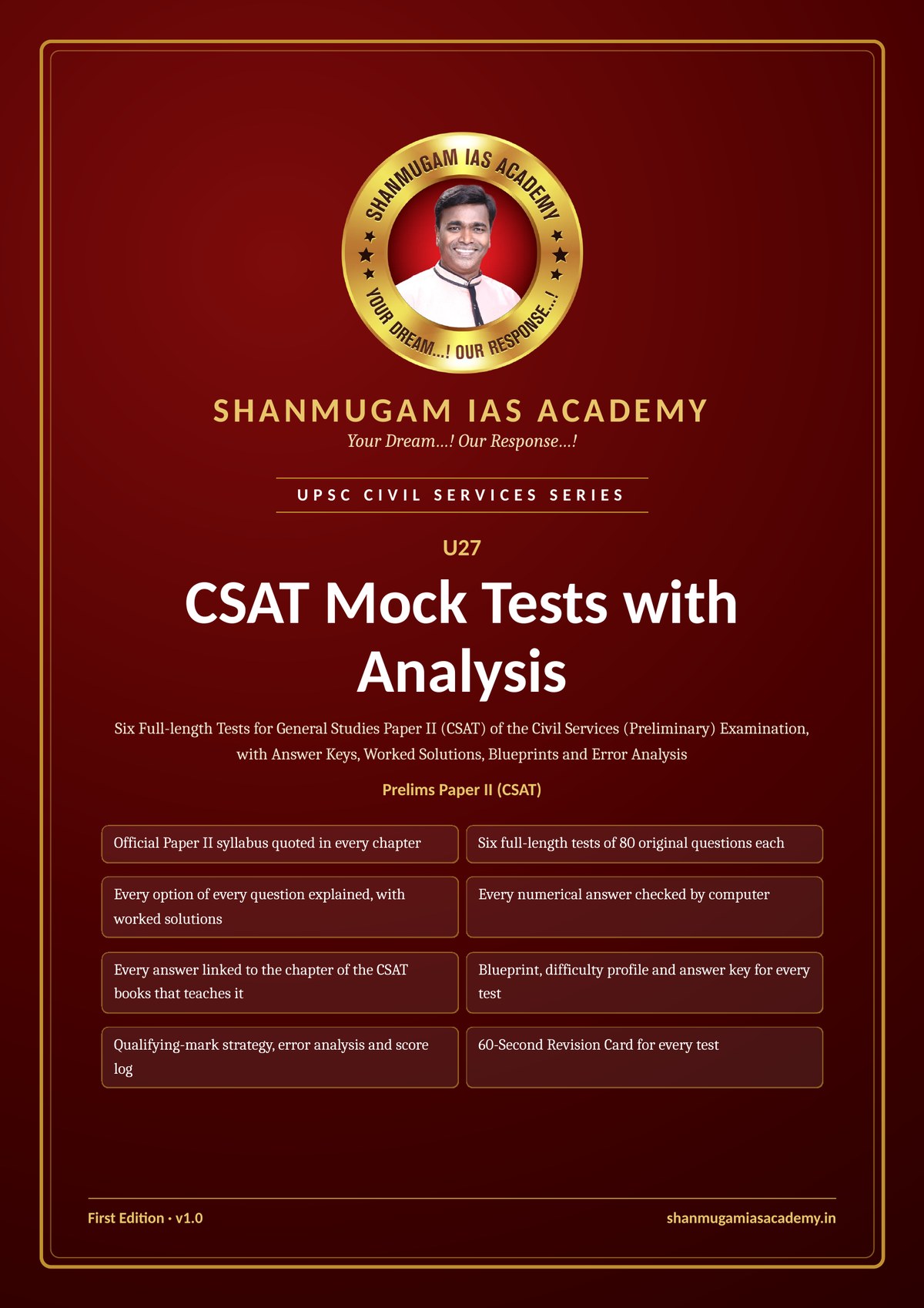 U27 · CSAT Mock Tests with Analysis – UPSC Civil Services (Prelims Paper II – CSAT)
₹249
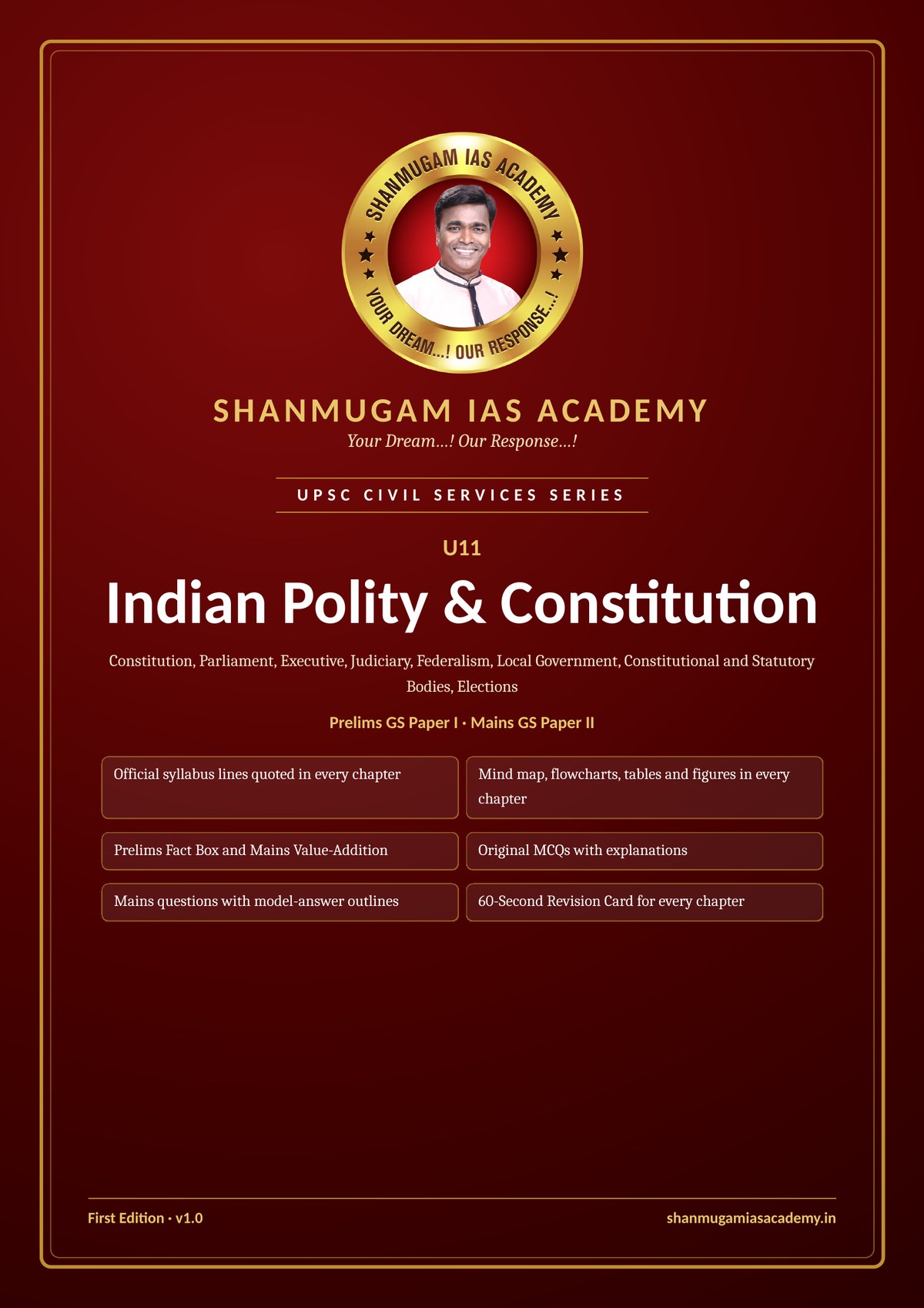 U11 · Indian Polity & Constitution – UPSC Civil Services (Prelims & Mains)
₹249
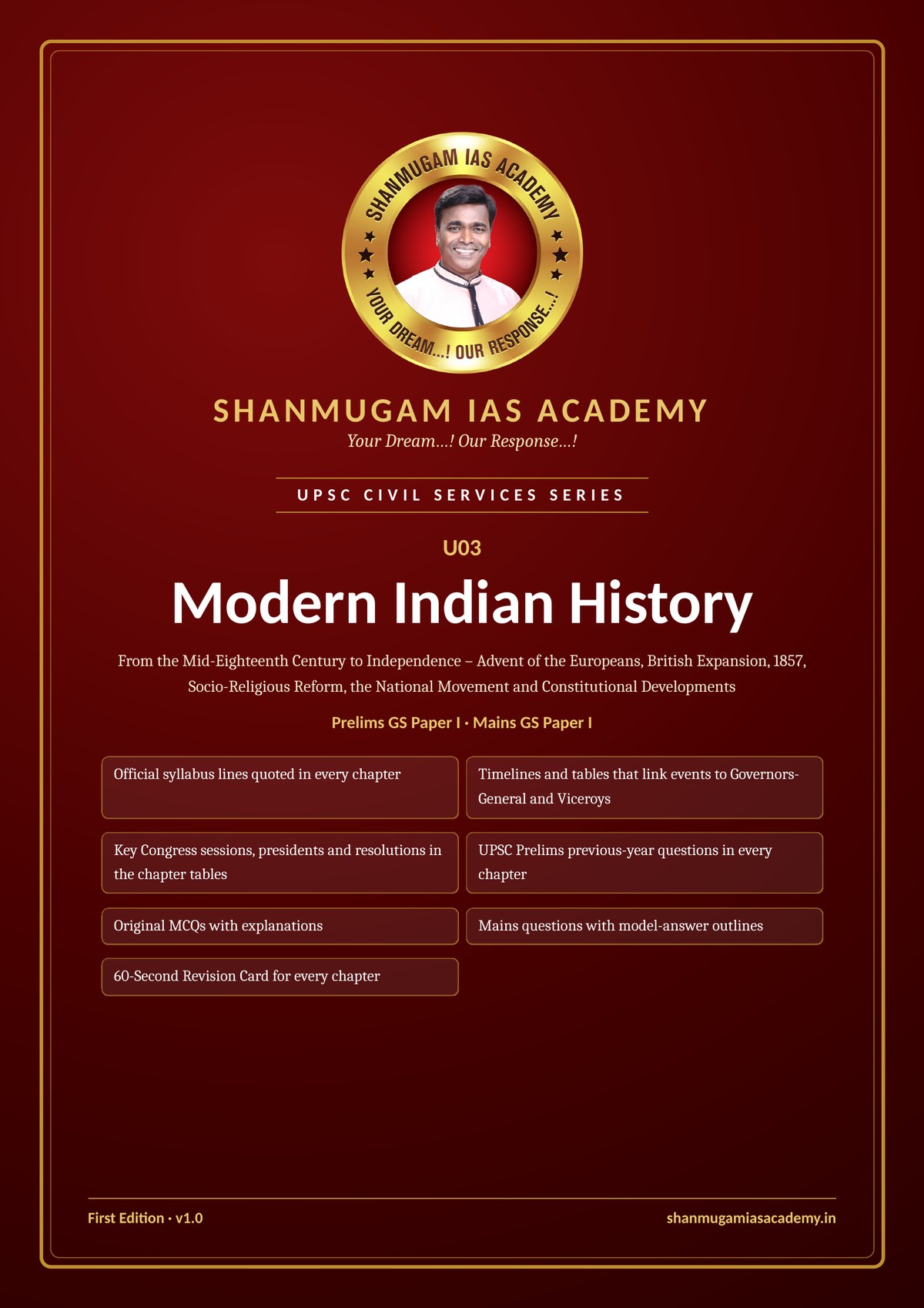 U03 · Modern Indian History – UPSC Civil Services (Prelims & Mains)
₹249
 U15 · Indian Economy – UPSC Civil Services (Prelims & Mains)
₹249
TNPSC குரூப் 1, 2/2A, 4 – நேரடி வகுப்புகள் · கோவை & மதுரை
2006 முதல் சண்முகம் IAS அகாடமி · Classroom & online coaching in Coimbatore and Madurai
