

UPSC Essay – Chapter 16: Truth, Reality and the Mind (20 MCQs)
UPSC Essay – Chapter 16: Truth, Reality and the Mind (20 MCQs) – 18 questions, subject: Essay. Every question has the correct answer with a two-line explanation; tap "Show Answer". Free practice for TNPSC, UPSC, SSC, Bank and RRB exams – Shanmugam IAS Academy, Coimbatore.
Link to this page from your website / blog (HTML code)
Correct Answer: A [2019]
Explanation:
'Wisdom finds truth' was the first topic in Section A of the 2019 UPSC Civil Services Mains essay paper. Short philosophical topics like this test whether a candidate can turn an abstract idea into a clear, well-argued thesis.
Correct Answer: B [Hegel]
Explanation:
"What is rational is real, and what is real is rational" is from the preface to Hegel's Philosophy of Right (1820). It expresses Hegel's view that reason works itself out through history and institutions.
Correct Answer: B [Jainism]
Explanation:
Anekantavada, the doctrine that reality and truth are many-sided, is a central teaching of Jainism. It is linked with Syadvada, the theory that every statement is true only from a certain point of view.
Correct Answer: C [Daniel Kahneman]
Explanation:
'Thinking, Fast and Slow' (2011) was written by Daniel Kahneman, the psychologist who won the 2002 Nobel Memorial Prize in Economic Sciences. It describes System 1 (fast, intuitive) and System 2 (slow, deliberate) thinking.
Correct Answer: C [A smile is the chosen vehicle for all ambiguities]
Explanation:
'A smile is the chosen vehicle for all ambiguities' was set in the 2022 UPSC essay paper. 'Thinking is like a game, it does not begin unless there is an opposite team' was set in 2023, and 'Wisdom finds truth' in 2019.
Correct Answer: D [Working in uncertainty and urgency]
Explanation:
Intuition works well in uncertainty and urgency, because it draws quickly on experience and pattern recognition when there is no time for full analysis. It is not free from bias, and where data exist, careful logical analysis is usually more accurate.
Correct Answer: A [confirmation bias]
Explanation:
Confirmation bias is the tendency to notice, seek and favour information that fits what one already expects or believes. Dialectic, by contrast, is reaching truth through the clash of opposing views.
Correct Answer: C [classical debate between schools]
Explanation:
Shastrartha is the classical Indian tradition of formal debate between scholars of different schools of thought, held before learned audiences. The famous debate between Adi Shankaracharya and Mandana Mishra is a well-known example.
Correct Answer: A [Descartes' Meditations]
Explanation:
Descartes' 'Meditations' (1641) used systematic doubt as a method, doubting everything until he reached a certainty he could not doubt: 'I think, therefore I am'. Kahneman's book is about two systems of thinking, not methodical doubt.
Correct Answer: B [1 and 2 only]
Explanation:
Descartes' 'Meditations on First Philosophy' appeared in 1641, and Gandhi's autobiography was serialised in 'Navajivan' between 1925 and 1929, so statements 1 and 2 are correct. Hegel's 'Philosophy of Right' dates from 1820, not 2011, so statement 3 is wrong.
Correct Answer: A [Both A and R are true, and R is the correct explanation of A]
Explanation:
Both are true, and R explains A: intuition gives direction when information is uncertain, and logic then tests the choice and plans the path. Visionary decisions therefore usually combine the leap of intuition with the checking of reason.
Correct Answer: D [1979]
Explanation:
Mindfulness-based stress reduction (MBSR) was started by Jon Kabat-Zinn at the University of Massachusetts Medical School in 1979. It adapted Buddhist meditation practices into an eight-week secular programme for stress and pain.
Correct Answer: C [decision-making]
Explanation:
'Intuition leaps, logic bridges' is a one-line thesis for decision-making topics: intuition suggests a quick answer and logic checks and supports it. Good decisions in administration use both instinct from experience and evidence-based reasoning.
Correct Answer: C [1-3-2-4]
Explanation:
Descartes' Meditations appeared in 1641, Hegel's Philosophy of Right in 1820, mindfulness-based stress reduction began in 1979 and Kahneman's Thinking, Fast and Slow in 2011, giving 1-3-2-4. Kahneman's book explains fast intuitive (System 1) and slow deliberate (System 2) thinking.
Correct Answer: A [self, society, state]
Explanation:
In the 'three mirrors' shortcut, a statement about the mind is applied to three levels: the self, society and the state. This helps the essay move from personal experience to social and governance examples in a structured way.
Correct Answer: A [26 January 1950]
Explanation:
The State Emblem of India, with the motto 'Satyameva Jayate' (Truth alone triumphs) from the Mundaka Upanishad, was adopted on 26 January 1950, the day the Constitution came into force. The motto is written in Devanagari script below the Lion Capital of Sarnath.
Correct Answer: B [intuition opens doors and logic confirms what lies behind them]
Explanation:
Ramanujan wrote many formulas by intuition, and other mathematicians proved them rigorously over the following decades. His work shows that intuition opens doors and logic confirms what lies behind them, so both are needed.
Correct Answer: C [Ramana Maharshi]
Explanation:
Ramana Maharshi of Tiruvannamalai taught self-enquiry (atma vichara), centred on the question 'Who am I?'.
➤ Essay-writing method, theme-wise idea banks, UPSC essay topics with outlines, model essays and practice topics – U22 · Essay (UPSC book, ₹249): www.shanmugamiasacademy.in/study-materials/upsc-essay
Today Current Affairs in Tamil | 23 நவம்பர் 2026 | TNPSC Group 4 முக்கிய வினாக்கள்
📚 TNPSC குரூப் 4 / 2 / 2A – பொதுத்தமிழ், பொது அறிவு நூல்கள்
PDF நூல்கள் · ₹149 முதல் · ஒவ்வொன்றுக்கும் 50 பக்க இலவச மாதிரி · UPI-இல் பணம் செலுத்தியதும் உடனே பதிவிறக்கம்
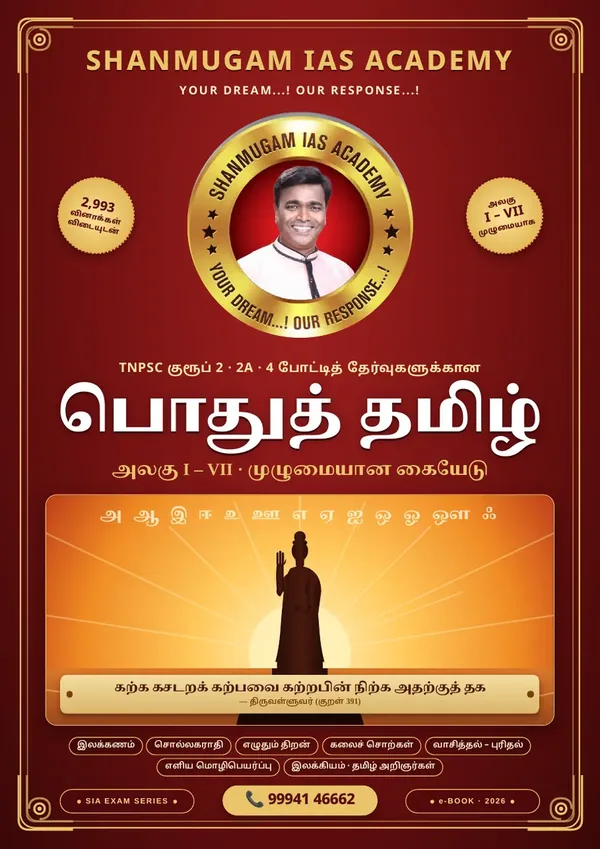 பொதுத் தமிழ் — முழுமையான கையேடு (TNPSC குரூப் 2 · 2A · 4)
₹199
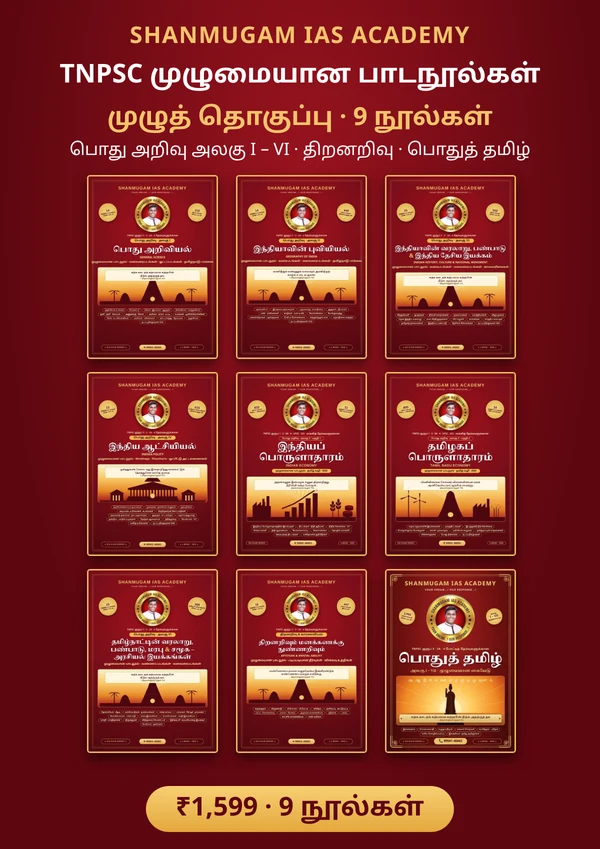 TNPSC முழுமையான பாடநூல்கள் – முழுத் தொகுப்பு (9 நூல்கள்)
₹1599
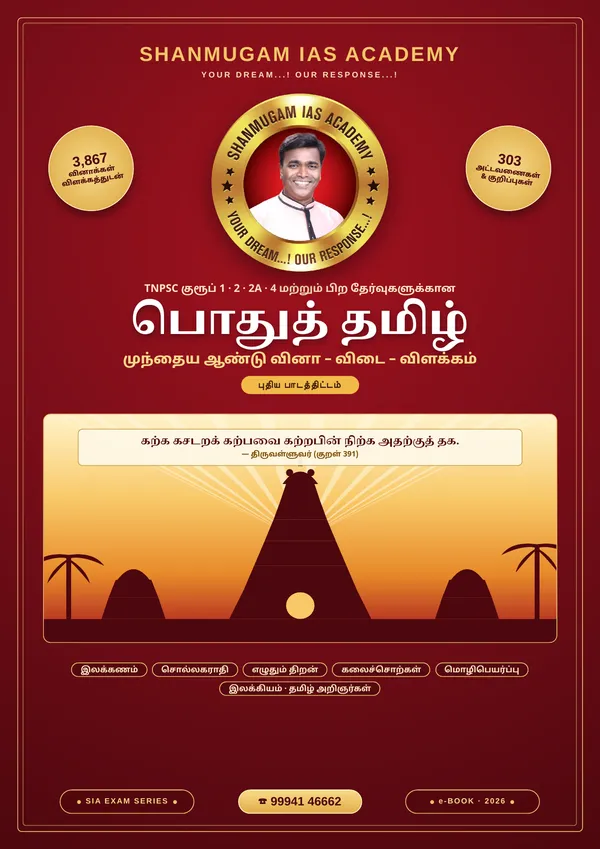 பொதுத் தமிழ் — முந்தைய ஆண்டு வினா – விடை – விளக்கம் (புதிய பாடத்திட்டம்)
₹199
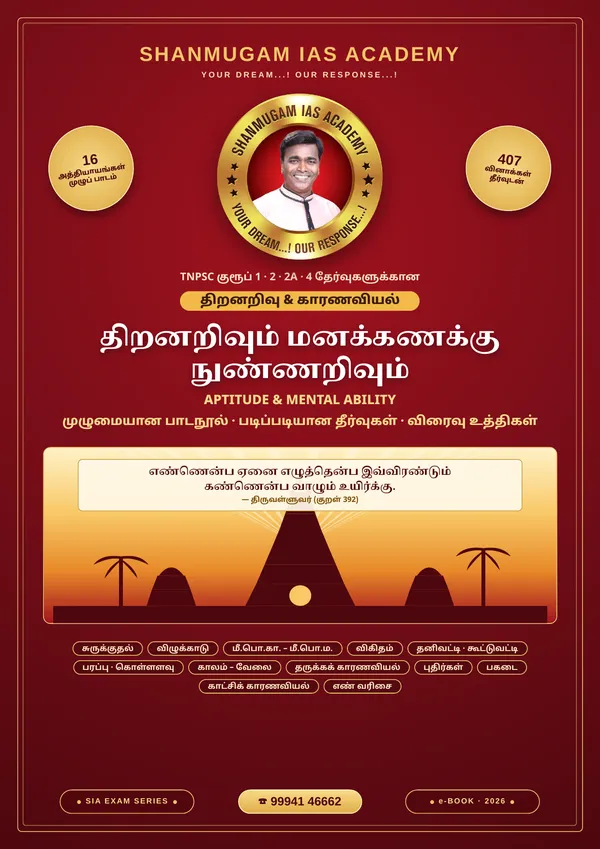 TNPSC திறனறிவும் மனக்கணக்கு நுண்ணறிவும் (Aptitude & Mental Ability) – முழுமையான பாடநூல்
₹199
TNPSC குரூப் 1, 2/2A, 4 – நேரடி வகுப்புகள் · கோவை & மதுரை
2006 முதல் சண்முகம் IAS அகாடமி · Classroom & online coaching in Coimbatore and Madurai
