

UPSC Geography Optional Paper I – Chapter 31: Models II – Von Thünen, Weber, Rostow, Heartland–Rimland and Boundaries (18 MCQs)
UPSC Geography Optional Paper I – Chapter 31: Models II – Von Thünen, Weber, Rostow, Heartland–Rimland and Boundaries (18 MCQs) – 18 questions, subject: Geography Optional Paper I. Every question has the correct answer with a two-line explanation; tap "Show Answer". Free practice for TNPSC, UPSC, SSC, Bank and RRB exams – Shanmugam IAS Academy, Coimbatore.
Link to this page from your website / blog (HTML code)
Correct Answer: A [forestry]
Explanation:
In von Thunen's model, forestry formed the second ring, right after market gardening and dairying, because firewood and timber were heavy and much needed in the city. Crop alternation, the three-field system and ranching lay further out.
Correct Answer: B [freight rate per unit of distance]
Explanation:
In Dunn's formula R = Y(p - c) - Yfd, 'f' stands for the freight rate per unit of produce per unit of distance. R is the economic rent, Y yield, p market price, c production cost and d distance from the market.
Correct Answer: C [R. J. Horvath]
Explanation:
R. J. Horvath (1969) found a ring of eucalyptus plantations grown for fuel around Addis Ababa, matching von Thunen's forestry ring. It showed that his model could apply to a modern city in a developing country.
Correct Answer: C [material index plus 1]
Explanation:
In Weber's theory the locational weight equals the material index plus 1, since localised materials (MI) and one unit of finished product must be moved. A material index above 1 pulls industry towards raw materials.
Correct Answer: D [inside the critical isodapane]
Explanation:
In Weber's theory a firm moves to a cheap-labour site only if that site lies inside the critical isodapane, where labour savings exceed the extra transport cost. Outside the critical isodapane, the extra transport cost outweighs the labour saving.
Correct Answer: C [Varignon frame]
Explanation:
Weber's least-transport-cost point can be found with the Varignon frame, in which weights on strings passing through holes at the three corners settle at the least-cost point. Thiessen polygons and the Lorenz curve are unrelated techniques.
Correct Answer: D [A. Pred]
Explanation:
A. Pred proposed the behavioural matrix (1967), ranking decision-makers by the quality of information they have and their ability to use it. It explained why firms often choose sub-optimal locations instead of the least-cost point.
Correct Answer: B [deepest channel of the river]
Explanation:
Under the thalweg principle, a boundary along a navigable river follows the deepest channel, keeping the navigable route open to both states. For non-navigable rivers, the median line between the banks is often used.
Correct Answer: A [10 per cent of national income]
Explanation:
Rostow held that take-off needs a rise in productive investment from about 5 per cent or less to over 10 per cent of national income. Other conditions are the growth of leading manufacturing sectors and a supportive political and social framework.
Correct Answer: B [high mass consumption]
Explanation:
In Rostow's high mass consumption stage, leading sectors shift to durable consumer goods and services. This fifth stage follows the drive to maturity, in which the economy spreads modern technology across many sectors.
Correct Answer: C [Democratic Ideals and Reality (1919)]
Explanation:
The dictum 'Who rules East Europe commands the Heartland' first appeared in Mackinder's Democratic Ideals and Reality (1919), written after the First World War. His 1904 paper 'The Geographical Pivot of History' had introduced the pivot area.
Correct Answer: A [the North Atlantic with Western Europe and North America]
Explanation:
Mackinder's 1943 'Midland Ocean' was the North Atlantic with Western Europe, Britain and North America around it. He saw it as a counterweight to the Heartland power of Eurasia.
Correct Answer: D [Kjellén]
Explanation:
The Swedish political scientist Rudolf Kjellen coined the term 'geopolitics' in 1899. Ratzel's organic theory of the state influenced him, and Haushofer later developed German Geopolitik.
Correct Answer: A [inner (marginal) crescent]
Explanation:
Spykman's Rimland, the coastal margin of Eurasia, corresponds broadly to Mackinder's inner (marginal) crescent. Spykman argued that 'who controls the Rimland rules Eurasia', reversing Mackinder's stress on the Heartland.
Correct Answer: B [antecedent]
Explanation:
An antecedent boundary is drawn before an area is densely settled, like the 49th parallel between the USA and Canada west of the Great Lakes. A subsequent boundary is drawn after settlement and follows cultural divides.
Correct Answer: C [geometrical boundary]
Explanation:
The Egypt-Sudan boundary along 22 degrees N follows a parallel of latitude, so it is a geometrical boundary. Such straight-line boundaries are common in Africa, where colonial powers drew lines on maps.
Correct Answer: D [demarcation]
Explanation:
In S. B. Jones's stages of boundary-making, demarcation means marking the delimited line on the ground with pillars and fences. The stages run allocation, delimitation, demarcation and administration.
Correct Answer: B [1 and 3 only]
Explanation:
Statements 1 and 3 are correct; statement 2 is wrong because a boundary is inner-oriented.
➤ Models, theories, diagrams, PYQs and Mains answer-writing practice for Geography Optional Paper I – U32 · Geography Optional Paper I (UPSC book, ₹349): www.shanmugamiasacademy.in/study-materials/upsc-geography-optional-paper-1
Today Current Affairs in Tamil | 23 நவம்பர் 2026 | TNPSC Group 4 முக்கிய வினாக்கள்
📚 UPSC Civil Services Books (Prelims & Mains)
PDF நூல்கள் · ₹149 முதல் · ஒவ்வொன்றுக்கும் 50 பக்க இலவச மாதிரி · UPI-இல் பணம் செலுத்தியதும் உடனே பதிவிறக்கம்
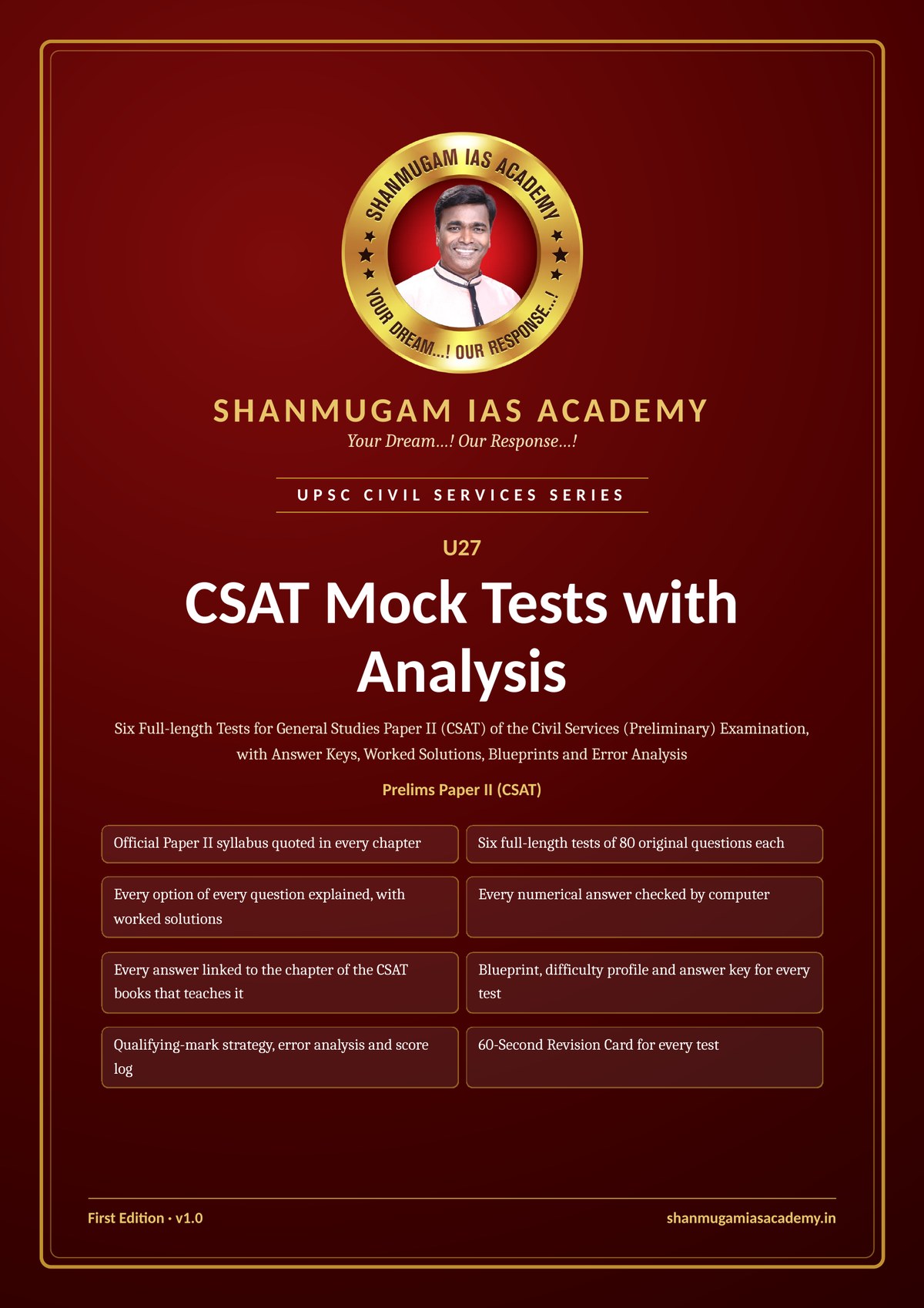 U27 · CSAT Mock Tests with Analysis – UPSC Civil Services (Prelims Paper II – CSAT)
₹249
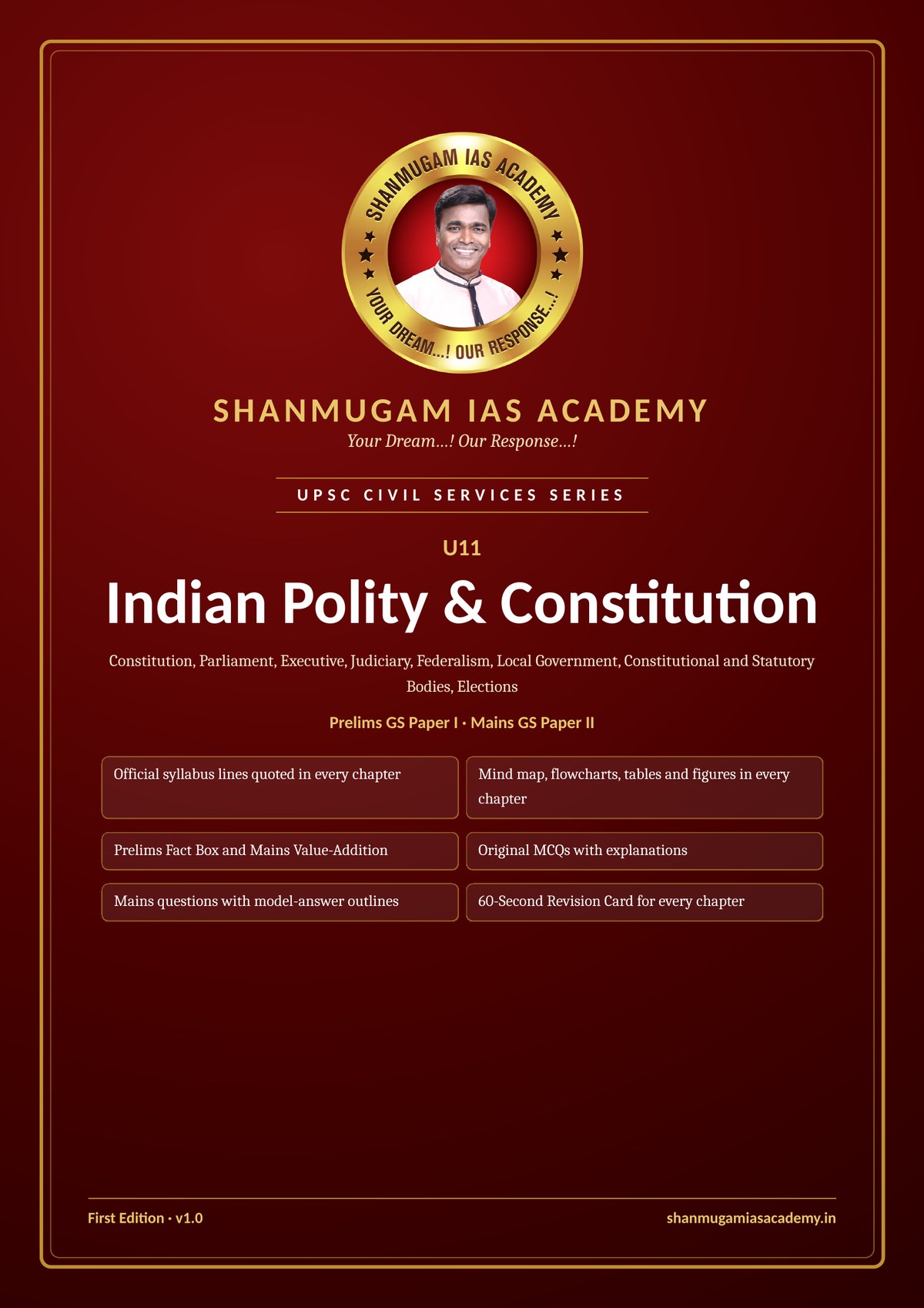 U11 · Indian Polity & Constitution – UPSC Civil Services (Prelims & Mains)
₹249
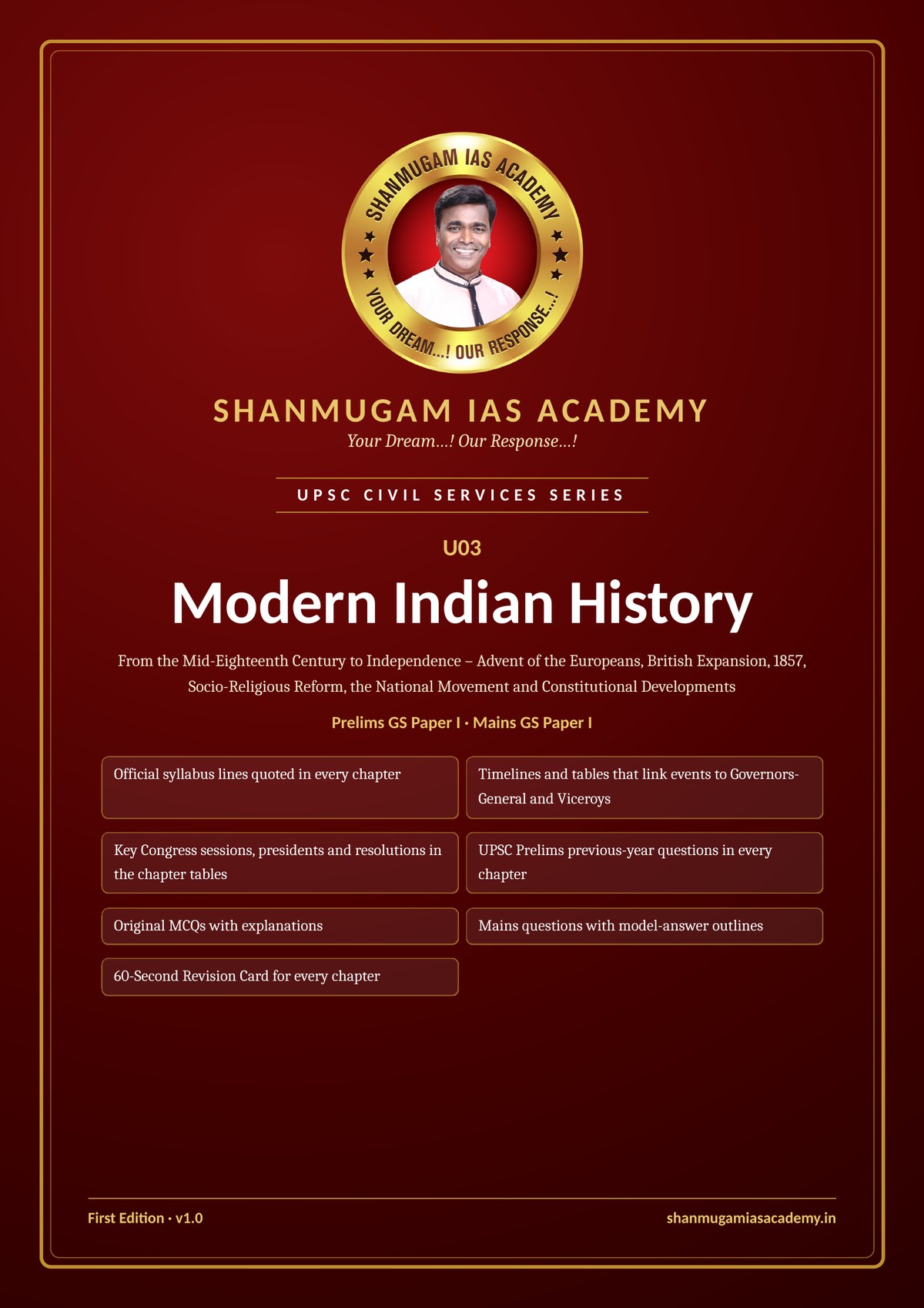 U03 · Modern Indian History – UPSC Civil Services (Prelims & Mains)
₹249
 U15 · Indian Economy – UPSC Civil Services (Prelims & Mains)
₹249
TNPSC குரூப் 1, 2/2A, 4 – நேரடி வகுப்புகள் · கோவை & மதுரை
2006 முதல் சண்முகம் IAS அகாடமி · Classroom & online coaching in Coimbatore and Madurai
