

UPSC Essay – Chapter 12: Environment, Climate and Nature (20 MCQs)
UPSC Essay – Chapter 12: Environment, Climate and Nature (20 MCQs) – 15 questions, subject: Essay. Every question has the correct answer with a two-line explanation; tap "Show Answer". Free practice for TNPSC, UPSC, SSC, Bank and RRB exams – Shanmugam IAS Academy, Coimbatore.
Link to this page from your website / blog (HTML code)
Correct Answer: A [2016]
Explanation:
'Need brings greed, if greed increases it spoils breed' was set in Section A of the 2016 UPSC Civil Services Mains essay paper. The topic links over-consumption with harm to future generations and other species.
Correct Answer: B [protect lives and infrastructure]
Explanation:
Early warning systems, cool roofs, urban wetlands and resilient embankments protect lives and infrastructure from climate hazards, so they belong to the adaptation set of technologies. Technologies that cut emissions at source include solar and wind power and electric vehicles.
Correct Answer: D [8]
Explanation:
The National Action Plan on Climate Change, released in June 2008, set out eight national missions, including the National Solar Mission and the National Mission for Enhanced Energy Efficiency. Others include missions on sustainable habitat, water, Himalayan ecosystem, Green India, agriculture and strategic knowledge.
Correct Answer: A [1987]
Explanation:
The Brundtland Report, 'Our Common Future', was published in 1987 by the World Commission on Environment and Development. It defined sustainable development as development that meets present needs without compromising the ability of future generations to meet their own needs.
Correct Answer: C [Heat action plans]
Explanation:
Heat action plans reduce harm from heat that can no longer be avoided, through warnings, cooling centres and changed working hours, so they are an adaptation measure. Solar power, electric vehicles and energy efficiency cut emissions, so they are mitigation measures.
Correct Answer: D [1972]
Explanation:
The United Nations Conference on the Human Environment met at Stockholm from 5 to 16 June 1972, and 5 June is now observed as World Environment Day. The conference led to the creation of the United Nations Environment Programme (UNEP).
Correct Answer: B [Kanniyakumari]
Explanation:
Muppandal, near the Aralvaimozhi pass at the southern end of the Western Ghats, is in Kanniyakumari district. Strong monsoon winds funnelled through this pass make it one of India's largest onshore wind-farm areas.
Correct Answer: B [1 and 2 only]
Explanation:
The Environment (Protection) Act was enacted in 1986 after the Bhopal gas tragedy, and the UNFCCC was opened for signature at the Rio Earth Summit in 1992, so statements 1 and 2 are correct. Mission LiFE was launched in October 2022, not 2008, so statement 3 is wrong.
Correct Answer: A [Both A and R are true, and R is the correct explanation of A]
Explanation:
Both are true, and R explains A: some warming is already locked in, so cutting emissions (mitigation) alone cannot prevent harm and adaptation is also needed. India's National Action Plan on Climate Change (2008) includes missions for both.
Correct Answer: A [Floods after encroachment on wetlands and floodplains]
Explanation:
Floods after encroachment on wetlands and floodplains show the ecological argument that nature's laws cannot be suspended: water returns to its natural paths whatever humans build. Solar and wind additions are mitigation examples, and sacred groves are examples of tradition.
Correct Answer: C [50%]
Explanation:
India's updated NDC (August 2022) targets about 50 per cent of cumulative installed electric power capacity from non-fossil sources by 2030. It also aims to cut the emissions intensity of GDP by 45 per cent from the 2005 level by 2030.
Correct Answer: B [1999]
Explanation:
The Odisha super cyclone struck in October 1999 and killed about 10,000 people. Its heavy toll led Odisha to build a strong preparedness system, including the Odisha State Disaster Management Authority and cyclone shelters, which reduced deaths in later cyclones like Phailin (2013).
Correct Answer: C [3-4-2-1]
Explanation:
The Stockholm Conference was held in 1972, the Brundtland Report came in 1987, India's National Action Plan on Climate Change in 2008 and the Paris Agreement in 2015, giving 3-4-2-1. The Brundtland Report popularised the term sustainable development.
Correct Answer: B [Meghalaya]
Explanation:
Bamboo drip irrigation is practised mainly in Meghalaya, especially in the Khasi and Jaintia hills, where spring or stream water is led through bamboo pipes to betel-leaf and black-pepper crops. It delivers a few drops of water directly at the roots with very little loss.
Correct Answer: D [an immediate local benefit]
Explanation:
Adaptation brings an immediate local benefit to communities at risk.
➤ Essay-writing method, theme-wise idea banks, UPSC essay topics with outlines, model essays and practice topics – U22 · Essay (UPSC book, ₹249): www.shanmugamiasacademy.in/study-materials/upsc-essay
Today Current Affairs in Tamil | 23 நவம்பர் 2026 | TNPSC Group 4 முக்கிய வினாக்கள்
📚 TNPSC குரூப் 4 / 2 / 2A – பொதுத்தமிழ், பொது அறிவு நூல்கள்
PDF நூல்கள் · ₹149 முதல் · ஒவ்வொன்றுக்கும் 50 பக்க இலவச மாதிரி · UPI-இல் பணம் செலுத்தியதும் உடனே பதிவிறக்கம்
 பொதுத் தமிழ் — முழுமையான கையேடு (TNPSC குரூப் 2 · 2A · 4)
₹199
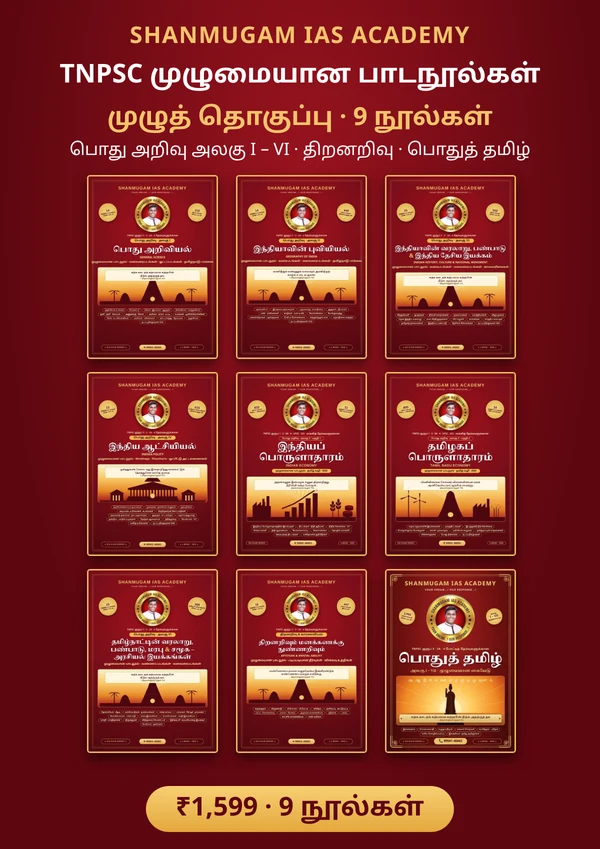 TNPSC முழுமையான பாடநூல்கள் – முழுத் தொகுப்பு (9 நூல்கள்)
₹1599
 பொதுத் தமிழ் — முந்தைய ஆண்டு வினா – விடை – விளக்கம் (புதிய பாடத்திட்டம்)
₹199
 TNPSC திறனறிவும் மனக்கணக்கு நுண்ணறிவும் (Aptitude & Mental Ability) – முழுமையான பாடநூல்
₹199
TNPSC குரூப் 1, 2/2A, 4 – நேரடி வகுப்புகள் · கோவை & மதுரை
2006 முதல் சண்முகம் IAS அகாடமி · Classroom & online coaching in Coimbatore and Madurai
