

UPSC Geography Optional Paper I – Chapter 20: Perspectives in Human Geography (18 MCQs)
UPSC Geography Optional Paper I – Chapter 20: Perspectives in Human Geography (18 MCQs) – 18 questions, subject: Geography Optional Paper I. Every question has the correct answer with a two-line explanation; tap "Show Answer". Free practice for TNPSC, UPSC, SSC, Bank and RRB exams – Shanmugam IAS Academy, Coimbatore.
Link to this page from your website / blog (HTML code)
Correct Answer: C [Varenius]
Explanation:
The division of geography into "general" and "special" was made by Bernhard Varenius in Geographia Generalis (1650). General geography dealt with laws applying to the whole earth, while special geography described individual regions and countries.
Correct Answer: A [Richard Hartshorne]
Explanation:
The Nature of Geography (1939) was written by Richard Hartshorne, who presented geography as the study of areal differentiation. He drew on the ideas of Alfred Hettner, and his idiographic approach was later challenged by Fred Schaefer.
Correct Answer: D [Fred K. Schaefer]
Explanation:
"Exceptionalism in Geography" (1953) was written by Fred K. Schaefer, who attacked Hartshorne's view that geography is a unique, idiographic discipline. He called for geography to seek general laws of spatial arrangement, paving the way for the quantitative revolution.
Correct Answer: D [William Kirk]
Explanation:
The behavioural environment, the environment as people perceive it and act upon it, is associated with William Kirk, who distinguished it from the phenomenal (real) environment. His model laid the foundation of behavioural geography, which studies decision-making based on perception.
Correct Answer: B [Immanuel Kant]
Explanation:
Immanuel Kant, in his lectures on physical geography (1756 to 1796), held that history describes events in time while geography describes phenomena side by side in space. This idea was later developed by Hettner and Hartshorne into the view of geography as a chorological science.
Correct Answer: C [systematic and regional approaches]
Explanation:
Alexander von Humboldt is associated with the systematic approach, studying single elements such as climate or vegetation across places, while Carl Ritter is associated with the regional approach. Ritter studied regions as wholes, examining how all elements combine in a particular area.
Correct Answer: C [Ellen Churchill Semple]
Explanation:
Influences of Geographic Environment (1911) was written by Ellen Churchill Semple, the American student of Friedrich Ratzel. The book spread Ratzel's environmental determinism in the English-speaking world.
Correct Answer: A [Lucien Febvre]
Explanation:
The term "possibilism" was coined by the French historian Lucien Febvre in La Terre et l'évolution humaine (1922), describing the ideas of Vidal de la Blache. Possibilism holds that nature offers a range of possibilities and humans choose among them, rejecting strict environmental determinism.
Correct Answer: B [Griffith Taylor]
Explanation:
"Stop-and-go determinism" is associated with Griffith Taylor, who likened nature to traffic lights that set the broad limits while humans control the pace of development. It is also called neo-determinism, a middle path between environmental determinism and possibilism.
Correct Answer: C [Peter Haggett]
Explanation:
Locational Analysis in Human Geography (1965) was written by Peter Haggett, who organised spatial structure around movement, networks, nodes, hierarchies and surfaces. It was a key text of the quantitative revolution in geography.
Correct Answer: C [positivism]
Explanation:
Positivism is the philosophy that accepts only knowledge based on observation and tested by the scientific method. In geography it underpinned the quantitative revolution of the 1950s and 1960s, while phenomenology and existentialism inspired humanistic geography.
Correct Answer: B [Kevin Lynch]
Explanation:
Paths, edges, districts, nodes and landmarks are the five elements of the city image identified by Kevin Lynch in The Image of the City (1960). He used mental maps of residents to show how people perceive and find their way through cities.
Correct Answer: D [behavioural geography]
Explanation:
The idea that people are "satisficers" rather than optimisers belongs to behavioural geography, drawing on Herbert Simon's concept of bounded rationality. Julian Wolpert (1964) showed that Swedish farmers settled for satisfactory rather than maximum returns.
Correct Answer: D [radical geography]
Explanation:
The journal Antipode, founded at Clark University in 1969, is associated with radical geography. It gave voice to Marxist and anarchist geographers concerned with poverty, racism and inequality, in reaction to the quantitative revolution.
Correct Answer: B [David Harvey]
Explanation:
Social Justice and the City (1973) was written by David Harvey, and it marked his turn from quantitative spatial science to a Marxist analysis of urban inequality. Harvey became one of the leading figures of radical geography.
Correct Answer: A [Edward Relph]
Explanation:
Place and Placelessness (1976) was written by Edward Relph, who set out the ideas of insideness and outsideness in how people experience place. He argued that mass culture and standardised landscapes were producing "placelessness", a loss of authentic sense of place.
Correct Answer: C [Bleddyn Davies]
Explanation:
The concept of territorial justice was developed by Bleddyn Davies in 1968, meaning that public services should be distributed among areas according to their needs. David Harvey and welfare geographers such as D. M. Smith later took up and extended the idea.
Correct Answer: A [Edward Said]
Explanation:
Said's Orientalism (1978) showed how the West constructed images of the East.
➤ Models, theories, diagrams, PYQs and Mains answer-writing practice for Geography Optional Paper I – U32 · Geography Optional Paper I (UPSC book, ₹349): www.shanmugamiasacademy.in/study-materials/upsc-geography-optional-paper-1
Today Current Affairs in Tamil | 23 நவம்பர் 2026 | TNPSC Group 4 முக்கிய வினாக்கள்
📚 TNPSC குரூப் 4 / 2 / 2A – பொதுத்தமிழ், பொது அறிவு நூல்கள்
PDF நூல்கள் · ₹149 முதல் · ஒவ்வொன்றுக்கும் 50 பக்க இலவச மாதிரி · UPI-இல் பணம் செலுத்தியதும் உடனே பதிவிறக்கம்
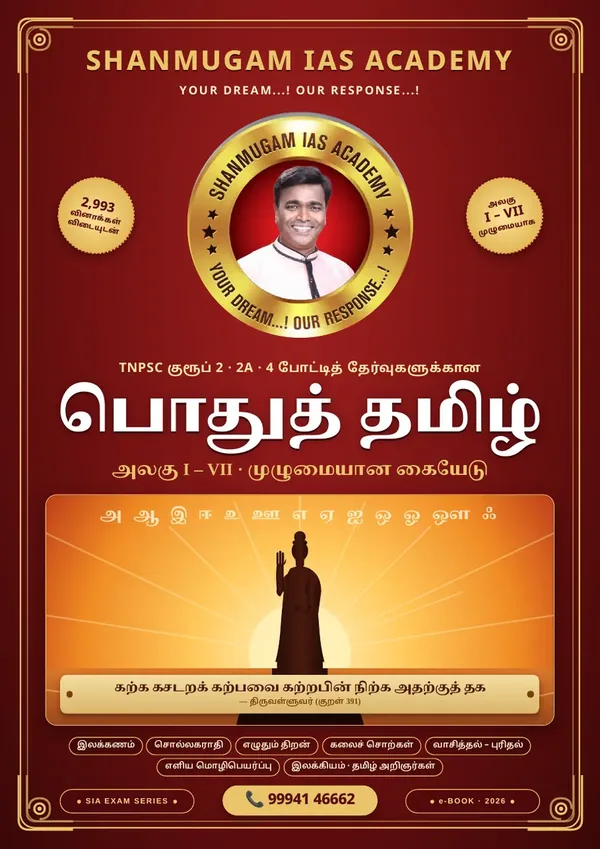 பொதுத் தமிழ் — முழுமையான கையேடு (TNPSC குரூப் 2 · 2A · 4)
₹199
 TNPSC முழுமையான பாடநூல்கள் – முழுத் தொகுப்பு (9 நூல்கள்)
₹1599
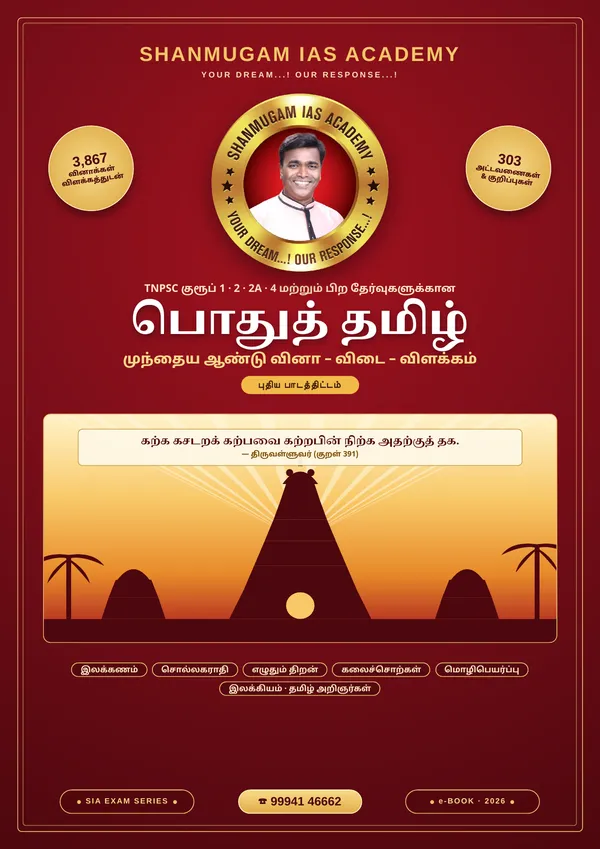 பொதுத் தமிழ் — முந்தைய ஆண்டு வினா – விடை – விளக்கம் (புதிய பாடத்திட்டம்)
₹199
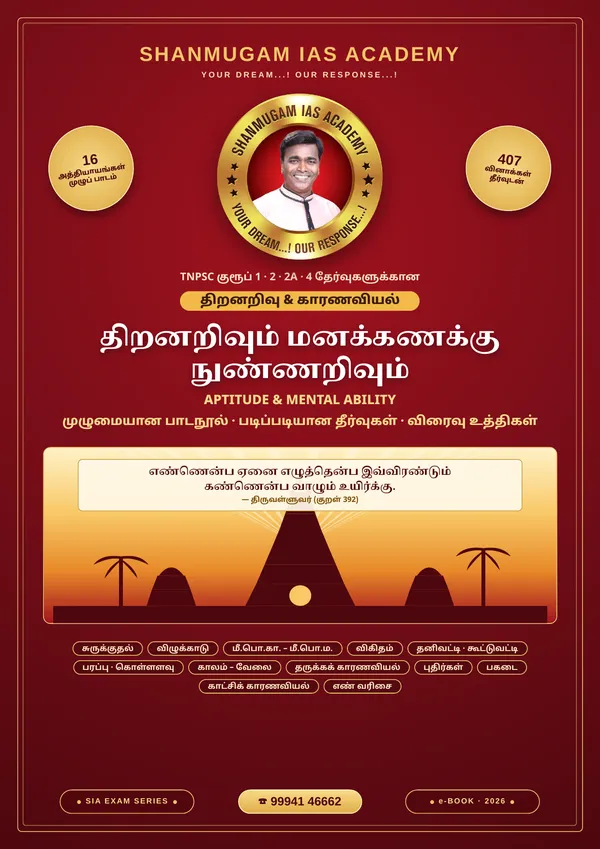 TNPSC திறனறிவும் மனக்கணக்கு நுண்ணறிவும் (Aptitude & Mental Ability) – முழுமையான பாடநூல்
₹199
TNPSC குரூப் 1, 2/2A, 4 – நேரடி வகுப்புகள் · கோவை & மதுரை
2006 முதல் சண்முகம் IAS அகாடமி · Classroom & online coaching in Coimbatore and Madurai
