

UPSC Ethics, Integrity and Aptitude – Chapter 7: Moral and Political Attitudes, Social Influence and Persuasion (20 MCQs)
UPSC Ethics, Integrity and Aptitude – Chapter 7: Moral and Political Attitudes, Social Influence and Persuasion (20 MCQs) – 19 questions, subject: Ethics (GS-IV). Every question has the correct answer with a two-line explanation; tap "Show Answer". Free practice for TNPSC, UPSC, SSC, Bank and RRB exams – Shanmugam IAS Academy, Coimbatore.
Link to this page from your website / blog (HTML code)
Correct Answer: D [Solomon Asch]
Explanation:
Solomon Asch conducted the conformity experiments using judgements of line lengths in 1951, showing that many people went along with an obviously wrong group answer. Muzafer Sherif studied group norms using the autokinetic effect.
Correct Answer: D [obedience to authority]
Explanation:
Stanley Milgram's experiments in the 1960s studied obedience to authority, showing that many people would give apparently harmful electric shocks when ordered by an experimenter. Conformity to a group was studied by Solomon Asch.
Correct Answer: B [Irving Janis]
Explanation:
Irving Janis developed the theory of groupthink (1972) to explain how cohesive groups that seek consensus make faulty decisions. He studied cases such as the Bay of Pigs invasion, where members suppressed doubts to keep harmony.
Correct Answer: C [Almond and Verba]
Explanation:
Gabriel Almond and Sidney Verba, in The Civic Culture (1963), classified political culture into parochial, subject and participant types. Petty and Cacioppo gave the Elaboration Likelihood Model, and Fishbein and Ajzen the theory of reasoned action.
Correct Answer: D [internalisation]
Explanation:
In Herbert Kelman's model, internalisation means accepting an idea because it fits one's own values, so the change is deep and lasting. Compliance is only outward agreement, and identification is adopting a view to be like a person one admires.
Correct Answer: D [Richard Thaler and Cass Sunstein]
Explanation:
Richard Thaler and Cass Sunstein wrote Nudge (2008), which explains how choices can be influenced through choice architecture without restricting freedom. Kahneman and Tversky are known for prospect theory, and Banerjee and Duflo for randomised trials on poverty.
Correct Answer: B [central route]
Explanation:
In the Elaboration Likelihood Model of Petty and Cacioppo, the central route involves careful thinking about the strength of arguments and produces lasting attitude change. The peripheral route relies on cues such as the speaker's looks or fame and gives only short-lived change.
Correct Answer: A [Social proof]
Explanation:
Telling people that most families in their ward have already vaccinated uses social proof, since people tend to follow what others like them are doing. Scarcity would stress limited availability, and authority would rely on an expert or official.
Correct Answer: B [compliance]
Explanation:
Compliance is going along with a direct request outwardly without necessarily agreeing privately. Obedience, in contrast, is following an order from a person in authority, and internalisation is genuine acceptance of an idea.
Correct Answer: B [1 and 2 only]
Explanation:
Statements 1 and 2 are correct: a nudge changes the choice architecture without banning any option, and Richard Thaler received the Nobel Memorial Prize in Economic Sciences in 2017. Statement 3 is wrong because manipulation hides its intent, while ethical persuasion is open about it.
Correct Answer: A [Both A and R are true, and R is the correct explanation of A]
Explanation:
Both statements are true and R explains A: moral attitudes are tied to a person's core values and sense of identity, so changing them threatens the self and meets strong resistance. That is why moral attitudes are harder to change than attitudes about ordinary things.
Correct Answer: C [source, message and audience]
Explanation:
The Yale approach, led by Carl Hovland, studied persuasion as who says what to whom: the source, the message and the audience. Central and peripheral routes belong to the Elaboration Likelihood Model, and defaults and choice architecture belong to nudge theory.
Correct Answer: C [Commitment and consistency]
Explanation:
A signed pledge creates a public commitment, and people then tend to act consistently with what they have committed to, which is Cialdini's principle of commitment and consistency. Scarcity, liking and authority work through limited availability, affection and expert status respectively.
Correct Answer: B [Following an order from a superior officer]
Explanation:
Obedience means following a direct order from a person in authority, such as a superior officer. Copying colleagues' dress code is conformity, and agreeing to a friend's request is compliance.
Correct Answer: A [Robert Cialdini]
Explanation:
Robert Cialdini wrote Influence (1984), which set out six principles of persuasion: reciprocity, commitment and consistency, social proof, liking, authority and scarcity. Irving Janis is known for groupthink and Leon Festinger for cognitive dissonance.
Correct Answer: A [Philip Zimbardo]
Explanation:
Philip Zimbardo led the Stanford prison experiment in 1971, in which students playing guards and prisoners showed how roles and situations shape behaviour. Stanley Milgram studied obedience and Solomon Asch studied conformity.
Correct Answer: C [2-1-4-3]
Explanation:
The order is: Asch's conformity experiments (1951), Milgram's obedience study published (1963), Cialdini's Influence (1984) and Thaler and Sunstein's Nudge (2008). So the correct sequence is 2-1-4-3.
Correct Answer: B [LPG]
Explanation:
The Give It Up campaign, launched in 2015, asked well-off consumers to voluntarily surrender their LPG cooking gas subsidy. The savings were used to give LPG connections to poor households, an example of moral persuasion in public policy.
Correct Answer: D [be accepted by the group]
Explanation:
Normative social influence comes from the wish to be accepted by a group; informational influence seeks accurate information.
➤ Concepts, thinkers, Indian administrative examples and solved case studies with model-answer outlines for GS Paper IV – U21 · Ethics, Integrity and Aptitude (UPSC book, ₹249): www.shanmugamiasacademy.in/study-materials/upsc-ethics-integrity-aptitude
Today Current Affairs in Tamil | 23 நவம்பர் 2026 | TNPSC Group 4 முக்கிய வினாக்கள்
📚 TNPSC குரூப் 4 / 2 / 2A – பொதுத்தமிழ், பொது அறிவு நூல்கள்
PDF நூல்கள் · ₹149 முதல் · ஒவ்வொன்றுக்கும் 50 பக்க இலவச மாதிரி · UPI-இல் பணம் செலுத்தியதும் உடனே பதிவிறக்கம்
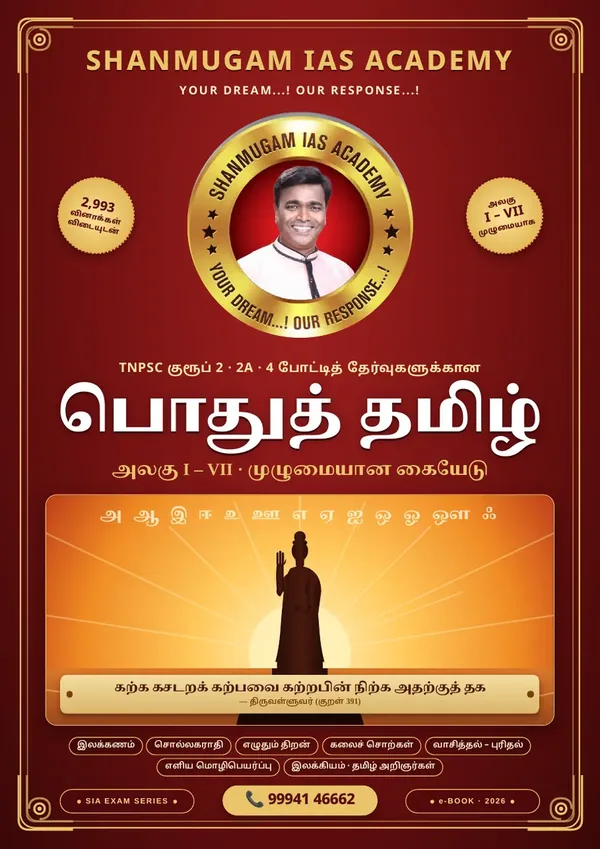 பொதுத் தமிழ் — முழுமையான கையேடு (TNPSC குரூப் 2 · 2A · 4)
₹199
 TNPSC முழுமையான பாடநூல்கள் – முழுத் தொகுப்பு (9 நூல்கள்)
₹1599
 பொதுத் தமிழ் — முந்தைய ஆண்டு வினா – விடை – விளக்கம் (புதிய பாடத்திட்டம்)
₹199
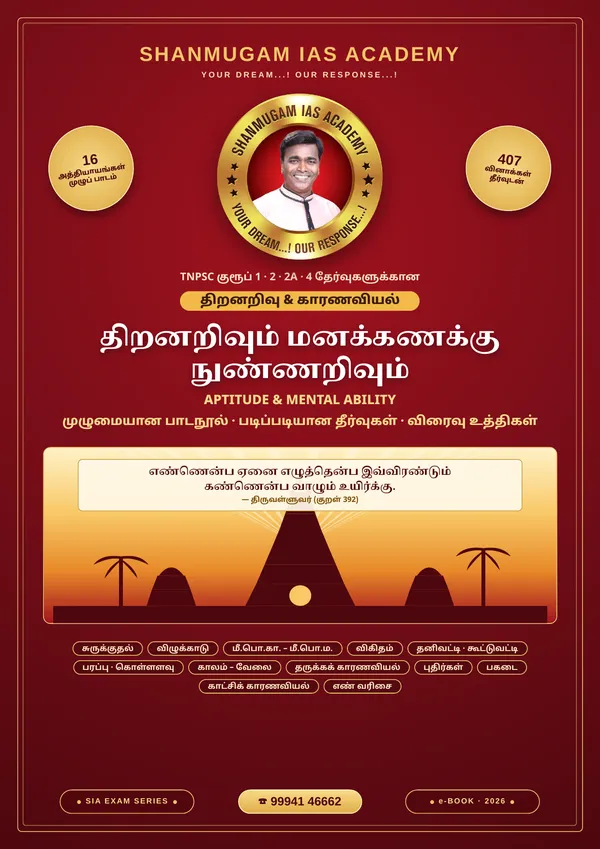 TNPSC திறனறிவும் மனக்கணக்கு நுண்ணறிவும் (Aptitude & Mental Ability) – முழுமையான பாடநூல்
₹199
TNPSC குரூப் 1, 2/2A, 4 – நேரடி வகுப்புகள் · கோவை & மதுரை
2006 முதல் சண்முகம் IAS அகாடமி · Classroom & online coaching in Coimbatore and Madurai
