

UPSC Ethics, Integrity and Aptitude – Chapter 13: Public and Civil Service Values and Ethics in Public Administration – Status and Problems (20 MCQs)
UPSC Ethics, Integrity and Aptitude – Chapter 13: Public and Civil Service Values and Ethics in Public Administration – Status and Problems (20 MCQs) – 17 questions, subject: Ethics (GS-IV). Every question has the correct answer with a two-line explanation; tap "Show Answer". Free practice for TNPSC, UPSC, SSC, Bank and RRB exams – Shanmugam IAS Academy, Coimbatore.
Link to this page from your website / blog (HTML code)
Correct Answer: D [T. S. R. Subramanian v. Union of India]
Explanation:
In T. S. R. Subramanian v. Union of India (2013), the Supreme Court sought civil services boards and fixed tenure for officers.
Correct Answer: A [Prakash Singh, 2006]
Explanation:
Prakash Singh v. Union of India (2006) directed police reforms such as fixed tenure, security commissions and police establishment boards.
Correct Answer: D [Santhanam Committee]
Explanation:
The Central Vigilance Commission was set up in 1964 on the recommendation of the Santhanam Committee on Prevention of Corruption. It received statutory status through the CVC Act, 2003.
Correct Answer: D [states broad values rather than specific rules]
Explanation:
A code of ethics states broad values and ideals, while a code of conduct lists specific, enforceable rules of behaviour. For example, the All India Services (Conduct) Rules, 1968 are a code of conduct with penalties for breach.
Correct Answer: C [civil service reforms]
Explanation:
The P.C. Hota Committee (2004) recommended civil service reforms on appraisal, tenure, lateral entry and accountability of officers. Police reforms were dealt with by bodies like the National Police Commission, and electoral reforms by committees like Dinesh Goswami.
Correct Answer: D [policy paralysis]
Explanation:
When officials avoid decisions for fear of audit, inquiry or vigilance action, the result is called policy paralysis. Groupthink and regulatory capture are different problems, and lateral entry is a recruitment reform.
Correct Answer: B [written instructions]
Explanation:
The Supreme Court in T. S. R. Subramanian (2013) said civil servants should act on written, not oral, instructions.
Correct Answer: A [fourth report]
Explanation:
'Ethics in Governance' (2007) is the Second Administrative Reforms Commission's fourth report. Its first report dealt with the Right to Information, titled 'Right to Information: Master Key to Good Governance'.
Correct Answer: C [Political control over transfers and postings]
Explanation:
Political control over transfers and postings lets politicians reward or punish officers, which is a main cause of politicisation of the civil service. Online appraisal, citizen's charters and social audit are reform tools that reduce such pressure.
Correct Answer: B [1 and 2 only]
Explanation:
Statements 1 and 2 are correct: the Draft Public Services Bill listed values for public servants, and the Supreme Court suggested civil services boards for transfers in the T.S.R. Subramanian case (2013). Statement 3 is wrong because red tape also arises from rigid rules, fear of audit and poor delegation, not only corruption.
Correct Answer: A [Both A and R are true, and R is the correct explanation of A]
Explanation:
Both statements are true and R explains A: frequent punitive transfers make officers vulnerable to political pressure, so a fixed tenure reduces politicisation. In T.S.R. Subramanian v. Union of India (2013), the Supreme Court called for minimum tenure for civil servants.
Correct Answer: C [outcomes for citizens]
Explanation:
Citizen-oriented administration judges itself by outcomes for citizens, such as timely and quality services, rather than by procedure and rule compliance. A rule-oriented system focuses on following procedures and avoiding blame, even when citizens are not served well.
Correct Answer: D [Allegiance to the Constitution]
Explanation:
Allegiance to the Constitution requires a public servant to uphold constitutional rights and the rule of law above personal or party views. It heads the list of foundational civil service values, as an officer's oath is taken to the Constitution, not to any party.
Correct Answer: A [online performance appraisal of officers]
Explanation:
SPARROW (Smart Performance Appraisal Report Recording Online Window) is the online system for recording the annual performance appraisal reports of officers. It was introduced for IAS officers and makes appraisal faster and more transparent.
Correct Answer: C [4-2-3-1]
Explanation:
The order is Santhanam Committee (1964), Hota Committee (2004), Prakash Singh (2006), T. S. R. Subramanian (2013).
Correct Answer: B [Punitive transfer culture]
Explanation:
A punitive transfer culture is a weakness of the Indian civil service, as frequent transfers punish honest officers and weaken accountability. Conducting general elections, disaster response and continuity across governments are recognised strengths.
Correct Answer: C [to lay down specific, enforceable rules of behaviour]
Explanation:
A code of conduct lays down specific, enforceable rules of behaviour; stating broad ideals is the role of a code of ethics.
➤ Concepts, thinkers, Indian administrative examples and solved case studies with model-answer outlines for GS Paper IV – U21 · Ethics, Integrity and Aptitude (UPSC book, ₹249): www.shanmugamiasacademy.in/study-materials/upsc-ethics-integrity-aptitude
Today Current Affairs in Tamil | 23 நவம்பர் 2026 | TNPSC Group 4 முக்கிய வினாக்கள்
📚 TNPSC குரூப் 4 / 2 / 2A – பொதுத்தமிழ், பொது அறிவு நூல்கள்
PDF நூல்கள் · ₹149 முதல் · ஒவ்வொன்றுக்கும் 50 பக்க இலவச மாதிரி · UPI-இல் பணம் செலுத்தியதும் உடனே பதிவிறக்கம்
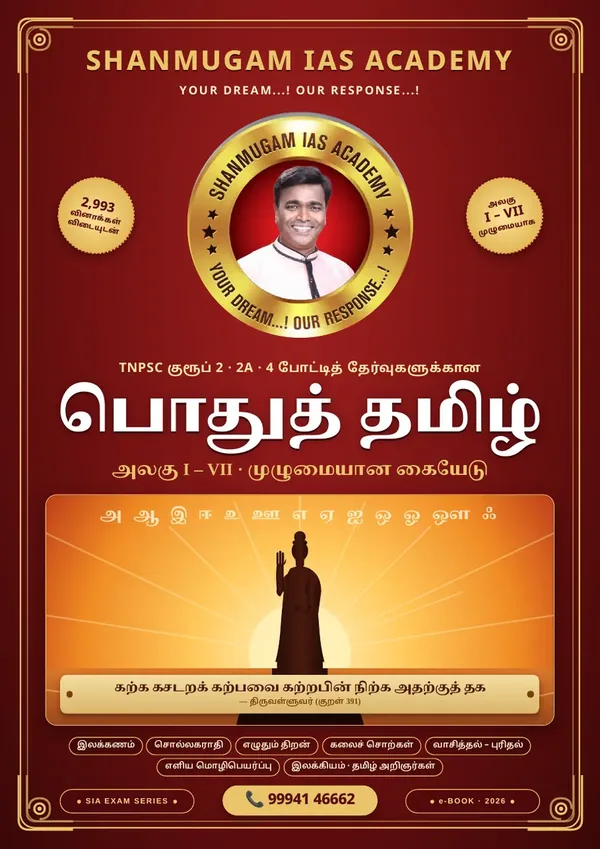 பொதுத் தமிழ் — முழுமையான கையேடு (TNPSC குரூப் 2 · 2A · 4)
₹199
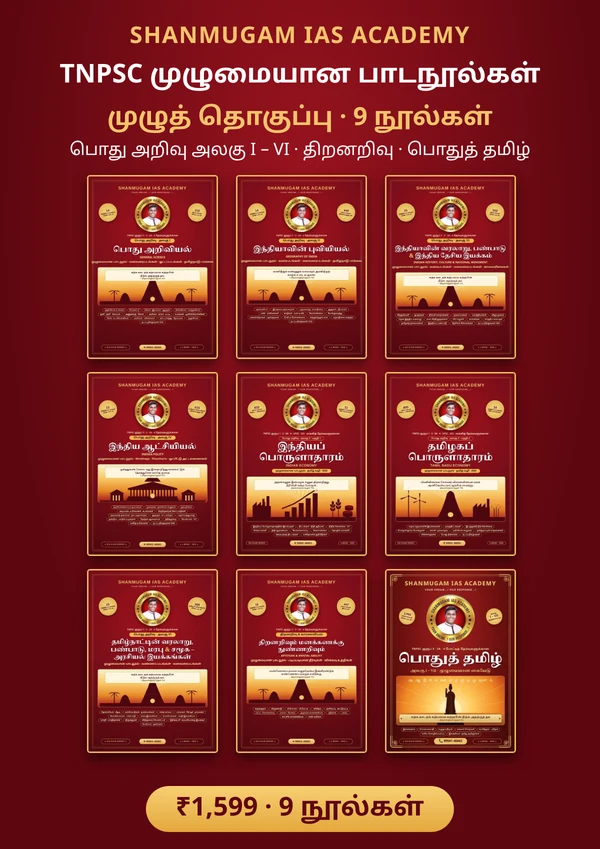 TNPSC முழுமையான பாடநூல்கள் – முழுத் தொகுப்பு (9 நூல்கள்)
₹1599
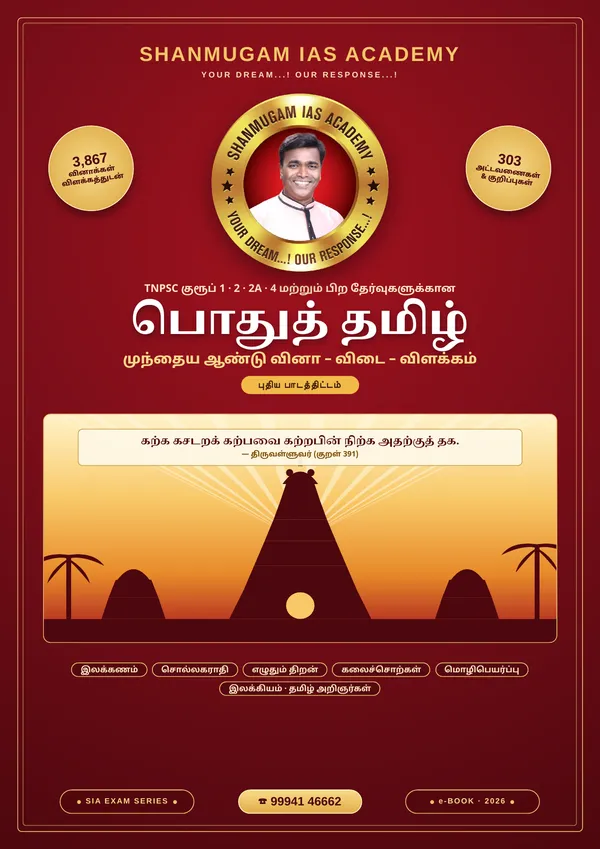 பொதுத் தமிழ் — முந்தைய ஆண்டு வினா – விடை – விளக்கம் (புதிய பாடத்திட்டம்)
₹199
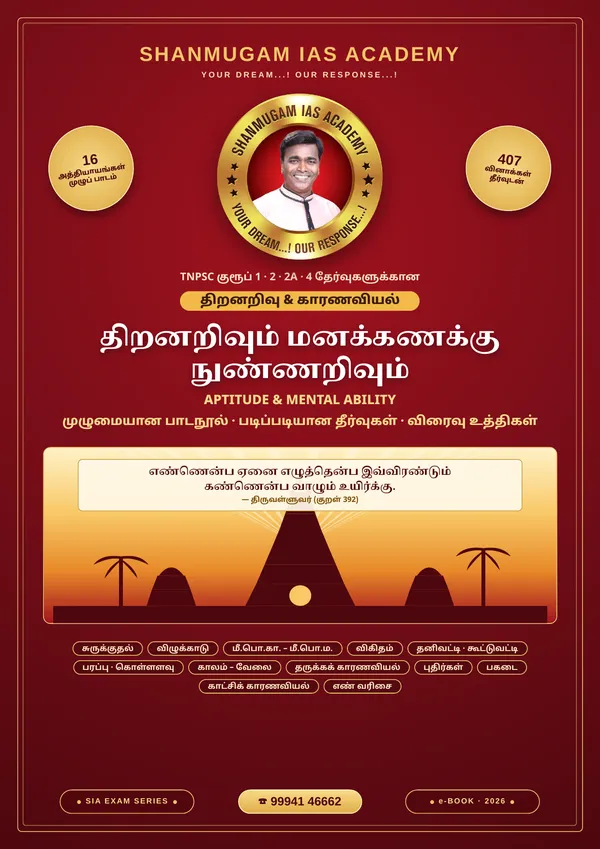 TNPSC திறனறிவும் மனக்கணக்கு நுண்ணறிவும் (Aptitude & Mental Ability) – முழுமையான பாடநூல்
₹199
TNPSC குரூப் 1, 2/2A, 4 – நேரடி வகுப்புகள் · கோவை & மதுரை
2006 முதல் சண்முகம் IAS அகாடமி · Classroom & online coaching in Coimbatore and Madurai
