

2026 Antarctic ozone hole 7th largest in 48 years: NOAA–NASA
5 November 2026 · English Environment & Ecology
⬇ Download this article as free PDF
Topics: Environment · 5 November 2026 Current Affairs (UPSC / TNPSC / SSC / RRB)
News
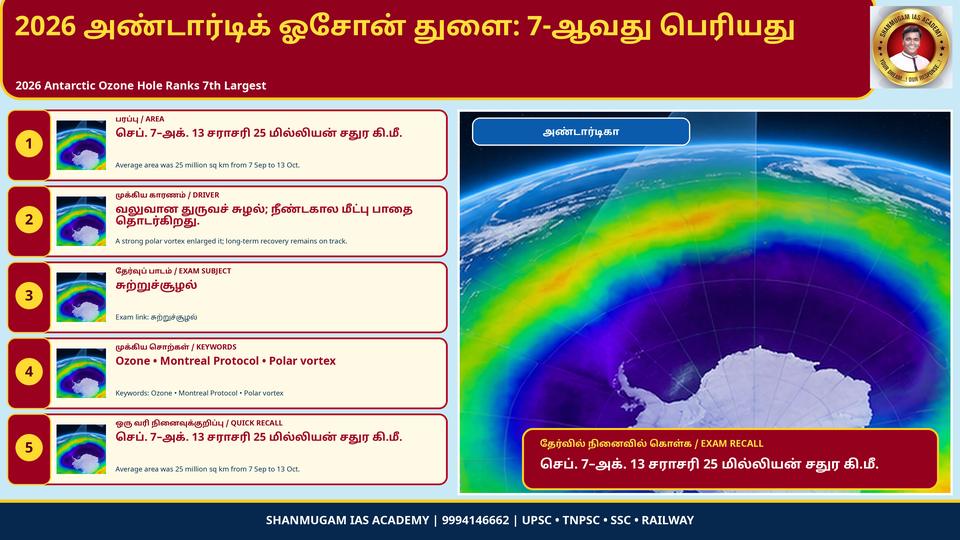
According to measurements released by the US agencies NOAA and NASA on 4 Nov 2026, the 2026 Antarctic ozone hole was the seventh largest in 48 years of monitoring (by seasonal mean area). During peak depletion (7 Sep – 13 Oct) it averaged about 25 million sq km – more than twice the area of the USA – and peaked at 27.1 million sq km on 18 Sep. The lowest ozone over the South Pole was 105 Dobson units on 17 Oct. An unusually strong 'polar vortex' was the cause; yet the ozone layer is healing – scientists expect full recovery by the 2070s.
Key facts
| Release | 4 Nov 2026 – NOAA and NASA (USA) |
| Rank | 7th largest in 48 years (seasonal mean) |
| Area | Mean ~25 million sq km (7 Sep – 13 Oct); peak 27.1 million sq km (18 Sep) |
| Lowest ozone | 105 Dobson units – South Pole, 17 Oct 2026 (record low: 92 DU, Oct 2006) |
| Cause | A strong polar vortex; weak planetary-scale waves in Aug–Sep |
| Recovery | Antarctic stratospheric chlorine down about one-third from the 1980s peak; full recovery by the 2070s |
Background
- Science: ozone (O₃) is a molecule of three oxygen atoms, found mostly in the stratosphere, where it absorbs the Sun's harmful ultraviolet (UV-B) rays. Ozone is measured in 'Dobson units' (DU); an area below 220 DU is called the 'ozone hole'.
- Cause: chlorine and bromine from man-made chemicals such as chlorofluorocarbons (CFCs) and halons destroy ozone. 'Polar stratospheric clouds' formed in Antarctica's bitter winter speed up these reactions, so the hole grows in the southern spring (Sep–Oct). British Antarctic Survey scientists first reported the ozone hole in 1985.
- Treaties: the Vienna Convention (1985) – framework for ozone protection; the Montreal Protocol (16 Sep 1987) – phases out ozone-depleting substances; it is the first treaty in UN history to achieve universal ratification. The Kigali Amendment (2016) phases down HFCs. 16 Sept is World Ozone Day.
- Science award: Paul Crutzen, Mario Molina and Sherwood Rowland won the 1995 Nobel Prize in Chemistry for explaining the chemistry of ozone depletion.
Tamil Nadu link: India's earliest ozone observations were made at the Kodaikanal Observatory (Dindigul district) in 1928–29. Routine ozone observations on a six-station network began in the International Geophysical Year (1957); Kodaikanal was one of that network's six Dobson spectrophotometer stations (the others: Srinagar, New Delhi, Varanasi, Ahmedabad/Mt Abu and Pune).
Source: NOAA news release, 4 Nov 2026; NASA Science (2026 ozone hole); DLR, 26 Oct 2026; US EPA (Montreal Protocol); UNEP Ozone Secretariat – India country report (Kodaikanal)
Join our UPSC classroom or online batch: UPSC coaching in Coimbatore · Fees · Call 99941 46662.
Prepared by the Shanmugam IAS Academy faculty team, Coimbatore (since 2006) · independently checked against primary sources · Our editorial policy
Add us as a preferred source on Google
Link to this page from your website / blog (HTML code)
TNPSC Achievers
-

AGATHIYAN
TNPSC TNPSC
நடப்பு நிகழ்வுகள் 24 நவம்பர் 2026 | Today Current Affairs in Tamil | TNPSC Group 4 வினா விடை
📚 TNPSC குரூப் 4 / 2 / 2A – பொதுத்தமிழ், பொது அறிவு நூல்கள்
PDF நூல்கள் · ₹149 முதல் · ஒவ்வொன்றுக்கும் 50 பக்க இலவச மாதிரி · UPI-இல் பணம் செலுத்தியதும் உடனே பதிவிறக்கம்
 பொதுத் தமிழ் — முழுமையான கையேடு (TNPSC குரூப் 2 · 2A · 4)
₹199
 TNPSC முழுமையான பாடநூல்கள் – முழுத் தொகுப்பு (9 நூல்கள்)
₹1599
 TNPSC குரூப் 4 பொதுத் தமிழ் – முழுமையான தேர்வுக் களஞ்சியம் 2026
₹249
 பொதுத் தமிழ் — முந்தைய ஆண்டு வினா – விடை – விளக்கம் (புதிய பாடத்திட்டம்)
₹199
TNPSC குரூப் 1, 2/2A, 4 – நேரடி வகுப்புகள் · கோவை & மதுரை
2006 முதல் சண்முகம் IAS அகாடமி · Classroom & online coaching in Coimbatore and Madurai
