

Daily History quiz – 16 November 2026
Tap an option – the right answer and a short explanation appear at once. Your score is at the bottom. (TNPSC / UPSC Prelims)
Dholavira lies on Khadir island in the Great Rann of Kutch, Gujarat. It was inscribed as India's 40th World Heritage Site in July 2021 and is known for its elaborate water-management system of reservoirs and channels and a large signboard inscription in the Harappan script.
All three are correct. First council – Rajagriha (c. 483 BCE), Ajatashatru, presided by Mahakassapa; Second – Vaishali, Kalasoka; Third – Pataliputra, Ashoka, presided by Moggaliputta Tissa; Fourth – Kashmir (Kundalavana), Kanishka, presided by Vasumitra with Ashvaghosha – after which Buddhism split into Mahayana and Hinayana.
Megasthenes – Seleucus Nicator's ambassador to Chandragupta Maurya; wrote 'Indica'. Fa-Hien – Chinese pilgrim in the time of Chandragupta II (early 5th century CE). Hiuen Tsang – visited during Harshavardhana's reign and studied at Nalanda. Ibn Battuta – Moroccan traveller, served as qazi of Delhi under Muhammad bin Tughluq; wrote the 'Rihla'.
Both are true, but R does not explain A. In the Aryabhatiya (499 CE, Gupta age) Aryabhata stated that the apparent westward motion of the stars is due to the Earth's rotation, explained eclipses by the shadows of the Earth and Moon, and gave an accurate value of pi (3.1416). The date of the book is not the reason for his theory. India's first satellite (1975) was named after him.
The Pandya king Nedunjeliyan defeated the confederacy of the Cheras, the Cholas and five Velir chieftains at Talaiyalanganam and was hailed as 'Talaiyalanganattu Seruvendra Nedunjeliyan'. His victory and his capital Madurai are celebrated in Mangudi Marudanar's 'Maduraikanchi' (one of the Pattuppattu). Karikala Chola is known for the Battle of Venni; Cheran Senguttuvan for instituting the worship of Kannagi (Pattini), as told in the Silappatikaram; Mudukudumi Peruvazhuthi for performing many Vedic sacrifices.
1 and 2 are correct. Alauddin Khalji (1296–1316) fixed prices and set up markets under the shahna-i-mandi to maintain a large standing army against the Mongols, and introduced dagh and huliya to stop fraud in the army. It was Muhammad bin Tughluq who shifted the capital to Daulatabad (Devagiri) – so 3 is wrong.
Panipat I (1526) – Babur defeated Ibrahim Lodi, founding Mughal rule; Khanwa (1527) – Babur defeated Rana Sanga of Mewar; Panipat II (1556) – Akbar's forces under Bairam Khan defeated Hemu; Haldighati (1576) – Akbar's army under Raja Man Singh fought Maharana Pratap of Mewar, who withdrew and continued the resistance.
Both are true, but R does not explain A. Shivaji's coronation took place at Raigad in June 1674. The Ashtapradhan – headed by the Peshwa (prime minister) and including the Amatya, Sachiv and Senapati – was his advisory council; it is not the reason for the coronation.
Under Lord Ripon (1880–1884), Law Member C.P. Ilbert's Bill sought to let Indian judges try Europeans in criminal cases. The organised protest of Europeans forced a compromise (a jury with at least half Europeans), and the episode showed educated Indians the value of organised agitation – a step towards the founding of the Indian National Congress in 1885.
1 and 2 are correct. Humayun's tomb (1560s–1570s), built under Bega Begum's patronage, is the first garden-tomb of the subcontinent and a World Heritage Site; the Buland Darwaza (c. 1575–76) marks Akbar's Gujarat victory. The Red Fort (Lal Qila) at Delhi was built by Shah Jahan as part of Shahjahanabad (completed 1648) – so 3 is wrong.
Frequently asked questions
What is the daily subject quiz?
Ten questions every day from one subject – Monday History, Tuesday Polity, Wednesday Geography, Thursday Economy, Friday Science & Technology, Saturday Environment, Sunday Tamil Nadu – with instant answers and explanations.
Do I need to sign up?
No. Tap an option to see the answer; your score is shown at the end. A free PDF of the day's questions with answers is also available.
Which exams is it for?
TNPSC Group 1, 2, 2A and 4 Prelims and UPSC Prelims; useful for SSC and bank general awareness too.
Link to this page from your website / blog (HTML code)
Free daily practice
- UPSC Mains answer practice
- Weekly Top 20 current affairs
- Daily subject quiz
- Knowledge nugget
- TNPSC Mains Practice
- All free PDFs
Classroom & online coaching – TNPSC, UPSC – Coimbatore, Madurai.
Courses & fees 99941 46662நடப்பு நிகழ்வுகள் 26 நவம்பர் 2026 | Today Current Affairs in Tamil | TNPSC Group 4 வினா விடை
📚 TNPSC குரூப் 4 / 2 / 2A – பொதுத்தமிழ், பொது அறிவு நூல்கள்
PDF நூல்கள் · ₹149 முதல் · ஒவ்வொன்றுக்கும் 50 பக்க இலவச மாதிரி · UPI-இல் பணம் செலுத்தியதும் உடனே பதிவிறக்கம்
 பொதுத் தமிழ் — முழுமையான கையேடு (TNPSC குரூப் 2 · 2A · 4)
₹199
 TNPSC முழுமையான பாடநூல்கள் – முழுத் தொகுப்பு (9 நூல்கள்)
₹1599
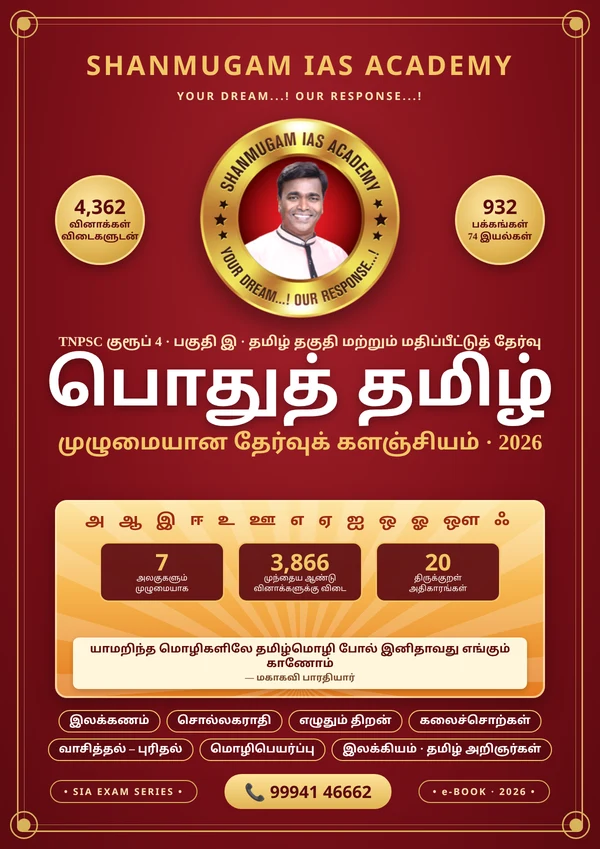 TNPSC குரூப் 4 பொதுத் தமிழ் – முழுமையான தேர்வுக் களஞ்சியம் 2026
₹249
 பொதுத் தமிழ் — முந்தைய ஆண்டு வினா – விடை – விளக்கம் (புதிய பாடத்திட்டம்)
₹199
TNPSC குரூப் 1, 2/2A, 4 – நேரடி வகுப்புகள் · கோவை & மதுரை
2006 முதல் சண்முகம் IAS அகாடமி · Classroom & online coaching in Coimbatore and Madurai
